
Iwagumi Aquascape Guide: How to Design a Stunning Minimalist Aquarium Layout
Iwagumi Aquascape: Introduction
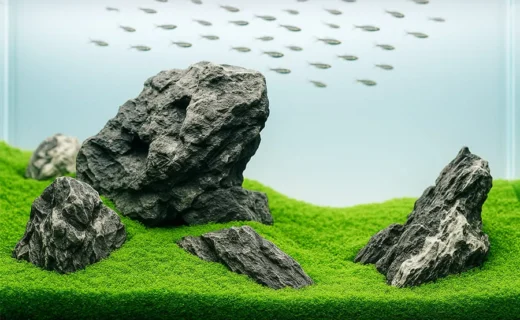
An Iwagumi aquascape is a minimalist aquarium layout built around a structured rock formation. Instead of heavy planting, it uses one dominant stone, supporting rocks, and intentional negative space to create calm, depth, and balance.
It can look effortless — but Iwagumi is one of the most technical styles to execute well. This guide covers the rock hierarchy (Oyaishi/Fukuishi/Soeishi), proven layout rules, the best stones and plants, and the maintenance habits that keep it clean long-term.
Quick answer: Place one strong Oyaishi off-center, add 2–4 supporting stones with matching flow lines, keep plants to 1–3 species, and stabilize light + CO₂ early to prevent algae in the open space.
What you’ll learn in this lesson
- The core principles behind the Iwagumi layout
- How to choose and position rocks effectively
- The best plants for minimalist aquascapes
- Equipment and maintenance tips
- Common challenges and how to overcome them
What Is an Iwagumi Aquascape?
“Iwagumi” (岩組) means “rock formation” — and in aquascaping it refers to layouts where rocks carry the composition. Popularized by Takashi Amano, the style is defined by clean lines, negative space, and a clear focal stone rather than heavy planting.
Iwagumi layouts typically consist of:
- An odd number of carefully selected stones
- Low-growing foreground plants
- Little to no wood, ornaments, or vertical plant growth
The simplicity of Iwagumi creates a feeling of calm, making the rocks the stars of the scene. These layouts mimic natural landscapes like open plains, rolling hills, or mountain valleys—scaled down into your aquarium.
Iwagumi aquascape rules (quick checklist):
- Use an odd number of stones (often 3 or 5) to avoid symmetry.
- Place the Oyaishi off-center (rule of thirds / golden ratio) as the main focal point.
- Match stone “flow lines” — tilt rocks in the same natural direction.
- Keep plant variety low (typically 1–3 species) so rocks stay dominant.
- Build depth with substrate slope and smaller stones toward the back.
- Control light + CO₂ early to prevent algae in the open space.
Iwagumi Aquascape Design Principles
Iwagumi looks simple — but the result depends on a few non-negotiable layout rules. Master these and your scape will feel calm, deep, and intentional (not random):
🎯 Negative Space
Empty areas are just as important as filled ones. Known in Japanese aesthetics as “Ma,” negative space draws the eye and allows key elements to breathe.
📐 Rule of Thirds & Golden Ratio
The main stone (Oyaishi) is usually placed off-center, aligning with the rule of thirds. Often, designers also follow the golden ratio (approx. 1:1.618) to create a naturally pleasing composition.
🧱 Odd Numbers
Odd-numbered rock groups—3, 5, or 7—prevent symmetry, which feels unnatural. This asymmetry adds to the visual tension and realism of the layout.
⛰ Natural Flow
Stones are often sloped in the direction of the imagined current, echoing how rocks settle in streams or rivers. This directional tilt gives the layout subtle movement.
🔄 Repetition and Rhythm
Repeating shapes, textures, or alignments (with variation) helps create a sense of rhythm in the aquascape.
Pro tip: Take photos of your layout while placing rocks. Seeing your design through a lens helps reveal imbalances.
Understanding the Iwagumi Rock Hierarchy
At the heart of every Iwagumi aquascape is the rock formation—each stone carefully chosen and placed with purpose. There’s a traditional naming system for the rocks, each playing a specific role in the visual hierarchy:
🪨 Oyaishi – The Main Stone
The Oyaishi is the focal point of your entire layout. It’s the largest and most dominant rock, often angled slightly to mimic natural flow. It should be clearly dominant, but still proportional to the tank — tall enough to lead the eye, angled to suggest natural flow, and placed off-center to avoid symmetry.
🪨 Fukuishi – Supporting Stones
Fukuishi are the secondary stones, smaller than the Oyaishi but important for balance. These rocks are usually placed to the sides of the Oyaishi, echoing its tilt and texture while reinforcing the overall layout.
🪨 Soeishi – Minor Accent Stones
These tertiary stones sit near the main group, adding texture and detail. Their job is to enhance the natural look without pulling attention away from the central formation.
🪨 Suteishi – The “Sacrificial” Stone
Suteishi translates to “throwaway stone.” It’s intentionally hidden or subdued to help bring balance to the others. It has no visual dominance and is often buried or tucked beneath plants. In some Iwagumi variants, it’s omitted entirely.
💡 A traditional configuration is the Sanzon Iwagumi, which features three stones representing Buddha and two disciples—simple, symbolic, and spiritually balanced.
Choosing the Best Rocks for Iwagumi Aquascapes
The type of stone you use sets the tone for your entire aquascape. Each rock type has unique colors, textures, and erosion patterns.
🔹 Seiryu Stone
The king of Iwagumi stones. It has bold, bluish-grey tones with dramatic white veins. Seiryu adds contrast and sharp structure, perfect for high-impact layouts.
🔸 Ohko Stone (Dragon Stone)
Light brown and heavily textured, Ohko stone looks like crumbled dragon scales. Its porous surface makes it great for attaching moss and creating an aged, natural feel.
🔴 Sado-Akadama Stone
This reddish-brown claystone provides earthy warmth. It contrasts beautifully with green plants and blue-gray stones, adding visual diversity while staying harmonious.
⚪ Other Options:
Ryuoh Stone – Jagged and rugged, similar to Seiryu but darker and rougher.
Manten Stone – Rare and expensive, often with vertical striations for a mountainous feel.
Iwagumi Stone Comparison Table
| Stone Type | Color | Texture | Ideal For |
|---|---|---|---|
| Seiryu | Blue-gray w/ veins | Rugged | High contrast, bold layouts |
| Ohko (Dragon) | Tan-brown | Crumbly | Natural look, moss setups |
| Sado-Akadama | Reddish-brown | Smooth | Warm-toned scapes |
| Ryuoh | Dark gray | Rough | Deep, dramatic scapes |
| Manten | Gray or beige | Vertical lines | Mountain-inspired themes |
How Many Rocks Do You Need?
The number and size of rocks depend on tank dimensions, visual goals, and how much negative space you want to preserve.
🧮 Finding the Right Quantity
Start with one strong Oyaishi and 2–4 supporting stones. If the layout feels too symmetrical, remove a stone before adding another — fewer rocks usually look more natural in Iwagumi.
📏 Scaling to Your Aquarium
Nano tanks (≤20L): 1 main + 1–2 support stones
Mid-sized tanks (60–90cm): 1 main + 3–5 supporting
Large tanks (100cm+): 1 dominant + 5+ supporting stones
🌀 Considering Negative Space
Don’t overcrowd the layout. Rocks should leave space for plants and “breathing room.” Too many stones = visual clutter.
🎨 Adapting to Personal Vision
There’s no strict rule—test layouts on a table first. Snap photos and assess how natural and balanced the formation feels.
📷 Pro tip: Arrange your rocks outside the tank before placing them in the substrate. Take photos from the same viewing angle as your aquarium.
Creating Depth and Perspective in Iwagumi Layouts
Iwagumi can look “flat” if the hardscape sits on one plane. Use these depth tricks to create a landscape you can visually enter:
🧱 Substrate Sloping
Start by building a slope in your substrate, rising from the front to the back of the tank. This simulates ground perspective and makes the layout feel deeper than it is.
Tips:
- Slope ratio: 1:3 (front to back)
- Use lava rocks or filter media bags underneath to save substrate
- Add fine soil at the top layer to stabilize plants
🎯 Forced Perspective
Place smaller rocks and plants toward the rear of the tank to trick the eye into perceiving greater depth. Combine this with low-growing foreground carpets up front for contrast.
🌿 Layering with Texture
Use a mix of fine- and coarse-textured plants:
- Fine textures in the back create distance
- Coarser leaves in the front bring the viewer forward
💡 Light and Shadow
Subtle shadows behind larger rocks add realism. Tilt lighting slightly from the front so shadows fall naturally. Use darker substrate in the back if needed to enhance contrast.
👁 A successful Iwagumi layout feels like you’re looking into a landscape, not just at one.
How to Place Iwagumi Rocks
Rock placement is the make-or-break step. The goal is not “nice stones” — it’s a composition with a clear focal point, supporting rhythm, and believable flow.
Step-by-Step Rock Placement
- Add Your Substrate
Create a sloped layout: higher at the back, lower in the front. This adds depth and perspective to your scape. - Place the Oyaishi (Main Stone)
Position it off-center (ideally using the rule of thirds). Tilt the stone slightly to suggest directionality and natural flow. - Add Fukuishi and Soeishi
Arrange the secondary and tertiary stones to complement the main one. Consider the angles—they should flow together as if shaped by the same current. - Adjust for Negative Space
Step back and review. Are there gaps that feel “right”? If not, reposition stones until the layout breathes properly. - Stabilize Stones
Use extra substrate, smaller stones, or glue gel if needed to prevent tipping once the tank is filled.
📸 Take top-down and frontal photos of your layout. This will reveal unwanted alignments or symmetry that may be hard to spot in real time.
Advanced Rock Placement Techniques
Beyond just placing the Oyaishi and support stones, rock orientation and composition lines elevate your aquascape from good to unforgettable.
🔄 Flow and Directionality
Your rocks should follow an invisible flow line—as if water once shaped them. Tilt stones in the same direction, slightly off vertical.
- Angles should echo each other subtly
- Avoid vertical placements unless stylistically deliberate
🌓 Use of Shadow
Place smaller stones where shadows naturally fall to enhance depth. This mimics erosion patterns and gives a more organic appearance.
📐 Line of Sight
Ensure there’s a clear “path” through the aquascape. This could be a valley between stones or a diagonal line of negative space that draws the eye.
- Avoid stone alignment that “blocks” the view
- Think in triangles and asymmetrical groupings
✏️ Sketch your hardscape layout before placing anything. It helps you visualize spatial relationships early on.
Best Plants for Iwagumi Aquascapes
In the Iwagumi style, plants play a supporting role. They’re not the stars of the show—but they elevate the scene when used with restraint and precision.
Best Plants for an Iwagumi Aquascape
| Plant | Role in Iwagumi | Notes |
|---|---|---|
| Hemianthus callitrichoides (HC) | Primary carpet | Classic Iwagumi choice, creates dense, fine-textured foreground |
| Glossostigma elatinoides | Traditional carpet | One of the original Amano Iwagumi plants, fast spreading under strong light |
| Eleocharis parvula | Grass-style carpet | Adds subtle height variation while maintaining minimalism |
| Eleocharis acicularis ‘Mini’ | Soft meadow effect | Slightly taller, creates natural flow around stones |
| Micranthemum tweediei ‘Monte Carlo’ | Beginner-friendly carpet | More forgiving than HC, ideal for modern Iwagumi layouts |
| Utricularia graminifolia | Fine texture carpet | Very soft look, requires stable CO₂ and clean conditions |
| Ranunculus inundatus | Subtle accent (optional) | Used sparingly for minimal focal variation without breaking style |
| Blyxa japonica | Rare accent (advanced layouts) | Only used carefully to preserve open negative space |
Design Considerations:
- Keep the species count low (1–3 species max)
- Use foreground carpets to cover the base
- Add occasional vertical or bushy plants for interest, but never overwhelm the rocks
Planting Techniques & Aquascaping Tips
The way you plant can dramatically influence how your aquascape matures. Here’s how to get it right:
🌱 Dry Start Method (DSM)
Start your layout without water:
- Place substrate and hardscape
- Mist the plants and cover the tank
- Let them root for 4–6 weeks before flooding
✅ Benefits:
- Strong root systems
- Minimal algae
- Easier planting in carpet zones
✂️ Spacing and Layout Tips
- Use tweezers for precise planting
- Space carpet plants 1–2 cm apart to avoid clumping
- Place vertical plants behind or beside main stones for subtle depth
🌿 Avoid Overgrowth
- Don’t overcrowd the tank with too many species
- Leave enough open areas for negative space
- Trim early and often to train plant shape
🔄 Iwagumi layouts are living artworks—designed to evolve slowly over time. Don’t rush the growth.
Tank Size Considerations
Iwagumi scales well — but the difficulty increases as the tank gets smaller (less margin for error) and as the carpet demand rises. Use these size-specific guidelines to avoid common setup traps:
🧊 Small Tanks (≤30L)
- Pros: Easy to set up and maintain, low budget, great for experimentation.
- Cons: Limited rock and plant choices, harder to create depth.
Tips:
- Use small-grain substrate to enhance perspective.
- Stick to 1–2 types of plants and 3 stones max.
- Elevate the back corners to enhance depth.
🐠 Medium Tanks (60–90cm)
- Ideal size for Iwagumi beginners and intermediates.
- Enough space for true depth and proper hardscape layering.
Tips:
- Use 5–7 stones with a clear Oyaishi.
- Blend two foreground plant species for texture contrast.
- Consider CO₂ injection to support healthy plant growth.
🌊 Large Tanks (100cm+)
- Offer the most dramatic visual impact.
- Suitable for competition-level scapes or long-term projects.
Tips:
- Create terracing or multi-slope layouts.
- Include support rocks that disappear into the background.
- Scale up lighting and CO₂ to match plant needs.
📏 Always match the rock size to your tank volume. Tiny rocks in large tanks get visually “lost.”
Recommended Equipment for Iwagumi Aquascapes
A successful Iwagumi aquascape setup depends heavily on stable lighting, CO₂ consistency, and strong filtration — more than most other aquascaping styles.
Having the right tools and tech makes all the difference in achieving a clean, healthy, and long-lasting Iwagumi layout.
🔆 High-Quality Lighting
Foreground carpets only stay tight and healthy with adequate light at the substrate. If light is too weak, carpets lift, melt, or grow patchy — and algae wins the open space.
Recommendations:
- LED fixtures with at least 800–1200 lumens for nano tanks
- Adjustable spectrum (6000–8000K) to enhance greens and reds
- Use a timer for 6–8 hours/day to prevent algae
💨 CO₂ Injection
Not mandatory, but strongly recommended for dense carpets and vibrant plants.
Benefits:
- Faster growth
- Richer colors
- Less algae (through plant competition)
Tools:
- Pressurized CO₂ system with diffuser
- Drop checker to monitor saturation
- Solenoid timer for automated injection
🧽 Filtration
Clean water is critical, especially with open layouts.
Options:
- Canister filters for medium to large tanks (quiet, powerful)
- Hang-on-back (HOB) filters for small tanks
- Add sponge pre-filters to protect shrimp or baby fish
🌱 Substrate & Fertilization
Use a nutrient-rich base layer to feed plant roots.
Best picks:
- ADA Aqua Soil Amazonia
- Tropica Aquarium Soil
- Add root tabs for heavy root feeders
Also use:
- Liquid fertilizer (micro + macro nutrients)
- Iron supplements for red plants
🧰 Maintenance Tools
- Long scissors for trimming
- Tweezers for planting
- Algae scraper for glass
- Water test kit (pH, GH, NO3, PO4)
💡 Organize your tools in a tray or roll-up bag—easy access encourages regular care.
Common Challenges in Iwagumi Aquascaping
Despite its clean look, the Iwagumi style is one of the most difficult aquascaping methods to master. Here’s how to stay ahead of the common hurdles:
🧪 Algae Outbreaks
Minimal planting means algae becomes visible quickly.
Prevention:
- Don’t over-light the tank
- Keep CO₂ steady
- Avoid overfeeding livestock
- Introduce Amano shrimp and Otocinclus early
🌱 Overgrown Carpets
Carpeting plants can become too thick, choking lower layers.
Solutions:
- Trim regularly (once every 2–3 weeks)
- Remove clippings manually to avoid decay
- Use a curved scissors for even cuts
⚖️ Losing Balance Over Time
As plants grow and shift, the layout may become top-heavy or chaotic.
Tips:
- Reposition rocks only during major rescapes
- Use trimming to restore visual flow
- Don’t be afraid to restart after 6–12 months
🧊 Poor Rock Selection
Rocks with mismatched tones or grain can ruin the visual unity.
Avoid:
- Mixing too many stone types
- Using polished or unnatural-looking rocks
- Ignoring the water chemistry impact (some stones raise pH)
🧘 Patience is key. A beautiful Iwagumi layout can take weeks to settle, and months to mature.
Iwagumi vs. Other Aquascaping Styles
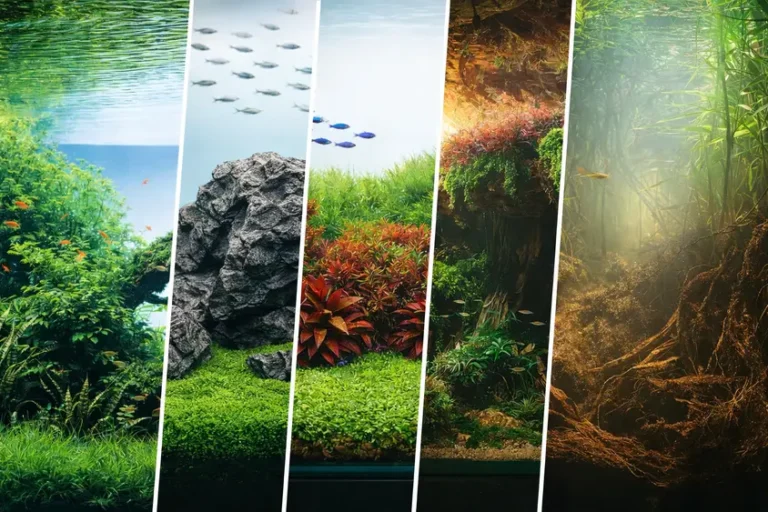
To appreciate Iwagumi, it helps to understand how it compares to other aquascaping schools of thought:
| Style | Focus | Complexity | Key Elements |
|---|---|---|---|
| Iwagumi | Minimalism, rocks | High | Rock arrangement, negative space |
| Nature | Natural realism | Medium | Wood, plants, asymmetry |
| Dutch | Color, plant contrast | Very High | Rows of stem plants, color bands |
| Jungle | Wild growth, chaos | Low–Med | Large leaves, roots, shadows |
| Biotope | Authentic ecosystems | Medium | Real species from one habitat |
🔍 Iwagumi Stands Out Because:
- It’s the most minimalist style
- It uses rocks as the star, not plants or driftwood
- It demands perfect balance with very few elements
While Nature and Jungle styles celebrate wild beauty, Iwagumi aims for peaceful precision and stillness.
Ideal Tank Inhabitants
An Iwagumi aquascape thrives with the right choice of livestock—species that complement the layout rather than dominate it.
🐠 Peaceful Schooling Fish
- Ember Tetras (Hyphessobrycon amandae)
- Harlequin Rasboras (Trigonostigma heteromorpha)
- Green Neon Tetras (Paracheirodon simulans)
- Chili Rasboras (Boraras brigittae)
These small, schooling fish add motion and energy while preserving the minimalist aesthetic.
🦐 Shrimp and Snails
- Amano Shrimp – excellent algae eaters and very peaceful
- Cherry Shrimp – colorful and low-maintenance
- Nerite Snails – clean glass and hardscape without reproducing in freshwater
🧪 Be mindful of CO₂ levels and water hardness when choosing invertebrates.
🚫 Avoid:
- Large or aggressive fish
- Digging species like cichlids
- Surface-dwelling fish that distract from the scape’s balance
Maintenance Routine & Long-Term Success
Maintaining an Iwagumi tank requires consistency and a light touch. Here’s your blueprint:
🗓 Weekly Tasks:
- Trim carpeting plants
- Remove algae manually
- Check CO₂ diffuser and drop checker
- Clean glass and remove debris
🗓 Monthly Tasks:
- Deep trim overgrown plants
- Inspect and clean filter media
- Vacuum substrate lightly (if needed)
- Replace 30–50% of the water
🧠 Pro Tips:
- Log water parameters weekly
- Observe your layout from multiple angles
- Take monthly photos to track changes
🌱 The cleaner and more stable your maintenance routine, the longer your layout will thrive—some Iwagumi aquascapes remain pristine for over 12 months without rescaping.
Key Takeaways
- Iwagumi aquascapes are minimalist but highly technical in execution.
- The layout depends on rock choice, negative space, and plant restraint.
- Seiryu, Ohko, and Sado-Akadama are ideal stone types.
- Choose only a few plant species, mainly carpets like HC or Eleocharis.
- CO₂, strong lighting, and good filtration are essential for long-term health.
- Select peaceful, small fish and shrimp to complement—not distract from—the scene.
- Regular pruning and algae control are non-negotiable for success.
Iwagumi Layout: Final Inspection Checklist
Before finalizing your layout, run through this checklist to ensure your aquascape follows classic Iwagumi principles and avoids common structural mistakes.
- Stone Count: Use an odd number of stones (3, 5, or 7) to prevent visual symmetry.
- Focal Point: Position the Oyaishi off-center according to the Rule of Thirds.
- Directional Flow: Ensure all stones share a consistent tilt and directional energy.
- Perspective: Create a strong substrate slope to enhance depth and scale.
- Active Void (Ma): Leave sufficient negative space so the composition can breathe.
- Tension: Maintain intentional asymmetry to avoid a constructed or artificial appearance.
- Species Discipline: Limit your plant palette to three species or fewer.
- Technical Readiness: Confirm that lighting and CO₂ systems are stabilized for the startup phase.
Tip: If you hesitate on more than two points, revisit your hardscape before flooding the tank. Precision at this stage determines long-term visual harmony.
Beginner Mistakes to Avoid in Iwagumi Aquascaping
Many first-time aquascapers make small mistakes that disrupt the harmony of their layout. Here’s how to avoid them:
❌ Centering the Main Stone
The Oyaishi should never be dead center. It breaks the rule of thirds and creates unnatural symmetry.
✅ Fix: Move it slightly left or right (⅓ from the edge).
❌ Mixing Too Many Plant Species
Too many textures and colors destroy the minimalist aesthetic.
✅ Fix: Limit yourself to 2–3 species max.
❌ Ignoring Negative Space
Filling every gap with plants or rocks removes visual balance.
✅ Fix: Leave deliberate empty zones—especially in the front or mid-ground.
❌ Choosing the Wrong Rocks
Using rounded or polished stones breaks the “natural” feel.
✅ Fix: Go for jagged, layered, or eroded rocks like Seiryu or Ohko.
❌ Poor Maintenance
Even the best Iwagumi layout will fail if it’s not pruned or cleaned regularly.
✅ Fix: Set a schedule—weekly trimming and monthly water quality checks.
Conclusion
Crafting an Iwagumi aquascape is both design and discipline. When the rock hierarchy is clear, the negative space is intentional, and light + CO₂ stay stable, the layout matures into that calm, minimalist “landscape” Iwagumi is known for.
Whether you’re building your first layout or refining your tenth, remember: Iwagumi is about restraint, harmony, and intention. Master those, and the results will speak for themselves.
Ready to build your own Iwagumi aquascape? Start with your rock layout — everything else follows from there.
💬 Join the Conversation
Tag us on Instagram @AquariumLesson — we’d love to see your Iwagumi creations!
FAQ – Iwagumi Questions Answered
What does “Iwagumi” mean?
It means “rock formation” in Japanese and refers to aquascapes focused on structured stone arrangements.
Do I need CO₂ in an Iwagumi tank?
Technically no, but CO₂ greatly improves plant growth, color, and algae control.
What’s the best rock for a beginner?
Ohko (Dragon) stone—lightweight, textured, and easy to place.
Can I use wood in an Iwagumi aquascape?
Traditionally, no. But modern hybrids sometimes incorporate small twigs subtly.
How many plant species should I use?
Ideally 1–3 species. Simplicity is part of the style.
Why does my layout look “flat”?
Try increasing substrate slope and adjusting stone angles. Use different heights and plant depths.
What fish best suit an Iwagumi tank?
Ember tetras, green neons, chili rasboras—all small, peaceful, and visually light.
How do I prevent algae?
Use proper lighting duration, inject CO₂, fertilize carefully, and introduce Amano shrimp early.
New to AquariumLesson? Start with our complete Aquarium Lessons Hub or return to the homepage at AquariumLesson.com.
Continue learning
References
- Amano, Takashi. Nature Aquarium World – Vol. 1–3
- Tropica Aquarium Plants: www.tropica.com
- The 2Hr Aquarist Guides: www.2hraquarist.com
- Green Aqua YouTube Channel: www.youtube.com/c/GreenAqua
- Aquasabi Blog – Hardscape Tutorials and Plant Profiles: www.aquasabi.com