Bacterial Bloom in Aquarium
A milky-white or pale-gray water-column haze caused by a rapid increase in free-floating bacteria, often seen in new or recently disturbed aquariums and best distinguished from visible debris and Green Water before treatment.
Save this guide or add this issue to one of your aquariums.
Need help with Bacterial Bloom?
Explore compatibility, care or problems using this guide and your aquarium’s conditions.
Identification
- Main color
- White, milky white, and pale gray
- Growth form
- Bloom
- Typical surfaces
- Water column
- Behavior
- Clouds water
- Diagnostic confidence
- Practical
- Uniform white, milky, or pale-gray cloudiness throughout the water column with few or no clearly visible particles; the water lacks the green tint of suspended algae.
- Milky water with no obvious particles is consistent with a bacterial bloom, especially after setup, organic loading, or biofilter disturbance, but appearance alone cannot prove the microbiological cause.
Probably not this algae if…
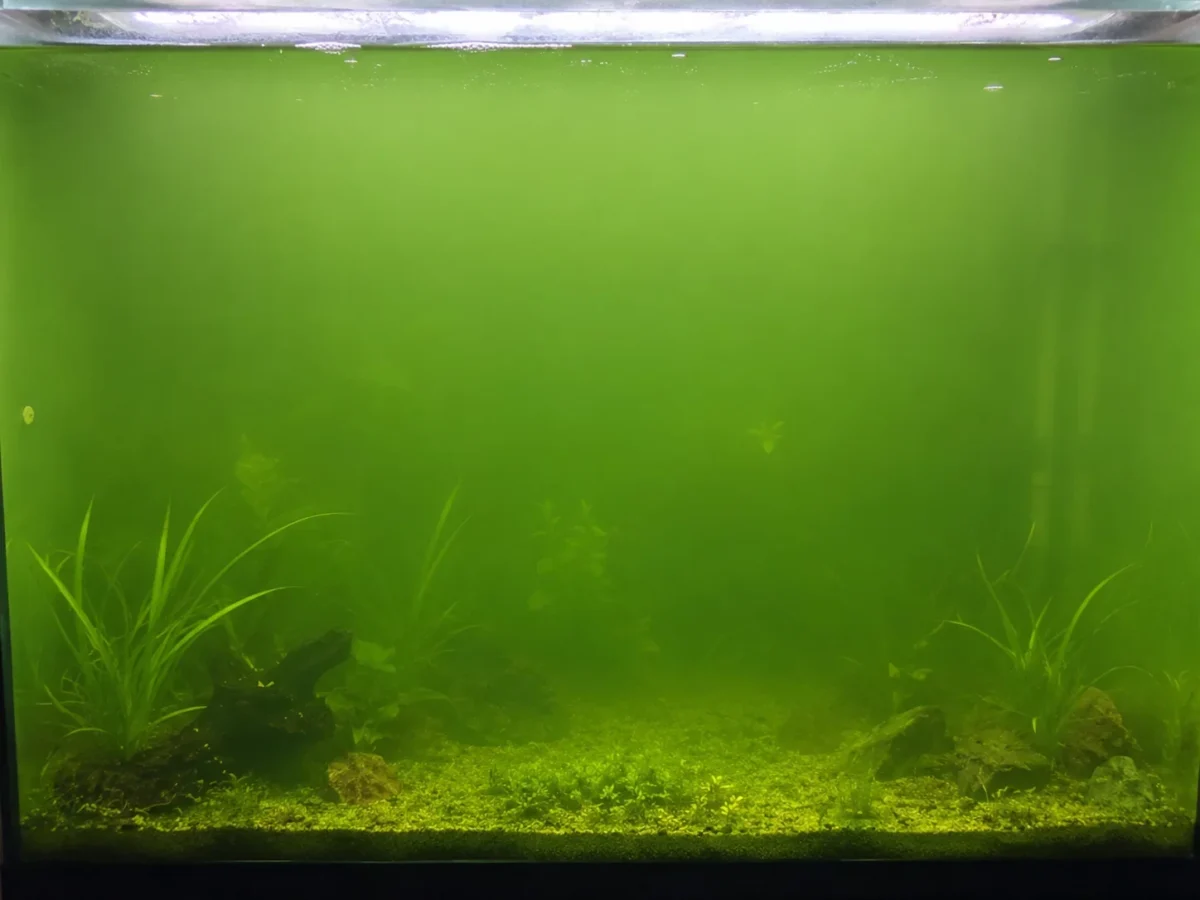
- Green Water has a clear green tint rather than white/pale-gray haze.
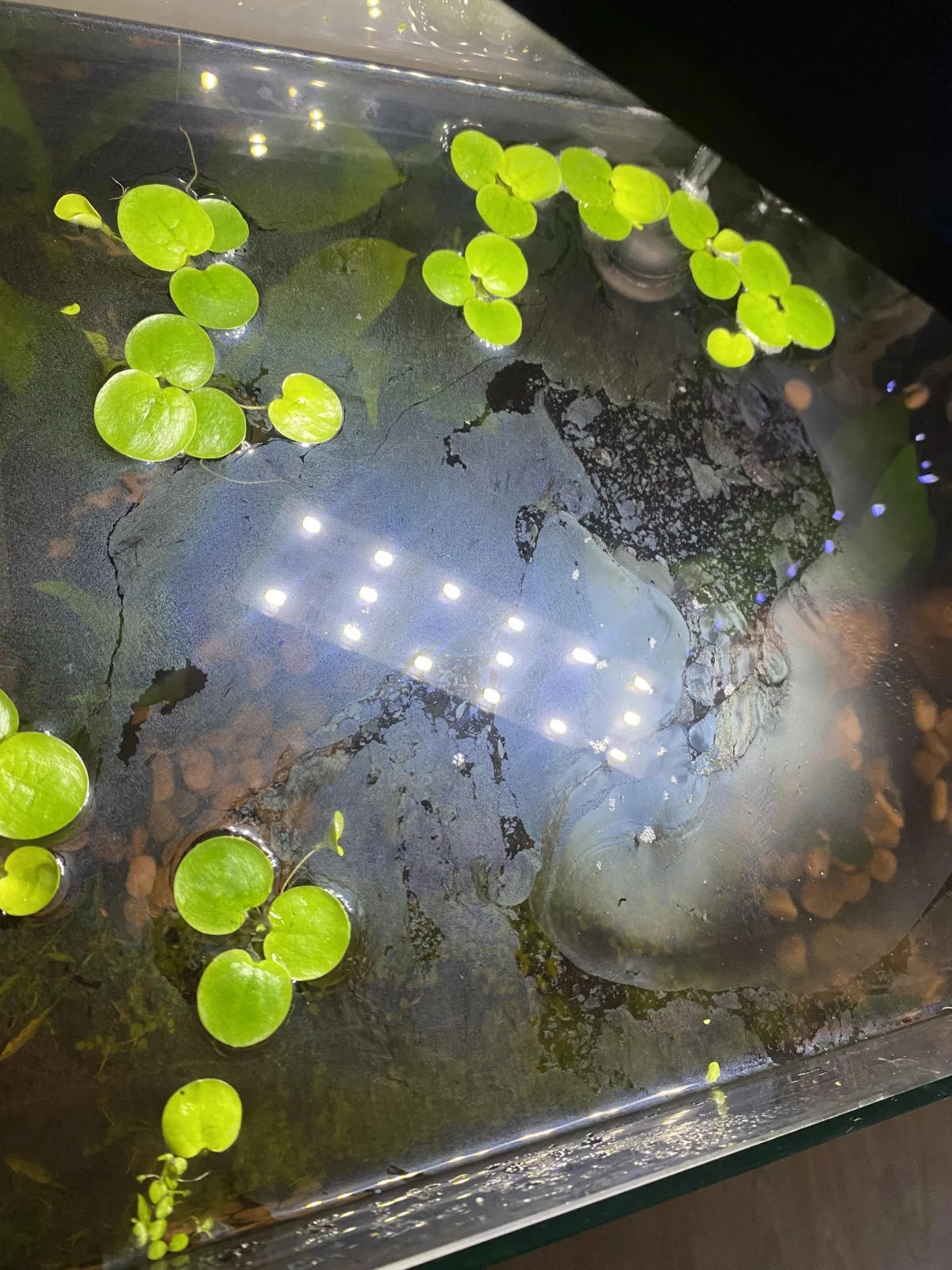
- Surface Biofilm forms a slick at the air-water interface rather than clouding the entire water column.
- Particulate cloudiness contains visible specks/dust that can settle or be captured mechanically.
Your fix plan
Today
- Check livestock behavior.
- Ensure adequate aeration.
- Test ammonia/nitrite.
This week
- Keep filtration running.
- Avoid another major cleaning/filter reset.
- Avoid adding livestock.
Keep it away
- Avoid abrupt organic overload, overfeeding, sudden large increases in livestock, and unnecessary wholesale replacement/sterilization of established biological filter media.
- In new tanks, stock/feed gradually and monitor ammonia/nitrite.
Causes
Bacterial blooms are most usefully understood as rapid growth of suspended heterotrophic bacteria after microbial instability or increased organic substrate. They are common in young systems but can also occur after overfeeding, decay, increased bioload, major filter disturbance, or substantial substrate disturbance.
- Microbial succession in a newly established aquarium can create conditions where free-floating heterotrophic bacteria temporarily proliferate.
- Sudden increases in degradable organic material from overfeeding, uneaten food, decay, or a dead organism can support rapid bacterial growth.
- A sudden increase in livestock or feeding can increase organic loading faster than the established system can process it.
- Major filter/biofilter disturbance can destabilize the aquarium microbial community and may precede a bloom.
- Major substrate disturbance can coincide with a bloom when it releases organics or disrupts an otherwise stable system.
What to check
- Check ammonia and nitrite, recent feeding, decay and filter disturbance.
- Watch fish breathing and surface agitation; distinguish milky suspended cloudiness from green water or a floating surface film.
Treatment options
- Fish
- Context dependent
- Invertebrates
- Context dependent
- Aquarium system
- Context dependent
Most uncomplicated new-tank bacterial blooms are best managed by protecting biological filtration, maintaining oxygenation, limiting further organic loading, and allowing microbial succession to stabilize. Water changes should respond to actual water-quality/livestock needs rather than haze alone; UV is situational.
Observation
First lineKeep filtration running, avoid another major cleaning/filter reset, avoid adding livestock, and reduce unnecessary organic input while monitoring water quality.
Best for: A new/recently disturbed aquarium with milky haze, normal livestock, adequate aeration, and ammonia/nitrite not rising.
Details and cautions
Not for: Livestock respiratory distress, unsafe ammonia/nitrite, an obvious decomposing source, or cloudiness that does not fit the diagnosis.
Limitations: Observation is appropriate only while water quality and livestock remain stable.
Fish caution: Escalate if fish gasp or become unusually lethargic.
Invertebrates caution: Escalate if invertebrates show unusual respiratory/behavioral stress.
System caution: Continue monitoring ammonia, nitrite, filtration, and gas exchange.
Oxygenation
SupportingIncrease surface agitation or aeration while the bloom and trigger are assessed.
Best for: Dense blooms, warm aquariums, recent organic-loading events, low surface movement, or respiratory concern.
Details and cautions
Not for: Treating aeration as a substitute for correcting unsafe ammonia/nitrite or decay.
Limitations: Reduces oxygen-risk margin but does not remove the organic source.
Water change
SituationalUse water changes according to actual water-quality need rather than appearance alone.
Best for: Measured ammonia/nitrite requiring correction, livestock distress, or removal of a known decomposing/contaminating source.
Details and cautions
Not for: Repeated large water changes performed only to make otherwise stable milky water look clear.
Limitations: May temporarily reduce haze without resolving the microbial/organic trigger.
Invertebrates caution: Avoid unnecessary abrupt parameter swings.
Filtration
SupportingKeep established biological media operating and avoid replacing/sterilizing the entire biofilter; correct genuinely clogged mechanical media without resetting all filtration.
Best for: New aquariums or blooms following filter cleaning, media replacement, medication, or biological-filter disturbance.
Details and cautions
Not for: Assuming clogged mechanical filtration should never be serviced.
Limitations: Supports recovery but does not instantly clear free-floating bacteria.
System caution: Do not interpret the bloom itself as proof that the nitrifying biofilter is healthy or failed.
UV-C treatment
SituationalA correctly sized/operated UV-C unit can reduce suspended microorganisms passing through it.
Best for: A persistent reasonably well-identified free-floating bacterial bloom where rapid clarification is important after causes/water quality have been assessed.
Details and cautions
Not for: Routine first-line treatment of an uncomplicated new-tank bloom already stabilizing.
Limitations: Specialist recommendations disagree on routine UV use; UV does not resolve the trigger.
Plants caution: Prolonged UV may interfere with some chelated water-column fertilizers.
System caution: Follow manufacturer flow, lamp, and compatibility instructions.
If it returns and prevention
Why it returns and what to inspect
- What to expect
- An uncomplicated bloom associated with a new or recently disturbed aquarium often clears as the microbial community and available organic substrate stabilize.
- When observation is reasonable
- The haze is uniformly white/pale gray with few visible particles, livestock behavior is normal, gas exchange is adequate, no major decaying source is present, and ammonia/nitrite are not rising.
- Timeframe
- Aquarium-specialist sources commonly report clearing over several days to roughly one or two weeks in uncomplicated new-tank cases; this is a practical range, not a biological deadline.
- Investigate sooner if
- Livestock shows respiratory stress, ammonia/nitrite rises, a strong decay event is present, visible particles suggest another diagnosis, water becomes green, or the bloom persists/worsens in an established aquarium. Test ammonia and nitrite. Observe livestock respiration/behavior. Ensure adequate aeration/gas exchange. Check for decaying organic material. Confirm cloudiness is uniform rather than visible particulate matter.
Aquarium-specific guidance and prevention
- New aquarium
- Milky cloudiness can occur during early microbial succession, but it does not prove the aquarium is safely cycled; test ammonia/nitrite, stock/feed conservatively, and keep biological filtration running.
Long-term prevention
- Avoid abrupt organic overload, overfeeding, sudden large increases in livestock, and unnecessary wholesale replacement/sterilization of established biological filter media. In new tanks, stock/feed gradually and monitor ammonia/nitrite.