Brown Diatoms in Aquarium
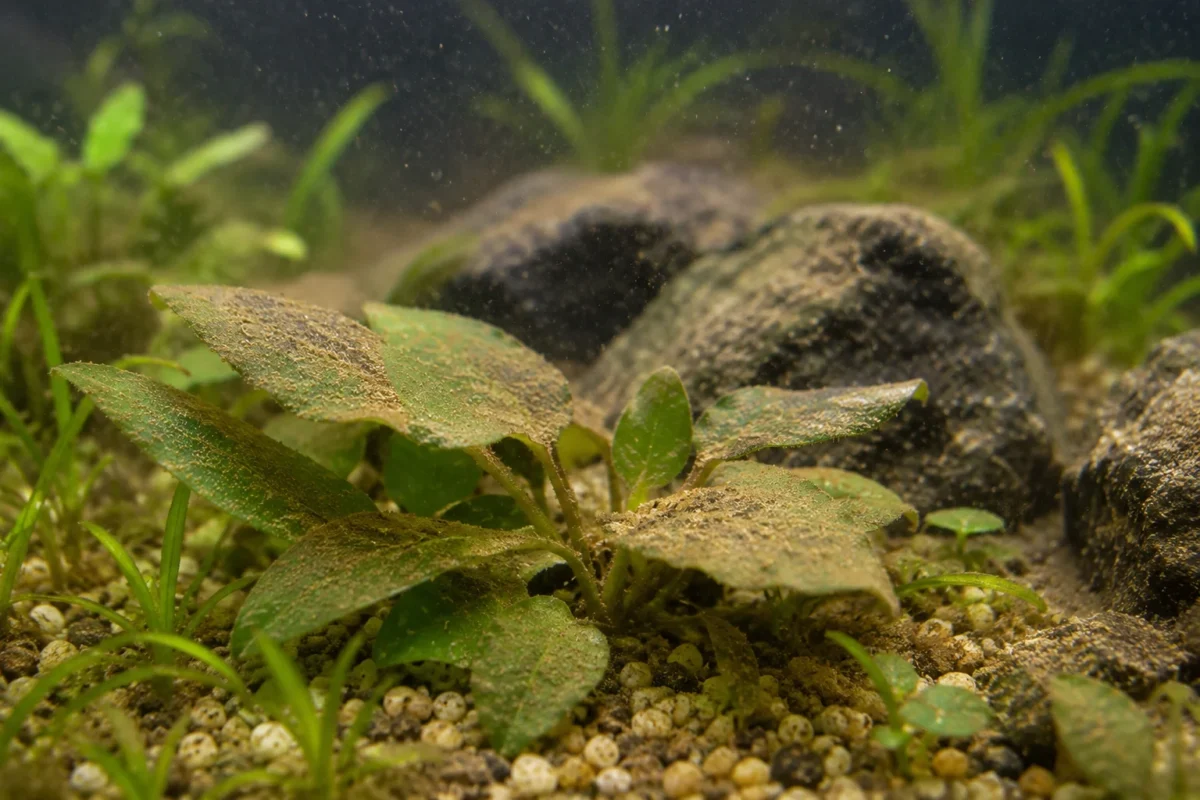
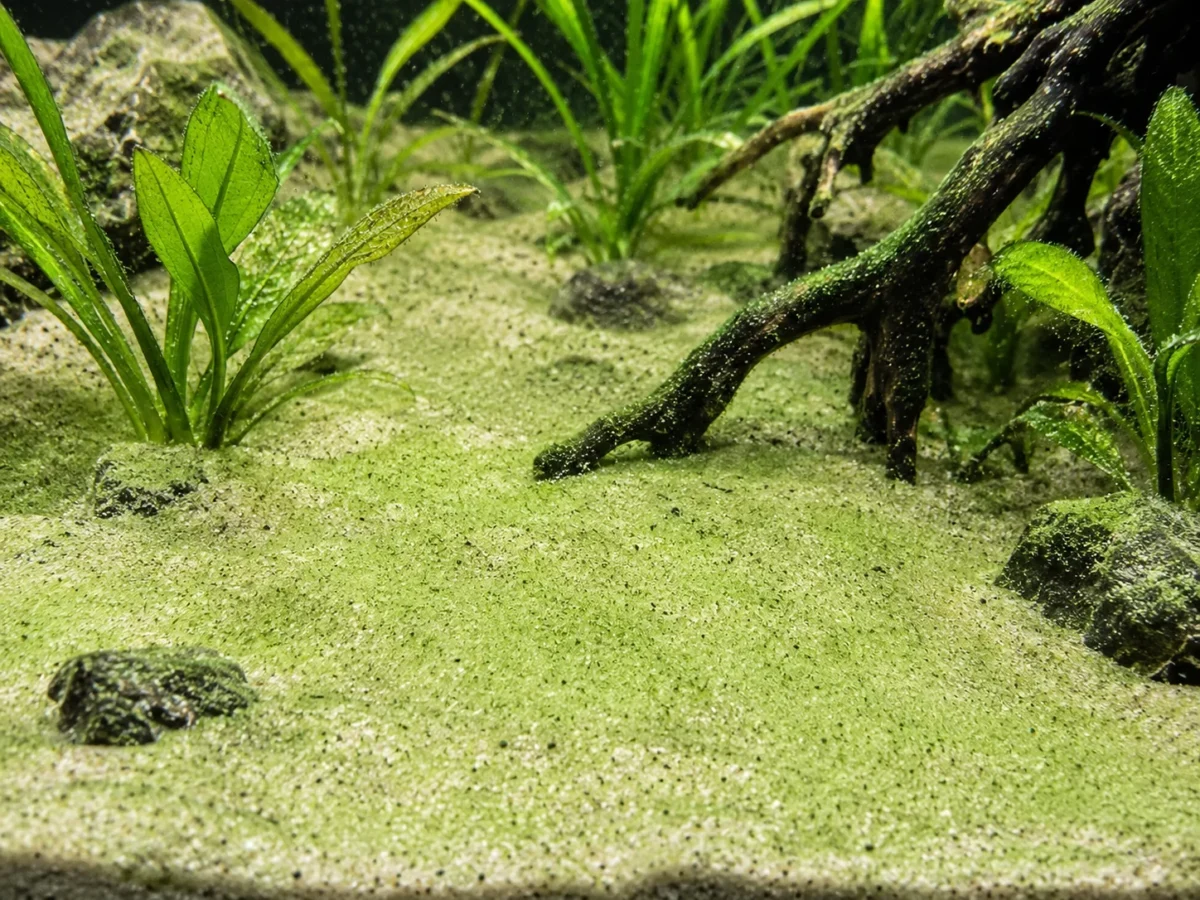
A soft brown or tan diatom coating that is especially common in newly established aquariums and usually wipes or siphons away easily.
Save this guide or add this issue to one of your aquariums.
Need help with Brown Diatoms?
Explore compatibility, care or problems using this guide and your aquarium’s conditions.
Identification
- Main color
- Brown, tan, and golden brown
- Growth form
- Film
- Attachment
- Weak
- Typical surfaces
- Glass, plant leaves, rocks, wood, and hardscape, substrate, and equipment
- Texture
- Powdery and velvety
- Behavior
- Wipes easily
- Diagnostic confidence
- Practical
- Dusty to velvety tan, golden-brown, or brown coating on glass, substrate, hardscape, equipment, and plant leaves, particularly during early aquarium maturation.
- A weakly attached brown dusty coating in a recently established aquarium is strongly consistent with diatoms, but appearance alone cannot prove taxonomic identity and loose detritus can look similar.
Probably not this algae if…
- Brown Dust Film substantially overlaps the same weakly attached new-tank brown-film spectrum.
- GDA is green rather than brown.
- Loose detritus behaves as deposited debris rather than a coherent surface-growing brown coating.
Your fix plan
Today
- If the coating fits a typical new-tank diatom phase, keep the aquarium stable and wipe or siphon visible buildup during routine maintenance if desired.
- Avoid aggressive chemical intervention solely because brown film appeared.
This week
- Allow maturation to continue while maintaining normal feeding, filtration, water changes, and plant care.
Keep it away
- There is usually no need to chemically prevent the normal new-tank diatom phase.
- Maintain steady maturation.
- Avoid excess feeding/decay, support healthy plants, and investigate persistent sources only in an established tank.
Causes
Brown diatoms are best treated as a common early-aquarium succession phenomenon rather than evidence of one bad water parameter. Silicon is biologically required, but elevated silicate is not automatically the sole cause.
- Early aquarium biological succession strongly favors temporary diatom coatings in many newly established tanks.
- Diatoms require silicon for their silicified cell walls, so silicate availability can contribute when other conditions allow growth.
- Immature microbial and grazer communities provide less competition/grazing during startup.
- Light and nutrient availability influence growth, but no single aquarium condition explains every outbreak.
What to check
- Check whether the brown layer wipes away easily and whether the aquarium is newly established.
- In a persistent established-tank case, review source-water changes, debris and plant health before adding a chemical treatment.
Treatment options
- Fish
- Low
- Invertebrates
- Low
- Plants
- Context dependent
- Aquarium system
- Low
Observation and routine physical cleaning are usually sufficient in a young aquarium. Investigate further only when the coating remains unusually heavy or persistent after the aquarium is otherwise mature and stable.
Observation
First lineAllow maturation to continue while maintaining normal feeding, filtration, water changes, and plant care.
Best for: A recently established aquarium with a soft brown coating that wipes away easily and no concerning signs.
Details and cautions
Not for: Persistent heavy brown growth in an established aquarium or material that does not behave like diatom film.
Limitations: Observation does not diagnose persistent mature-tank problems.
Manual removal
SupportingWipe accessible surfaces gently and siphon loose material during routine maintenance.
Best for: Visible coating on glass, hardscape, equipment, leaves, or upper substrate.
Details and cautions
Not for: Aggressive scrubbing that damages leaves or repeatedly disrupts an immature aquarium.
Limitations: The coating may return during maturation.
Plants caution: Clean delicate leaves gently.
Organic-load reduction
SupportingRemove avoidable decaying material and excess food while keeping biological maturation stable.
Best for: Tanks where excess food, decay, or visible detritus accompanies the brown coating.
Details and cautions
Not for: Assuming all new-tank diatoms are caused by organic waste.
Limitations: Does not address silicon availability and is not a universal cure.
System caution: Avoid over-cleaning or replacing all biological filter media during startup.
Grazers
- Neritid snails, including Clithon spp. · UsefulThey graze diatom films effectively but should be stocked only when the aquarium can support them long term.
- Otocinclus spp. · UsefulReadily graze diatoms but are best introduced to mature stable aquariums with sustained biofilm and food.
- Amano shrimp · LimitedCan graze soft films and support cleanup but should not be added to an immature aquarium solely because diatoms appeared.
If it returns and prevention
Why it returns and what to inspect
- What to expect
- In a typical newly established aquarium, brown diatom growth commonly appears during early maturation and often declines as microbial communities, plants, and grazing pressure establish.
- When observation is reasonable
- The tank is recently established, the coating is brown/tan and wipes easily, livestock behavior is normal, and routine water-quality checks show no separate problem.
- Timeframe
- Specialist sources commonly report appearance in the first weeks and decline over following weeks; this is a practical pattern, not a fixed biological deadline.
- Investigate sooner if
- Heavy brown coating persists in a mature aquarium, becomes unusually difficult to remove, repeatedly smothers plants, or no longer matches dusty diatoms. Confirm weakly attached brown/tan film rather than loose mulm. Confirm livestock behavior is normal. Continue ammonia/nitrite monitoring in a cycling aquarium. Confirm no major decaying organic source is present.
Aquarium-specific guidance and prevention
- New aquarium
- Treat ordinary diatoms primarily as a maturation issue; maintain routine care and water-quality monitoring and do not add sensitive grazers solely to accelerate a temporary phase.
Long-term prevention
- There is usually no need to chemically prevent the normal new-tank diatom phase. Maintain steady maturation, avoid excess feeding/decay, support healthy plants, and investigate persistent sources only in an established tank.