Cyanobacteria in Aquarium
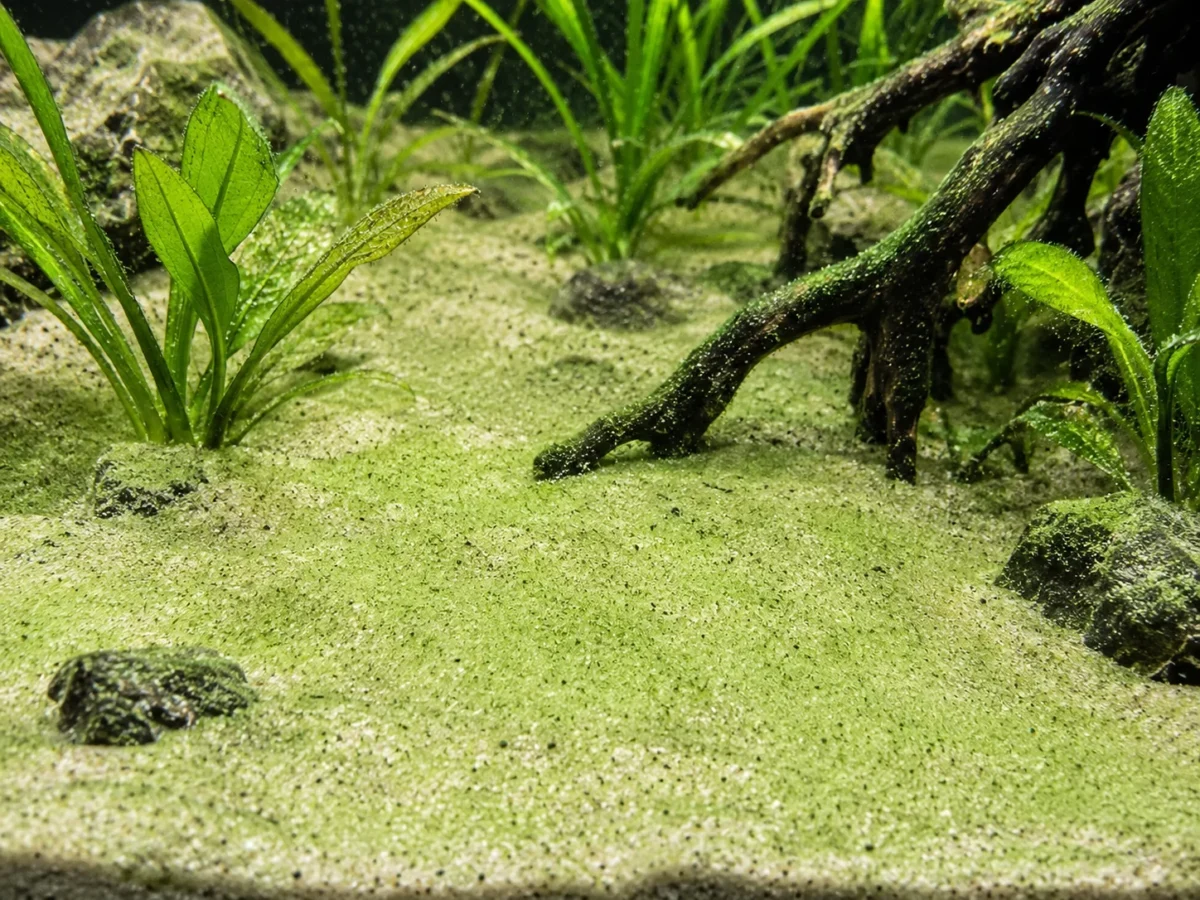
A photosynthetic bacterial mat, not true algae, that forms cohesive slimy blue-green to dark sheets over substrate, plants, and hardscape and can spread quickly if favorable conditions persist.
Save this guide or add this issue to one of your aquariums.
Need help with Cyanobacteria?
Explore compatibility, care or problems using this guide and your aquarium’s conditions.
Identification
- Main color
- Blue green, dark green, black green, and reddish brown
- Growth form
- Mat
- Attachment
- Moderate
- Typical surfaces
- Substrate, plant leaves, rocks, wood, and hardscape, and glass
- Texture
- Slimy
- Behavior
- Peels in sheets and traps bubbles
- Diagnostic confidence
- High
- Slimy cohesive sheets or mats ranging from blue-green and dark green to nearly black or reddish-brown; growth can peel away in sheets, may trap bubbles, and may have an earthy or unpleasant odor.
- An earthy, musty, swampy, or unpleasant odor can support identification, but smell is not unique to cyanobacteria and does not indicate whether the mat is producing cyanotoxins.
- A cohesive slimy mat that peels in sheets is a strong practical diagnosis, especially when odor or trapped bubbles are present. Visual identification cannot establish species or toxin status.
Probably not this algae if…
- GDA is powdery/wipeable and especially noticeable on glass.
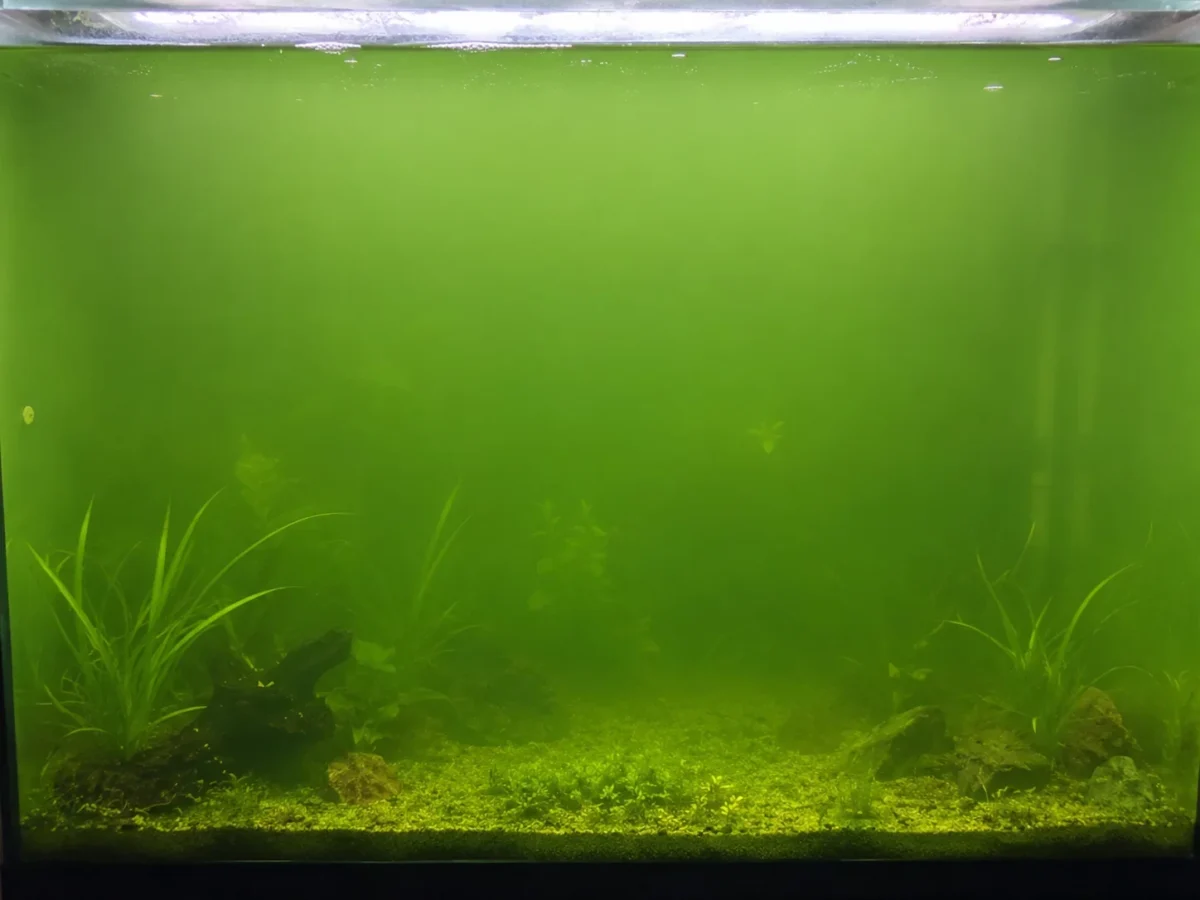
- Green Water is suspended in the water column.
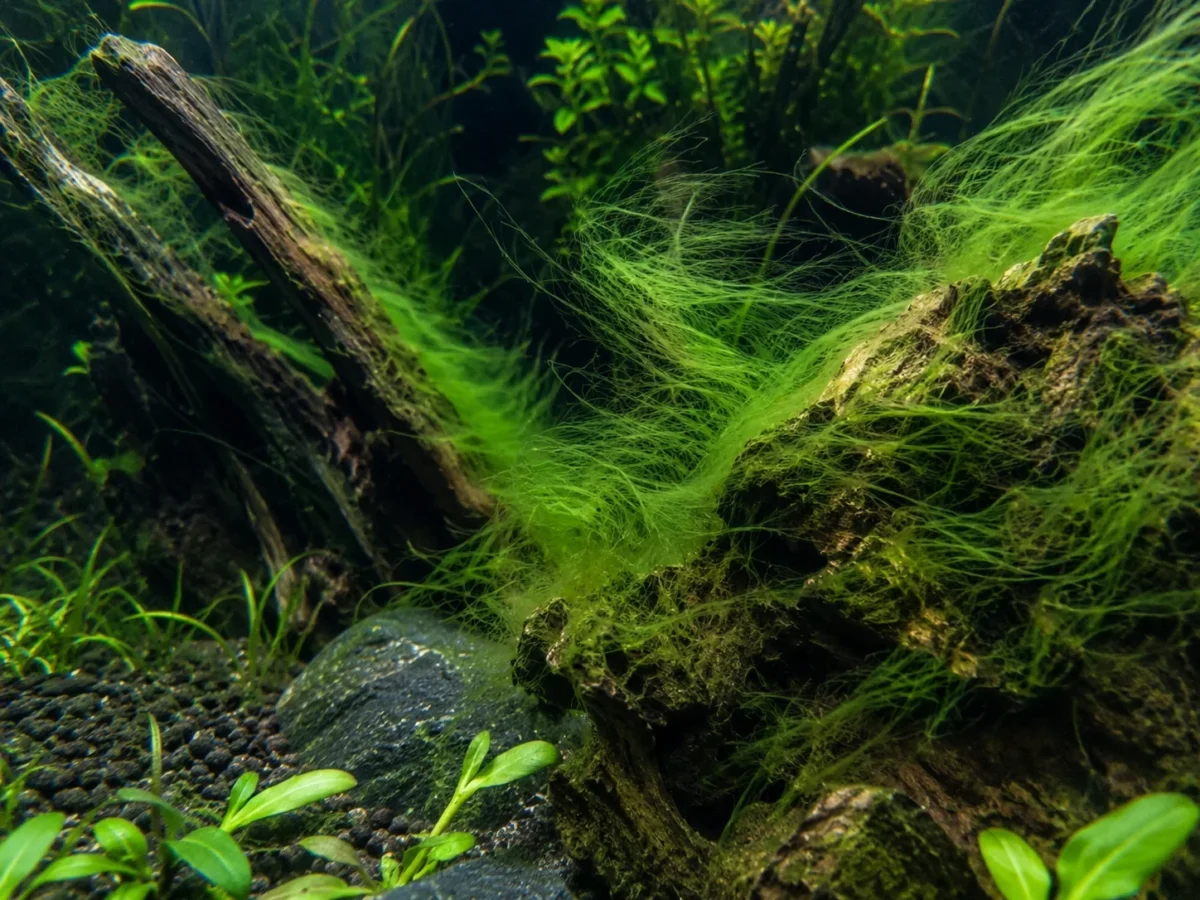
- Hair Algae forms strands rather than cohesive slimy sheets.
Your fix plan
Today
- Siphon out visible mats during a partial water change.
- Remove trapped organic debris, and restore adequate circulation and aeration around the affected area.
- Do not blindly change nitrate/phosphate ratios or add an antibiotic.
This week
- Use a siphon to lift cohesive sheets and export the mat and nearby debris.
Keep it away
- Export detritus and decaying material.
- Avoid chronic organic overload.
- Maintain appropriate circulation/oxygenation through debris-prone areas.
Causes
Cyanobacterial mats do not have one universal aquarium cause. Outbreaks are best understood as an interaction among nutrients/organics, surface habitat, light, local water movement, and microbial ecology. Low nitrate, low oxygen, or a fixed N:P ratio should not be presented as independently proven causes.
- Localized areas where detritus and organic material accumulate are common aquarium outbreak sites.
- Poorly circulated or sheltered zones are frequently associated with aquarium mats, although low flow is not a universal biological cause.
- Nutrient availability influences cyanobacterial ecology, but no single nitrate level or nitrate-to-phosphate ratio reliably explains outbreaks.
- Light supports photosynthesis, so excessive/prolonged light can increase growth pressure without being a sufficient cause by itself.
- Immature or disrupted microbial conditions may coincide with outbreaks but are not a single causal diagnosis.
What to check
- Check whether the growth peels in cohesive slimy sheets; color alone cannot establish toxin status.
- Inspect debris-prone areas and surface movement, and watch for livestock respiratory distress.
Nutrient guidance
- Relevance: Medium
- Overall nutrient availability and organic loading can influence cyanobacterial proliferation, but there is no universal nitrate-to-phosphate ratio or low-nitrate threshold that predicts or controls it.
- Aquarium sources commonly associate BGA with low nitrate or nutrient imbalance, but broader research does not support a universal ratio rule.
- Maintain stable plant-appropriate nutrient conditions and reduce avoidable organic accumulation; do not manipulate nitrate or phosphate toward a fixed ratio as the sole treatment.
Treatment options
- Fish
- Uncertain
- Invertebrates
- Uncertain
- Plants
- Meaningful
- Aquarium system
- Context dependent
Physical removal plus correction of local debris accumulation, circulation, and system stability is first-line. Blackout can be useful for spreading photosynthetic mats, and specifically labeled cyanobacteria treatment can be considered for persistent outbreaks.
Manual removal
First lineUse a siphon to lift cohesive sheets and export the mat and nearby debris.
Best for: Accessible mats, especially localized/newly spreading growth.
Details and cautions
Not for: Breaking mats apart and leaving fragments distributed through the tank.
Limitations: Visible removal alone commonly fails if the same local conditions remain.
Plants caution: Handle delicate plants carefully.
System caution: Export removed biomass rather than dispersing it.
Water change
SupportingCombine an appropriate partial water change with siphoning and cleanup.
Best for: Removal sessions where mats and loose detritus are being exported.
Details and cautions
Not for: Repeated water changes as the only intervention while mats/debris remain.
Limitations: Water replacement does not independently correct recurring habitat/circulation issues.
Flow correction
SupportingImprove circulation through the affected zone and eliminate obvious stagnant debris pockets.
Best for: Mats repeatedly beginning in sheltered corners, behind hardscape, dense carpets, or debris-collecting zones.
Details and cautions
Not for: Simply maximizing aquarium flow without regard to livestock/plants.
Limitations: Flow is one factor and not a stand-alone cure.
Fish caution: Do not create flow inappropriate for stocked species.
Plants caution: Avoid mechanically damaging delicate plants.
Oxygenation
SupportingMaintain strong gas exchange during cleanup and treatment.
Best for: Heavy outbreaks, blackout treatment, warm water, high organic load, or oxygen concern.
Details and cautions
Not for: Treating oxygenation as proof that low oxygen caused the outbreak.
Limitations: Protects system stability but does not directly remove the mat.
Lighting adjustment
SupportingBring lighting back to a level appropriate for the aquarium.
Best for: Aquariums running unnecessarily long/intense lighting while growth is active.
Details and cautions
Not for: Using ordinary light reduction as the only treatment for a substantial mat.
Limitations: Light is relevant but not sufficient as a single cause.
Plants caution: Avoid prolonged light restriction that weakens plants.
Blackout
SituationalUse complete temporary light exclusion, strong aeration, reduced organic input, and post-blackout biomass removal.
Best for: Spreading/substantial Cyanobacteria after accessible biomass/debris have been removed.
Details and cautions
Not for: Uncertain ID, very light-sensitive plant displays, or inability to maintain oxygenation.
Limitations: Suppresses the photosynthetic mat but recurrence remains likely if underlying conditions persist.
Plants caution: Extended darkness can stress plants.
System caution: Maintain strong aeration/gas exchange.
Commercial treatment
EscalationUse only a product explicitly labeled for aquarium cyanobacteria and follow its exact directions.
Best for: Persistent or rapidly recurring Cyanobacteria after physical/husbandry measures have not provided adequate control.
Details and cautions
Not for: Using arbitrary algaecides, antibiotics, or unlabeled chemicals.
Limitations: Effectiveness and safety are formulation-specific; treatment does not necessarily correct recurrence drivers.
Fish caution: Product-specific; follow the exact label.
Invertebrates caution: Verify invertebrate safety on the exact label.
Plants caution: Some products may affect sensitive plants.
System caution: Carbon, UV, aeration, and filtration requirements are product-specific.
Match the response to severity
- LocalizedOne or a few small mats are confined to a specific substrate edge, gap, or plant area. Remove early and investigate why that location traps debris or supports the mat.
- SpreadingMats are expanding across substrate, multiple plant groups, or hardscape, or reappear quickly after siphoning. Use tank-level control rather than repeatedly treating individual patches.
- Heavy outbreak or system concernExtensive mat coverage, major plant smothering, rapid regrowth, or livestock/water-quality stress. Stabilize livestock/water quality first, remove biomass, then escalate treatment if needed.
If it returns and prevention
Why it returns and what to inspect
Why it may return
- Cyanobacteria often returns when treatment removes the visible mat but leaves the same local habitat, organic source, or instability.
- Detritus continues to accumulate in the same zone.
- The affected area remains poorly circulated.
- Decay or excess feeding continues to supply organics.
- Blackout/treatment removed biomass without correcting recurring conditions.
- The aquarium remains unstable after major setup or maintenance changes.
What to inspect
- Inspect exactly where the first new mat reappears.
- Check debris beneath carpets, hardscape, and plant bases.
- Review feeding and decay.
- Review circulation through the recurring zone.
- Maintain stable plant-appropriate nutrients rather than chasing a nitrate-to-phosphate ratio.
Aquarium-specific guidance and prevention
- Planted aquarium
- Remove dense mats before they substantially cover leaves; blackout is an escalation tool, not a substitute for cleanup and local husbandry correction.
- Shrimp aquarium
- Do not assume a chemical Cyanobacteria treatment is shrimp-safe; prefer manual/husbandry control first and verify the exact product label.
Long-term prevention
- Export detritus and decaying material, avoid chronic organic overload, and maintain appropriate circulation/oxygenation through debris-prone areas. Keep lighting and plant nutrition stable rather than targeting a fixed nitrate-to-phosphate ratio.