Green Dust Algae in Aquarium
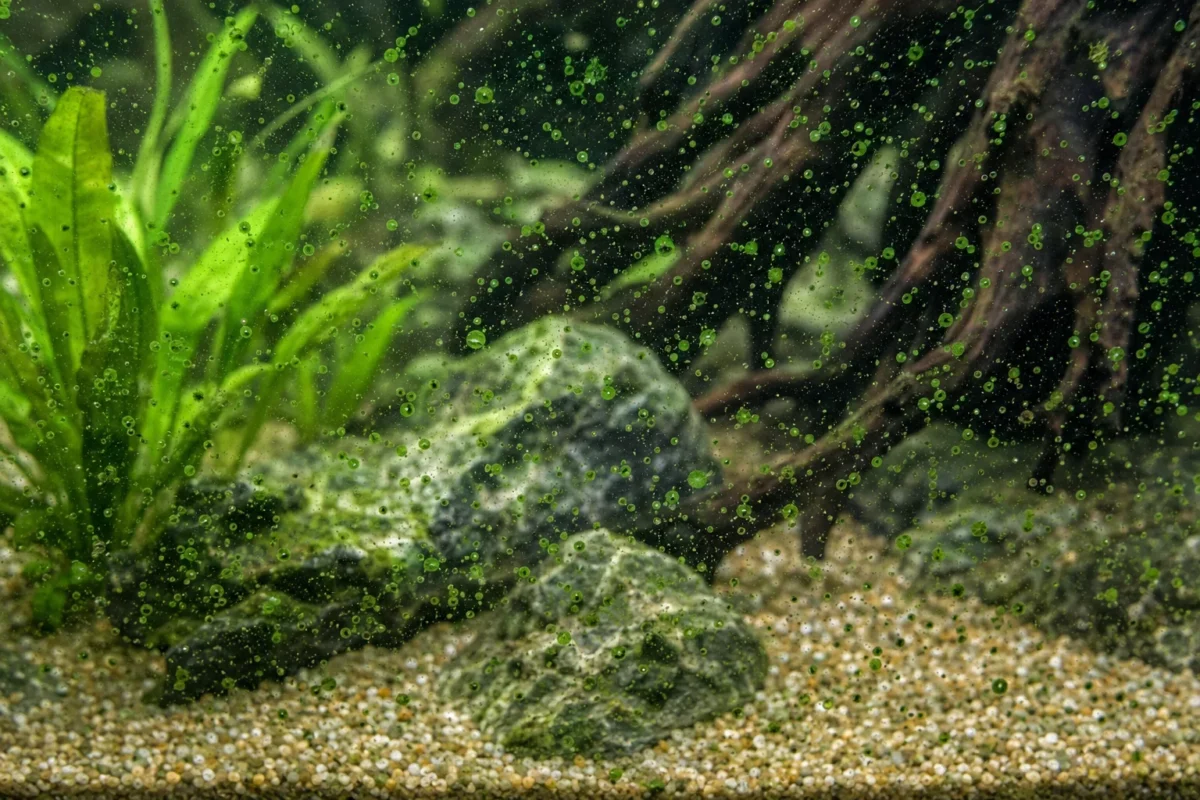
A soft, weakly attached green dust-like film that is most noticeable on aquarium glass, wipes away easily, and can return unusually quickly after cleaning.
Save this guide or add this issue to one of your aquariums.
Need help with Green Dust Algae?
Explore compatibility, care or problems using this guide and your aquarium’s conditions.
Identification
- Main color
- Light green and green
- Growth form
- Film
- Attachment
- Weak
- Typical surfaces
- Glass and rocks, wood, and hardscape
- Texture
- Powdery and slimy
- Behavior
- Wipes easily and returns quickly
- Diagnostic confidence
- High
- Fine light-to-medium green film or haze across aquarium glass, sometimes slightly slimy or powdery, with much weaker attachment than Green Spot Algae.
- An easily wiped green film that returns quickly is a useful recognition clue, not a species identification.
Probably not this algae if…
- Green Spot Algae forms hard individual green dots that resist wiping.
- Green Algae Coats form broader flat patina and are not defined by rapid dust-like return.
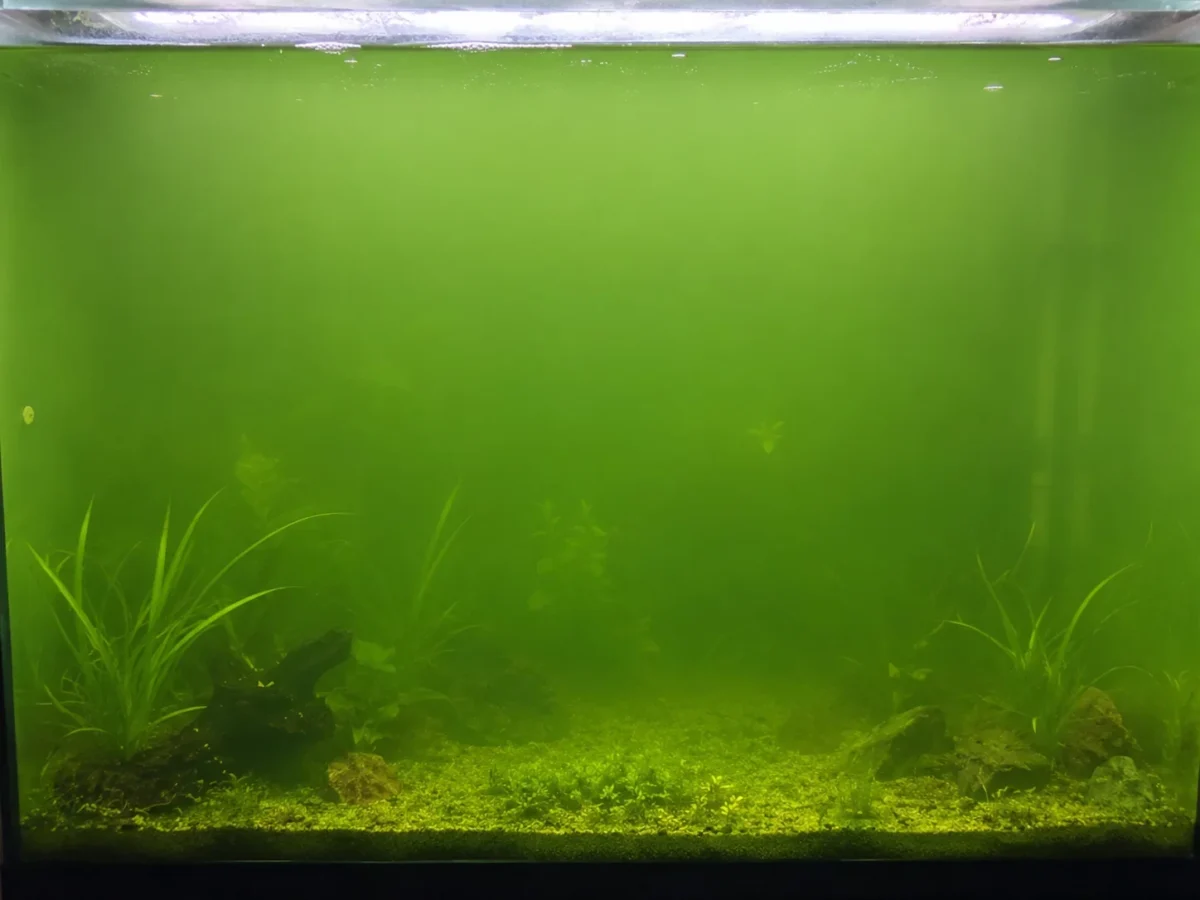
- Green Water colors the water column itself rather than only the glass.
Your fix plan
Today
- Confirm that the green layer wipes easily and is attached to glass rather than suspended in the water.
- Clean it during maintenance if desired, or observe mild growth in an otherwise stable young tank.
This week
- Wipe or scrape the film with a surface-appropriate aquarium tool and export loosened material.
Keep it away
- Keep the light timer consistent.
- Review lighting after removing a large amount of plant growth, and record changes before adjusting fertilizer.
- Clean accessible viewing surfaces during routine maintenance rather than repeatedly resetting the aquarium.
Causes
GDA is most consistently associated with new or recently disturbed planted aquariums rather than one proven nutrient defect.
- Green Dust Algae is commonly associated with new or recently destabilized aquariums.
- Major changes to plant mass, layout, or lighting are common aquarium-husbandry associations.
- Strong light can accelerate visible growth when plant mass and system stability are not keeping pace.
- Nitrogen or ammonia spikes are reported associations but are not established universal triggers.
What to check
- Compare a cleaned patch with an untouched patch: does a soft dust-like film return, or are there hard individual spots?
- Review recent changes to the light timer, planting or layout before changing nutrient dosing.
Nutrient guidance
- Relevance: Medium
- No validated nitrate or other nutrient threshold defines GDA; reported nitrogen/ammonia associations remain contextual.
- Maintain consistent plant-appropriate nutrition and correct documented water-quality events rather than chasing a GDA-specific nutrient target.
Treatment options
- Fish
- Low
- Invertebrates
- Low
- Plants
- Low
- Aquarium system
- Low
GDA is physically easy to remove but can return rapidly. Manual cleaning, conservative lighting, system stability, and maturation are the core strategies; the traditional 3–4 week no-clean approach is optional hobby guidance rather than a proven universal lifecycle requirement.
Manual removal
First lineWipe or scrape the film with a surface-appropriate aquarium tool and export loosened material.
Best for: Visible GDA on viewing panes or hardscape.
Details and cautions
Not for: Aggressive repetitive cleaning as the only strategy while the aquarium remains unstable.
Limitations: The film may return rapidly while favorable conditions persist.
System caution: Use an acrylic-safe tool where required.
Observation
SituationalKeep routine care stable; leaving the film untouched for a period is an optional hobby strategy, not a biological requirement.
Best for: Mild GDA in a young or recently disturbed aquarium with normal livestock and water quality.
Details and cautions
Not for: Growth that no longer fits soft wipeable GDA or a tank with water-quality concerns.
Limitations: The widely repeated 3–4 week lifecycle mechanism is not scientifically established.
Lighting adjustment
SupportingTemporarily align light intensity and duration with current healthy plant growth.
Best for: Young, recently trimmed, or destabilized tanks running more light than current plant mass can use.
Details and cautions
Not for: Treating light as the only possible driver.
Limitations: Existing film still requires cleaning or time to decline.
Plants caution: Avoid unnecessarily starving healthy plants of required light.
Organic-load reduction
SupportingRemove the identified avoidable organic source and return to a stable maintenance routine.
Best for: GDA following a clear decay, ammonia, or organic-loading event.
Details and cautions
Not for: Assuming all GDA is caused by dirty water.
Limitations: The exact biological trigger of the GDA phenotype remains poorly defined.
Grazers
- Clithon spp. and other suitable neritid snails · UsefulThey can graze dust algae effectively, but must fit the aquarium's long-term food, mineral, water-quality, and stocking needs.
If it returns and prevention
Why it returns and what to inspect
Why it may return
- Rapid return after wiping is a defining practical feature of persistent GDA; cleaning removes visible biomass but not necessarily the conditions that allow recolonization.
- The aquarium is still biologically immature.
- Recent rescape, heavy pruning, or lighting change continues to affect stability.
- Light remains high relative to healthy plant mass.
- A recent organic or nitrogenous waste event has not fully resolved.
What to inspect
- Review aquarium age and recent major changes.
- Review light intensity and photoperiod.
- Review healthy plant mass and growth.
- Check for decay or recent ammonia/organic-loading events.
- Confirm the returning layer still wipes easily and has not become hard GSA.
- What to expect
- Mild GDA in a young aquarium often declines as the aquarium matures and healthy plant mass increases.
- When observation is reasonable
- The film is soft, green, weakly attached, primarily on glass, and livestock and water quality are normal.
- Timeframe
- A 3–4 week undisturbed period is longstanding hobby guidance, but no controlled validation of a universal GDA lifecycle was identified.
- Investigate sooner if
- The aquarium is mature and stable but GDA remains severe, the film becomes hard/spot-like, the water column turns green, or another water-quality problem appears. Confirm the film is soft, green, weakly attached, and primarily on glass. Distinguish it from Green Spot Algae and Green Water. Confirm livestock behavior and water quality are normal. Review recent rescapes, heavy pruning, and lighting changes.
Aquarium-specific guidance and prevention
- New aquarium
- Use conservative lighting and stable maintenance while plant and microbial communities mature.
- Planted aquarium
- After major pruning or plant-mass loss, reassess light pressure and prioritize plant recovery rather than abrupt fertilizer changes.
Long-term prevention
- Keep the light timer consistent, review lighting after removing a large amount of plant growth, and record changes before adjusting fertilizer. Clean accessible viewing surfaces during routine maintenance rather than repeatedly resetting the aquarium.