Green Water in Aquarium
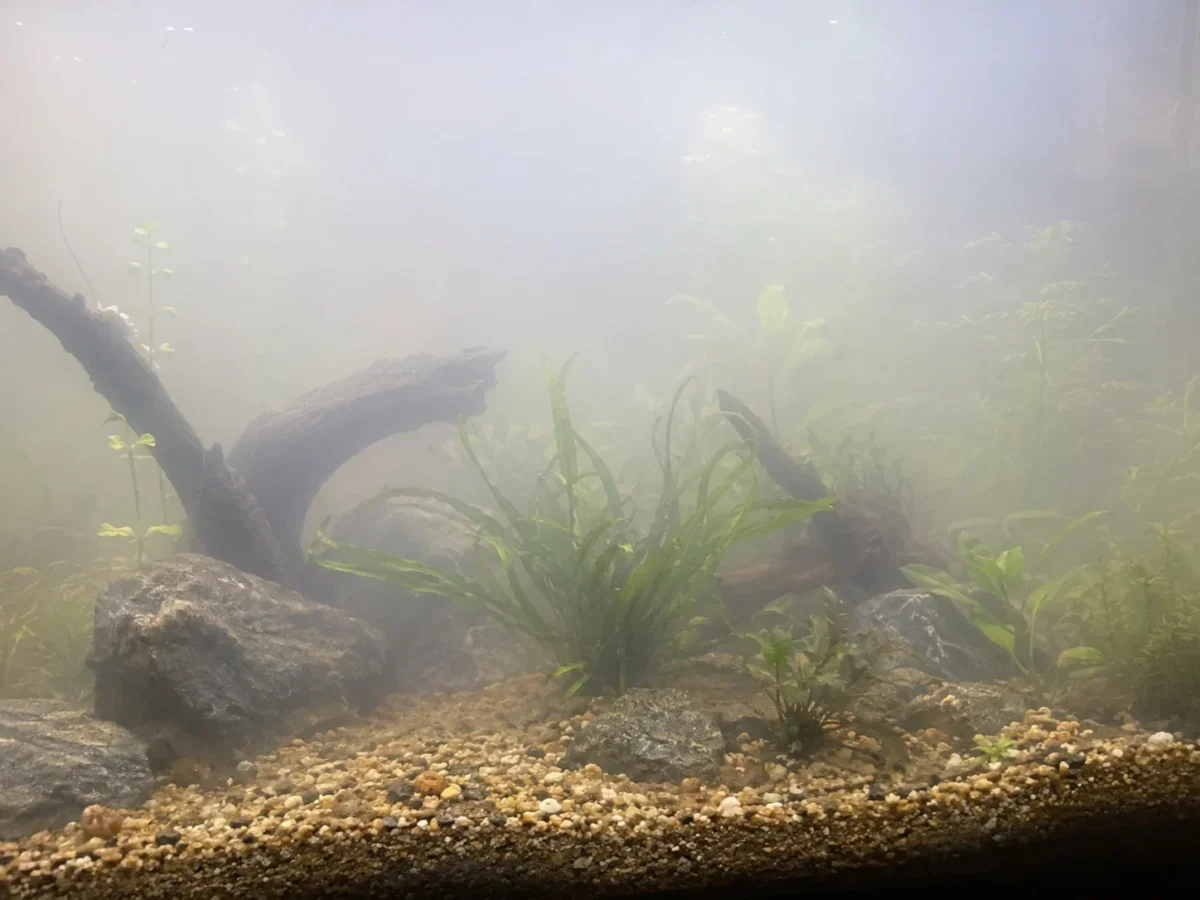
A suspended bloom of microscopic green algae that turns aquarium water uniformly green rather than coating glass, plants, or hardscape.
Save this guide or add this issue to one of your aquariums.
Need help with Green Water?
Explore compatibility, care or problems using this guide and your aquarium’s conditions.
Identification
- Main color
- Light green, green, and yellow green
- Growth form
- Bloom
- Typical surfaces
- Water column
- Behavior
- Clouds water
- Diagnostic confidence
- High
- Light-green haze to dense pea-green water with reduced visibility throughout the aquarium; the color is in the water column itself rather than a wipeable coating on glass.
- Uniform green water with clean underlying glass is a strong practical Green Water diagnosis, although exact phytoplankton taxa cannot be determined from appearance alone.
Probably not this algae if…
- Bacterial Bloom produces white, milky, or pale-gray haze rather than distinctly green water.
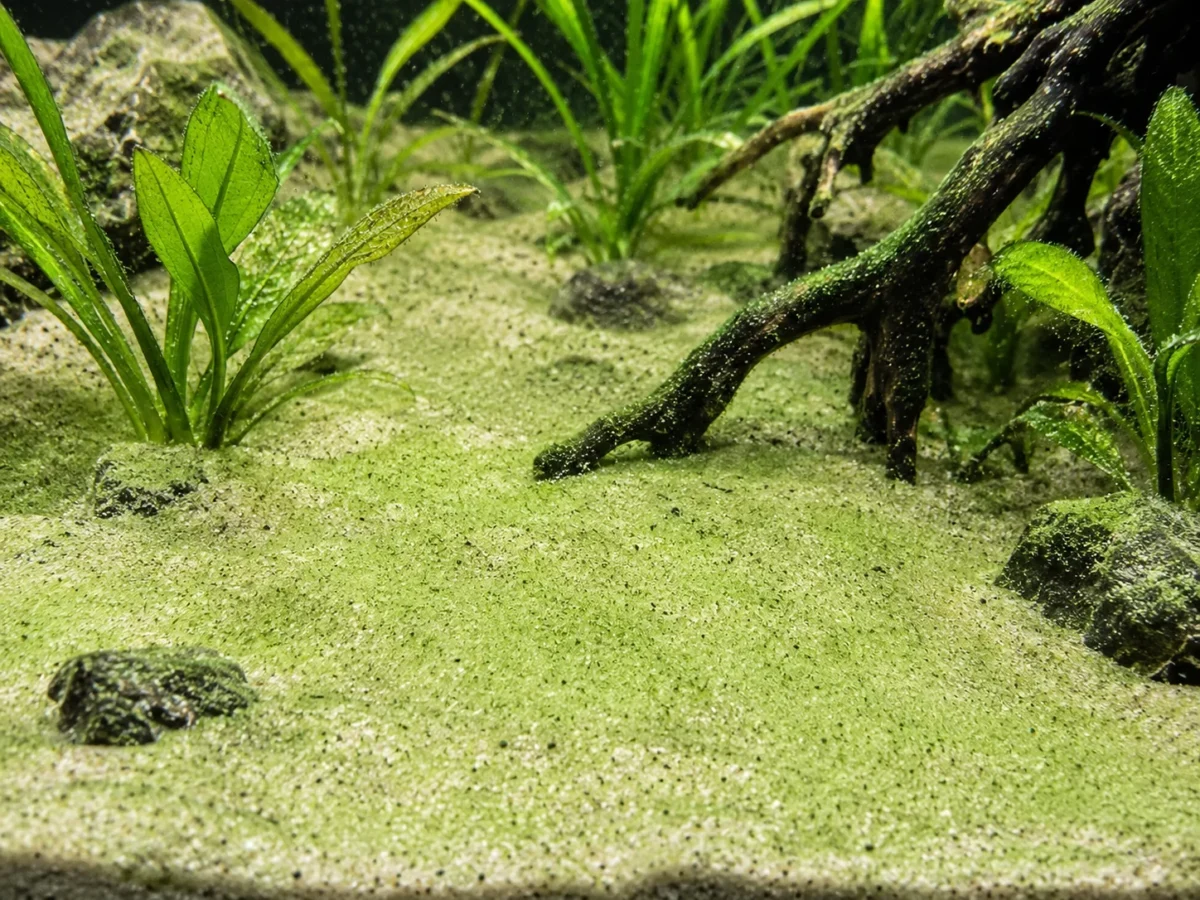
- GDA is attached primarily to glass and wipes off.
- Tannins produce yellow, amber, tea-brown, or brown coloration rather than an opaque green bloom.
Your fix plan
Today
- Confirm that the water itself is green.
- Remove direct sunlight or clearly excessive light.
- Maintain strong gas exchange.
This week
- Eliminate direct sunlight and return lighting to a reasonable intensity/duration.
Keep it away
- Limit direct sunlight and excessive photoperiod.
- Avoid large organic/nutrient-loading events.
- Maintain appropriate feeding and filtration.
Causes
Green Water develops when free-floating photosynthetic microorganisms gain enough light and resources to reproduce faster than the aquarium suppresses them; direct sunlight, high light pressure, nutrient/organic events, and immature biology are common contributors.
- Strong light and especially direct sunlight can support rapid phytoplankton growth.
- Available water-column nutrients support bloom growth, but no single nitrate or phosphate threshold defines Green Water.
- Young or recently disturbed aquariums can provide a temporary ecological opportunity for suspended algae.
- Organic-loading or ammonia events are common aquarium associations, especially in immature systems, but an ammonia spike is not required.
What to check
- View water in a clear container against a white background to distinguish green water from a coating on the glass.
- Check direct sunlight, feeding changes, ammonia and nitrite; watch livestock breathing.
Nutrient guidance
- Relevance: Medium
- Excess nutrient availability can support phytoplankton, but no single nitrate or phosphate threshold diagnoses Green Water.
- Correct documented overfeeding, decay, accidental fertilizer overdosing, or ammonia problems while keeping plant nutrition appropriate and stable.
Treatment options
- Fish
- Context dependent
- Invertebrates
- Context dependent
- Plants
- Context dependent
- Aquarium system
- Context dependent
Reduce the light and source conditions supporting the bloom. UV-C is a strong situational tool for persistent/dense Green Water because the target algae is suspended; blackout is another practical option. Repeated water changes alone often fail when cells reproduce rapidly.
Lighting adjustment
First lineEliminate direct sunlight and return lighting to a reasonable intensity/duration.
Best for: Aquariums receiving direct sunlight, excessive intensity, or an unnecessarily long photoperiod.
Details and cautions
Not for: Assuming light reduction alone will immediately clear a dense bloom.
Limitations: Existing phytoplankton may remain abundant after the light driver is corrected.
Plants caution: Avoid unnecessarily prolonged severe light reduction.
Observation
SituationalMonitor while the system stabilizes instead of escalating solely for a light green tint.
Best for: A light new-tank haze with normal livestock, adequate gas exchange, safe ammonia/nitrite, and an obvious corrected trigger.
Details and cautions
Not for: Dense persistent blooms, livestock respiratory stress, unsafe water quality, or uncertain diagnosis.
Limitations: There is no reliable universal deadline for spontaneous clearing.
Fish caution: Escalate if respiratory behavior changes.
Invertebrates caution: Escalate if abnormal behavior suggests oxygen/water-quality stress.
System caution: Continue water-quality monitoring.
UV-C treatment
SituationalUse a correctly sized UV-C unit at the specified flow for algae control.
Best for: Persistent or dense Green Water where rapid clarification is desired.
Details and cautions
Not for: Using UV instead of correcting sunlight, overfeeding, or water-quality problems.
Limitations: UV only acts on organisms passing through the chamber and does not correct the bloom source.
Plants caution: Follow equipment/fertilizer guidance where continuous UV may affect additives.
System caution: Effectiveness depends on dose, lamp condition, chamber design, flow, and water clarity.
Blackout
SituationalUse complete temporary light exclusion and maintain good aeration.
Best for: Established Green Water where temporary darkness is practical.
Details and cautions
Not for: Light-sensitive planted displays or situations where oxygenation cannot be maintained.
Limitations: Does not prevent recurrence if source conditions remain.
Fish caution: Maintain oxygenation as biomass dies.
Invertebrates caution: Maintain oxygenation.
Plants caution: Prolonged darkness can weaken plants.
System caution: Dying biomass can increase decomposition and oxygen demand.
Organic-load reduction
SupportingRemove the avoidable organic source and return feeding/maintenance to appropriate levels.
Best for: Blooms associated with overfeeding, decay, or another obvious organic-loading event.
Details and cautions
Not for: Assuming all Green Water is caused by dirty water.
Limitations: May not immediately clear the existing suspended population.
Oxygenation
SupportingMaintain vigorous but appropriate gas exchange.
Best for: Dense blooms, warm water, blackout, bloom collapse, or livestock respiratory concern.
Details and cautions
Not for: Treating aeration as a direct algae-killing method.
Limitations: Protects livestock/system but does not remove the source.
Water change
SupportingUse water changes for real water-quality and biomass-export needs.
Best for: Actual water-quality correction, removal of dead biomass, or dilution of a documented nutrient/organic event.
Details and cautions
Not for: Repeatedly replacing large volumes solely to flush an actively reproducing bloom.
Limitations: Cells can reproduce quickly enough that water changes alone do not provide lasting control.
Invertebrates caution: Avoid unnecessary abrupt parameter swings.
Match the response to severity
- Light haze, stable aquariumWater has a mild green tint but livestock behavior and tested water quality remain normal. Correct obvious triggers and monitor before escalating solely for cosmetic reasons.
- Dense bloomVisibility is strongly reduced and water is distinctly pea-green or opaque. Use an active suspended-bloom treatment while maintaining gas exchange and correcting the trigger.
- Livestock or water-quality concernFish/invertebrates show respiratory stress, ammonia/nitrite is unsafe, or a large bloom is collapsing. Stabilize livestock and water quality first; cosmetic clearing is secondary.
If it returns and prevention
Why it returns and what to inspect
Why it may return
- Green Water can return after blackout or UV when treatment removes suspended cells but the same light/resource conditions remain.
- Direct sunlight or excessive lighting remains unchanged.
- Overfeeding, decay, or another organic source persists.
- A new aquarium remains biologically unstable.
- A nutrient or ammonia event recurs.
- Dead bloom biomass is not exported and is mineralized back into the system.
What to inspect
- Check for direct sunlight at every time of day.
- Review photoperiod and intensity.
- Check feeding, decay, and other organic sources.
- Test ammonia and nitrite in new/disturbed aquariums.
- Confirm UV flow and maintenance if UV only worked temporarily.
- What to expect
- A light bloom in a new aquarium may decline as the system matures once excessive light or an obvious trigger is corrected, but Green Water has no reliable universal self-clear timeframe.
- When observation is reasonable
- The bloom is light, livestock behavior normal, gas exchange adequate, ammonia/nitrite safe, and there is no rapid worsening.
- Investigate sooner if
- The bloom becomes dense, persists after obvious light correction, livestock shows respiratory stress, ammonia/nitrite rises, or appearance suggests another bloom. Confirm the water column itself is green rather than the glass. Check direct sunlight and photoperiod. Observe livestock respiration and behavior. Test ammonia and nitrite in new/disturbed aquariums. Ensure adequate gas exchange.
Aquarium-specific guidance and prevention
- New aquarium
- Check ammonia and nitrite rather than assuming Green Water is harmless simply because new tanks commonly experience blooms.
- Planted aquarium
- Avoid chronically starving plants to treat Green Water; correct excessive light and specific source problems while maintaining appropriate plant nutrition.
Long-term prevention
- Limit direct sunlight and excessive photoperiod, avoid large organic/nutrient-loading events, maintain appropriate feeding and filtration, and correct the source after UV or blackout to prevent recurrence.