Green Algae in a New Aquarium
Green film, fuzz or strands during aquarium startup. Identify the actual growth and check water quality before deciding whether treatment is needed.
Save this guide or add this issue to one of your aquariums.
Need help with Green Algae in a New Aquarium?
Explore compatibility, care or problems using this guide and your aquarium’s conditions.
Identification
- Main color
- Light green and green
- Growth form
- Film
- Typical surfaces
- Glass, plant leaves, and rocks, wood, and hardscape
- Diagnostic confidence
- Practical
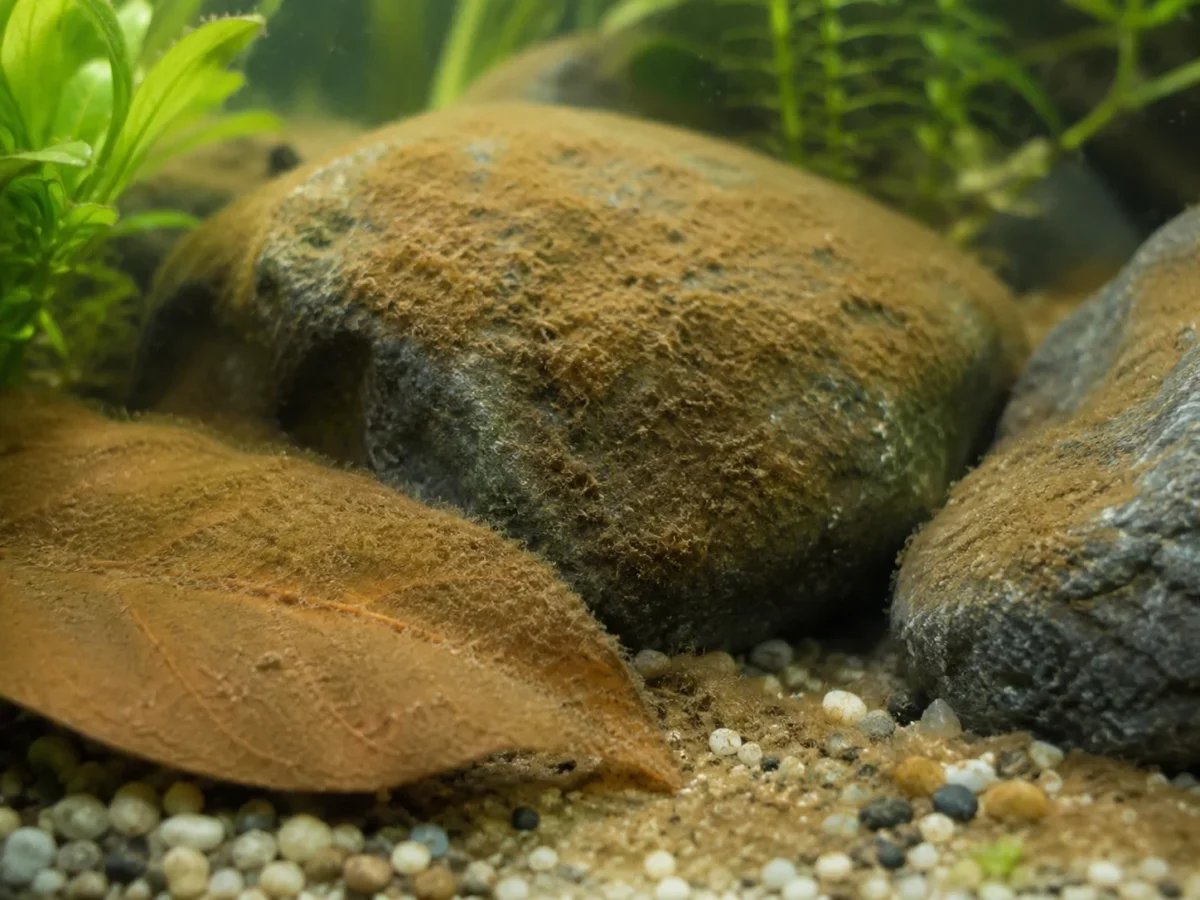
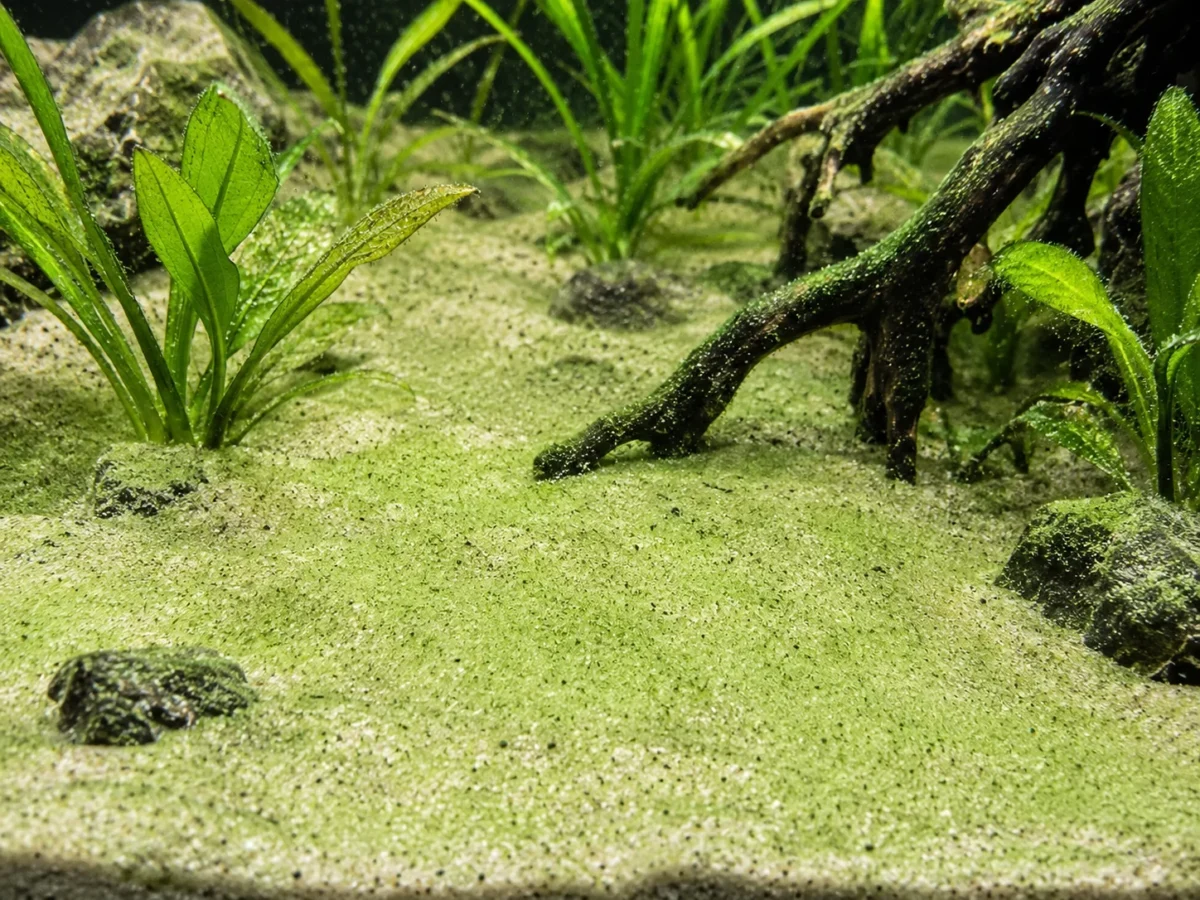
- Mixed early green surface growth in a new aquarium, often following an earlier brown-diatom phase and potentially including flat green coats, dust-like growth, short fuzz, or early filamentous algae.
- This is deliberately a context pattern rather than a biological diagnosis; visible growth should still be routed to a more specific morphology whenever possible.
Probably not this algae if…
- Brown Diatoms commonly dominate the earlier brown-coating phase.
- Flat green patina routes to Green Algae Coats.
- Loose rapidly returning green glass dust routes to GDA.
Your fix plan
Today
- Check ammonia and nitrite.
- Inspect the growth closely enough to route it to a specific algae type.
- Remove melting plant material.
This week
- Keep maintenance, feeding, lighting, and plant care measured and consistent while routing individual forms as they become identifiable.
Keep it away
- Use moderate startup lighting.
- Avoid overfeeding.
- Remove major plant melt, establish sufficient healthy plant mass.
Causes
The problem is aquarium immaturity and changing ecological opportunity rather than one organism called Mixed Green Film. Visible growth should be identified more specifically whenever possible.
- New aquariums undergo substantial microbial and ecological succession before biofilter and surface communities mature.
- Recently planted aquarium plants may still be adapting while early algae colonizes exposed surfaces.
- Brown diatoms are commonly followed by green coatings and filamentous algae during aquarium startup, although timing and exact sequence vary.
- Strong light, plant melt, organic loading, and immature biological filtration can increase nuisance growth during startup.
What to check
- Test ammonia and nitrite; visible algae is not evidence that cycling is complete.
- Identify the actual growth form before treating it: soft dust, hard spots, short fuzz, long threads and slimy mats need different comparisons.
Treatment options
- Fish
- Context dependent
- Invertebrates
- Context dependent
- Plants
- Context dependent
- Aquarium system
- Context dependent
There is no single treatment for all green growth in a new aquarium. Check water quality, compare the visible growth with specific profiles, and use gentle cleanup where appropriate.
Observation
First lineKeep maintenance, feeding, lighting, and plant care measured and consistent while routing individual forms as they become identifiable.
Best for: Mild mixed green surface growth in a genuinely new aquarium with improving plants, normal livestock, and safe ammonia/nitrite.
Details and cautions
Not for: Livestock distress, unsafe water quality, rapid severe spread, or growth that clearly matches Cyanobacteria or another specific problem.
Limitations: New-tank context does not make every algae type harmless.
Fish caution: Do not use visible algae as proof that the aquarium has completed cycling.
Invertebrates caution: Do not add cleanup animals until water quality and species requirements are appropriate.
System caution: Continue ammonia/nitrite monitoring during startup.
Manual removal
SupportingClean accessible surfaces gently and remove melting plant material without sterilizing the system.
Best for: Light surface buildup that can be removed during ordinary maintenance.
Details and cautions
Not for: Repeatedly resetting or deep-cleaning the entire developing aquarium.
Limitations: Different algae forms may continue appearing while the aquarium matures.
Plants caution: Do not remove healthy plant mass unnecessarily.
System caution: Avoid repeatedly resetting developing biological filtration.
If it returns and prevention
Why it returns and what to inspect
- What to expect
- Algae types commonly change as a new aquarium matures, with brown diatoms often appearing before later green coatings and filamentous forms.
- When observation is reasonable
- The aquarium is genuinely new, growth is mild, plants are beginning to establish, livestock behavior is normal, and ammonia/nitrite are safe.
- Timeframe
- Specialist startup guides commonly show algae transitions over the first several weeks, but no fixed week-by-week sequence applies to every aquarium.
- Investigate sooner if
- Growth becomes slimy, foul-smelling, very rapidly spreading, heavily smothers plants, turns the whole water column green or milky, or livestock/water quality becomes abnormal. Test ammonia and nitrite. Observe livestock behavior. Identify whether growth is film, dust, fuzz, filament, slime, or water-column bloom. Remove significant plant melt or another obvious organic source. Review whether lighting is excessive for current plant mass.
Aquarium-specific guidance and prevention
- New aquarium
- Expect ecological change, but use water testing and actual morphology to decide when observation is appropriate and when a specific problem needs treatment.
Long-term prevention
- Use moderate startup lighting, avoid overfeeding, remove major plant melt, establish sufficient healthy plant mass, and allow microbial and plant communities to mature without repeated major resets.