Aquarium Lighting and Algae: Why Light Causes Algae and How to Prevent It
Introduction
Aquarium lighting and algae are closely connected, but light does not create algae on its own. In planted aquariums, lighting mistakes are one of the most common triggers behind recurring algae problems because algae exploits imbalance faster than aquarium plants do. When light intensity, photoperiod, plant mass, CO₂ availability, and tank stability do not match, algae takes advantage of the gap.
That is why two aquariums can use similar lighting and show completely different results. One grows clean, healthy plants. The other develops green dust on the glass, hair algae on hardscape, or black beard algae on leaf edges. The difference is rarely the fixture alone. It is usually the way the whole system responds to the amount of energy the light delivers.
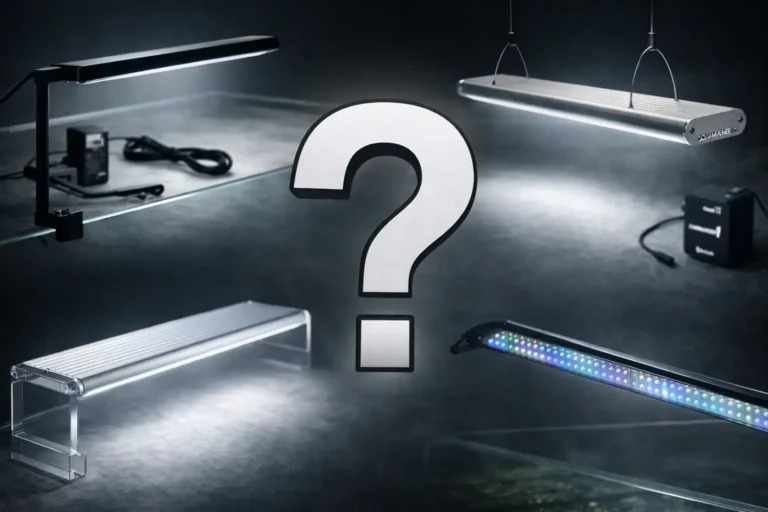
This lesson explains how aquarium lighting influences algae growth, which lighting mistakes most often trigger outbreaks, and how to correct them without restarting the tank. If you want the broader foundation behind fixture types, intensity, and setup planning, read our Aquarium Lighting Guide.
What you’ll learn in this lesson
- Why aquarium lighting and algae are closely connected in planted tanks
- Which lighting mistakes most often trigger algae in aquariums
- Why light must always match CO₂, nutrients, and plant mass
- How to recognize algae patterns that point to lighting-related instability
- What safe PAR ranges can reduce algae risk
- How to fix lighting problems without tearing the aquarium down
Why Algae Grow in Aquariums
Algae are not invaders from nowhere. They are part of the normal biology of freshwater systems. In practical aquarium terms, that means every tank already contains the potential for algae growth. The real question is not whether algae exists, but whether conditions allow it to dominate.
Algae as natural primary producers
Like aquatic plants, algae uses light to drive photosynthesis. It responds quickly to available energy, especially when the system has unused nutrients, unstable carbon availability, weak plant competition, or excess illumination. This is why algae often behaves like a symptom rather than a root problem. It reveals that the tank is receiving more energy than its higher plants can use cleanly.
Competition between plants and algae
Healthy plants are your best long-term algae prevention tool. Fast, stable plant growth absorbs nutrients, occupies space, and consumes the light energy that algae would otherwise exploit. When plant growth is slow, inconsistent, shaded, or carbon-limited, algae becomes the more efficient competitor. This is especially common in newly set up tanks, lightly planted layouts, and aquariums where the light was upgraded without adjusting the rest of the system.
This is why the same fixture can produce completely different results from one tank to another. The light itself is not always the problem. The real issue is whether the aquarium can use that energy in a stable and plant-dominant way.
Key principle: algae usually appears where energy exceeds biological control. In planted aquariums, that energy is most often light.
How Lighting Influences Algae Growth in Aquariums
Light is the energy source that drives photosynthesis. In a planted aquarium, that energy should support healthy plant growth. But algae uses light too, and it often reacts faster than higher plants when conditions become unstable. That is why lighting mistakes are so often visible as algae before aquarists fully understand what went wrong.
Photosynthesis works for plants and algae
Aquarium plants need light to grow, repair tissue, and build biomass. Algae also uses light to grow, but it has a much lower threshold for taking advantage of a weak system. It does not need a well-balanced aquascape. It only needs an opening, such as excess light, unstable CO₂, poor plant growth, or an immature tank.
This is why a strong light is not automatically a problem. The risk begins when the aquarium cannot support the growth demand that light creates. Stronger light raises the pace of the system. If the rest of the aquarium cannot keep up, algae often steps in first.
Why algae often responds faster than plants
Plants, especially in new tanks or low-tech layouts, take time to adapt. They need to root, establish themselves, and begin stable growth. Algae does not wait for that process. If the light is too intense or on for too long during this unstable period, algae can colonize glass, wood, rocks, and older leaves long before the plants are fully established.
This is one of the main reasons hobbyists say, “I upgraded my light and suddenly got algae.” The new fixture did not create algae on its own. It exposed a system that was not yet ready to handle the increased energy.
If you want a broader explanation of aquarium light intensity and fixture planning, see the Aquarium Lighting Guide.
[al_callout title=”Aquarium Lighting Calculator” text=”Use the Aquarium Lighting Calculator to estimate PAR, Lux, and photoperiod based on your tank dimensions and plant demand.” url=”https://aquariumlesson.com/tools/aquarium-lighting-calculator/” button=”Open Calculator”]The Most Common Aquarium Lighting Mistakes
Most algae problems caused by lighting come from a small number of repeated mistakes. Some are obvious, such as leaving the light on too long. Others are more subtle, such as using a strong planted-tank light over a low-tech aquarium with very little plant mass.
Too much light intensity
This is the most common mistake. Many aquarists assume that more light will always improve plant growth. In reality, more light only helps if the aquarium can support the increased demand. If high PAR is pushed into a system with unstable CO₂, weak plant mass, or inconsistent nutrients, algae often appears first on exposed surfaces.
Common signs include green dust algae on the glass, green spot algae on rocks, and thread algae in the brightest parts of the tank. Strong light alone is not always the problem. Strong light without matching support usually is.
Lights on for too many hours
Photoperiod mistakes are just as common as intensity mistakes. Many hobbyists keep their lights on for 10 to 12 hours because they want to enjoy the aquarium longer. Plants do not need endless exposure. In many cases, that long schedule adds more energy than the system can use cleanly, and algae takes advantage of the excess.
For many planted aquariums, 6 to 8 hours is a safer and more stable starting point. Longer schedules can work in mature, well-balanced tanks, but they are often a bad idea in beginner setups, low-tech tanks, or newly planted layouts.
Lighting that is too strong for a low-tech tank
Low-tech aquariums work because they stay within a manageable range. They usually rely on moderate light, slower growth, and simpler stability. When a strong high-output LED is used over a low-tech system, the aquarium may be pushed beyond what it can realistically support. The result is often stalled plants and opportunistic algae.
Many aquarists buy a premium light and assume they should use maximum output. In low-tech tanks, the smarter move is often to run the fixture at a lower percentage and keep the photoperiod controlled.
Upgrading light without adjusting CO₂ and maintenance
A stronger fixture changes the entire tank. It increases demand for CO₂ stability, nutrient consistency, trimming, circulation, and regular maintenance. If you upgrade the light but keep the same weak CO₂ delivery, poor flow, or inconsistent water change routine, algae often appears soon after.
This is why a light upgrade should never be treated as a standalone change. It is a system upgrade, not just an equipment upgrade.
Using powerful lighting on a new tank
Fresh aquariums are biologically unstable. Plants are adjusting, substrates may release nutrients, and microbial systems are still immature. This is the worst time to run high intensity for long hours. New layouts benefit from restraint: moderate light, shorter photoperiods, frequent observation, and strong maintenance discipline.
Frequent water changes are especially important during this phase. For the maintenance side of that strategy, see our Aquarium Water Change Guide.
Direct sunlight hitting the aquarium
Sunlight adds energy that many aquarists underestimate. Even indirect sunlight can create bright zones and encourage algae on the viewing panes or hardscape facing the window. If the tank receives uncontrolled natural light, your carefully planned fixture schedule may not be the full story.
This is especially relevant in nano aquariums, shallow tanks, and layouts positioned near bright windows.
Lighting Mistakes That Most Aquarists Don’t Realize
Some of the most frustrating algae problems come from lighting issues that do not look obvious at first. The fixture may seem appropriate on paper, yet the way light is distributed or changed over time still creates instability inside the aquarium.
Incorrect PAR distribution
Average light output is not the same as even light output. Many aquariums have hotspots in the center, dim zones in the corners, and shadowed sections under hardscape. This uneven distribution can create one part of the tank that is overexposed and another part that is starved. Plants respond inconsistently, and algae can appear only in specific zones.
If algae repeatedly shows up in the same bright area while shaded plants struggle elsewhere, the issue may be distribution rather than average power.
Too little plant mass for the light level
Aquascapes with heavy hardscape and limited plant biomass are especially vulnerable to this mistake. If you run strong lighting over a layout with lots of rock, wood, and open substrate but very little active plant growth, the light energy is not being used effectively. Algae can exploit that imbalance.
This is particularly common in newly built layouts and minimalist hardscape-driven tanks. For the design side of layout structure, see our Aquarium Hardscape Guide.
Sudden intensity changes
Plants do not adapt instantly. If light output is raised sharply from one day to the next, algae may react faster than the plants do. This often happens when hobbyists move from a weak light to a strong LED, extend the schedule too quickly, or push all channels much higher after reading that more light improves color.
Lighting changes should be gradual. Small increases followed by observation are far safer than sudden jumps.
Running RGB channels at maximum
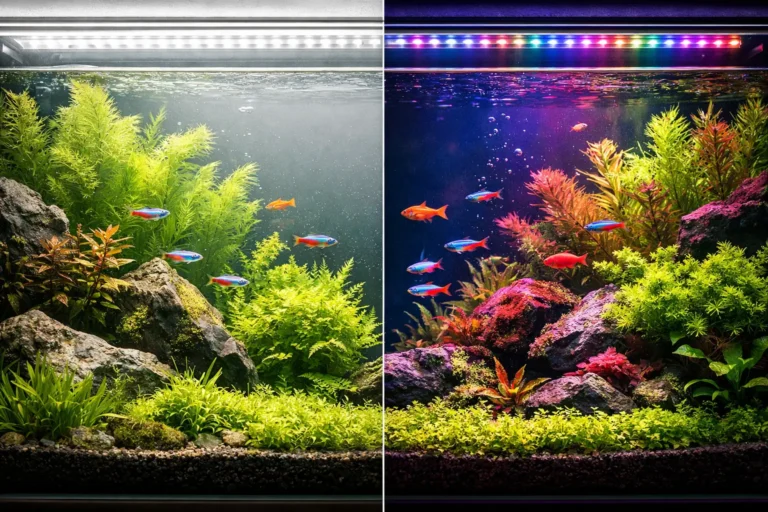
Many modern RGB aquarium lights make plants look vivid and colorful, but that visual appeal often tempts aquarists to run every channel too high. The result is not that RGB itself causes algae. The real problem is excessive total intensity and poor control.
Visual brightness is not a reliable way to judge usable plant light. A tank can look attractive while still receiving more intensity than it can manage.
Fixture mounted too close to the water
Mounting height affects both spread and intensity. A light placed too close to the water surface can create harsh hotspots and an uneven distribution pattern. In many tanks, raising the fixture slightly improves spread and reduces local algae pressure without requiring a major reduction in output.
The Light–CO₂–Nutrient Balance Explained
If there is one concept that prevents more algae problems than any other, it is this: light does not work alone. It is only one part of the planted tank equation. The other major parts are carbon availability and nutrient support.
Light sets the pace
The brighter the light, the faster the plants are expected to grow. That sounds good, but it also means every weakness becomes more visible. Poor circulation, nutrient inconsistency, low plant mass, or lazy maintenance are all amplified by strong light.
CO₂ supports the demand
In medium- and high-energy tanks, unstable CO₂ is one of the most common reasons algae appears after lighting increases. Plants are asked to grow faster, but their carbon supply is not consistent enough to support that pace. This weakens plant performance and gives algae an opening.
For a deeper breakdown of carbon management, read our CO₂ System Guide.
Nutrients must remain available
Reducing nutrients is not always the cure for algae. In many planted aquariums, plants perform worse under strong light when nutrients are inconsistent or insufficient. Weak plant growth under high demand is exactly the type of instability algae exploits.
| Factor | Role in the tank | What happens when it falls behind |
|---|---|---|
| Light | Drives growth demand | Too much demand exposes system weakness |
| CO₂ | Supports faster metabolism | Plants stall and algae gains ground |
| Nutrients | Enable stable plant growth | Deficiencies weaken competition against algae |
For the plant nutrition side, see our Aquarium Plants Guide.
PAR Levels That Help Prevent Algae
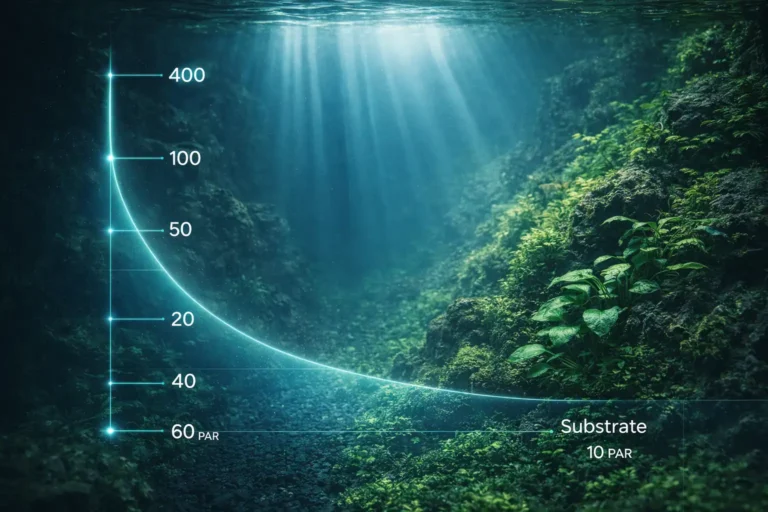
PAR is one of the most useful ways to think about algae risk because it moves the discussion away from vague terms like bright or dim. These ranges are not rigid rules, but they are practical working targets for many planted aquariums.
| Setup | Recommended PAR | General algae risk pattern |
|---|---|---|
| Low-tech planted tank | 20–40 PAR | Usually manageable when the photoperiod is controlled |
| Moderate planted tank | 40–70 PAR | Good balance when maintenance and plant growth are stable |
| High-tech CO₂ aquascape | 70–120 PAR | High reward, but very sensitive to instability |
Many algae-prone tanks are simply operated above their real support capacity. A low-tech aquarium does not usually improve because it receives 90 PAR at the substrate. It usually becomes more demanding and less stable.
Use the Aquarium Lighting Calculator to estimate whether your setup is running in a realistic range.
Light Spectrum and Algae
Spectrum is one of the most misunderstood parts of aquarium algae discussions. Many users ask whether blue light causes algae or whether red channels are dangerous. In practice, spectrum matters less than intensity, duration, and overall system balance. A balanced modern LED does not automatically create algae just because it includes blue, red, or RGB output.
Do blue and red LEDs cause algae?
Blue and red wavelengths can absolutely drive photosynthetic organisms, but that includes both plants and algae. The real issue is not the existence of those wavelengths. It is whether the total energy delivered is excessive for the tank. Blaming spectrum alone is often a distraction from more meaningful corrections such as reducing intensity or shortening the schedule.
How modern aquarium LEDs affect algae
Modern LEDs are powerful, efficient, and highly adjustable. That is excellent for aquascaping, but it also means many tanks are unintentionally overpowered. A user may run a premium RGB light at settings that look visually modest while still supplying far more plant-usable energy than expected. Good hardware does not prevent algae by itself. It simply gives you better control.
Balanced spectrum for plant growth
If you want a deeper comparison of fixture types, that belongs in a dedicated article about white versus RGB aquarium lights. For algae control, the main takeaway is simpler: choose a quality fixture, then manage the variables that matter most — output level, photoperiod, tank depth, plant demand, and system stability.
How to Diagnose Algae Based on Lighting
Algae type does not always point to only one cause, but lighting patterns can still offer useful clues. The goal is not to oversimplify diagnosis. It is to identify the most likely direction before making changes.
| Algae Type | Common lighting pattern | Typical supporting issue |
|---|---|---|
| Green spot algae | Strong light on slow surfaces | Long photoperiod, slow-growing leaves, exposed hardscape |
| Hair algae | Strong or unstable light | Fluctuating CO₂, stalled plant growth |
| Black beard algae | Light combined with instability | CO₂ inconsistency, poor flow, dirty zones |
| Green dust algae | Excess exposure on glass and upper surfaces | High intensity, immature tank, overlong schedule |
| Diatoms | Often seen in weak, immature systems | New tank instability, low competition from plants |
Look for pattern, not just algae type. Ask where the algae appears first, whether it started after a lighting change, and whether it is strongest in the brightest part of the layout. Those clues are often more valuable than the algae label itself.
Warning Signs Your Lighting Is Causing Algae
Most aquariums do not jump from perfectly clean to heavily overrun overnight. They usually show warning signs first. Recognizing those early signals is one of the most valuable practical skills in algae prevention.
Algae appearing after a lighting upgrade
If algae shows up shortly after increasing brightness, extending the schedule, changing fixtures, or moving to a stronger RGB light, the change itself is your primary clue. Do not ignore timing. In aquarium troubleshooting, the thing that changed most recently often matters most.
Fast algae growth on glass
When glass films return quickly after cleaning, the system is often receiving more light than the plants are productively using. That does not always mean you need a weaker lamp, but it often means the total daily light dose should be reconsidered.
Algae on slow-growing plants
Anubias, Java Fern, Bucephalandra, mosses, and other slower plants are excellent indicators. Because they grow more slowly, they reveal overexposure earlier than fast stems do. If these plants collect persistent algae while the tank is brightly lit, the lighting may simply be too aggressive for the plant profile in the aquarium.
Seasonal changes with no obvious equipment change
If algae appears “for no reason,” check the room and the calendar, not just the tank. Seasonal light changes can alter window exposure, ambient brightness, and even heat gain. A planted aquarium that was stable in winter may become algae-prone in spring if natural light conditions shift while the artificial schedule stays the same.
How to Fix Lighting Problems Without Restarting the Tank
Most lighting-related algae problems can be corrected without tearing the tank down. The key is to make measured changes in the right order rather than reacting with several drastic adjustments at once.
Reduce the photoperiod first
If the light is on too long, shorten the schedule first. This is usually the easiest and safest correction because it reduces total energy without changing distribution or forcing new equipment decisions.
Lower intensity if the tank still looks overstressed
If algae pressure remains high, reduce output or raise the fixture slightly. Aim for a calmer and more realistic demand level instead of guessing by appearance alone.
Increase plant competition
Add fast-growing stems, floating plants, or more overall plant mass if the tank is too sparse. More active growth gives the system a better chance to use available light productively.
Stabilize CO₂ and circulation
If your aquarium uses injected CO₂, consistency matters more than occasional high output. If it does not use CO₂, the light must remain realistic for that limitation. Flow matters too, because even good CO₂ injection fails when distribution is poor.
Support the correction with maintenance
Manual algae removal, glass cleaning, trimming damaged leaves, and regular water changes help reset the aquarium while the corrected lighting strategy begins to work. Maintenance is not separate from the fix. It is part of the fix.
Ideal Lighting Schedules for Different Aquariums
There is no universal schedule that works for every tank. A realistic photoperiod depends on maturity, plant mass, energy level, and how stable the aquarium is overall.
Low-tech tanks
Most low-tech setups do best with a conservative range of around 6 to 8 hours. Stability matters more than pushing fast growth.
CO₂ aquascapes
High-energy planted tanks can handle stronger lighting, but only if the rest of the system is managed tightly. Even then, many successful aquascapes still use a controlled rather than excessive schedule.
Shrimp aquariums
Shrimp tanks often rely on mosses, epiphytes, and slow-growing plants. They rarely need strong lighting. Gentle, predictable output is usually the better choice.
Nano aquariums
Nano tanks respond quickly to small mistakes. A slight excess in intensity or sunlight exposure can turn into visible algae faster than in larger aquariums, so conservative schedules are especially important.
Advanced Lighting Strategies Used by Aquascapers
Experienced aquascapers do not simply buy stronger lights. They manage them more precisely. That control is often what separates a clean, high-energy layout from one that constantly slides into algae.
Ramp lighting
Gradual ramp-up and ramp-down periods can reduce abrupt intensity changes and make strong fixtures easier to manage. They are not a cure for imbalance, but they can improve consistency.
Intensity tuning
Advanced users treat light as a variable to tune, not a number to maximize. They use only the amount of intensity needed to achieve healthy growth and desired form.
PAR mapping
Instead of assuming the tank is evenly lit, they think in zones. Foreground plants, shaded epiphytes, and tall background stems do not always receive the same usable intensity. This explains many local algae problems.
Lighting Setup Checklist
- Is your photoperiod longer than 8 hours?
- Did algae appear after increasing fixture output?
- Did the problem begin after a light upgrade?
- Does your tank have low plant mass for the amount of light used?
- Are slow-growing plants or hardscape receiving direct hotspots?
- Is the aquarium still new and biologically unstable?
- Does the tank receive direct or indirect sunlight from a window?
- Have seasonal light changes altered the room exposure?
- Are CO₂ delivery and circulation consistent enough for the light level?
- Is algae strongest on the brightest side of the layout?
- Have you changed multiple lighting variables at once?
If several of these apply, your lighting strategy is very likely contributing to the algae problem.
FAQ
Does blue light cause algae in aquariums?
Blue light alone is usually not the real cause. In most planted tanks, algae appears because total light intensity or photoperiod is too high for the tank’s balance.
Can aquarium lights be on for 12 hours?
For many planted aquariums, 12 hours is excessive. It often adds more energy than the system can use cleanly and increases algae risk.
Does sunlight cause algae in aquariums?
Yes. Direct or repeated indirect sunlight adds uncontrolled exposure and can worsen algae even if the artificial lighting schedule seems reasonable.
Do I need CO₂ if I use a strong planted-tank light?
Not every aquarium needs injected CO₂, but stronger lighting increases the risk of imbalance if carbon availability cannot match the demand.
Why did algae appear after I upgraded my aquarium light?
The new light probably increased plant demand faster than your system could support it. CO₂, circulation, plant mass, nutrients, and maintenance may all need adjustment.
How do I know if my aquarium light is too strong?
Common signs include algae forming on bright surfaces, stalled plant growth despite strong lighting, and problems that begin after raising output or moving the fixture closer to the water.
Can low light also cause algae?
Yes. Very weak light can slow plant growth so much that algae still gains an advantage, especially in unstable or newly set up tanks.
Does RGB light cause more algae than white light?
Not necessarily. RGB lighting does not automatically cause more algae. The more important factors are total intensity, photoperiod, and whether the aquarium can biologically support the energy delivered.
Conclusion
Aquarium lighting and algae are linked through balance, not blame. Aquarium lighting mistakes cause algae when they push the system beyond what its plants and support structure can handle. Too much intensity, overly long photoperiods, uncontrolled sunlight, seasonal exposure changes, and abrupt upgrades are all common triggers. But the deeper pattern is always the same: more energy than the aquarium can convert into stable plant growth.
The solution is not to fear light. The solution is to match light to the real capacity of the tank. Keep the photoperiod controlled, use realistic output, increase plant competition, maintain stable CO₂ when used, and make changes gradually. When light supports plant dominance instead of overwhelming it, algae loses its advantage.
Want a safer lighting setup?
Use the Aquarium Lighting Calculator to estimate PAR, Lux, and photoperiod before increasing intensity.
New to AquariumLesson? Start with our complete Aquarium Lessons Hub or return to the homepage at AquariumLesson.com.