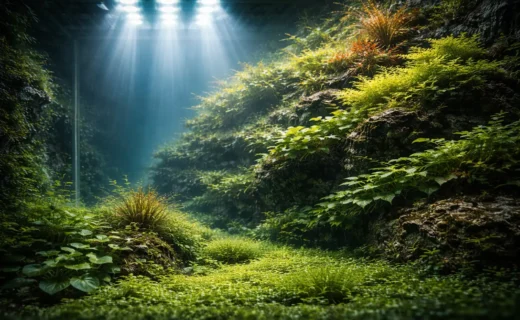
Aquarium Lighting for Deep Tanks: How to Grow Plants in Tall Aquariums
Aquarium Lighting for Deep Tanks is one of the most overlooked challenges in planted tank design. As aquarium depth increases, usable light drops significantly before it reaches the substrate, which makes plant growth much harder in tall aquariums.
This is why deep planted aquariums often struggle in a very predictable way: plants near the surface may grow well, while foreground plants stay weak, carpeting plants fail to spread, and shaded areas become increasingly vulnerable to algae. In most cases, the problem is not that the aquascaper chose the “wrong plants” — it is that not enough usable light reaches the bottom of the tank.
This guide focuses specifically on that problem. Instead of repeating general aquarium lighting basics, it explains how depth changes light performance, what PAR targets make sense in tall aquariums, how to position fixtures more intelligently, and how to choose plants and layouts that work with deep-tank conditions.
What you’ll learn in this lesson
- Why deep aquariums are harder to light than shallow tanks
- How light intensity decreases with water depth
- Recommended substrate PAR levels for tall aquariums
- Which lighting setups work best for deep planted tanks
- How to choose plants and layouts that match depth-related light loss
- How to measure, estimate, and optimize lighting performance
Why Deep Aquariums Are Harder to Light
Deep aquariums create a simple but important challenge: the distance between the light source and the plant leaves becomes much greater. In a shallow aquarium, light travels only a short distance before reaching the foreground. In a tall aquarium, that same light must travel through much more water before it reaches the substrate.
That extra distance matters because planted tanks do not respond to light at the water surface — they respond to the usable light that actually reaches the leaves. If the light is strong near the top but weak near the bottom, the aquarium may still look bright to your eyes while plants on the substrate remain underlit.
Several factors work together here. First, intensity naturally decreases with distance from the fixture. Second, water absorbs and scatters part of the light on its way downward. Third, deep aquariums often include large hardscape, thick substrate slopes, floating plants, or dense stems that create additional shading. All of this means that tall aquariums require more deliberate lighting strategy than standard shallow tanks.
If you want the broader foundation behind aquarium light intensity, fixture categories, and plant demand, see the Aquarium Lighting Guide. This lesson focuses specifically on how those principles change once aquarium depth becomes the limiting factor.
How Light Intensity Decreases With Depth
The biggest mistake aquarists make with tall tanks is assuming that a fixture that looks bright at the surface must also be strong enough at the substrate. In reality, light loss happens progressively as the distance through water increases.
Some of that loss is caused simply by distance. As light spreads away from its source, intensity becomes less concentrated. In addition, water itself absorbs part of the light energy. Clear water performs better than stained water, but even in a clean tank the intensity at the bottom will always be lower than near the top.
Scattering is another important factor. Surface movement, suspended particles, fine debris, tannins, and microbubbles all reduce the efficiency of light penetration. In a deep aquarium, small losses add up quickly because the light has a longer path to travel before it reaches carpeting plants or low-growing foreground species.
A simple example makes this easier to visualize. A fixture may create 60 PAR close to the upper zone of the tank, but only around 35 PAR in the middle and 15 to 20 PAR at the substrate. That difference is often the reason why stem plants near the top look healthy while carpets or short foreground plants remain weak or melt away.
| Tank Zone | Example PAR |
|---|---|
| Upper zone / near surface | 60 PAR |
| Mid tank | 35 PAR |
| Substrate | 15–20 PAR |
This is why deep tanks must always be evaluated from the bottom up. The important question is not “How bright is my light?” but rather “How much usable PAR reaches the plants that need it most?”
Recommended PAR Levels for Deep Aquariums
For deep tanks, PAR should be judged at the substrate rather than at the water surface. This is especially important for foreground plants, carpets, and compact layouts where the most demanding leaves sit furthest away from the light source.
The following ranges are useful practical targets for planted aquariums. They are not rigid rules, but they provide a realistic starting point when depth becomes a limiting factor.
| Tank Depth | Low-Tech Setup | Medium Light | High Light |
|---|---|---|---|
| 30 cm | 15–20 PAR | 25–35 PAR | 40+ PAR |
| 45 cm | 20–30 PAR | 35–45 PAR | 50+ PAR |
| 60 cm | 25–35 PAR | 40–55 PAR | 60+ PAR |
| 75 cm | 30–40 PAR | 50–65 PAR | 70+ PAR |
These numbers describe PAR where the plants actually grow, not what the fixture produces above the tank. A tall low-tech aquarium may still succeed with modest substrate PAR if the plant selection is conservative. By contrast, a deep tank with carpeting plants, red stems, or compact foreground composition often needs significantly higher intensity and much tighter system control.
Depth also has to be interpreted realistically. A tank listed as 60 cm high may behave more like a 65–70 cm system once you account for the mounting height above the water and the actual distance down to the leaves. On the other hand, a thick substrate slope can bring plants slightly closer to the light, which partly offsets the effective depth.
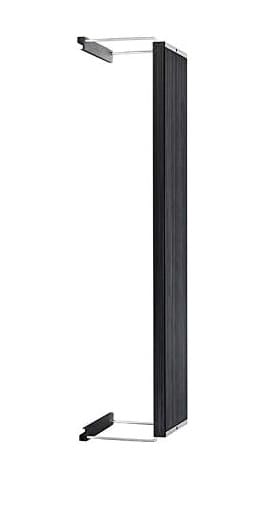
High-output planted tank fixtures can be especially useful here because they give you enough headroom to maintain workable substrate PAR in taller layouts while still allowing dimming and fine adjustment.
Best Lighting Types for Deep Tanks
Deep aquariums do not necessarily require exotic technology, but they do require fixtures that can deliver enough intensity with usable spread. In practice, a few lighting approaches stand out more than others.
High-output LED systems
Modern planted aquarium LEDs are the most practical solution for most deep tanks. Good models combine strong output, controllability, and relatively efficient energy use. They also make it easier to tune intensity gradually as the aquarium matures.
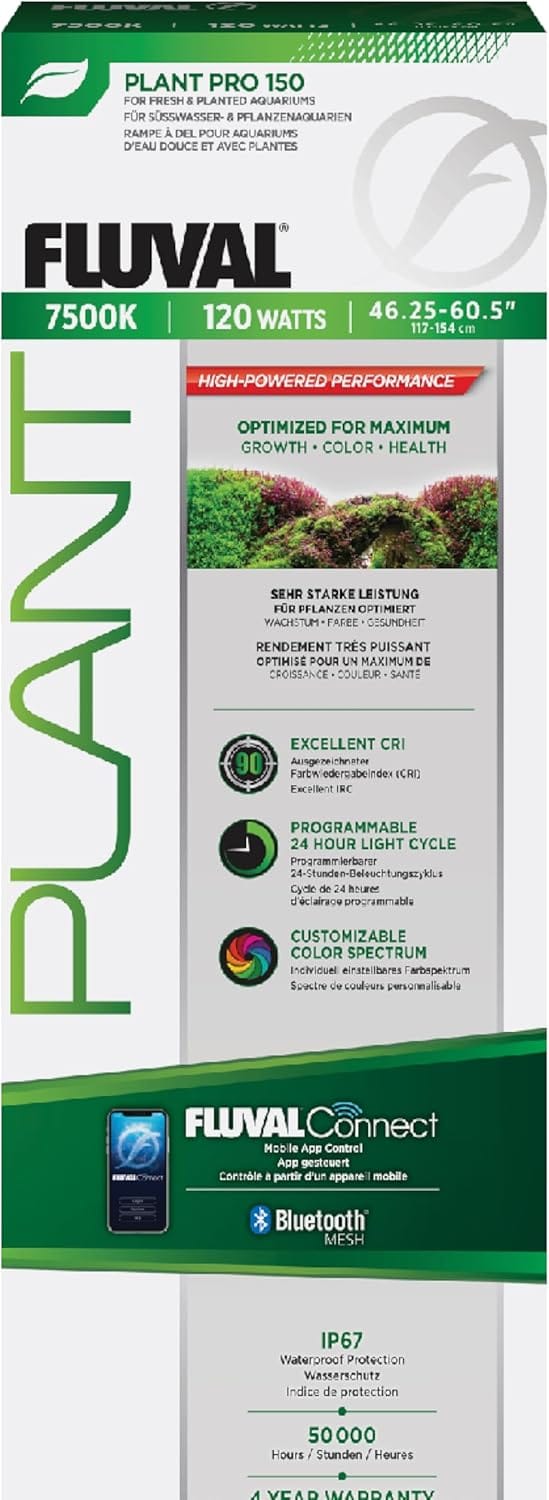
In tall aquariums, powerful LEDs are often preferable to weak fixtures running permanently at maximum. A stronger light gives more flexibility for later adjustments, especially if the tank includes demanding plants or a wide front-to-back layout.
T5 HO systems
T5 high-output lighting is less common than it used to be, but it still offers one important advantage: broad and even surface coverage. In a deep planted tank, that evenness can be helpful when you want to reduce patchy growth and strong shadow zones.
Metal halide
Metal halide lighting historically performed very well on deep aquariums because of its concentrated intensity and strong penetration. However, heat production, electricity consumption, and the convenience of modern LEDs have made halide systems far less common in planted aquariums today.
Multi-light systems
One of the most overlooked solutions for deep tanks is using multiple fixtures instead of relying on a single light. This often improves not only intensity but also distribution. Two fixtures can reduce shadowing, improve front-to-back coverage, and create a more even field of PAR across the whole scape.
That matters because deep tanks are often also wide tanks. In those cases, penetration alone is not enough — the fixture must also illuminate the layout evenly from front to back.
How to Position Lights for Deep Aquariums
Fixture power is only part of the equation. Positioning has a major influence on how much useful light actually reaches the substrate and how evenly it is distributed.
Centered mounting
A centered fixture usually creates the most balanced general spread. This is the safest default when using one light over a tall tank.
Raised mounting height
Mounting a light slightly higher above the aquarium can improve spread and reduce harsh spotlighting. This can be useful in deep tanks with strong hardscape where you want smoother coverage across the layout. However, raising the light too high may reduce raw intensity at the bottom, so this always requires balance.
Dual fixtures for better coverage
Two moderate fixtures often outperform one extreme fixture in deep, wide aquariums. They improve uniformity, soften shadowing around wood and stone, and make it easier to support plants placed across the entire scape.
Front-to-back spread matters
Many aquarists focus only on tank length, but deep layouts often fail because the front or rear planting zones remain underlit. If your aquarium has serious width and height, you need to think in three dimensions, not just in centimeters across the rim.
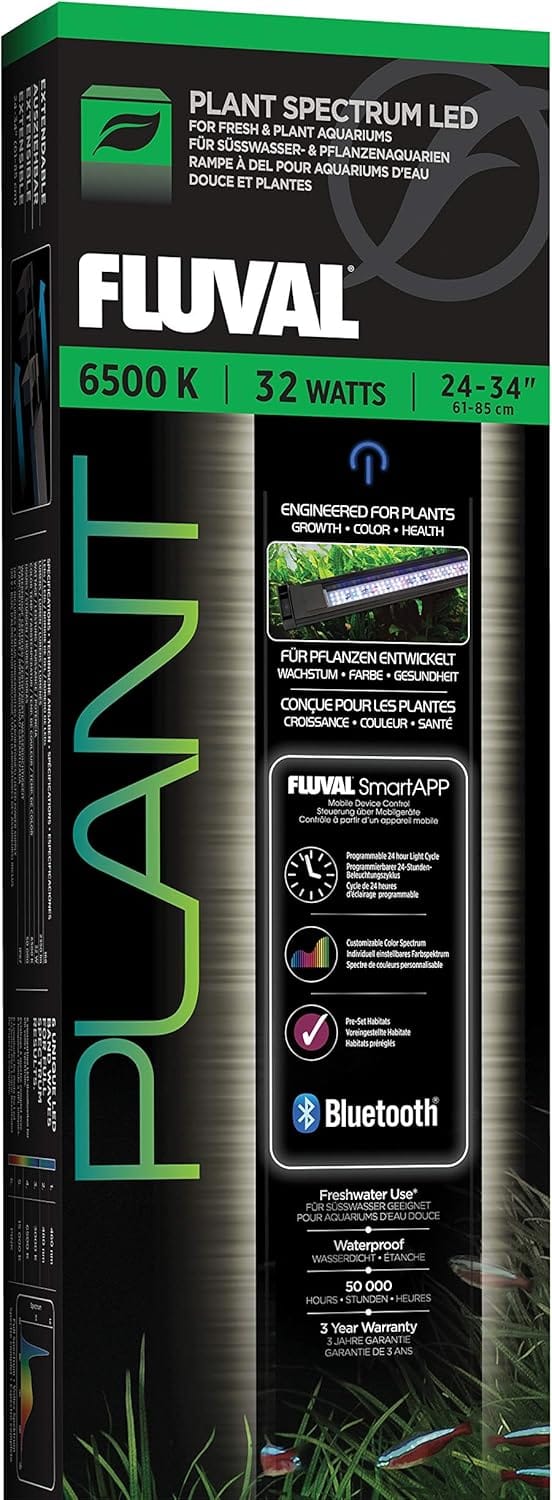
Moderate fixtures can still perform well in deeper aquariums when used intelligently, especially in pairs or on layouts built around less demanding plants.
How to Choose the Right Light for Tank Depth
As a working rule, lighting strategy should scale with aquarium depth. A shallow tank may succeed with a single moderate fixture, while a tall aquarium often needs stronger output or multiple fixtures to create comparable substrate PAR.
| Tank Depth | Typical Recommendation |
|---|---|
| Up to 40 cm | Single mid-power LED |
| 45–60 cm | Strong LED fixture |
| 60–75 cm | High-output LED or dual lights |
| 75+ cm | Multi-light system with careful layout planning |
But depth alone is not enough. The right choice also depends on substrate thickness, mounting height, the density of your hardscape, and whether you use floating plants. A tank with heavy driftwood and broad-leaf floating plants may behave like a much deeper system because so much light is intercepted before it ever reaches the foreground.
Another important point is that “more powerful” does not always mean “better” in isolation. If the plant selection is conservative and the scape is designed intelligently, a deep aquarium can succeed without chasing extreme output. The goal is not to blast the tank with light. The goal is to deliver the right PAR where the plants actually grow.
Plant Selection for Deep Tanks
Plant choice becomes much more important as aquarium depth increases. In a tall tank, the smartest strategy is usually not to force every plant category into the scape, but to select species that can realistically perform at their intended position.
For a broader overview of planting zones and category logic, see the Aquarium Plants Guide.
Easy plants for deep tanks
Shade-tolerant species are often ideal for the lower zones of a tall aquarium. Anubias, Java Fern, and many Cryptocoryne species can adapt to more modest PAR levels and still provide healthy, attractive growth when the system is stable.
Moderately demanding plants
Many stem plants and taller background species work well in deep aquariums because their upper leaves grow closer to the light. Vallisneria, Hygrophila, and similar plants often fit tall layouts naturally because they use the vertical space rather than depending entirely on strong substrate-level intensity.
Challenging plants in tall tanks
Carpeting plants are where deep aquariums become most demanding. Because these plants stay close to the substrate, they receive the weakest light in the entire aquarium. If the bottom zone does not receive enough usable PAR, carpets will struggle to spread, grow upward instead of outward, or collapse altogether.
If carpeting is part of your goal, it is worth reviewing the Aquarium Carpeting Plants guide and planning the scape around realistic substrate PAR rather than aesthetics alone.
In many deep tanks, a more realistic approach is to use epiphytes, low Cryptocoryne groups, or textured foreground transitions instead of forcing a dense carpet where the light simply does not support it well.
Layout Strategies for Tall Aquariums
Aquascape design can either fight against depth or work with it. In deep aquariums, layout strategy often matters almost as much as fixture choice.
Use vertical composition intelligently
Tall tanks naturally favor vertical structure. Stem plants, long-leaf species, branch wood, and elevated planting shelves can all reduce the effective distance between important plant leaves and the light source.
Place demanding plants higher in the scape
One of the simplest and most effective deep-tank strategies is to place the most light-demanding species on raised hardscape, terraces, or upper planting zones. This reduces the lighting burden at the substrate and makes the entire system more forgiving.
Reserve the substrate for tolerant species
If the deepest zone receives the least PAR, it makes sense to reserve that zone for plants that can actually handle it. Slow-growing epiphytes attached low on wood, shade-tolerant Cryptocoryne groups, and softer transition planting are often better choices than demanding foreground carpets in very tall aquariums.
Hardscape design strongly affects these choices, so it helps to think about plant placement and structure together. For that, see the Aquarium Hardscape Guide.
Measuring PAR in Deep Aquariums
If you really want to understand whether your lighting works in a tall tank, PAR measurement is the most useful reference point. It is not the only thing that matters, but it is far more relevant than judging brightness by eye or relying on wattage alone.
PAR meters
A PAR meter is the most direct way to evaluate how much usable light reaches different parts of the aquarium. In deep tanks, measurements at the substrate, mid-water, and elevated hardscape levels can reveal major differences that are impossible to see visually.
Manufacturer PAR charts
Many higher-end aquarium lights provide PAR charts under defined mounting conditions. These are useful as comparative tools, but they should never be treated as exact predictions for your individual scape. Water clarity, mounting height, glass thickness, and hardscape can all change the real result.
Practical estimation tools
If you do not have a PAR meter, a calculator is the next best step. It helps you estimate target intensity, compare likely outcomes, and avoid building a deep planted tank around vague assumptions.
You can use the Aquarium Lighting Calculator to estimate PAR, Lux, and photoperiod more realistically based on tank dimensions and plant demand.
Common Lighting Mistakes in Deep Tanks
Most failures with tall planted aquariums are not random. They usually come from a few repeat mistakes that make the bottom zone much darker than expected.
- Using lumens instead of PAR → Lumens describe perceived brightness, not the plant-usable light that reaches the substrate.
- Choosing a light based only on tank length → A fixture may match the tank width perfectly while still being too weak for the actual depth.
- Ignoring hardscape shadows → Large wood or stone structures can block a surprising amount of usable light from foreground zones.
- Letting floating plants overgrow → Surface cover can dramatically reduce substrate PAR in already challenging deep tanks.
- Trying to force demanding carpets in low substrate light → The scape may look attractive on paper, but the plants will not perform without sufficient intensity.
- Running strong light without matching system stability → More light increases demand for consistency in CO₂, flow, nutrients, and maintenance.
If your system uses injected carbon, it also helps to review the CO₂ System Guide. CO₂ does not replace light, but in higher-energy tanks it becomes more important as intensity increases.
Real Deep Tank Lighting Examples
Different depths create different lighting realities, even when the aquarium footprint looks similar from the front.
45 cm planted aquarium
This is often still manageable with a single good planted-tank LED. Many aquascapers can support a broad plant range at this depth if the fixture is strong enough and the layout does not create severe shadow zones.
60 cm aquascape
At this depth, lighting decisions become more important. Medium and high-demand plants at the substrate require deliberate fixture choice, careful mounting, and more realistic plant selection. This is the range where weak general-purpose lights often start to fail noticeably.
75 cm tall aquarium
Once a planted aquarium becomes this tall, many setups benefit from dual fixtures or very strong output combined with intelligent layout design. At this point, “Can I grow plants?” becomes the wrong question. The better question is “Which plants can I grow well at each height level of the layout?”
Deep Tank Lighting Setup Guide
When you build or upgrade a tall planted tank, the safest approach is to work in a clear sequence instead of choosing a fixture first and hoping everything else will adapt.
- Choose plants realistically based on where they will sit in the aquarium.
- Estimate the substrate PAR you need for the most demanding plants in the lowest zone.
- Select the lighting system that can realistically provide that intensity across the scape.
- Set photoperiod and intensity conservatively instead of starting too aggressively.
- Observe plant response and make gradual adjustments rather than dramatic jumps.
As the tank matures, maintenance becomes part of lighting performance too. Dirty glass, overgrown floating plants, and excess surface cover can all reduce usable light in the lower zones. Stable care routines help preserve the conditions you designed the tank around. If needed, review the Aquarium Water Change Guide as part of long-term system maintenance.
FAQ
How much PAR do deep aquariums need?
Most planted aquariums perform well with roughly 30–50 PAR at the substrate, while demanding carpets and high-energy layouts often require more.
Can carpeting plants grow in deep aquariums?
Yes, but this is one of the most demanding deep-tank scenarios. Carpets need sufficient substrate PAR and usually respond best in stable, well-managed systems.
Do deep aquariums need two lights?
Not always, but many deep and wide aquariums benefit from dual fixtures because they improve both penetration and front-to-back coverage.
Does CO₂ help compensate for lower light in deep tanks?
CO₂ does not increase light intensity, but it can help plants use the available energy more efficiently in higher-demand systems.
What counts as a deep aquarium for planted tank lighting?
In practice, planted aquariums deeper than about 50–60 cm are usually where depth-related lighting limitations become much more noticeable.
Should I raise the light higher above a deep tank?
Sometimes. A slightly raised fixture can improve spread and reduce harsh shadows, but raising it too much may reduce usable intensity at the substrate.
Are floating plants a problem in deep planted aquariums?
They can be. In already challenging deep setups, heavy floating plant cover may block a substantial amount of light before it reaches lower plant zones.
Conclusion
Deep aquariums offer impressive visual possibilities, but they also expose one of the most common weak points in planted tank design: insufficient usable light at the substrate. As depth increases, light loss becomes more relevant, plant selection becomes more strategic, and fixture placement matters far more than many aquarists expect.
The key is not to think of deep-tank lighting as a general brightness problem. It is a placement problem, a penetration problem, and often a layout problem. Once you evaluate the aquarium from the substrate upward, the choices become much clearer.
When substrate PAR, fixture coverage, and plant placement all work together, even tall planted aquariums can grow beautifully and remain stable over time.
Want to plan your lighting more precisely?
Use the Aquarium Lighting Calculator to estimate PAR, Lux and photoperiod for your planted tank.
New to AquariumLesson? Start with our complete Aquarium Lessons Hub or return to the homepage at AquariumLesson.com.