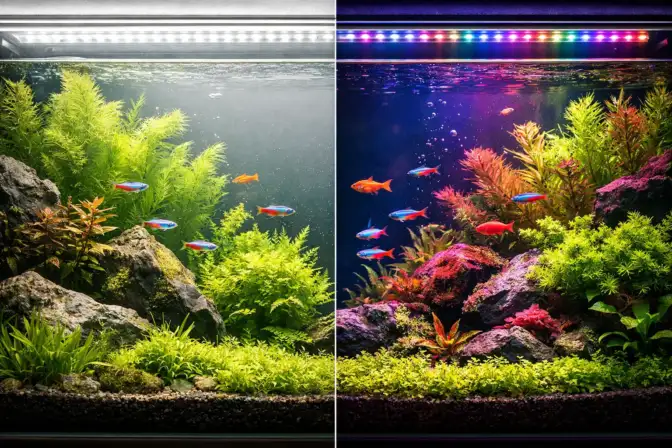
White vs RGB Aquarium Lighting: Which Is Better for Planted Tanks?
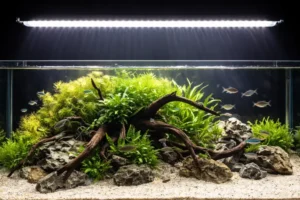
The debate between white LED lighting and RGB aquarium lighting is one of the most common questions among aquarists building planted tanks.
Some aquascapers insist that RGB lighting is essential for vibrant colors and plant growth. Others argue that traditional white LEDs are more efficient and deliver better long-term performance.
The truth is more nuanced. Both lighting technologies can grow healthy aquarium plants, but they behave differently in terms of spectrum control, efficiency, color rendering, and visual aesthetics.
This lesson focuses specifically on the differences between white LEDs, RGB LEDs, and modern WRGB systems so you can decide which lighting approach matches your aquarium goals best.
What you’ll learn in this lesson
- How white and RGB aquarium lighting systems differ
- Why RGB lights became popular in aquascaping
- Whether plants actually benefit from RGB lighting
- When white LEDs are the smarter choice
- How to tune RGB spectrum for aquascaping aesthetics
- How to choose the right lighting technology for your tank
What Is White LED Aquarium Lighting?
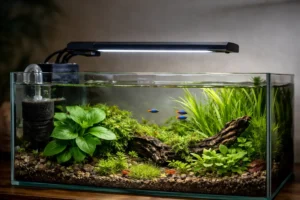
White LED lighting is the most traditional and widely used technology in aquarium lighting systems. Many entry-level and mid-range aquarium lights rely on white diode arrays that produce a balanced daylight-style spectrum.
Instead of emitting a single color, white LEDs generate a broad spectrum by combining a blue diode with phosphor coatings. This process converts part of the emitted light into green, yellow, and red wavelengths.
The result is a spectrum that appears visually white and often resembles natural daylight. That is why many aquarium lights advertise color temperatures around 6500K to 7500K.
How White LEDs Produce Light
White LEDs begin with a blue emitter. A phosphor coating shifts part of that light into other visible wavelengths, creating a broader and more continuous spectrum.
This design is efficient for producing high visible brightness, which is why white LEDs typically deliver more lumens per watt than RGB systems.
Color Temperature Explained
Color temperature describes the visual tone of light. In aquarium lighting, common values include neutral daylight, cool white, and slightly warmer tones.
| Kelvin | Appearance |
|---|---|
| 5000K | Warm daylight |
| 6500K | Neutral daylight |
| 7000–7500K | Cool white |
Most planted aquarium lights target the 6500K to 7000K range because this creates a clean, natural look. For a broader foundation, see the Aquarium Lighting Guide.
Typical White LED Spectrum
White LEDs usually provide a balanced spectrum with a strong blue peak, a broad green plateau, and moderate red output. This supports plant growth while maintaining a natural appearance.
The main limitation is that white LEDs offer little or no manual spectrum control. That is one reason many aquascapers move toward RGB-based systems.
What Is RGB Aquarium Lighting?
RGB aquarium lighting uses three primary LED colors: red, green, and blue. By mixing these channels at different intensities, the system can create a wide range of spectral combinations and visual tones.
Unlike white LEDs, RGB lighting allows aquarists to adjust each channel independently. That flexibility is a major reason RGB fixtures became so popular in planted tank aquascaping.
How RGB LEDs Work
Instead of using phosphor conversion, RGB fixtures contain separate diodes for each primary color. Each diode emits a narrower wavelength band, and the final appearance depends on how these channels are combined.
| Channel | Approximate Wavelength |
|---|---|
| Blue | 450 nm |
| Green | 520 nm |
| Red | 630 nm |
Spectrum Control
RGB lighting allows much more visual tuning than standard white LEDs. You can boost red for stronger plant coloration, soften blue for a calmer look, or fine-tune the overall tone of the aquarium for photography and display.
Why Aquascapers Prefer RGB
RGB lighting can make aquascapes look more vivid. Reds appear deeper, greens appear cleaner, and fish colors often look more saturated. This is especially valuable in display tanks, contest layouts, and aquariums designed for social media or photography.
WRGB Lighting: The Modern Hybrid
Modern planted tank lights often use WRGB technology, which combines white LEDs with RGB channels. This approach tries to capture the strengths of both systems.
WRGB fixtures offer the efficiency and natural base spectrum of white LEDs while still allowing channel-based color tuning. That balance is one reason WRGB lights are so common in high-end aquascaping.
Why WRGB Lights Dominate Aquascaping
WRGB lights provide strong PAR output, adjustable spectrum control, and a more natural-looking blend than pure RGB-only systems. For aquascapers who care equally about plant health and presentation, WRGB is often the most flexible option.
Spectrum Blending Advantages
Because WRGB lights include a white base spectrum, they can avoid the exaggerated or artificial look that some aggressively tuned RGB lights create. The result is often cleaner, brighter, and more balanced.
White vs RGB: The Core Differences
| Feature | White LED | RGB LED |
|---|---|---|
| Energy efficiency | Higher | Lower |
| Spectrum control | None or limited | Full |
| Visual color intensity | Natural | Vivid |
| Price | Usually lower | Usually higher |
| Customization | Minimal | Extensive |
White LEDs prioritize efficiency and simplicity. RGB lights prioritize visual flexibility and display quality. WRGB sits between both extremes and is often the most premium option.
Which Lighting Is Better for Aquarium Plants?
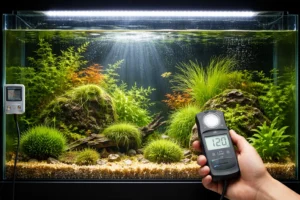
The most important factor for plant growth is usable light intensity, not the marketing label of the fixture. Plants respond primarily to how much effective light reaches the leaves.
PAR vs Spectrum
PAR describes the amount of light available for photosynthesis. Spectrum influences how that light looks and how wavelengths are distributed, but plant success depends first on whether enough intensity reaches the planting zones.
For a deeper explanation, see Aquarium PAR Explained.
Why Intensity Matters More Than Color
Healthy plant growth depends on more than light alone. The three biggest drivers are:
- light intensity
- CO₂ availability
- nutrient balance
That is why a well-designed white LED system can outperform a poorly configured RGB system. If CO₂ is unstable or nutrients are inconsistent, spectrum alone will not solve plant issues. For more on carbon management, see the CO₂ System Guide.
Photosynthesis Wavelengths
Aquatic plants absorb primarily blue and red wavelengths. Green light is less strongly absorbed, which is why leaves appear green to our eyes. Both white and RGB lighting can provide the wavelengths plants need, as long as the fixture is strong enough for the tank depth and planting style.
Do Plants Actually Need RGB Light?
No. Aquarium plants do not specifically require RGB lighting. They require sufficient PAR across the photosynthetically useful range. Plants do not need RGB specifically; they need enough usable light. Estimate PAR at substrate level with the Aquarium Lighting Calculator before choosing a fixture based on spectrum alone.
That means plants can grow very well under white LEDs. RGB lighting mainly improves how the aquarium looks, not whether plants are physically capable of growing.
This distinction is important because many beginners assume RGB automatically means better growth. In reality, RGB mostly gives you more control over visual presentation.
How Lighting Affects Aquarium Colors
Lighting spectrum strongly affects how an aquarium appears to the human eye. This is where RGB systems often stand out most clearly.
Fish Coloration
Fish with red, orange, or metallic blue pigments often appear richer and more saturated under RGB-based lighting. This can make community tanks and display aquariums look more dramatic.
Red Plants
Red stem plants often look deeper and more vivid under RGB lighting because red wavelengths are emphasized more strongly. The plant does not suddenly become healthier just because the tank looks redder, but the visual effect can be impressive.
Aquascape Photography
RGB lighting is especially popular for aquascape photography because it improves contrast, depth, and color separation. That is one reason many showcase aquariums use RGB or WRGB fixtures even when a white LED could also grow the plants successfully.
When RGB Lighting Is Worth the Upgrade
RGB lighting becomes more valuable when aesthetics are a core part of the project.
Aquascaping Layouts
High-end aquascapes often use RGB or WRGB fixtures to highlight plant textures, stone detail, and wood structure. If layout presentation matters as much as plant health, RGB can be worth the extra investment.
To understand how light interacts with layout design, see the Aquarium Hardscape Guide and Aquarium Styles.
Red Plant Aquariums
Tanks built around red stem plants often benefit visually from adjustable RGB channels. Strong red output can make the entire aquascape look more vibrant and premium.
Display Aquariums
If your aquarium is meant to impress guests, customers, or social media followers, RGB lighting offers a clear aesthetic advantage.
When White Lighting Is the Smarter Choice
White LEDs still make a lot of sense for many planted tanks, especially when simplicity and efficiency matter most.
Budget Setups
White LED fixtures are often more affordable than RGB systems. They can still provide excellent growth if the intensity matches your plant demand and tank depth.
Beginner Tanks
White LEDs are easier to use because there are fewer variables. You do not need to manage separate color channels, and the overall setup is often more straightforward.
Efficient High-PAR Systems
Because white LEDs often deliver more PAR per watt, they can be a more efficient option for aquarists who prioritize strong plant growth without paying extra for visual tuning.
The Biggest Lighting Myth: RGB = Better Growth
One of the biggest misunderstandings in planted aquarium lighting is the idea that RGB automatically means better plant growth.
That is not true. Growth depends on system balance:
- adequate PAR
- stable CO₂
- balanced nutrients
- strong circulation
- consistent maintenance
RGB lighting cannot compensate for weak husbandry. If your routine is unstable, algae will appear whether your fixture is white, RGB, or WRGB. For maintenance support, see the Aquarium Water Change Guide and the Aquarium Plants Guide.
Spectrum Tuning for Aquascaping
One real advantage of RGB lighting is that you can tune the spectrum for the look you want. There is no single universal setting, but a few proven starting points are useful.
Balanced Nature Aquarium Spectrum
- Red: 60%
- Green: 60%
- Blue: 40%
This setting aims for a clean, balanced aquascape with natural greens and a restrained but premium look.
Red Plant Spectrum
- Red: 80%
- Green: 50%
- Blue: 60%
This profile increases red emphasis for stronger stem plant coloration and a more dramatic display.
Fish Color Spectrum
- Red: 70%
- Green: 50%
- Blue: 50%
This setting can improve visual fish saturation while still keeping the tank balanced and pleasant to view.
Tip: Treat RGB channel recipes as starting points, not fixed rules. Tank depth, water clarity, plant density, and hardscape color all influence how the final spectrum looks in practice.
Lighting Setup Examples
Low Tech Tank
- White LED lighting
- Moderate intensity
- Easy maintenance
- Best for undemanding plants and simple layouts
Nature Aquascape
- WRGB lighting
- Balanced spectrum
- Natural greens and detailed hardscape contrast
- Best for carefully composed show layouts
Dutch Aquascape
- RGB-heavy or WRGB lighting
- Higher PAR levels
- Strong visual emphasis on red and orange stems
- Best for dense plant-driven compositions
How to Choose Between White and RGB Lights
The right choice depends less on theory and more on your real goals as an aquarist.
| Factor | Best Choice |
|---|---|
| Budget | White LED |
| Visual impact | RGB or WRGB |
| Aquascaping focus | RGB or WRGB |
| Beginner setup | White LED |
| Energy efficiency | White LED |
| Maximum flexibility | WRGB |
If your priority is simply growing healthy plants with minimal complexity, white LEDs are often enough. If you want to fine-tune how your aquascape looks and feels, RGB or WRGB will usually be more satisfying.
Frequently Asked Questions
Is RGB lighting better for aquarium plants?
Not automatically. Plants respond mainly to light intensity and overall system balance. Both white and RGB lighting can grow plants successfully when PAR, CO₂, and nutrients are appropriate.
Does RGB lighting cause algae?
No. Algae problems usually come from unstable maintenance, too much light, weak CO₂, or nutrient imbalance. RGB does not inherently cause algae.
Can aquarium plants grow under white LEDs only?
Yes. Many successful planted tanks use only white LED fixtures. The key is choosing enough intensity for your plant demand and aquarium depth.
Are WRGB lights worth it?
WRGB lights are often worth it for aquascapers who want both strong plant performance and advanced visual tuning. They are less essential for basic planted tanks.
What color temperature is best for planted aquariums?
Many planted tanks use lighting around 6500K to 7000K because it creates a natural daylight look. However, the ideal visual tone depends on your aquascape style and personal preference.
Is RGB necessary for red plants?
No. Red plants do not require RGB lighting to survive, but RGB can make their coloration appear stronger and more vibrant.
Conclusion
The difference between white and RGB aquarium lighting is mainly about visual control rather than pure plant growth potential.
White LEDs remain efficient, reliable, and beginner-friendly. They are an excellent choice for budget tanks, practical planted setups, and aquarists who want solid growth without extra complexity.
RGB lighting offers stronger visual customization, richer color rendering, and more dramatic presentation. For aquascapers focused on aesthetics, photography, and premium display quality, RGB or WRGB is often the more satisfying path.
In the end, healthy planted aquariums can be built under both technologies. The better choice depends on whether you value efficiency and simplicity or maximum visual expression.
Want to compare your tank more precisely?
Use the Aquarium Lighting Calculator to estimate PAR, Lux, and photoperiod before choosing your next fixture.
Turn the Spectrum Choice Into a Lighting Plan
White, RGB, and WRGB describe spectrum and appearance; intensity and photoperiod still determine whether the setup suits the plants. Use the aquarium lighting calculator to estimate a practical starting point.
Lesson completed!
You've finished this lesson. Keep building your aquarium knowledge, one lesson at a time.
Continue learning →New to AquariumLesson? Start with our complete Aquarium Lessons Hub or return to the homepage at AquariumLesson.com.