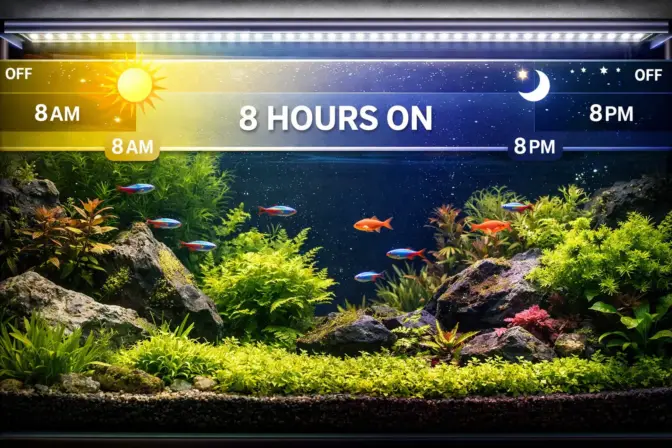
Aquarium Lighting Schedule Guide: How to Set the Perfect Photoperiod
Introduction
An effective aquarium lighting schedule is one of the most powerful tools for controlling plant growth, preventing algae, and stabilizing the entire ecosystem of a planted aquarium. While many aquarists focus on buying stronger lights or adding fertilizers, the daily photoperiod often determines whether a tank becomes balanced or unstable.
A lighting schedule defines when lights turn on, how long they stay on, and how intensity changes during the day. In nature, aquatic plants experience sunrise, stronger daylight, sunset, and darkness. Recreating a simplified version of this rhythm inside an aquarium helps plants photosynthesize efficiently while giving fish a predictable day-night cycle.
This guide explains how to design a stable lighting schedule for planted aquariums, how long aquarium lights should be on, how to adjust duration based on tank type, and how to avoid algae caused by too much or inconsistent light. If you want a broader overview of lighting systems, intensity, spectrum, and equipment, see our Aquarium Lighting Guide.
Quick answer: Most planted aquariums perform best with 6 to 9 hours of useful light per day. New tanks and high-light setups should start closer to 6 hours, while stable low-tech tanks can often run 7 to 9 hours. Avoid 10–12+ hour schedules unless the tank is very stable and algae-free.
What you’ll learn in this lesson
- How long aquarium lights should run each day
- Why photoperiod stability matters for plants, fish, and algae control
- Real lighting schedules used in planted aquariums
- How lighting duration interacts with intensity and PAR
- How to synchronize lighting with CO₂ and fertilization
- Signs your aquarium lights are on too long or too short
- How to use timers, smart plugs, and ramp-up/ramp-down settings
- How to adjust your lighting schedule during algae outbreaks or new tank setups
What Is an Aquarium Lighting Schedule?
An aquarium lighting schedule defines the daily photoperiod — the amount of time your aquarium light remains active during a 24-hour cycle. In planted aquariums, this schedule shapes the rhythm of photosynthesis, nutrient uptake, fish behavior, and overall system stability.
Many beginners assume that stronger lights automatically solve plant growth problems. In reality, timing is often just as important as brightness. A moderate light used consistently can produce better long-term results than a powerful fixture running too long or at irregular times.
Definition of Photoperiod
The photoperiod is the total number of hours your aquarium receives light each day. In most planted tanks, the useful range sits between 6 and 9 hours, depending on intensity, plant demand, CO₂ availability, fertilization, and system maturity.
Aquarium plants do not need endless light. They need a stable, repeatable energy window that matches the rest of the system. Once that balance is lost, algae often takes advantage before plants can fully respond.
Why Plants Depend on a Stable Light Cycle
Aquatic plants adapt their metabolism to predictable conditions. When light turns on and off at random times, or when duration changes too often, plant growth becomes inconsistent. This makes the aquarium more vulnerable to imbalance, especially in newer tanks.
Stability matters because planted aquariums behave like energy systems. Light drives growth, but only when carbon and nutrients are available at the same time. That is why a good schedule is never just about “more hours.” It is about matching light energy to biological capacity.
Important: If your plants struggle, do not automatically increase lighting duration. In many tanks, the real problem is too much light for the current level of CO₂, nutrients, plant mass, or maintenance stability.
How Many Hours Should Aquarium Lights Be On?
The ideal lighting duration depends on the type of aquarium, the intensity of the fixture, and how demanding the plants are. Low-energy tanks often tolerate slightly longer schedules, while high-energy aquascapes usually need shorter, more controlled photoperiods.
As a practical rule, most planted aquariums perform best between 6 and 9 hours of useful light. Running lights longer does not always improve plant growth. Beyond a certain point, plants stop benefiting significantly, but algae continues to benefit from the extra energy.
| Tank Type | Typical Lighting Duration | Beginner Note |
|---|---|---|
| New planted aquarium | 6 hours | Start conservatively and increase slowly |
| Low-tech planted tank | 7–9 hours | Works best with moderate intensity and easy plants |
| Medium-tech planted tank | 7–8 hours | Good range for balanced fertilization and optional CO₂ |
| High-tech CO₂ aquascape | 6–8 hours | Strong light needs tighter control |
| Shrimp or epiphyte tank | 6–8 hours | Useful for mosses, Anubias, Bucephalandra and Java Fern |
| Nano aquarium | 6–7 hours | Small tanks react quickly to algae triggers |
| Fish-only aquarium | 6–8 hours | Enough for viewing without unnecessary algae pressure |
| Deep planted tank with strong lighting | 6–7 hours | Intensity control matters more than simply adding hours |
If your fixture is strong and your tank is shallow, a shorter schedule is often safer. If your light is weaker and your plant selection is conservative, a somewhat longer schedule may work well. The important point is that duration must always be interpreted together with intensity.
If you need a broader understanding of plant demand across different tank styles, you can also explore the Aquarium Plants Guide.
The Ideal Lighting Schedule for Planted Aquariums
A good aquarium lighting schedule is not just a number of hours. It is a daily rhythm. Modern LED fixtures often allow you to create a smoother day with ramp-up, stable working intensity, and ramp-down instead of one harsh on/off block.
That matters for two reasons. First, it creates a more natural visual experience for fish and for the viewer. Second, it helps you structure the strongest part of the day around the period when plants can use the most energy efficiently.
Beginner Schedule
A beginner planted tank should start conservatively. In most cases, stability matters more than maximum growth speed.
Lights on: 10:00
Full intensity: 11:00
Lights off: 17:00
Total photoperiod: 6–7 hours
This kind of schedule reduces algae pressure during the early phase while still giving easy plants enough energy to establish.
Standard Planted Tank Schedule
A stable planted aquarium with moderate light, healthy plants, and regular maintenance can often use a slightly longer schedule.
Lights on: 09:30
Full intensity: 10:30
Peak window: 11:00–16:30
Ramp down: 17:00
Lights off: 18:00
Total photoperiod: 8–8.5 hours
This creates a clear daytime rhythm without pushing the aquarium into excessive light exposure.
High-Tech CO₂ Tank Schedule
High-tech aquariums use more energy, so the photoperiod must stay disciplined. Strong light with injected CO₂ usually works best with a shorter total duration and tighter timing.
CO₂ on: 09:00
Lights on: 10:00
Peak intensity: 12:00–16:00
Lights off: 18:00
CO₂ off: 17:00
This kind of structure helps plants access carbon before full lighting begins. For a deeper explanation of carbon timing and delivery, see the CO₂ System Guide.
Lighting Schedule for New Aquariums
New planted aquariums are especially vulnerable to algae because the biological system is still immature. Root systems are not fully established, microbial balance is still forming, and plant mass may not yet be strong enough to compete for nutrients efficiently.
That is why new tanks should usually begin with a shorter lighting schedule. One of the most common beginner mistakes is running a fresh tank at full duration immediately because the layout looks better under strong light. In practice, that often leads to instability before the system has a chance to settle.
Week 1–2: 6 hours
Week 3–4: 7 hours
Week 5+: 8 hours
This gradual increase gives plants time to root, adapt, and begin active growth before the aquarium receives a more aggressive photoperiod. It also supports cleaner early maintenance and reduces the risk of nuisance algae taking over exposed hardscape.
If your setup includes fresh wood, nutrient-rich substrate, or bright lighting, a conservative start is even more important. If you are working on layout structure and stone or wood placement, the Aquarium Hardscape Guide can help you understand how hardscape design influences early tank behavior.
Practical tip: In a new tank, it is usually safer to increase duration slowly than to increase intensity and duration at the same time. Adjust in small steps of 15–30 minutes and observe the tank for at least one to two weeks.
Ramp-Up and Ramp-Down Lighting
Modern LED lights make it possible to move beyond a simple on/off schedule. Instead of blasting the aquarium with instant full brightness, you can shape the day more gradually.
Simulating Sunrise
A ramp-up phase slowly increases brightness over 30 to 90 minutes. This is visually more pleasant, reduces sudden stress for fish, and creates a more natural transition into the active daylight period.
Simulating Sunset
A ramp-down phase gradually reduces intensity before lights turn off. This avoids the abrupt blackout effect that can make the aquarium feel artificial, especially in display tanks located in living spaces.
Midday Peak Intensity
The most productive part of the lighting day is usually the middle section, when the tank runs at its target output. In practice, many aquascapers build their schedule around a peak window of 3 to 5 hours, while the beginning and end of the day remain softer.
This approach makes sense because plants do not need maximum intensity all day long. A structured peak often produces a better balance between growth and algae control than one long period of flat, aggressive brightness.
Lighting Schedule Based on Light Intensity (PAR)
Lighting duration only makes sense when viewed together with intensity. A weak light can sometimes run longer without causing problems. A strong light often needs a shorter photoperiod to stay safe and efficient.
This is why planted aquarium lighting should be interpreted through PAR rather than just wattage or product marketing. You do not need a full PAR lecture inside this article, but you do need the core principle: higher usable light intensity usually requires shorter total duration.
| PAR Level | Suggested Schedule | Typical Use |
|---|---|---|
| Low PAR (≤30) | 8–10 hours | Low-tech tanks, shade plants, fish-focused aquariums |
| Medium PAR (30–60) | 7–8 hours | Most balanced planted aquariums |
| High PAR (60+) | 6–7 hours | High-tech aquascapes, carpeting plants, strong LEDs |
This is not a rigid law, but it is a strong practical framework. If your tank receives high PAR at substrate level and you still run a long 9–10 hour schedule, algae pressure often rises quickly unless CO₂ and nutrients are exceptionally well controlled.
If you want a more practical estimate for your own tank, use the Aquarium Lighting Calculator.
Lighting Schedule for Different Aquarium Types
Not every planted aquarium should follow the same daily rhythm. Tank dimensions, plant selection, maintenance style, and livestock all influence the most effective schedule.
Low-Tech Planted Tanks
Low-tech tanks typically use moderate light, no injected CO₂, and slower-growing plant species. These systems usually benefit from 7 to 9 hours of controlled light, often with a simple schedule and moderate output.
Longer schedules are only useful if the intensity remains modest. Otherwise, even a low-tech tank can drift into algae issues.
High-Tech Aquascapes
High-tech layouts with carpeting plants, stem plants, and injected CO₂ usually perform best with 6 to 8 hours of disciplined lighting. These tanks use high energy efficiently, but they punish inconsistency quickly.
Shrimp Tanks
Shrimp-focused aquariums often use mosses, Bucephalandra, Anubias, and other slower-growing plants. These setups benefit from a gentler schedule, usually around 6 to 8 hours, especially when the goal is calm, stable growth rather than aggressive biomass production.
Nano Aquariums
Nano tanks react quickly to imbalance. Because the water volume is smaller and the system is less forgiving, a photoperiod of 6 to 7 hours is often a safer starting point. This is especially true when strong LEDs are mounted close to the water surface.
Deep Tanks
Deep planted aquariums often require stronger fixtures or more focused optics to push light to the substrate. That stronger energy should usually be balanced with a shorter daily schedule. In these tanks, the mistake is often assuming that more hours compensates for depth. In practice, it is usually smarter to improve intensity management rather than stretch the photoperiod too far.
Fish-Only Aquariums
Fish-only aquariums do not need long lighting periods for plant growth. In these tanks, lighting is mostly for viewing and fish rhythm. A schedule of 6 to 8 hours is often enough, especially if algae appears on glass, decorations, or hardscape.
Signs Your Aquarium Lights Are On Too Long
Too much light does not always look dramatic at first. Often, the aquarium simply becomes harder to keep clean. Algae increases, plants look stressed, and the tank feels less stable even if the light fixture itself is high quality.
- Green dust algae appears quickly on the glass
- Hair algae grows on moss, slow plants, or hardscape
- Plants bleach or look pale near the surface
- New aquariums develop algae before plants establish
- Fish hide more often or seem overstimulated
- The water turns cloudy or greenish
- Algae gets worse after increasing duration or intensity
If these symptoms appear after a lighting change, reduce duration first before making several other adjustments at once. A one-hour reduction can often reveal whether light pressure was the main trigger.
Signs Your Aquarium Lights Are On Too Short
Too little light can also limit plant growth, especially in tanks with carpeting plants, demanding stems, or deep layouts. However, it is important not to confuse low light with poor CO₂, weak fertilization, or adaptation stress after planting.
- Stem plants grow long and leggy
- Carpeting plants fail to spread
- Lower leaves deteriorate in shaded areas
- Plant color becomes dull despite stable nutrients
- Growth remains very slow after several weeks of stability
If the tank is algae-free but plant growth is clearly weak, you can increase the photoperiod gradually by 15–30 minutes and observe the response. Do not jump from 6 hours to 10 hours in one step.
How Lighting Schedules Affect Algae
Lighting is one of the fastest levers you can adjust when algae appears. That does not mean light is always the root cause, but it is often the force that allows the problem to accelerate.
Algae tends to gain ground when the aquarium receives more usable light than plants can process under the current conditions. This often happens when the photoperiod is too long, intensity is too high, CO₂ is unstable, nutrients are inconsistent, or plant mass is still too weak to dominate nutrient uptake.
| Symptom | Possible Lighting Adjustment |
|---|---|
| Green dust or film algae increasing quickly | Reduce duration by 1 hour |
| Hair algae in a high-light tank | Shorten the peak intensity window |
| Persistent algae in a new aquarium | Return to a conservative 6-hour schedule |
| Plants stagnate but algae still grows | Reassess CO₂ and nutrient consistency, not just light |
| Algae appears after a recent light upgrade | Reduce intensity or duration before changing fertilization aggressively |
If algae pressure is high, one of the smartest corrections is often this: short, controlled light with strong consistency instead of long, weak, poorly structured lighting. For a deeper explanation, read the Aquarium Lighting and Algae guide.
Synchronizing Lighting With CO₂ and Fertilization
Lighting never works in isolation. The moment lights switch on, plant demand begins to rise. If carbon and nutrients are not available in a stable way, the extra light becomes stress rather than productive energy.
For high-tech planted aquariums, the usual recommendation is simple:
CO₂ on: 1–2 hours before lights
CO₂ off: 1 hour before lights off
This gives dissolved carbon time to build before full intensity begins. If the light starts before CO₂ reaches an effective level, plants enter the day underpowered while algae remains ready to exploit the imbalance.
Fertilization also interacts with lighting schedule, though not always in a minute-by-minute way. What matters most is consistency across the week. If you are maintaining a high-energy planted aquarium, stable dosing and regular maintenance should support the same predictable rhythm as the lighting itself. For maintenance support, the Aquarium Water Change Guide is a relevant companion resource.
| Lighting Duration | CO₂ / Nutrient Demand | Algae Risk If Unbalanced |
|---|---|---|
| 6 hours | Lower | Low to moderate |
| 8 hours | Moderate | Moderate if CO₂ or nutrients are unstable |
| 10+ hours | High | High in most planted tanks |
Timers, Smart Plugs and Automation
A timer is one of the simplest upgrades you can make to an aquarium lighting schedule. Manual switching often leads to irregular photoperiods, which makes the tank harder to stabilize. Even a basic plug timer can improve consistency immediately.
Common automation options include:
- Basic plug timers for simple on/off schedules
- Digital timers for more precise daily control
- Smart Wi-Fi plugs for app-based scheduling
- Light-specific controllers for ramp-up, ramp-down, and intensity curves
- Built-in LED apps on modern aquarium lights
The goal is not complexity. The goal is reliability. A simple 7-hour schedule that runs exactly the same every day is usually better than an advanced lighting profile that changes constantly.
Should You Use a Siesta Lighting Schedule?
A siesta schedule splits the photoperiod into two separate blocks with a break in between.
Light: 5 hours
Break: 2 hours
Light: 5 hours
This approach has been discussed for years in the planted aquarium community. Some aquarists use it to reduce algae pressure or to match viewing times in the morning and evening. In certain situations, it can work.
Still, most modern planted tanks benefit more from a continuous and stable schedule. Plants generally respond best when the lighting day is predictable and uninterrupted. If the tank is already unstable, a split schedule can become another variable rather than a solution.
A siesta is not automatically wrong, but it should be treated as an adjustment tool, not a default recommendation for every aquarium.
Special Lighting Situations
Some aquarium situations need temporary lighting adjustments. These changes should be targeted and limited, not random daily changes.
During Algae Outbreaks
- Reduce the photoperiod to 5–6 hours temporarily.
- Shorten the peak intensity window if your light is programmable.
- Remove excess organics through cleaning and water changes.
- Do not increase fertilizer, CO₂, and light all at once.
- Return to a longer schedule only after the algae trend improves.
After Adding New Plants
- Keep the schedule conservative for the first one to two weeks.
- Allow plants to adapt before increasing intensity or duration.
- Watch for melting, algae, and weak new growth before adjusting.
With Floating Plants
Floating plants naturally shade lower areas of the aquarium. This can reduce algae pressure and create calmer zones for fish, but it can also limit light for carpeting plants or low foreground growth.
- Thin floating plants regularly if the tank becomes too shaded.
- Do not automatically increase duration unless the lower plants need it.
- Watch whether algae improves or plant growth weakens after floating plants spread.
For Fish That Need a Clear Day-Night Rhythm
Fish need darkness at night. Constant illumination can disturb rest, feeding behavior, and normal activity patterns. Even fish-only aquariums should have a stable dark period every day.
Common Lighting Schedule Mistakes
Most aquarium lighting problems do not come from exotic technical errors. They come from a few repeated habits that look harmless at first, but create instability over time.
- Running lights for 12+ hours because the tank looks good for longer
- Changing the schedule too often instead of allowing the system to adapt
- Increasing intensity and duration together, which overwhelms the tank
- Ignoring the difference between low-tech and high-tech systems
- Using a strong light in a new tank with a full photoperiod
- Failing to use a timer, which makes the schedule inconsistent
- Trying to fix weak plant growth only by adding more hours
- Leaving lights on late into the night without giving fish a proper dark phase
If you fix only one thing, fix consistency first. A timer is not optional in a serious planted aquarium. It is one of the cheapest ways to improve long-term stability.
Example Lighting Schedules Used by Aquascapers
Below are practical templates that reflect real planted-tank logic rather than generic advice.
Classic Aquascape Schedule
09:00 ramp up
10:00 full intensity
14:00 peak PAR
18:00 ramp down
19:00 lights off
Best for: mature planted aquariums with good maintenance and balanced plant mass.
Beginner Safe Schedule
Week 1–2: 6 hours
Week 3–4: 7 hours
Week 5+: 8 hours
Best for: new planted tanks, cautious starts, algae-prone setups.
High-Energy CO₂ Schedule
CO₂ on: 09:00
Lights on: 10:00
Peak output: 12:00–16:00
Lights off: 18:00
CO₂ off: 17:00
Best for: advanced aquascapes with strong light, active trimming, and consistent dosing discipline.
Fish-Only Viewing Schedule
Lights on: 12:00
Lights off: 19:00
Total photoperiod: 7 hours
Best for: aquariums where lighting is mainly for viewing and fish rhythm, not plant growth.
How to Adjust Your Lighting Schedule Over Time
A good lighting schedule is not set once forever. It should evolve as the aquarium matures. A new tank, a stabilized tank, and a dense aquascape do not always need the exact same energy pattern.
The key is to respond to visible signals rather than chasing constant change. Adjust only one variable at a time and then observe for at least one to two weeks.
| What You See | Possible Schedule Response |
|---|---|
| Algae increasing after a recent lighting boost | Reduce duration or shorten peak window |
| Healthy growth but weak compactness | Reassess intensity before extending hours |
| Plants melting in a fresh setup | Return to a shorter, safer schedule |
| Tank stable and dense after several weeks | Consider a gradual increase of 15–30 minutes |
| Fish hide when lights turn on | Use ramp-up or reduce sudden brightness changes |
This measured approach prevents overcorrection. In planted aquariums, small adjustments often outperform dramatic ones.
Final Aquarium Lighting Schedule Checklist
Use this checklist when setting or correcting your aquarium lighting schedule:
- Start new planted tanks at around 6 hours per day.
- Use 7–9 hours for stable low-tech planted tanks.
- Use 6–8 hours for high-tech CO₂ aquascapes.
- Shorten the schedule if algae increases quickly.
- Do not run aquarium lights 24/7.
- Give fish a stable dark phase every night.
- Use a timer or smart plug for consistency.
- Adjust duration slowly in 15–30 minute steps.
- Interpret duration together with PAR and intensity.
- Synchronize strong light with stable CO₂ and nutrients.
Conclusion
A well-designed aquarium lighting schedule is one of the simplest and most effective ways to create a healthier planted tank. It shapes how plants grow, how algae behaves, how fish rest, and how stable the aquarium feels over time.
The most successful schedules are not the longest. They are the ones that match the aquarium’s actual energy balance. When duration, intensity, CO₂, nutrients, and maintenance work together, plant growth becomes more predictable and the tank becomes easier to manage.
Start conservatively, use a reliable timer, observe your aquarium carefully, and adjust slowly. In most planted aquariums, a stable 6 to 9 hour photoperiod will outperform long, inconsistent lighting every time.
Want to fine-tune your setup?
Use the Aquarium Lighting Calculator to estimate PAR, Lux, and a practical photoperiod for your tank.
💬 Join the Conversation
How many hours do your aquarium lights run each day — and did changing the schedule improve plant growth or algae control?
Tag us on Instagram @AquariumLesson — we’d love to see your planted tank lighting setup, aquascape progress, and daily lighting routine.
FAQ
How many hours should aquarium lights be on?
Most planted aquariums perform best with 6 to 9 hours of light per day, depending on intensity, plant demand, and whether CO₂ is injected. New tanks and high-light aquascapes should usually start closer to 6 hours.
Is 8 hours enough for aquarium plants?
Yes. For many planted tanks, 8 hours is an excellent target. It is often long enough for healthy growth while remaining conservative enough to help limit algae.
Is 12 hours of light too much for an aquarium?
Usually, yes. A 12-hour photoperiod often creates unnecessary algae pressure, especially in planted tanks. Most aquariums are easier to manage with 6 to 9 hours of consistent light.
Should aquarium lights run 24/7?
No. Aquarium plants and fish both need a dark period. Running lights continuously creates stress and almost always increases algae problems.
Do fish need darkness at night?
Yes. Fish rely on a stable day-night rhythm for rest and normal behavior. Constant illumination can increase long-term stress and disrupt natural activity patterns.
Is a siesta lighting schedule better?
Not necessarily. Some aquarists use it successfully, but most planted tanks benefit more from a continuous and stable daily schedule. A siesta should be treated as an adjustment tool, not a default solution.
Can I split the aquarium light period into two sessions?
You can, but it is not usually necessary. A split photoperiod may help with viewing times or specific algae management experiments, but a continuous schedule is simpler and more predictable for most planted aquariums.
Why do I get algae when lights run 10 hours?
Because the total light energy may exceed what your plants can use under the current CO₂, nutrient, and maintenance conditions. Reducing the photoperiod is often one of the first useful corrections.
Do plants grow faster with longer lighting?
Only up to a point. Once photosynthesis reaches its practical limit, extra light hours mainly increase algae risk rather than improving plant performance.
Is ramp-up and ramp-down lighting essential?
No, it is not essential, but it is useful. Ramp-up and ramp-down create smoother transitions, reduce sudden brightness changes for fish, and make the aquarium look more natural.
Do different aquarium lights need different durations?
Yes, indirectly. Duration depends less on the brand and more on actual intensity. High-PAR lights often need shorter schedules, while weaker lights can sometimes run longer without creating the same algae pressure.
New to AquariumLesson? Start with our complete Aquarium Lessons Hub or return to the homepage at AquariumLesson.com.