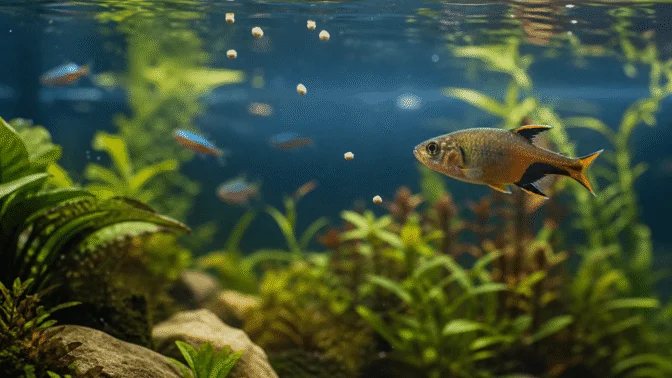
Fish Not Eating: Causes, Safe Checks & When to Act
Appetite loss is a symptom, not a diagnosis. Check whether the fish is newly introduced, whether water and oxygen are safe, whether it can reach the right food and whether other signs have appeared before changing diet or adding treatment.
Quick answer
- Check for immediate distress, especially rapid breathing or surface gasping.
- Test ammonia and nitrite, then review temperature and recent changes.
- Watch a full feeding to see whether the fish is outcompeted or offered an unsuitable food.
- Use visible accompanying signs to guide the next step instead of treating appetite loss alone.
What you will learn in this lesson
- Why a missed meal is not always an emergency, but a persistent change can be.
- The safest order for checking water, oxygen, social pressure and visible symptoms.
- What information makes diagnosis more reliable.
- When to stop guessing and ask for qualified fish-health help.
Introduction
“My fish is not eating” describes a change in behaviour, not a diagnosis. A new arrival may take time to settle. A nocturnal or shy species may feed when the room is quiet. A fish that has been chased away may be hungry even though food is entering the aquarium. On the other hand, appetite loss together with rapid breathing, clamped fins, darkening, weight loss, white spots or unusual swimming can be an early sign that the aquarium or the fish needs attention.
Check the aquarium before changing the food
- Test ammonia and nitrite. These should not be detectable in a healthy established freshwater aquarium. Use the Aquarium Water Parameters Guide to work through the results.
- Look at oxygen and filter flow. Surface gasping, rapid gill movement or several fish acting distressed takes priority over appetite. Start with Aquarium Oxygen Levels.
- Check the recent timeline. New fish, a water change, a temperature shift, medication, filter cleaning, a power interruption or a new tank mate can be more informative than the food brand.
- Watch one full feeding. See whether food reaches the fish’s level and whether faster or more dominant fish are taking it first.
Use the timeline to narrow the cause
| Timing or pattern | Useful first question |
|---|---|
| New fish will not eat | Was the fish acclimated calmly, given cover and placed in a stable or quarantine system? |
| Several fish stop eating together | What changed in water, temperature, equipment or maintenance? |
| One fish misses food while being chased | Can it access food without dominant fish intercepting it? |
| Appetite loss with spots, flashing or clamped fins | Is a specific health problem emerging rather than a food issue? |
| Persistent loss with weight decline | Can a qualified fish-health professional help diagnose the cause? |
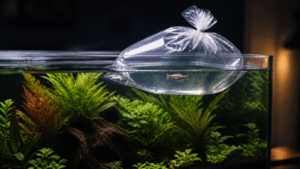
For fish that have just arrived, review Acclimating New Fish and consider an observation period in a quarantine aquarium. Do not assume the fish is merely settling if the condition is worsening.
Common possibilities, without over-diagnosing
- Settling or stress: new fish, inadequate cover, transport and abrupt environmental changes can temporarily reduce appetite.
- Water-quality or oxygen stress: poor water conditions often affect more than feeding and can worsen quickly.
- Social pressure: chasing, territorial behaviour or an unsuitable group size can prevent a fish from reaching food.
- Food mismatch: a species may need food at a different depth, texture or feeding time. A profile’s diet notes are more useful than a one-size-fits-all recommendation.
- Illness or parasite burden: visible lesions, flashing, clamped fins, heavy breathing, swelling, stringy faeces or persistent weight loss change the level of concern. These signs need a differential, not a guess from appetite alone.
Safe actions today
- Remove uneaten food rather than repeatedly adding more. Excess food can make a water-quality problem worse.
- Keep temperature and other parameters stable while you test and observe.
- Offer the normal, species-appropriate food in a small amount; do not use a long series of new foods or medicines as a diagnostic experiment.
- Feed in a way that gives slower, bottom-dwelling or shy fish an opportunity to eat.
- Record the start of the appetite change, water tests, visible signs and recent changes. A short video of feeding can be very useful.
When it is more urgent
Act promptly when appetite loss comes with gasping, inability to stay upright, severe swelling, fast weight loss, open sores, repeated deaths, or non-zero ammonia or nitrite. If several fish stop eating after a shared change, treat the aquarium as the first investigation rather than assuming every fish has a separate disease. An aquatic veterinarian or qualified fish-health professional can advise on diagnostics and treatments that are appropriate for the species and country.
White salt-like spots, flashing and worsening clamped fins deserve the differential in Ich / White Spot Disease. Do not medicate only because a fish skipped food.
Prevention is routine, not a product
Stable water, realistic stocking, compatible groups and a feeding routine matched to the species make appetite changes easier to notice. Before adding fish, cycle the aquarium and understand the capacity of the biological filter with the Aquarium Cycling Guide. After an appetite issue, review the system rather than simply increasing the amount of food.
Conclusion
Do not treat a fish refusing food as proof of a particular disease. Begin with water, oxygen, the recent timeline and feeding competition; then look for specific accompanying signs. Stable, measured actions protect the fish while you gather the information needed for a useful diagnosis.
FAQ
Should I keep trying different foods?
Offer small, species-appropriate amounts, but do not turn the aquarium into a stream of uneaten food. First check whether the fish can reach food and whether water conditions are safe.
Can a new fish skip food while settling in?
It can, especially after transport. However, rapid breathing, physical changes, worsening behaviour or unsafe water results should not be dismissed as settling in.
Lesson completed!
You've finished this lesson. Keep building your aquarium knowledge, one lesson at a time.
Continue learning →New to AquariumLesson? Start with our complete Aquarium Lessons Hub or return to the homepage at AquariumLesson.com.