
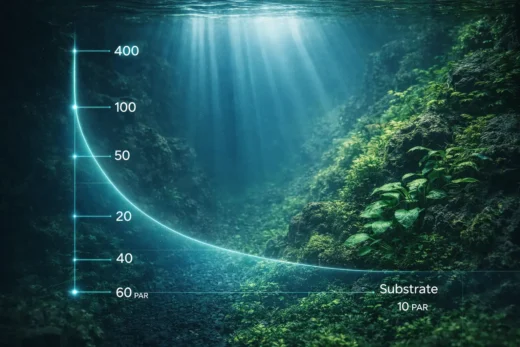
Aquarium PAR Chart for Aquarium Plants: Ideal Light Levels Explained
Aquarium PAR Explained for Planted Tanks means understanding how much usable light your aquatic plants actually receive. In a planted aquarium, PAR is one of the most practical metrics for judging whether your foreground carpet, midground plants, and background stems get enough light for healthy growth.
Choosing the right aquarium light is one of the most important decisions in a planted tank. Yet many aquarists still judge lighting by watts, lumens, or brand reputation alone — and that often leads to the same frustrating outcome: carpeting plants that never spread, red stems that stay pale, shaded corners that underperform, or algae appearing even though the tank seems “bright enough.”
An aquarium PAR chart gives you a much more practical way to think about lighting. Instead of focusing on how bright a fixture looks to your eyes, PAR helps you estimate how much usable light actually reaches your plants. That makes it easier to match plant choice, tank depth, hardscape, and aquascape style with realistic lighting expectations.
In this lesson, you will learn what PAR means in aquarium lighting, how to read an aquarium PAR chart correctly, what PAR ranges make sense for different plant groups, and how depth, spread, CO₂, nutrients, and photoperiod all influence real-world results. If you want the broader lighting foundation behind fixture categories, spectrum, and general setup logic, read the Aquarium Lighting Guide. This lesson stays focused on PAR for aquarium plants and how to use it as a practical decision-making tool.
What you’ll learn in this lesson
- What PAR means in a planted aquarium
- How PAR differs from lumens, watts, PPF, and PPFD
- How to use an aquarium PAR chart for real plant planning
- Recommended PAR ranges for low, medium, and high light plants
- How tank depth, spread, mounting height, and hardscape affect PAR
- Why substrate PAR matters more than headline fixture specs
- How PAR interacts with CO₂, fertilization, algae pressure, and photoperiod
- How to make better planted tank lighting decisions without guessing
What Is PAR in Aquarium Lighting?
PAR stands for Photosynthetically Active Radiation. In simple terms, it describes the range of light that plants can use for photosynthesis. In planted aquariums, PAR is one of the most useful ways to think about light because it moves the conversation away from marketing language and toward something much more practical: how much usable light actually reaches the plant.
That matters because aquarium plants do not respond to a fixture label. They respond to the intensity that reaches their leaves. A light can appear visually bright and still perform poorly for carpeting plants if the tank is deep, the spread is weak, or the hardscape creates strong shadows. This is exactly why PAR matters so much in aquascaping.
In real aquarium practice, PAR discussions usually focus on usable intensity at a specific position in the tank — often at the substrate, where foreground plants and carpets reveal very quickly whether the lighting setup is actually sufficient.
Why PAR matters more than perceived brightness
Human eyes and aquatic plants do not evaluate light in the same way. Your eyes are influenced strongly by perceived brightness, while plants respond to usable photon energy. This is why a “bright-looking” aquarium is not automatically a well-lit planted aquarium.
For aquascaping, the more useful question is always this: How much usable light reaches the plant surface in the zone where the plant is growing? Once you start thinking this way, lighting decisions become much more precise.
If you want a faster planning starting point before using a PAR meter, the Aquarium Lighting Calculator helps you estimate intensity more realistically based on tank size, plant demand, and expected layout goals.
PAR vs Lumens vs Watts vs PPF vs PPFD
Planted tank lighting often feels confusing because too many different metrics are used interchangeably. They are not interchangeable. Each one describes a different part of lighting performance, and only some of them are truly useful when evaluating plant growth.
| Metric | What it describes | Useful for planted tanks? |
|---|---|---|
| Watts | Power consumption | Only loosely useful |
| Lumens | Brightness as perceived by humans | Limited usefulness |
| PAR | Usable light range for photosynthesis | Very useful |
| PPF | Total useful photons emitted by a fixture | Useful, but incomplete alone |
| PPFD | Photon density reaching a surface | Most practical in real tank positions |
Why watts are not enough
Watts only tell you how much electricity a light consumes. They do not tell you how effectively that energy is converted into plant-usable light, how well the fixture spreads light across the aquarium, or how much intensity reaches the substrate. Two lights with similar wattage can perform very differently over the same tank.
Why lumens can be misleading
Lumens describe how bright a light appears to people, not how useful it is to aquarium plants. That makes lumens only partly helpful for planted tanks. They can support rough comparisons, but they do not tell you what a carpeting plant experiences at the bottom of a deep aquarium with wood, rock, and shadow zones.
What PPF and PPFD tell you
PPF tells you how many photosynthetically useful photons a fixture emits in total. That is useful when comparing raw output. But output alone is not enough, because planted tanks are not lit in empty air under perfect lab conditions.
PPFD goes a step further and tells you how many useful photons actually reach a specific surface area. In practical aquarium language, this is usually what aquarists care about when they talk about PAR in a planted tank. In other words, real-world PAR discussions are usually about PPFD at the plant position, especially at substrate level.
If you are still deciding between fixture categories, broader lighting strategy, or beginner-friendly setup logic, the better starting point is the Aquarium Lighting Guide. This lesson stays focused on how to use PAR correctly.
Aquarium PAR Chart: Low, Medium, and High Light Levels
The simplest way to use an aquarium PAR chart is to think in practical light bands. These ranges are most useful when interpreted at the plant position, not just at the surface. For foreground plants and carpets, substrate PAR is especially important.
| Light level | Typical PAR at substrate | Practical use case |
|---|---|---|
| Low light | 10–30 | Epiphytes, mosses, shade zones, low-tech tanks |
| Low to medium | 20–40 | Cryptocoryne, Bucephalandra, forgiving planted layouts |
| Medium | 30–50 | Most planted community tanks, balanced all-round growth |
| Medium to high | 45–70 | Demanding stems, stronger compact growth, more refined layouts |
| High light | 60–90+ | Carpets, red stems, high-tech aquascapes with stronger control |
A practical shortcut looks like this:
- 20–30 PAR at substrate works for many easy planted tanks
- 30–50 PAR at substrate is a strong all-round planted tank zone
- 50–80+ PAR at substrate enters advanced territory for carpets and high-demand growth
These are not rigid rules. A healthy aquarium at 35 PAR can outperform a poorly managed aquarium at 75 PAR. The chart is a planning tool, not a guarantee. It only becomes useful when combined with plant choice, tank depth, carbon supply, nutrients, and maintenance quality.
PAR Chart for Popular Aquarium Plants
Many articles stop at low, medium, and high light. That is not enough for real planning. Aquarium plants respond differently depending on growth habit, leaf structure, tank depth, and system stability. A more useful PAR chart for aquarium plants connects light levels with actual plant categories and species.
| Plant | Recommended PAR range | Difficulty | Notes |
|---|---|---|---|
| Anubias | 10–30 | Easy | Best in shaded zones; too much direct light can encourage algae |
| Java Fern | 15–35 | Easy | Performs well in moderate light; appreciates protected placement |
| Bucephalandra | 15–35 | Easy–Medium | Prefers stability over brute intensity |
| Cryptocoryne wendtii | 20–40 | Easy | Well suited to balanced low-tech and moderate-energy tanks |
| Amazon Sword | 25–45 | Easy–Medium | Needs good root nutrition more than extreme light |
| Hygrophila polysperma | 25–50 | Easy | Flexible stem plant and useful response indicator |
| Ludwigia repens | 35–60 | Medium | Better shape and color under stronger stable PAR |
| Rotala rotundifolia | 40–65 | Medium | Compact tops and stronger coloration need more energy |
| Monte Carlo | 40–70 | Medium | Can grow at lower PAR, but carpets much better with stronger substrate light |
| Glossostigma elatinoides | 50–80 | Advanced | Needs strong substrate PAR to stay compact |
| HC Cuba | 60–90+ | Advanced | One of the clearest indicators of insufficient bottom-level light |
These ranges are still practical estimates, not fixed rules. Water clarity, spread, mounting height, CO₂ stability, and nutrient consistency all influence how plants respond. For broader planting strategy across foreground, midground, and background roles, also read the Aquarium Plants Guide.
Why Substrate PAR Matters So Much
One of the most common lighting mistakes in planted tanks is focusing too much on overall brightness and not enough on what reaches the substrate. This matters because the bottom of the tank is usually the most difficult zone to light effectively, especially in deeper aquariums or layouts with heavy hardscape.
Foreground carpets, many rosette plants, and compact low-growing species all depend on bottom-level intensity. If substrate PAR is too weak, carpets often grow upward instead of sideways, leaves become sparse, and the planting never develops the dense look many aquascapers want.
Meanwhile, tall background stems may still appear healthy because they sit much closer to the light source. This is why some aquariums can grow stems fairly well while carpets struggle badly at the same time. The issue is not always that the fixture is weak overall. Often the real issue is that usable light at substrate level is insufficient.
PAR by Aquarium Zone
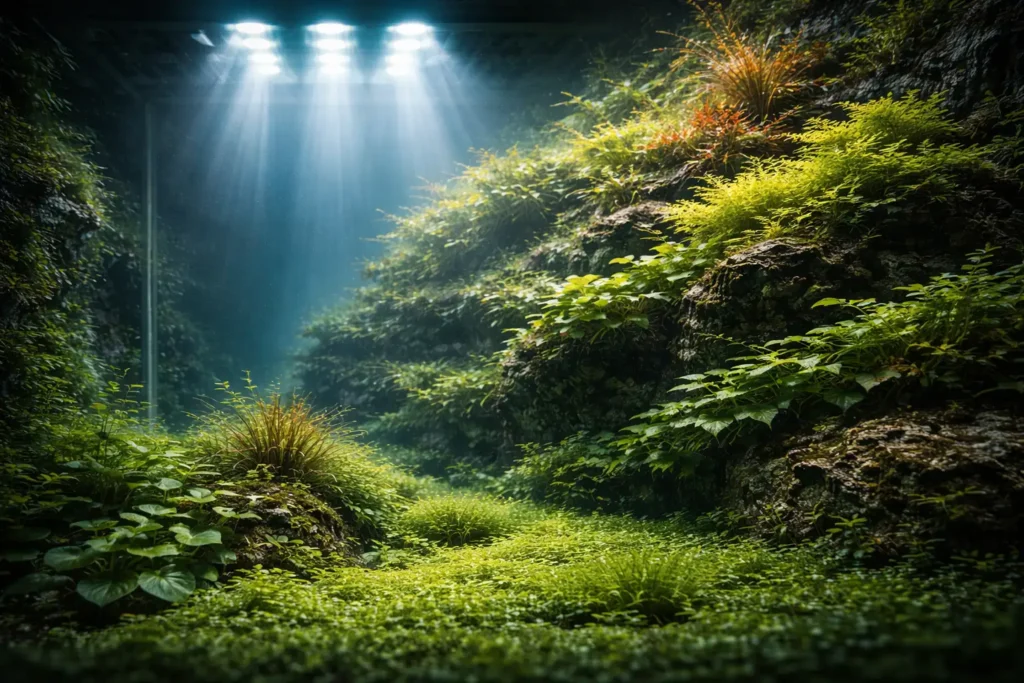
A planted tank does not have one PAR value. It has multiple lighting zones. Once you stop thinking of your aquarium as a single number and start seeing it as a map of brighter and dimmer areas, plant placement becomes much easier and much more intentional.
| Tank zone | Typical PAR strategy | Best plant types |
|---|---|---|
| Foreground center | Medium to high | Carpets, compact foreground plants |
| Midground | Medium | Crypts, compact bushes, transition plants |
| Background | Medium to high | Stem plants, taller species |
| Shaded hardscape | Low to low-medium | Anubias, Java Fern, Bucephalandra, mosses |
This zoning approach is especially useful in aquascapes where bright and dim zones are part of the composition. A smart layout does not force equal PAR everywhere. It uses gradients intentionally.
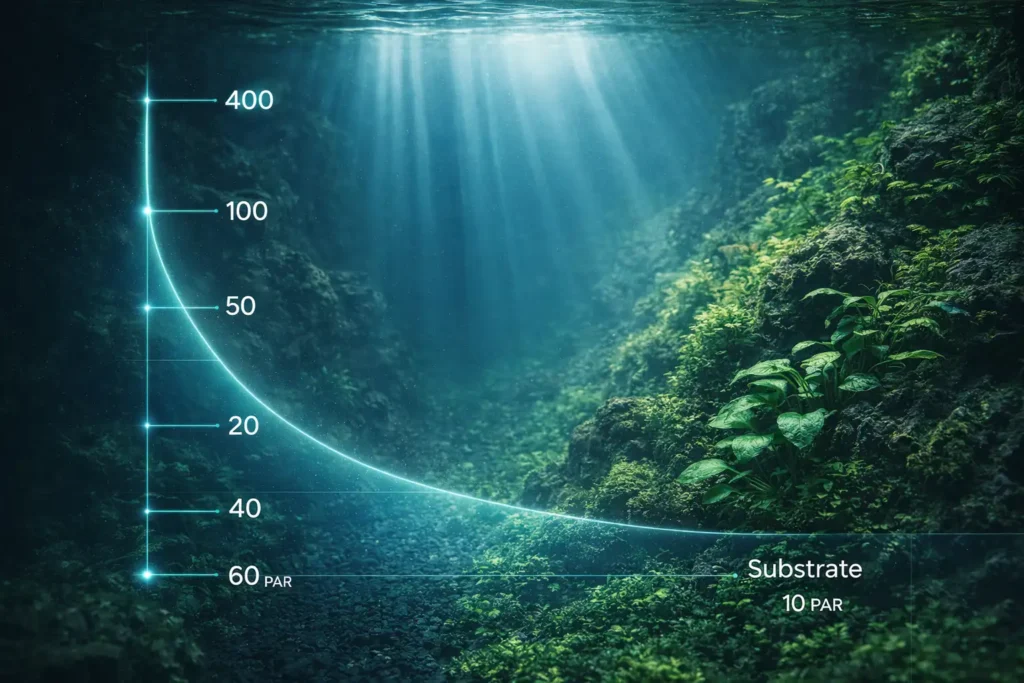
How Tank Depth Changes PAR
Tank depth changes everything. A light that performs very well over a shallow aquarium may feel underpowered over a deeper tank, even when the fixture itself is considered strong. This is one of the main reasons aquarium lighting cannot be judged from fixture specs alone.
As light travels through water, its intensity decreases. Surface movement, wood, rock, plant mass, floating plants, and even glass influence how much usable light reaches the lower zones. The deeper the aquarium, the more important it becomes to think about substrate PAR instead of only surface brightness.
Deep tank strategy
In deeper aquariums, you usually need one or more of the following: a stronger fixture, improved spread, lower mounting height, fewer floating obstructions, elevated hardscape planting zones, or a more realistic plant list. Trying to force a demanding carpet in a deep tank under weak bottom-level PAR is often much less effective than choosing plants that match the available energy level.
If hardscape height influences where your plants sit relative to the light, the Aquarium Hardscape Guide can help you plan those elevations more intentionally.
How Light Distribution Affects Plant Growth
One of the biggest weaknesses in many lighting articles is the lack of attention to distribution. Two aquariums can show a similar center reading and still grow very differently if one has even spread and the other has a strong hotspot with weak corners.
Center vs corners
Many LED fixtures produce their strongest intensity in the center zone directly below the light. Corners, front edges, and shaded rear sections often receive far less usable light. That is not automatically a problem if the layout uses those gradients well. But it becomes a problem when demanding plants are placed where the PAR drop is too steep.
Surface vs substrate
PAR is almost always higher near the surface and lower near the substrate. This explains why upper stem tops can look excellent while carpets stay weak or vertical. It also explains why many aquarists overestimate their lighting by judging only what happens in the top half of the tank.
Shadow zones from wood and rock
Hardscape can reduce usable PAR more than many aquarists expect. Large stones, branchy driftwood, and layered layouts create shade pockets that can either be a design advantage or a plant problem. Epiphytes and low-demand species often love these areas. Demanding foreground plants usually do not.
A useful way to think about a planted aquarium is as a PAR map with three practical zones:
- Peak zone for demanding plants
- Support zone for general planted growth
- Shade zone for slower or more protected species
How to Measure PAR in an Aquarium
The most accurate way to understand lighting in your tank is a real PAR meter. That gives you actual readings inside your aquarium instead of forcing you to rely on assumptions, broad manufacturer charts, or recommendations from tanks that may be much shallower, simpler, or differently planted than yours.
Where to measure
- substrate center
- substrate corners
- midwater plant zones
- surface center
- under hardscape shadows
If you only measure the brightest point in the aquarium, you can build your whole lighting strategy around a misleading best-case number. Good plant growth depends on distribution, not only peak intensity.
Be careful with smartphone estimates
Phone-based light apps can support rough comparison, but they are not a true replacement for underwater PAR measurement. Their best use is trend comparison — for example, checking whether changing fixture height, dimming, or spread angle moves you in the right direction.
If you do not own a PAR meter, a reliable estimation tool is still far better than guessing by watts alone. That is where the Aquarium Lighting Calculator becomes especially useful.
PAR, CO₂, and Nutrient Balance
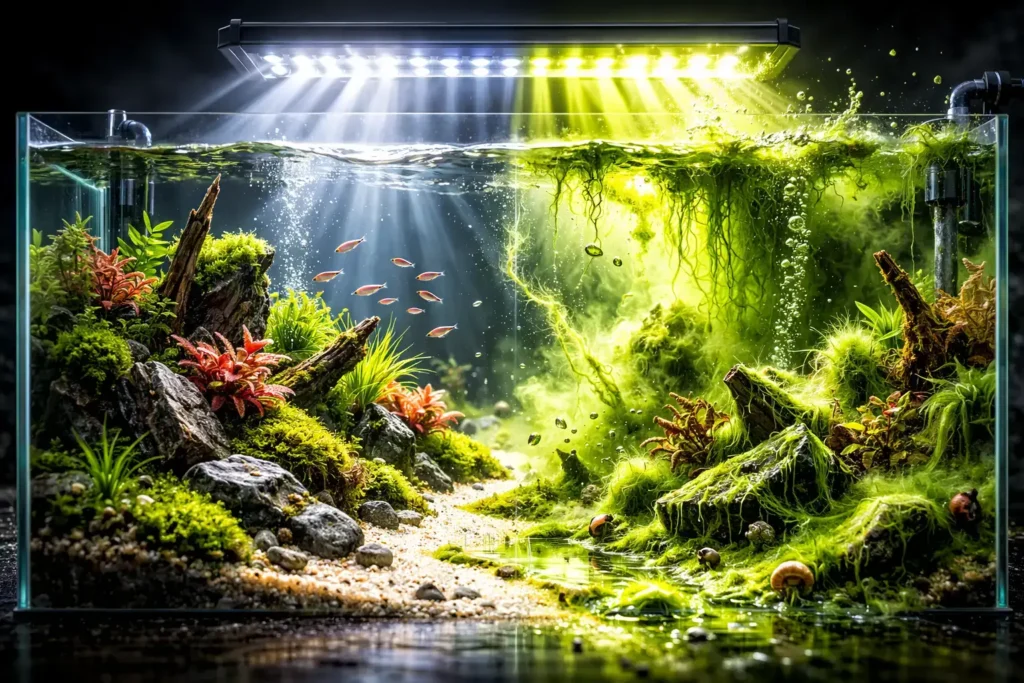
PAR is not a stand-alone success metric. Higher light increases plant demand for carbon and nutrients. When light rises faster than CO₂ stability, fertilization consistency, flow quality, and maintenance discipline, algae pressure usually rises with it.
| PAR level | CO₂ demand | System sensitivity |
|---|---|---|
| Low | Optional or modest | Forgiving |
| Medium | Helpful for stronger growth | Moderate |
| High | Usually essential for stability | Demanding |
This is why many algae problems are not truly “lighting problems” in isolation. They are mismatch problems. The light is driving more demand than the rest of the system can support. If you want to understand the carbon side in more detail, see the CO₂ System Guide. For maintenance support, the Aquarium Water Change Guide is the natural companion article.
In practical terms, one of the smartest improvements in planted tank stability is not always to add more light. Often it is to run slightly less PAR and maintain much better consistency.
PAR and Photoperiod: Why Duration Still Matters
PAR tells you how strong the light is at a given moment. Photoperiod tells you how long that intensity is applied. Plants respond not only to intensity, but also to total daily light exposure. This is why a moderate PAR level over a reasonable schedule can outperform an overly intense setup that runs too long.
For many planted aquariums, increasing runtime is not a safe substitute for proper intensity. If the substrate is underlit, extending the photoperiod often just prolongs weak growth instead of fixing the real problem. At the same time, blasting high PAR for too many hours can increase algae pressure very quickly.
A good working rule is simple: get the intensity close first, then fine-tune the duration. If you want to go deeper into timing strategy, that topic belongs more naturally in a dedicated lighting schedule lesson.
Daily Light Integral: The Bigger Picture
Daily Light Integral, often shortened to DLI, describes the total amount of photosynthetically useful light plants receive over the course of a day. In aquariums, DLI is discussed far less often than PAR, but it is an excellent concept for understanding why intensity and photoperiod cannot be separated completely.
Think of PAR as the strength of the light at a given moment, while DLI describes the total daily light dose. A tank with moderate PAR for a longer period may create a similar daily growth signal to a tank with stronger PAR for a shorter period. This does not make both setups identical, but it explains why duration changes can influence growth pressure in meaningful ways.
For most aquarists, DLI does not need to become a daily calculation habit. Its real value is conceptual. It helps you stop treating lighting as one-dimensional.
How Much PAR Do Different Aquascapes Need?
Not every aquascape needs the same PAR target. Style affects plant demand, layout density, shadow structure, and the level of refinement you expect from the final result.
| Aquascape style | Typical substrate PAR | Why |
|---|---|---|
| Low-tech planted tank | 20–40 | Stable, forgiving, slower growth |
| Nature-style aquascape | 30–60 | Balanced growth and layered planting zones |
| Dutch-style aquarium | 45–80+ | Dense stems and stronger shaping response |
| Carpet-focused aquascape | 50–90+ | Compact foreground growth and stronger bottom intensity |
A Nature style aquascape often benefits from moderate, well-distributed light rather than maximum intensity. A Dutch-style aquarium often pushes higher because dense stems and tighter group growth reward stronger energy input. Carpet-driven layouts, especially Iwagumi-inspired tanks, reveal substrate PAR weakness very quickly.
Low-tech layouts are often better served by restraint. Moderate PAR with forgiving plants usually creates a healthier long-term result than trying to imitate a high-energy aquascape without matching support systems.
Common PAR Mistakes in Planted Tanks
- Chasing high numbers without a clear plant goal → more PAR is not automatically more success
- Ignoring substrate PAR → especially damaging for carpet planning
- Using one center reading as the whole story → hides weak corners and edge zones
- Underestimating tank depth → shallow-tank recommendations often fail in deeper aquariums
- Over-lighting slow plants → often leads to algae on Anubias, Bucephalandra, and Java Fern
- Trying high PAR without stable CO₂ → common source of frustration and algae pressure
- Treating PAR as independent from photoperiod → total daily light exposure still matters
Most lighting failures in planted tanks are not caused by a lack of physics knowledge. They are caused by applying the right concept in the wrong way. PAR helps most when it guides better layout-specific decisions.
Troubleshooting Plant Growth with PAR
| Problem | Likely PAR-related cause | What to check |
|---|---|---|
| Carpet grows upward instead of sideways | Substrate PAR too low | Foreground intensity, fixture height, tank depth |
| Stem plants become leggy | Insufficient usable light | Spread, midwater intensity, plant shading |
| Anubias leaves collect algae | Too much direct light for a slow plant | Shade placement, hotspot exposure, flow balance |
| Red plants stay pale green | PAR may be too low or the whole system too weak | Intensity, CO₂ stability, nutrient consistency |
| Good stem growth but weak carpet | Strong upper light but poor substrate PAR | Depth, spread, foreground placement |
| Algae appears after increasing intensity | PAR raised beyond system balance | CO₂, maintenance, photoperiod, plant mass |
Practical PAR Setup Guide
- Choose the plant demand first. Decide whether the tank is built for epiphytes, general planted growth, or demanding carpets and stems.
- Set a realistic substrate PAR goal. Use moderate ranges for balanced tanks and stronger ranges only when the whole system can support them.
- Think in zones. Put demanding plants where the strongest usable light reaches, not simply where they look best on paper.
- Start dimmer than you think. Many modern LEDs are stronger than expected, and gradual adjustment is safer than correcting algae after over-lighting.
- Match maintenance to energy. Higher PAR means tighter discipline with CO₂, trimming, fertilization, and water changes.
- Re-evaluate as the tank matures. Dense plant mass, floating cover, and growing hardscape biofilm all affect how light behaves over time.
Conclusion
An aquarium PAR chart is most useful when it helps you connect real plant demand with real tank conditions. That means looking beyond watts, beyond lumens, and beyond the simple impression that a fixture “looks bright.” It means thinking about substrate intensity, tank depth, spread, hardscape shadows, plant zones, and the balance between light, CO₂, nutrients, and maintenance.
For most aquarists, the smartest move is not to chase the highest PAR number. It is to create a stable range that fits the plants you actually want to grow. Easy epiphytes and Cryptocoryne do not need the same environment as HC Cuba or a demanding Dutch stem layout. Once you understand that, lighting decisions become much more precise and much less frustrating.
If you want to turn this into a practical starting point for your own aquarium, use the Aquarium Lighting Calculator and compare your tank dimensions, plant goals, and target intensity more realistically before buying or adjusting a fixture.
Next step:
Use this PAR guide to define a realistic target zone for your plants, then verify your setup with the Aquarium Lighting Calculator and the broader Aquarium Lighting Guide.
💬 Join the Conversation
How do you currently judge light in your planted tank — by fixture brand, PAR data, plant response, or simple trial and error? Tag us on Instagram @AquariumLesson — we’d love to see your setup, your lighting strategy, and how your plants respond over time.
FAQ
What PAR is best for aquarium plants?
There is no single best PAR value for all aquarium plants. Easy epiphytes may thrive at 10–30 PAR, while carpeting plants and demanding stems often perform better at 40–80+ PAR, especially at the substrate.
What PAR should I measure at substrate level?
For many planted tanks, 20–30 PAR at the substrate is a realistic starting point. A stronger general planted layout often works well around 30–50 PAR. Demanding carpets may require 50–80+ PAR depending on species, depth, and system stability.
Is 50 PAR enough for aquarium plants?
Yes. In many aquariums, 50 PAR at substrate level is already fairly strong and can support a wide range of plants. Whether it is enough depends on plant type, tank depth, spread, and how balanced the rest of the system is.
Do low-light aquarium plants grow in high PAR?
They can, but that does not mean they should be placed in the brightest zone. Slow plants like Anubias and Java Fern often perform better in protected or shaded areas, even inside a brighter aquarium.
Why do my plants struggle even though my light is powerful?
A powerful fixture does not automatically mean the plants receive the right PAR where they are positioned. The real issue may be poor spread, weak substrate intensity, excessive mounting height, hardscape shadows, or a mismatch between light and CO₂ support.
Does higher PAR always cause algae?
No. Higher PAR does not directly create algae on its own. Problems usually appear when light demand rises faster than the rest of the system can keep up. In balanced high-tech tanks, stronger PAR can work very well. In unstable tanks, it exposes weaknesses quickly.
How do I read an aquarium PAR chart correctly?
Use the chart as a planning framework, not as an isolated target. Always ask where the reading is taken, whether it reflects surface or substrate PAR, how deep the tank is, what plant type you want to grow there, and whether your CO₂ and maintenance can support that light level.
Is PAR more important than lumens for planted tanks?
For plant growth, yes. Lumens describe visual brightness for human eyes, while PAR-based thinking focuses on usable light for photosynthesis. That makes PAR much more relevant when evaluating aquarium plant lighting.
New to AquariumLesson? Start with our complete Aquarium Lessons Hub or return to the homepage at AquariumLesson.com.
Continue learning
References
- Apogee Instruments — PAR, PPFD, and light measurement resources
- AquariumLesson — Aquarium Lighting Guide
- AquariumLesson — Aquarium Plants Guide
- AquariumLesson — CO₂ System Guide
- AquariumLesson — Aquarium Water Change Guide
- AquariumLesson — Aquarium Hardscape Guide