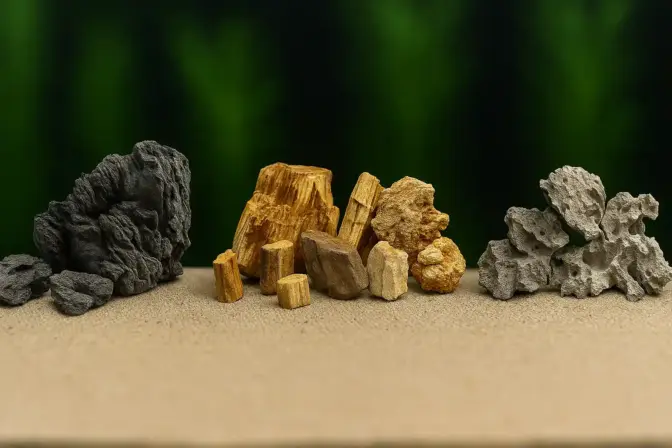
Types of Aquarium Rocks: Safe Stones, Water Chemistry & Aquascaping
Quick Answer
The safest aquarium rocks are clean, structurally sound and suitable for the water chemistry you want to keep. Granite, quartzite, plain slate, lava rock and most Dragon Stone are commonly used when little change to pH or hardness is wanted. Limestone, marble, dolomite, Texas Holey Rock and many Seiryu stones contain carbonates and can raise KH, GH and pH. A vinegar test can reveal exposed carbonate, but it cannot prove that an unknown rock is completely safe.
Choosing rock by appearance alone is risky. A stone can look perfect and still crumble, carry roadside contamination, contain sharp mineral veins or change the water over time. The useful questions are simple: What is it made of, where did it come from, how will it affect the water, and can it be placed without shifting?
Plan the complete hardscape first: Rocks add substantial weight. Include them when checking the aquarium and stand in the aquarium stand guide, and build the layout before filling the aquarium.
Types of Aquarium Rocks at a Glance
Rock names used in aquascaping do not always describe one exact geological composition. Stones sold under the same trade name can vary between deposits and suppliers. Use the table as a practical starting point, then test any unfamiliar batch before placing it in an established aquarium.
| Aquarium Rock Type | Typical Water Effect | Best Use | Main Check |
|---|---|---|---|
| Dragon Stone / Ohko | Usually little effect | Planted layouts, cliffs and detailed nature aquascapes | Remove packed clay and check fragile points |
| Lava rock | Usually little effect | Lightweight height, hidden supports, moss and epiphytes | Check rough and sharp surfaces |
| Slate | Usually little effect | Caves, terraces and flat ledges | Avoid crumbly pieces and metallic veins |
| Granite | Usually little effect | Stable structures and natural river layouts | Check weight, edges and source |
| Quartz or quartzite | Usually little effect | Neutral-water layouts and rounded stone groups | Avoid glass-sharp fractures |
| Seiryu Stone | Can raise KH, GH and pH | Iwagumi and mountain-style layouts | Test the actual stones and monitor hardness |
| Limestone / Texas Holey Rock | Raises alkalinity and hardness | Hard-water and African cichlid aquariums | Use only when the chemistry effect is wanted |
| Marble or dolomite | Can raise hardness and pH | Selected hard-water setups | A weak vinegar reaction does not rule out carbonate |
| River stones | Depends on their geology | Riverbeds and rounded natural layouts | “River stone” describes the shape, not the composition |
| Sandstone | Variable | Only when the stone is identified and remains solid | It may crumble or contain carbonate cement |
Which Rocks Are Safe for an Aquarium?
An aquarium-safe rock must pass more than one test. Water chemistry is important, but physical condition and collection history matter just as much.
1. The rock should not release unwanted material
Avoid stones with oily residue, a chemical smell, soft colored coatings, flaking paint or unknown treatments. Rocks collected beside busy roads, industrial sites, treated farmland, mine waste or polluted water are poor candidates. Cleaning removes dirt; it does not reliably remove fuel, pesticides, heavy metals or other absorbed contaminants.
2. It should remain solid underwater
Rub the dry surface firmly and scratch an inconspicuous area. A rock that sheds grains, splits into thin flakes or turns muddy during soaking may continue to break down in the aquarium. Small loose fragments can cloud the water, jam equipment or undermine a structure.
3. The edges must suit the animals
A sharp rock is not automatically unusable, but it is a poor choice where long fins, barbels or soft-bodied animals will brush against it. Run a cloth over exposed edges. If the fabric catches easily, smooth the point or place the rock where livestock cannot reach it.
4. Its effect on pH and hardness must be intentional
Carbonate-rich rocks are not poisonous. They are simply unsuitable when you are trying to maintain soft, low-alkalinity water. In a hard-water aquarium, the same stone may be useful. Match the rock to the livestock and source water instead of dividing every stone into “safe” or “unsafe.”
Read the KH vs. GH guide if the difference between alkalinity and mineral hardness is unclear, and use the aquarium pH guide before deliberately choosing a reactive rock.
Inert Aquarium Rocks vs. Rocks That Raise pH
An inert rock causes little measurable change to aquarium water under normal conditions. Granite, quartzite, many slates, lava rock and most Dragon Stone are commonly selected for this reason. “Inert” does not mean that every specimen from every location is identical, so unknown stones still need inspection and testing.
Calcareous rocks contain carbonate minerals. As those minerals dissolve, they can add alkalinity and calcium or magnesium to the water. The effect is usually stronger in acidic, low-KH water and with a larger exposed rock surface. Limestone, marble, dolomite and Texas Holey Rock belong in this group. Seiryu Stone often contains enough carbonate to affect KH, GH and pH as well.
- Choose known inert rocks when you want the source water to determine the aquarium chemistry.
- Choose carbonate-rich rocks when harder, more alkaline water suits the animals and the change can be monitored.
- Do not use a reactive stone as a quick pH fix. Its effect depends on the water and exposed surface, so it is not a precise dosing method.
Popular Aquarium Rock Types
Dragon Stone (Ohko Stone)
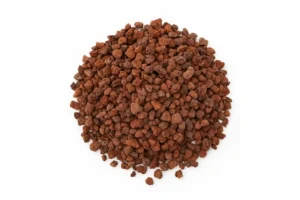
Dragon Stone has an earthy brown color with deep grooves and cavities. It works especially well in planted aquariums because small plants, moss and substrate can be worked into its surface. The stone is generally chosen when little influence on water chemistry is wanted.
The cavities often contain dried clay. Rinse and brush each piece until loose material stops washing out. Thin ridges can snap, so test them before building a tall structure.
Lava Rock
Lava rock is porous and comparatively light, making it useful for building height without filling the entire structure with dense stone. It can remain visible, support moss and epiphytes, or sit beneath more expensive feature rocks as a hidden framework.
Its rough texture is the main drawback. Check every contact point and exposed edge, particularly in aquariums with bottom-dwelling fish or animals that squeeze through narrow gaps. Porous surfaces also collect debris, so leave enough room for water flow and cleaning.
Slate
Flat slate pieces are useful for terraces, ledges and caves. Plain, sound slate usually causes little change to freshwater chemistry, but not every dark, layered rock is the same. Reject pieces that crumble, split unexpectedly or show suspicious metallic staining.
Slate caves need more than a balanced stack. Secure the structure so digging fish cannot remove the substrate beneath a support.
Granite, Quartz and Quartzite
These hard silicate-rich rocks are often good choices when a stable, low-reactivity material is wanted. Granite is dense and heavy. Quartz and quartzite can form attractive pale or rounded stones, but freshly broken edges may be extremely sharp.
Inspect mixed-color granite carefully rather than assuming that every visible mineral is harmless. A known source is always preferable to an unidentified decorative stone.
Seiryu Stone
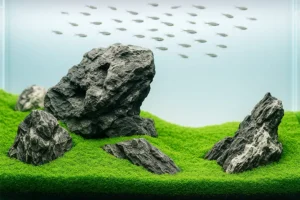
Seiryu Stone is popular for its gray surface, white veins and strong directional lines. It creates convincing mountain formations and classic Iwagumi layouts, but it should not be described as inert. Many pieces contain carbonate material and gradually increase hardness and alkalinity.
The change may be manageable in harder source water or with regular water changes, but it can be significant in a soft-water aquarium. Test the stones you actually intend to use rather than relying on the trade name alone.
Limestone, Texas Holey Rock, Marble and Dolomite
These rocks are chosen for aquariums that benefit from harder, more alkaline water. Texas Holey Rock also provides caves and visual barriers, which is useful for territorial fish. The same chemistry makes these stones a poor match for a setup intended to remain soft and acidic.
Marble is largely recrystallized carbonate, while dolomite contains calcium and magnesium carbonate. Dolomite can react less clearly with weak vinegar than calcite-rich limestone, so a quiet vinegar test does not necessarily make it inert.
River Rocks and Collected Pebbles
“River rock” tells you that water has rounded the stone; it does not identify the mineral content. A handful collected from one river can contain several different rock types. Test each visibly different group rather than treating the entire collection as one material.
Rounded stones work well in stream and riverbed layouts, but they can roll when stacked. Set them into the substrate or secure larger pieces instead of balancing smooth surfaces against each other.
Dragon Stone vs. Lava Rock
| Feature | Dragon Stone | Lava Rock |
|---|---|---|
| Appearance | Earthy, layered and deeply grooved | Dark, porous and volcanic |
| Weight | Moderate | Relatively light for its size |
| Water chemistry | Usually little effect | Usually little effect |
| Best visible use | Cliffs, valleys and planted nature layouts | Dark rockscapes, moss-covered structures and shrimp layouts |
| Best hidden use | Rarely used as filler | Excellent for building inexpensive height beneath feature stone |
| Main preparation | Brush clay from holes and check fragile ridges | Check rough edges and rinse dust from pores |
Choose Dragon Stone when the rock itself should carry the visual detail. Choose lava rock when low weight, porous texture or hidden structural volume matters more. Both can work in planted freshwater aquariums when the individual stones are clean and stable.
How to Test Rocks for an Aquarium
No single home test can identify every mineral or contaminant. Use several checks together, and reject any rock whose source or behavior remains doubtful.
Step 1: Check the source
Find out where the rock came from and whether collecting it was permitted. Avoid protected areas, private land without permission, roadsides, mine tailings, construction waste, industrial ground and waterways with pollution warnings. A commercially sold aquarium rock offers a clearer history than an unidentified landscaping stone.
Step 2: Inspect the dry rock
- Reject oily, unusually soft or strongly scented pieces.
- Look for rust-colored streaks, metallic-looking veins and loose crystals.
- Tap and handle the rock to find cracks or hollow, unstable sections.
- Brush the surface and see whether it continuously sheds grains.
- Check every exposed edge with a cloth.
Step 3: Perform the vinegar test
The vinegar test checks for exposed carbonate minerals. It does not test for toxins, metals, pollutants or structural weakness.
- Clean and dry the rock.
- Choose several areas, including a fresh scratch or broken surface when possible.
- Add a few drops of plain white vinegar.
- Watch closely for fine bubbles or fizzing.
A clear reaction means carbonate is present and the rock may increase KH, GH or pH. No visible reaction only means that weak vinegar did not detect exposed carbonate at the tested spots. It does not prove that the stone is inert or otherwise safe.
Step 4: Run a bucket test
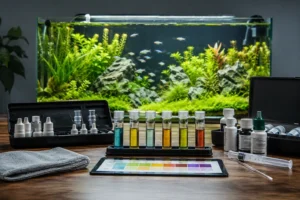
A bucket test shows how the rock behaves in your actual source water.
- Fill two clean containers with the same conditioned water.
- Record pH, KH and GH in both containers.
- Place the cleaned rock in one container and leave the other as a control.
- Keep both under the same conditions for at least seven days.
- Test both containers again and compare the change.
Repeat the test for another week when the aquarium depends on very soft water or the first result is unclear. The control matters because source water can change after standing even without a rock.
How to Clean Aquarium Rocks
New aquarium rocks usually need dust, clay and loose debris removed. Cleaning should be thorough without introducing detergent residue.
- Rinse each rock under running water.
- Scrub holes, grooves and rough surfaces with a new stiff brush reserved for aquarium work.
- Remove loose clay and unstable fragments.
- Soak the rocks in clean water, then rinse again until the water stays clear.
- Allow them to dry so cracks, residue and remaining problem areas are easier to see.
Do not use dish soap, household detergent, polish or scented cleaner. Porous rock can retain residues that are difficult to rinse away. Do not boil or bake an unknown rock: rapid heating can crack stone, and heat does not remove chemical contamination. When a collected rock may have contacted fuel, pesticides or polluted runoff, discard it rather than trying to sterilize it.
How to Place Aquarium Rocks Without Cracking the Glass
Rock placement is a structural task, not just decoration. Build the hardscape in the empty aquarium and make sure the load reaches a stable surface. Do not balance heavy stones on deep loose substrate where digging animals or maintenance can undermine them.
- Check the aquarium instructions. The permitted protective layer beneath hardscape depends on the aquarium construction.
- Clean the base and rocks. A grain trapped beneath a narrow contact point can concentrate pressure.
- Set the main stones first. Add loose substrate around them rather than relying on substrate to hold them up.
- Test every direction. Push the structure gently from the front, sides and top.
- Leave a gap from the glass. Rocks should not press against a side panel or block cleaning access.
- Secure unstable joints. Use aquarium-safe adhesive, epoxy or fully cured aquarium silicone according to its instructions.
Large structures add both total weight and concentrated contact loads. Review the aquarium glass guide before building a tall rockscape.
Aquascaping With Rocks
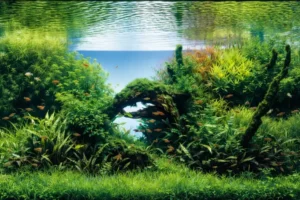
A convincing rock layout rarely comes from buying several stones of the same size and spacing them evenly. Natural formations have a dominant direction, a clear hierarchy and partly buried bases.
Use one visual rock family
Stones with matching color, texture and geological lines look as though they belong together. Mixing unrelated gray, red and white rocks usually makes the layout feel assembled rather than formed.
Start with one main stone
Choose the strongest piece first and angle the remaining stones so their layers or veins follow the same movement. Supporting stones should reinforce the focal point instead of competing with it.
Use several sizes
One large stone, a few medium pieces and smaller fragments create a more believable transition than a row of equal rocks. Small matching chips can hide joins and connect the hardscape to the substrate.
Bury the bases
A stone sitting fully above the substrate often looks placed. Bury part of the base while keeping the actual structure supported beneath it. The visible rock will appear larger and more settled.
Leave room for the aquarium to function
Keep routes open for water flow, cleaning and animal movement. A dramatic cliff loses its value when waste collects behind it or fish become trapped in narrow gaps.
For forced perspective, paths and mountain formations, continue with the diorama aquascaping guide. The broader aquarium hardscape guide covers composition beyond stone alone.
Best Rocks for Different Freshwater Aquariums
| Aquarium Goal | Useful Rock Choices | Reason |
|---|---|---|
| Stable soft to neutral water | Known granite, quartzite, plain slate, lava rock or tested Dragon Stone | These are commonly chosen for little chemistry change |
| Hard-water cichlid aquarium | Limestone, Texas Holey Rock or tested dolomite | They add caves and can support harder, more alkaline water |
| Iwagumi aquascape | Seiryu Stone or another strongly textured matching stone set | Directional lines create a clear composition; monitor chemistry with Seiryu |
| Planted nature aquarium | Dragon Stone, lava rock, slate or granite | They provide varied texture and surfaces for plants |
| Moss and epiphyte layout | Lava rock, Dragon Stone or rough granite | Irregular surfaces make attachment easier |
| Riverbed layout | Tested rounded stones of one geological family | Matching shape and color create a natural stream appearance |
| Caves and terraces | Slate or securely joined dense stone | Flat pieces form useful ledges and shelters |
Mosses, Anubias, Bucephalandra and Java fern can be attached to suitable rock without burying their rhizomes. Find more options in the epiphyte aquarium plants guide or browse the Plant Library.
Can You Collect Rocks for an Aquarium?
Collected rocks can work, but the saving is not worth guessing about pollution or mineral content. Start only where collection is legal and the site has no obvious contamination risk.
- Get permission on private land and obey local collection rules.
- Avoid protected habitats and archaeological or geological sites.
- Do not collect beside roads, railways, sprayed fields, factories or mine waste.
- Avoid rocks with tar, paint, oil, an unusual smell or heavy rust staining.
- Keep visually different stones separate and test each group.
- Photographs and identification apps can suggest a rock type, but they cannot confirm aquarium safety.
When the intended aquarium contains valuable or sensitive livestock, a known aquarium rock is the safer choice. The price difference is small compared with rebuilding a layout after the water chemistry changes.
Common Problems With Aquarium Rocks
The pH or hardness keeps rising
Test KH and GH as well as pH. Remove a suspect stone and compare the aquarium with the source water. Water changes may slow the increase, but replacing the reactive rock is the cleaner solution when soft water is the goal.
The structure moves
Drain enough water to work safely and rebuild the unstable section. Do not wedge another loose stone into the gap. Set supports on a firm base and secure joints that cannot remain stable by shape and weight alone.
The water turns cloudy after adding rocks
Dust or clay is the usual cause with new stone. Remove the worst pieces, rinse them again and use fine mechanical filtration. A rock that continues to release grains after repeated cleaning may be too soft for the layout.
Algae grows on the rock
Rock does not create algae by itself. Light, nutrients and maintenance determine how quickly the surface becomes covered. Brush visible algae during a water change, improve flow around dead areas and leave harmless biofilm in place where grazing animals use it.
A cave has sharp or narrow openings
Remove or rebuild it before adding animals. Openings should be wide enough for the intended species to turn around and leave without scraping their body or fins.
FAQ
What rocks are safe for a freshwater aquarium?
Known granite, quartzite, plain slate, lava rock and most Dragon Stone are commonly used when little change to water chemistry is wanted. Every rock should still be checked for contamination, weak areas and sharp edges.
What are the best inert rocks for an aquarium?
Granite, quartzite, many slates, lava rock and tested Dragon Stone are practical choices. Geological variation means that “usually inert” is more accurate than assuming every specimen will behave identically.
Does the vinegar test prove that a rock is aquarium-safe?
No. Fizzing identifies exposed carbonate that may raise hardness and pH. No fizz does not detect pollutants, metals, weak structure or every carbonate mineral.
Which aquarium rocks raise pH?
Limestone, marble, dolomite, Texas Holey Rock and many Seiryu stones can raise alkalinity, hardness and pH. The effect depends on the stone, water chemistry and exposed surface area.
Can I use rocks from a river?
Yes, when collection is legal and the rocks come from a clean source, remain structurally sound and pass chemistry checks. River stones are not one rock type, so test visibly different pieces separately.
Should aquarium rocks be boiled?
No boiling is needed for ordinary preparation. Scrub and rinse the rocks thoroughly. Unknown stones can crack when heated, and boiling does not remove chemical contamination.
Can aquarium rocks crack the glass?
They can damage glass when dropped, pressed against a panel or placed on an unstable point with debris beneath it. Build on a firm, clean base and follow the aquarium manufacturer’s hardscape instructions.
Is Dragon Stone or lava rock better?
Dragon Stone provides more visible detail for planted cliffs and valleys. Lava rock is lighter, cheaper for building height and useful beneath feature stones. The better choice depends on whether appearance or structural volume matters more.
Can I mix different aquarium rock types?
You can, but matching color, grain and directional lines usually creates a more natural layout. Test each rock type separately because one reactive stone can alter the water even when the others are inert.
New to AquariumLesson? Start with our complete Aquarium Lessons Hub or return to the homepage at AquariumLesson.com.