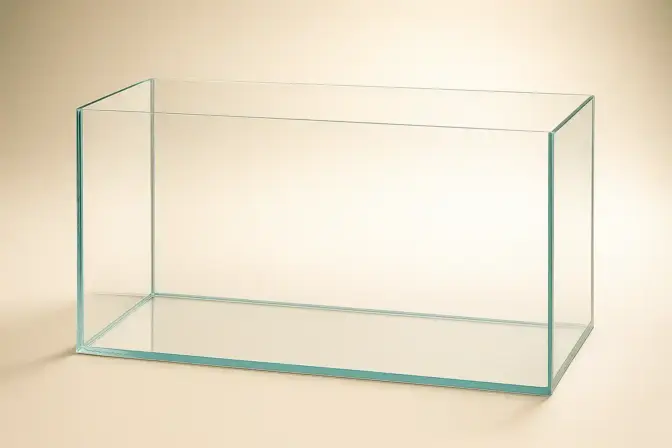
Aquarium Glass Types: Float, Low-Iron, Tempered & Rimless
Quick Answer
Most glass aquariums use standard soda-lime float glass. Low-iron glass is also float glass, but with less iron, so it has less green tint and a more neutral view. Choose standard float glass for value and low-iron glass when display clarity matters most.
Low-iron glass is not inherently easier to scratch than comparable standard float glass. Both can be scratched by trapped sand, gravel, metal blades or dirty magnetic cleaners. For structural safety, aquarium dimensions, glass thickness, bracing, edge quality, silicone joints and support matter more than whether the glass is standard or low-iron.
Compare float vs. low-iron glass, or jump to aquarium glass thickness if safety and panel size are your main concern.
Planning the complete setup? Use the aquarium volume calculator to estimate water volume. It does not calculate safe glass thickness, so always verify the exact aquarium design separately.
What Type of Glass Is Used for Aquariums?
Most home aquariums use soda-lime silicate glass produced by the float process. Molten glass is formed into a flat sheet on a bath of molten metal, creating smooth, parallel surfaces. The finished sheet may then be cut, polished, drilled, laminated or heat-treated depending on the aquarium design.
Standard clear and low-iron glass are both forms of float glass. Low-iron glass is not a separate structural system; it is a clearer version made with less iron in the raw materials.
| Glass Term | What It Describes | What It Means for an Aquarium |
|---|---|---|
| Standard clear float glass | Common soda-lime glass with a noticeable green edge tint | Widely used, affordable and suitable when the aquarium is correctly designed |
| Low-iron glass | Extra-clear float glass made with reduced iron content | More neutral color, especially through thick panels and visible edges |
| Annealed glass | Glass cooled in a controlled way without tempering | Can be cut and drilled before assembly; breakage creates larger sharp pieces |
| Tempered glass | Heat-treated glass with surface compression | Stronger against some loads and impacts, but cannot be cut or drilled after tempering |
| Laminated glass | Two or more sheets bonded with an interlayer | Broken pieces can remain attached to the interlayer; specialist design is required |
| Acrylic | A transparent plastic, not glass | Lighter and more impact-resistant, but easier to scratch and built differently |
Float Glass vs. Low-Iron Glass
The main difference is visual. Standard float glass contains enough iron to create a green cast. The effect is mild through a thin front panel but becomes more obvious through thicker glass, at the edges and when viewing pale sand, white stone or red plants.
Low-iron glass reduces that color shift. Whites look cleaner, reds remain more accurate and polished edges appear pale blue rather than deep green. This is why low-iron front panels are popular in rimless display aquariums and aquascapes.
| Feature | Standard Float Glass | Low-Iron Glass |
|---|---|---|
| View through the panel | Slight green cast | More neutral and color-accurate |
| Edge color | Green, increasingly visible as thickness rises | Paler blue-green edge |
| Scratch resistance | Typical glass surface hardness | Not inherently softer than standard clear glass |
| Tensile performance | Depends on processing, edge quality and design | Comparable to standard clear glass of the same type and processing |
| Cost | Usually lower | Usually higher |
| Best use | General aquariums, utility setups and budget-conscious builds | Display fronts, thick panels and aquascapes where color neutrality matters |
Is low-iron aquarium glass easier to scratch?
No. The common claim that low-iron glass is softer than regular float glass is not supported by manufacturer technical data. Comparable low-iron and standard clear glass have the same surface hardness and resistance to abrasion when processed in the same way.
Both can be scratched by sand, gravel, metal blades or grit trapped in a magnetic cleaner. Low-iron glass deserves careful cleaning because it is expensive and chosen for its appearance, not because it requires a completely different cleaning method.
Is low-iron glass worth it?
It is worth considering when the front panel is thick, the edges remain visible or the aquarium is built around precise plant and hardscape colors. The difference is less important in a small aquarium with a dark background, dark substrate or framed edges.
A practical compromise is a low-iron front panel with standard clear glass on the sides and rear. This preserves the main viewing benefit without paying for low-iron glass where it is rarely seen.
What Is the Best Glass for an Aquarium?
The best glass is the one used in a properly designed aquarium that suits the way it will be viewed and maintained.
- For a standard freshwater aquarium: Clear float glass is usually the sensible choice.
- For a display aquascape: Low-iron glass improves color neutrality and reduces the green edge tint.
- For a rimless aquarium: Buy a finished aquarium with published dimensions, glass thickness and installation instructions.
- For an aquarium that may need plumbing holes: Confirm which panels are annealed and approved for drilling before any work begins.
- For a large custom aquarium: Use a specialist builder or engineer rather than adapting a general thickness chart.
Clarity should never take priority over construction. A well-made standard glass aquarium is a better choice than a poorly supported low-iron aquarium with uncertain seams or thickness.
How Thick Should Aquarium Glass Be?
Aquarium glass thickness cannot be selected from volume or height alone. Water pressure increases with depth, so height is important. The length of the unsupported panel also affects how far the glass can flex. Bracing, glass type, edge finish, silicone joint design and the chosen safety margin change the result again.
This is why two aquariums holding a similar volume can use different glass thicknesses. A long, shallow aquarium and a short, tall aquarium place different demands on their panels. A braced aquarium and a rimless aquarium with identical outside dimensions are also different structures.
Aquarium glass thickness chart
The table below shows real dimensions and glass thicknesses found in one established line of finished rimless aquariums. It is useful for understanding how thickness rises with both height and span, but it is not a DIY construction chart. The manufacturer’s glass, edges, seams, workmanship and installation system form part of each finished design.
| Aquarium Dimensions | Glass Thickness | Approx. Capacity |
|---|---|---|
| 30 × 18 × 24 cm | 5 mm | 12 L |
| 30 × 30 × 30 cm | 5 mm | 25 L |
| 45 × 27 × 30 cm | 5 mm | 34 L |
| 60 × 30 × 36 cm | 6 mm | 60 L |
| 60 × 30 × 45 cm | 6 mm | 75 L |
| 60 × 45 × 36 cm | 6 mm | 90 L |
| 90 × 45 × 45 cm | 10 mm | 166 L |
| 120 × 50 × 50 cm | 12 mm | 273 L |
| 150 × 60 × 60 cm | 15 mm | 490 L |
| 180 × 60 × 60 cm | 15 mm | 590 L |
Do not copy one row into a custom build and assume it is safe. Even a small change in height, length, bracing, glass condition or seam design changes the calculation. Use the specifications for the exact finished aquarium or obtain a design from a competent aquarium builder.
What determines aquarium glass thickness?
- Water height: Deeper water creates greater pressure near the bottom of the panel.
- Panel length: A longer unsupported span can flex more than a short one.
- Bracing: A center brace or perimeter brace reduces the unsupported span when it is part of the original design.
- Rimless construction: The open top leaves the front and rear panels without an upper frame or cross brace.
- Glass processing: Annealed, heat-strengthened, tempered and laminated panels behave differently.
- Edge quality: Chips, poor grinding and damaged edges reduce confidence in the panel.
- Silicone joint design: Bond area, preparation, sealant and workmanship affect the complete aquarium.
- Support underneath: The aquarium must sit on the base or perimeter support specified by its manufacturer.
- Safety margin: A calculated panel should not operate at the point where failure is expected.
Rimless vs. Braced Aquariums
Rimless and braced aquariums can both be safe when built and installed correctly. They control panel movement in different ways.
| Feature | Rimless Aquarium | Braced Aquarium |
|---|---|---|
| Top edge | Open and unobstructed | Supported by a frame, center brace or glass perimeter bracing |
| Visual appearance | Clean lines and exposed polished edges | Bracing remains visible from above or across the opening |
| Glass requirement | Often thicker for the same dimensions | Bracing can reduce panel movement and unsupported span |
| Maintenance access | Excellent open access | Cross braces can restrict large tools or hardscape |
| Installation | Flat, level support and any specified mat are critical | Support must match the frame or base design |
| Common mistake | Assuming all rimless aquariums need the same mat or thickness | Removing or modifying a brace because it appears inconvenient |
Never remove a center brace or cut a perimeter brace from a filled aquarium. It is part of the structure. If a brace is cracked, distorted or detached, empty the aquarium to a safe level and contact the manufacturer or a qualified repairer.
Annealed vs. Tempered Aquarium Glass
Annealed glass is common in aquarium side panels because it can be cut, edge-finished and drilled before assembly. When it breaks, it forms larger sharp fragments.
Tempered glass is heat-treated after cutting and drilling. The treatment creates compressive stress at the surface, increasing resistance to some bending and impact loads. When it fails, the entire panel breaks into many small pieces. Tempered glass cannot be cut, ground or drilled after tempering.
Some manufactured aquariums use annealed front and side panels with a tempered bottom. Others use different combinations. Do not assume that every panel in one aquarium has received the same treatment.
How can you tell whether aquarium glass is tempered?
Look for a permanent etched or printed tempering mark and check the manufacturer’s specifications for the exact model. A missing mark does not provide enough certainty for drilling. When the panel type cannot be confirmed, treat it as unsuitable for modification.
Can tempered aquarium glass be drilled?
No. Drilling, cutting or edge-grinding a tempered panel can cause it to shatter. Any holes must be made before the glass is tempered. Even annealed aquarium glass should only be drilled when the panel location, thickness, edge distance and remaining strength have been assessed.
Glass vs. Acrylic Aquariums
| Feature | Glass | Acrylic |
|---|---|---|
| Scratch resistance | Better resistance to routine cleaning scratches | Scratches more easily but can often be polished |
| Weight | Heavier | Much lighter |
| Impact behavior | Rigid and brittle | More flexible and impact-resistant |
| Shapes | Best suited to flat panels and manufactured curves | Easier to form into large curves and unusual shapes |
| Long spans | Requires thickness and bracing appropriate to the design | Can be practical for very large custom aquariums |
| Cleaning | More tolerant of common glass tools | Requires acrylic-safe pads and scrapers |
Glass remains the straightforward choice for most home aquariums. Acrylic becomes more attractive where low weight, impact resistance, curved panels or very large dimensions matter enough to justify more careful scratch management.
Aquarium Glass Support and Stand Requirements
The glass and stand form one system. A correctly built aquarium can still be damaged by an uneven, undersized or unsuitable support surface.
- Match the full footprint: Do not allow the aquarium to overhang the stand.
- Follow the required support pattern: Some framed aquariums rest on the perimeter, while many rimless aquariums require full base support.
- Use a mat only when specified: Some manufacturers require a particular foam mat; others require direct contact with the stand.
- Level the stand first: Do not use random material beneath one corner of the aquarium.
- Keep the surface clean: Remove grit, screws and hard debris before placing the aquarium.
- Recheck after positioning: Confirm that the stand remains stable before adding substrate and water.
The aquarium stand guide explains footprint, filled weight, floor loading and leveling in more detail.
Heavy Rocks and Glass Safety
Aquascaping rocks add weight and can create concentrated contact points. Place the main stones before deep loose substrate, make sure they cannot shift and keep hard edges away from the side panels. A grain trapped beneath a narrow contact point can concentrate pressure.
Do not assume that every aquarium should have foam or plastic beneath the hardscape. The correct base protection depends on the aquarium design and manufacturer instructions. The aquarium rocks guide covers stable placement, cleaning and rock safety.
How to Clean Aquarium Glass Without Scratching It
- Use a clean pad or scraper intended for aquarium glass.
- Check both halves of a magnetic cleaner for trapped sand before every use.
- Keep the cleaner away from the substrate where grit is easiest to collect.
- Work slowly near silicone seams and avoid cutting into the seal.
- Follow the aquarium manufacturer’s instructions before using a metal blade.
- Use a separate soft cloth on the outside so household dust is not dragged across the panel.
Low-iron glass does not need special treatment because it is softer; it needs the same grit-free technique as standard glass. A deep scratch, chip or damaged edge should be assessed rather than polished casually. Machine polishing can distort the view, create heat and weaken a local area when done incorrectly.
Inspecting Seams, Chips and Bowing
Inspect the aquarium before setup and during routine maintenance. Look for a new chip, a crack extending from an edge, silicone separating from the glass, bubbles that are spreading through a structural seam, a damaged brace or a panel shape that has changed.
There is no universal bowing limit that can be applied to every aquarium. Some movement may be part of a design, while a new or increasing curve can signal a problem. Compare with the manufacturer’s specification and do not add an improvised brace to a filled aquarium.
Small cosmetic bubbles in a silicone fillet are not automatically a leak, but separation within the bonded seam deserves attention. When a crack, active leak or changing seam is visible, move livestock and reduce the water load safely instead of waiting for the damage to worsen.
DIY Aquarium Glass: What a Thickness Calculator Cannot Tell You
An aquarium glass thickness calculator can estimate panel stress only from the assumptions built into it. It cannot inspect edge quality, confirm the glass treatment, choose a suitable silicone joint, assess workmanship or guarantee that the stand is flat.
DIY construction also requires accurate cutting, finished edges, controlled joint gaps, clean bonding surfaces, compatible structural silicone and enough curing time for the exact sealant and seam size. “Aquarium-safe” on a tube does not replace structural suitability.
Small experimental aquariums still release enough water to damage a room. Large, tall, rimless or drilled builds should be designed and assembled by someone who understands glass engineering and structural silicone rather than copied from a generic chart.
Common Aquarium Glass Mistakes
- Choosing glass thickness from aquarium volume alone
- Using a height-only chart as construction approval
- Assuming low-iron glass is weaker or easier to scratch
- Calling low-iron and float glass two completely different manufacturing systems
- Drilling a panel without confirming whether it is tempered
- Removing a center brace from a manufactured aquarium
- Adding a foam mat without checking the installation instructions
- Allowing a rimless aquarium to overhang the stand
- Dragging a magnetic cleaner through sand at the bottom edge
- Polishing a deep scratch while the aquarium remains filled
FAQ
What type of glass is used for aquariums?
Most glass aquariums use soda-lime float glass. It may be standard clear or low-iron and may remain annealed or receive further processing such as tempering or lamination.
Is float glass suitable for an aquarium?
Yes. Standard float glass is widely used in manufactured aquariums. Suitability depends on the complete design, including dimensions, thickness, bracing, edges, seams and support.
What is the difference between float and low-iron aquarium glass?
Both are float glass. Low-iron glass contains less iron, so it has less green tint and shows colors more neutrally. Comparable products have similar surface hardness and tensile performance.
How thick should aquarium glass be?
Thickness depends on water height, panel length, bracing, glass processing, edge condition, seam design, support and safety margin. Use the specifications for the exact aquarium or a professionally engineered design.
Is 5 mm glass safe for a 90 × 45 × 45 cm aquarium?
Dimensions alone are not enough to approve a build. As a comparison, one established commercial rimless aquarium of that size uses 10 mm glass. A braced design behaves differently, but 5 mm should not be accepted without a verified structural design.
Is low-iron aquarium glass more fragile?
Not simply because it contains less iron. Low-iron and standard clear glass of the same type can have comparable surface hardness and tensile performance. Processing, edge quality and aquarium design matter more.
Can low-iron glass be tempered?
Yes. Low-iron float glass can be heat-treated, laminated and processed in many of the same ways as standard float glass. Any cutting and drilling must be completed before tempering.
Can aquarium glass be drilled?
Some annealed panels can be drilled by a competent person when the design allows it. Tempered glass cannot be drilled. Confirm the exact panel type and manufacturer guidance before attempting any modification.
Does a rimless aquarium need thicker glass?
Often yes, because it lacks an upper frame or cross brace. The required thickness still depends on the full dimensions, glass, seam design and safety margin rather than the word “rimless” alone.
Should foam be placed under a glass aquarium?
Only when the aquarium manufacturer requires a specific mat or full-base support. Some framed aquariums must sit directly on their perimeter frame, while many rimless models include or require a leveling mat.
Can scratched aquarium glass be repaired?
Very light surface marks may sometimes be professionally polished, but deep scratches and edge damage need assessment. Polishing can distort the panel or remove too much material when done incorrectly.
New to AquariumLesson? Start with our complete Aquarium Lessons Hub or return to the homepage at AquariumLesson.com.