
Beginner Community Fish: Peaceful Tank Guide
Introduction
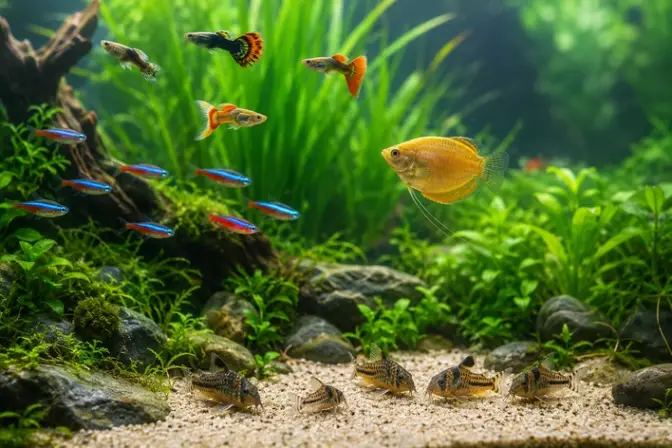
Beginner community fish are peaceful freshwater species that can live together in the same aquarium when their size, temperament, water needs, activity level, and social behavior are compatible. A good community tank is not a random mix of colorful fish. It is a planned ecosystem where each species has enough space, clean water, suitable tankmates, and a clear role in the layout.
Many beginners dream of a lively aquarium with fish swimming at every level: a colorful school in the middle, a calm centerpiece fish, bottom dwellers exploring the substrate, and maybe shrimp or snails helping complete the system. That can work beautifully — but only when the community is built around compatibility instead of impulse buying.
This guide explains how to choose the best community fish for beginners, how to combine species safely, which fish belong in different tank zones, which popular fish are risky, and how to avoid overstocking, aggression, stress, and water quality problems in your first peaceful aquarium.
If you are still learning the basics of fish selection, start with the Easy Fish for Beginners guide and the broader Aquarium Fish Guide.
Quick answer: The best beginner community fish are peaceful, appropriately sized species that share similar water temperature, pH, hardness, temperament, and activity levels. Good options include harlequin rasboras, ember tetras, platies, cherry barbs, corydoras, honey gouramis, white cloud mountain minnows, and carefully selected livebearers.
What You’ll Learn in This Lesson
- What makes a fish suitable for a beginner community tank
- How to choose peaceful freshwater species that actually fit together
- Why tank zones matter when planning a community aquarium
- Which beginner community fish are safest for first-time aquarists
- Which popular fish are often misunderstood in community tanks
- How to avoid overstocking, aggression, stress, and feeding competition
- How to build simple stocking plans for small and medium aquariums
- Why cycling, water testing, and maintenance are essential before adding fish

What Is a Beginner Community Fish Tank?
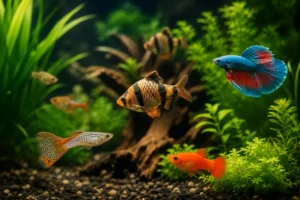
A beginner community fish tank is a freshwater aquarium that contains multiple compatible species living together peacefully. The goal is harmony: fish should not constantly chase, hide, nip fins, compete for every bite of food, or force each other into unsuitable areas of the tank.
A community aquarium usually includes fish with different behaviors and swimming zones. Some fish school in the midwater. Some explore the bottom. Some act as a calm centerpiece. Some stay near plants or shaded areas. When planned correctly, these differences make the aquarium feel alive without creating conflict.
For beginners, the best community tanks are simple. One strong schooling group, one peaceful centerpiece fish, and one compatible bottom group can often work better than many small groups of unrelated species. The fewer competing needs you combine, the easier the aquarium becomes.
| Good Community Tank | Problem Community Tank |
|---|---|
| Fish share similar water needs | Fish require different temperatures or hardness |
| Species have peaceful temperaments | Aggressive and shy fish are mixed together |
| Stocking is gradual and controlled | All fish are added at once |
| Each species has enough space | Too many fish compete in one zone |
| Groups are large enough for social fish | Schooling fish are kept alone or in tiny groups |
| Maintenance matches the bioload | Fish waste overwhelms the system |
A peaceful community tank is designed before fish are purchased. Do not buy fish first and try to make them fit together later.
What Makes a Fish Good for a Beginner Community?
A good beginner community fish should be peaceful, hardy, easy to feed, suitable for your tank size, and compatible with other calm species. It should not grow too large, bully tankmates, require extreme water conditions, or depend on advanced care.
The best community fish also have predictable behavior. They do not constantly defend large territories, nip fins, hunt smaller fish, or outcompete shy species at feeding time. They should be active enough to enjoy but not so hyperactive that slower fish become stressed.
- Peaceful temperament: The fish should not regularly attack, chase, or intimidate tankmates.
- Manageable adult size: Adult size matters more than store size.
- Clear social needs: Schooling and shoaling fish should be kept in proper groups.
- Compatible temperature: Warm tropical fish and cooler-water fish should not be forced together.
- Similar water preferences: pH, GH, KH, and general hardness should be reasonably compatible.
- Normal feeding habits: The fish should accept appropriate prepared foods and not starve slower tankmates.
- Low aggression risk: Avoid species known for fin nipping, territoriality, or predation in beginner communities.
No fish is “community-safe” in every situation. Tank size, group size, sex ratio, decor, plant cover, and individual temperament can all change behavior. That is why observation matters after stocking.
Best Beginner Community Fish
The following fish are commonly suitable for beginner community aquariums when the tank is cycled, the group size is correct, and the water conditions match. Use this list as a planning guide, not a shopping cart.
| Fish | Tank Role | Why It Works | Beginner Caution |
|---|---|---|---|
| Harlequin Rasbora | Midwater school | Peaceful, calm, attractive in groups | Needs a proper group |
| Ember Tetra | Small midwater school | Peaceful, colorful, good for planted tanks | Best in stable mature aquariums |
| Black Neon Tetra | Midwater school | Hardy, peaceful, less delicate than some tetras | Needs group and swimming space |
| Cherry Barb | Active peaceful group | Colorful and calmer than many barbs | Do not keep alone |
| Platy | Colorful livebearer | Hardy, active, easy to feed | Breeding can increase stocking quickly |
| Guppy | Small active livebearer | Colorful and popular | Breeding and strain health vary |
| Endler’s Livebearer | Small active livebearer | Colorful, tiny, good in harder water | Breeding control matters |
| Corydoras | Bottom group | Peaceful, social, interesting behavior | Needs group, smooth substrate, and direct feeding |
| Honey Gourami | Peaceful centerpiece | Calm, attractive, good for planted tanks | Avoid aggressive or hyperactive tankmates |
| White Cloud Mountain Minnow | Cooler-water group | Hardy and peaceful | Do not mix with warm tropical fish that need higher temperatures |
Choose fish that fit together as a system. A community aquarium should be planned around shared needs, not just a list of peaceful names.
Harlequin Rasboras for Peaceful Community Tanks
Harlequin rasboras are one of the strongest beginner community fish because they are peaceful, attractive, and relatively calm. They work especially well in planted aquariums with open swimming space and gentle tankmates.
They should be kept in a group. A proper group makes them more confident and helps them show natural shoaling behavior. Keeping only one or two can cause stress and poor behavior.
Harlequin rasboras are a good choice when you want a peaceful midwater group that does not dominate the tank. They combine well with other calm species when temperature and water parameters match.
- Best role: main schooling or shoaling group.
- Best setup: planted community aquarium with open midwater space.
- Avoid: aggressive barbs, fin nippers, large predators, and tiny groups.
Tetras in Beginner Community Aquariums
Tetras are classic community fish, but not all tetras are equally beginner-friendly. Some are hardy and peaceful, while others are sensitive, large, nippy, or better suited to mature aquariums.
Ember tetras, black neon tetras, and some other peaceful small tetras can work well in beginner communities. Neon tetras are very popular, but they often do best in stable, mature aquariums rather than brand-new tanks with changing water conditions.
Tetras should usually be kept in groups. A larger group of one tetra species is almost always better than two or three individuals from several different species.
| Tetra Type | Community Use | Beginner Note |
|---|---|---|
| Ember Tetra | Small peaceful planted tanks | Good when water is stable |
| Black Neon Tetra | Hardy community school | Often more forgiving than delicate species |
| Neon Tetra | Classic colorful school | Better after tank maturity and stability |
| Serpae Tetra | Colorful but more nippy | Not ideal for calm beginner communities |
| Rummy Nose Tetra | Beautiful tight schooling fish | Often better for experienced aquarists with stable tanks |
If you choose tetras, build the tank around a proper group, stable water, and peaceful tankmates.
Livebearers in Beginner Community Tanks
Livebearers such as platies, guppies, and Endler’s livebearers are popular beginner community fish because they are colorful, active, and easy to feed. They often do well in harder water and can bring constant movement to the aquarium.
The main issue is breeding. If males and females are kept together, fry may appear regularly. This can turn a peaceful beginner tank into an overstocked aquarium if there is no plan.
Livebearers also vary in long-term health depending on strain and source. Fancy guppies, for example, can be more delicate than beginners expect. Choose active fish from clean tanks and avoid individuals with clamped fins, damaged tails, white spots, or weak swimming.
- Good for: active community aquariums with suitable water.
- Best choices: platies, guppies, Endler’s livebearers.
- Main caution: breeding, overstocking, and sex ratio planning.
- Beginner tip: A male-only group can reduce breeding pressure where appropriate.
Do not mix livebearers with fish that require very different water conditions just because they are all labeled peaceful.
Cherry Barbs as Calm Beginner Barbs
Many barbs are too active or nippy for calm beginner communities, but cherry barbs are often a better option. They are generally peaceful, colorful, and suitable for planted aquariums when kept in a proper group.
Cherry barbs do best with plant cover and open swimming space. They should not be kept alone, and they should not be combined with aggressive fish that make them hide constantly.
They are a good choice for beginners who want warm color and activity without choosing a more problematic barb species.
- Best role: peaceful active group.
- Best setup: planted community tank with cover and calm tankmates.
- Avoid: tiny groups, aggressive tankmates, and bare stressful layouts.
Corydoras in Community Tanks
Corydoras are excellent community fish when their needs are respected. They are peaceful, social bottom dwellers that spend much of their time exploring the substrate. However, they are not “cleaner fish” that replace maintenance.
Corydoras need a group, smooth substrate, clean water, and suitable food. They should be fed directly with sinking foods rather than expected to survive on leftovers. Rough substrate and poor water quality can create health problems.
They are usually better in a mature aquarium than a brand-new unstable tank. In the right setup, they add natural bottom activity without aggression.
- Best role: peaceful bottom group.
- Best setup: mature tank with smooth sand or gentle substrate.
- Avoid: rough gravel, poor water quality, and keeping only one or two.
Honey Gouramis as Centerpiece Fish
Honey gouramis can be excellent centerpiece fish for beginner community aquariums. They are usually calmer and more manageable than larger or more aggressive gourami species.
A honey gourami works best in a peaceful planted tank with gentle tankmates. Floating plants, tall plants, and shaded cover can help them feel secure. Avoid aggressive fish, fin nippers, and hyperactive species that may outcompete them at feeding time.
If you want one visually interesting fish without building the tank around a territorial predator, a honey gourami can be a strong beginner choice.
- Best role: peaceful centerpiece fish.
- Best setup: calm planted community tank.
- Avoid: aggressive barbs, large territorial fish, and chaotic active communities.
Tank Zones: Build a Community That Uses Space Well
A peaceful community aquarium should use space intelligently. If every fish occupies the same zone, they may compete for room and food. A balanced community uses top, middle, and bottom areas without overcrowding any one level.
This does not mean every tank needs fish in all zones. It means you should understand where each species naturally spends time. A small tank with one healthy group may be better than a crowded tank trying to fill every layer.
| Tank Zone | Beginner Fish Examples | Planning Note |
|---|---|---|
| Top / surface area | Guppies, Endler’s livebearers, some killifish | Needs calm surface access and suitable cover |
| Midwater | Harlequin rasboras, tetras, cherry barbs, white clouds | Usually best as the main schooling group |
| Bottom | Corydoras, kuhli loaches in suitable mature tanks | Needs smooth substrate and direct feeding |
| Centerpiece role | Honey gourami, carefully planned betta setups | Should not be bullied or stressed by active fish |
| Cleanup/support species | Snails, shrimp in compatible setups | They support the system but do not replace maintenance |
For broader livestock planning, read the Aquarium Fish, Shrimp & Snails Guide.
Best Community Fish by Tank Size
Tank size should decide your stocking plan. A fish can be peaceful and still unsuitable for a small aquarium if it needs a group, swimming length, or more stable water than the tank provides.
For beginners, a moderate aquarium is usually easier than a tiny one. More water volume provides better stability and more realistic stocking options. Before planning fish, check your real water volume with the Aquarium Volume Calculator.
| Tank Size Direction | Beginner Community Strategy | Important Note |
|---|---|---|
| Under 40 liters | Not ideal for mixed communities | Consider shrimp, snails, plants, or one carefully planned fish setup |
| 40–60 liters | One small group or one centerpiece direction | Avoid mixing too many species |
| 60–100 liters | Good beginner community range | One main school plus a compatible support species may work |
| 100–150 liters | Strong community flexibility | Better for schooling fish, bottom groups, and centerpiece fish |
| Over 150 liters | More options but still needs planning | Avoid assuming size alone solves compatibility |
A larger tank does not mean unlimited fish. It simply gives you more stability and more room to build a peaceful structure.
Community Fish Compatibility Rules
Compatibility is the core of a community aquarium. Beginners often think compatibility means “will they fight?” But true compatibility includes water chemistry, temperature, swimming space, group size, activity level, feeding style, and long-term adult size.
Before mixing species, compare these factors:
- Temperature: Do not mix cooler fish with warm tropical fish if their needs conflict.
- pH and hardness: Choose fish that match your water reasonably well.
- Adult size: Small juveniles can become large adults.
- Mouth size: Large fish may eat smaller tankmates.
- Activity level: Hyperactive fish can stress calm species.
- Fin-nipping risk: Avoid nippy fish with long-finned or slow fish.
- Territorial behavior: Some fish become aggressive when mature.
- Group needs: Schooling fish need groups, not lonely individuals.
- Feeding style: Make sure all fish get food without competition.
Use your tap water as a starting point rather than constantly fighting it. The Aquarium Water Parameters Guide explains pH, GH, KH, ammonia, nitrite, nitrate, and other values that influence fish health.
Fish to Avoid in Beginner Community Tanks
Some fish are popular, attractive, or commonly sold, but they are not always good beginner community fish. They may grow too large, produce too much waste, become aggressive, eat smaller fish, nip fins, or need more specialized care.
This does not mean these fish are bad. It means they should not be used casually in a first peaceful community setup.
| Fish or Group | Why It Can Be Risky | Beginner Advice |
|---|---|---|
| Goldfish | Heavy waste, large size, cooler water needs | Do not mix with tropical community fish |
| Common Pleco | Often grows far too large for beginner tanks | Research adult size before buying any pleco |
| Large Cichlids | Territorial, predatory, or aggressive behavior | Avoid in peaceful beginner communities |
| Tiger Barbs | Can be nippy and active | Not ideal with slow or long-finned fish |
| Red Tail Shark | Can become territorial | Needs more space and careful tankmates |
| Chinese Algae Eater | Can become problematic as it matures | Do not buy as a simple cleaner fish |
| Male Betta in random community | Temperament varies and fins can be targeted | Plan carefully or keep as a solo centerpiece |
| Very delicate wild-type species | May need stable mature conditions | Start with hardy captive-bred fish |
Never buy a fish as a “cleaner” without understanding its adult size and care needs. Maintenance is your job, not the fish’s job.
Beginner Community Stocking Plans
The safest community stocking plans are simple. These examples are not exact formulas because final stocking depends on tank size, filtration, water parameters, plants, substrate, and fish availability. Use them as structure, not as automatic recipes.
Peaceful Planted Community
A peaceful planted community might use one group of harlequin rasboras or ember tetras, a honey gourami as a calm centerpiece, and a group of corydoras if the tank is large enough and mature enough. Plants provide cover, visual barriers, and comfort.
Livebearer Community
A livebearer community can focus on platies, guppies, or Endler’s livebearers. This setup works best in suitable harder water. Breeding must be planned carefully, especially in smaller aquariums.
Cooler Water Community
A cooler freshwater community might focus on white cloud mountain minnows with other species that enjoy similar temperatures. Do not mix them into warm tropical tanks just because they are hardy.
Small Community Tank
In a smaller tank, avoid trying to include top, middle, bottom, and centerpiece fish all at once. One healthy group of small peaceful fish may be better than a crowded miniature community.
Centerpiece-Based Community
A centerpiece-based community starts with one calm focal species, such as a honey gourami, and then adds peaceful schooling fish that will not bully or outcompete it. The centerpiece fish should shape the tankmate list, not be added as an afterthought.
How Many Fish Should Beginners Add First?
Beginners should add fish gradually. Even after cycling, a young aquarium’s biological system needs time to adjust to real fish waste. Adding too many fish at once can create ammonia or nitrite problems and stress the entire community.
Start with one suitable group or one clear stocking direction. Test water after adding fish. Feed lightly. Watch behavior. Wait before adding more fish.
- Do not fully stock the aquarium in one shopping trip.
- Add one compatible group first.
- Test ammonia and nitrite after stocking.
- Watch for chasing, hiding, fin nipping, and feeding competition.
- Let the aquarium stabilize before adding another species.
- Keep the final stocking plan lighter than the theoretical maximum.
If the aquarium is not cycled yet, do not add fish. Use the Fishless Cycle Guide before stocking.
Cycling Before Adding Community Fish
A beginner community tank must be cycled before fish are added. A cycled aquarium has beneficial bacteria that help process fish waste. Without them, ammonia and nitrite can rise and harm fish.
Community tanks can become risky because multiple species are added in a short time. Each new fish increases waste production. If the biological filter is immature, the system can become unstable quickly.
- Set up the tank before buying fish.
- Run the filter continuously.
- Use a proper cycling method.
- Test ammonia, nitrite, and nitrate.
- Add fish gradually only after the tank is ready.
- Do not use fish as cycling tools.
Start with the Aquarium Cycling Guide. If fish were already added too early, read the New Tank Syndrome Guide and act carefully based on water test results.
Feeding a Beginner Community Tank
Feeding a community tank is more complex than feeding one species. Different fish may eat at different levels, move at different speeds, and prefer different food sizes. Fast fish can steal food from slower fish, while bottom dwellers may be ignored if food never reaches them.
A good feeding routine makes sure every species gets suitable food without overfeeding the aquarium. Extra food is one of the fastest ways to pollute a beginner tank.
- Use food that matches the fish’s mouth size.
- Feed small portions.
- Watch whether all fish actually eat.
- Use sinking foods for bottom dwellers when needed.
- Do not rely on leftovers to feed corydoras or loaches.
- Remove obvious uneaten food where possible.
- Reduce feeding if water quality becomes unstable.
A peaceful community tank is easier to feed when all fish have compatible feeding speeds and food requirements.
Plants and Layout for Peaceful Communities
Plants and hardscape are not just decoration. They help reduce stress by creating cover, visual barriers, shaded areas, resting places, and territory boundaries. A bare tank can make peaceful fish feel exposed and can increase chasing or hiding.
Beginner community tanks usually benefit from easy plants, driftwood, rocks, and open swimming areas. The layout should provide shelter without blocking all movement.
- Use background plants to create security.
- Leave open midwater space for schooling fish.
- Add shaded zones for shy species.
- Use hardscape to break lines of sight.
- Keep bottom areas accessible for corydoras or other bottom fish.
- Avoid sharp decor that can damage fins or barbels.
For beginner plant choices, read the Aquarium Plants Guide. A planted tank is often easier for peaceful community fish because it creates a more natural and secure environment.
Common Beginner Community Fish Mistakes
Most community tank mistakes happen because beginners add fish based on color, price, or availability instead of compatibility. A peaceful community requires planning.
| Mistake | Why It Causes Problems | Better Approach |
|---|---|---|
| Mixing too many species | Creates competition and unclear needs | Start with one main group and build slowly |
| Keeping schooling fish alone | Causes stress and unnatural behavior | Keep proper groups where tank size allows |
| Adding aggressive fish | Leads to chasing, hiding, and injury | Choose peaceful species only |
| Ignoring adult size | Fish may outgrow the tank or eat tankmates | Research adult size before purchase |
| Mixing different temperature needs | One species is always compromised | Choose fish with matching temperature ranges |
| Overstocking | Increases waste, stress, and disease risk | Stock lightly and gradually |
| Buying cleaner fish | No fish replaces maintenance | Choose support species only if their care needs fit |
| Skipping cycling | Ammonia and nitrite can harm fish | Cycle first and test water |
If you want a broader beginner error checklist, use the Easy Fish for Beginners guide and compare your stocking plan before buying fish.
Final Beginner Community Fish Checklist
Before buying community fish, run through this checklist. It will prevent most beginner compatibility problems.
- The aquarium is fully cycled.
- Ammonia and nitrite are safe.
- The tank size fits the adult fish and group sizes.
- All species share compatible temperature needs.
- Water parameters are suitable for the chosen fish.
- Schooling or shoaling fish will be kept in proper groups.
- Aggressive, nippy, predatory, or territorial fish are avoided.
- The tank has enough plants, cover, and open swimming space.
- Bottom dwellers have suitable substrate and direct food.
- The first stocking round is light and gradual.
- The filter can handle the planned bioload.
- A water change routine is ready before fish arrive.
If any item is uncertain, pause before buying fish. A peaceful community tank is much easier to build slowly than to fix after compatibility problems appear.
Conclusion
Beginner community fish should be peaceful, compatible, appropriately sized, and suited to the same water conditions. Good choices include harlequin rasboras, ember tetras, black neon tetras, cherry barbs, platies, guppies, Endler’s livebearers, corydoras, honey gouramis, and white cloud mountain minnows in the right setup.
The best beginner community tank is not the one with the most species. It is the one where every fish has enough space, a proper group, suitable water, compatible tankmates, and a stable environment.
Start simple. Cycle the aquarium first, choose one main group, add fish gradually, keep stocking light, and build around peaceful behavior. A calm, stable community tank will always be more rewarding than a crowded aquarium full of hidden stress.
💬 Join the Conversation
What kind of beginner community tank are you planning — a rasbora school, livebearer tank, planted peaceful community, honey gourami centerpiece, or mixed fish-and-bottom-dweller setup?
Tag us on Instagram @AquariumLesson — we’d love to see your stocking plan, planted layout, and peaceful community aquarium as it develops.
FAQ
What are the best beginner community fish?
Good beginner community fish include harlequin rasboras, ember tetras, black neon tetras, cherry barbs, platies, guppies, Endler’s livebearers, corydoras, honey gouramis, and white cloud mountain minnows. The best choice depends on tank size, water parameters, and compatibility.
What makes a fish good for a community tank?
A good community fish is peaceful, appropriately sized, easy to feed, and compatible with the same temperature, water parameters, activity level, and temperament as the other fish in the aquarium.
Can beginners keep multiple fish species together?
Yes, but the community should be planned carefully. Beginners should start with a simple stocking plan, choose compatible species, avoid overcrowding, and add fish gradually after the aquarium is cycled.
How many species should a beginner community tank have?
Fewer species are usually easier. One schooling group, one peaceful centerpiece fish, and one compatible bottom group can work better than many small groups of unrelated fish.
Are bettas good community fish?
Bettas are not automatic community fish. Some individuals tolerate carefully chosen tankmates, while others are best kept alone. They need warm, filtered water, gentle flow, cover, and careful planning.
Are corydoras good beginner community fish?
Corydoras can be excellent community fish in mature peaceful tanks with smooth substrate, clean water, a proper group, and direct feeding. They should not be treated as cleaner fish.
What fish should beginners avoid in community tanks?
Beginners should avoid fish that grow large, produce heavy waste, become aggressive, nip fins, eat smaller fish, or need very different water conditions. Common examples include common plecos, goldfish in tropical communities, large cichlids, and many aggressive barbs.
New to AquariumLesson? Start with our complete Aquarium Lessons Hub or return to the homepage at AquariumLesson.com.
References
- RSPCA — Keeping Fish Together
- RSPCA — Keeping Freshwater Fish as Pets
- RSPCA — Choosing an Aquarium for Pet Fish
- Ornamental Aquatic Trade Association — How to Set Up and Look After a Freshwater Tank
- MSD Veterinary Manual — Providing a Home for Fish
- Merck Veterinary Manual — Environmental Diseases of Aquatic Animals


