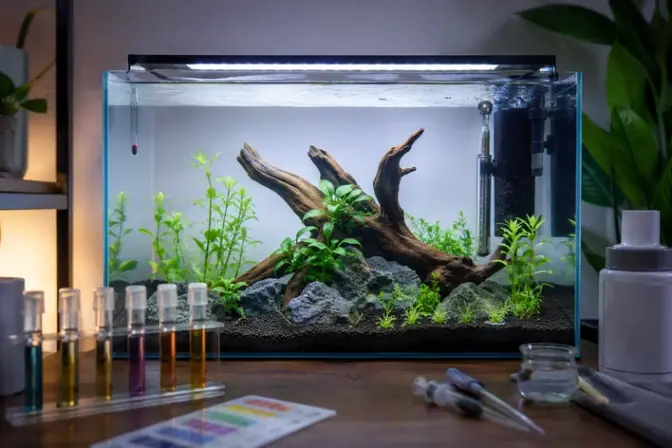
Fishless Cycle Guide: How to Cycle an Aquarium Without Fish
Introduction
A fishless cycle is one of the safest ways to prepare a new freshwater aquarium before adding fish. Instead of using live fish to produce waste, you add a controlled ammonia source and allow beneficial microorganisms to develop inside the filter, substrate, plants, hardscape and other aquarium surfaces. Once the tank can process ammonia and nitrite reliably, it becomes much safer for livestock.
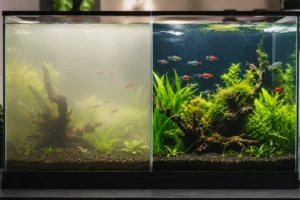
This method protects fish from the most common new-tank dangers: ammonia spikes, nitrite spikes and new tank syndrome. A new aquarium may look clean on the outside, but clear water does not mean the biological filter is ready. The fishless cycle gives the aquarium time to become biologically stable before animals are exposed to waste.
This guide explains what a fishless cycle is, how it works, which tests you need, what ammonia, nitrite and nitrate should do, how long the process can take, when water changes are useful, and how to know when your aquarium is ready for fish. For the broader cycling foundation, read the Aquarium Cycling Guide. For testing context, continue with the Aquarium Water Parameters Guide.
Quick Answer
- A fishless cycle prepares the aquarium before fish are added.
- You need an ammonia source, filter, dechlorinated water and test kits.
- Ammonia appears first and feeds the first stage of beneficial microorganisms.
- Nitrite appears next as ammonia begins converting.
- Nitrate appears later when nitrite begins converting.
- The aquarium is not ready just because ammonia drops once.
- The tank is ready when ammonia and nitrite can return to 0 ppm reliably after a controlled ammonia source.
- Nitrate usually rises during cycling and can be reduced with a water change before stocking.
- Do not add fish during the fishless cycle unless you intentionally switch to a fish-in cycle.
- Patience is safer than rushing because immature tanks are one of the biggest beginner risks.
The basic idea is simple: grow the biological filter first, add livestock later.
What you’ll learn in this lesson
- What a fishless cycle is
- Why cycling without fish is safer
- Which equipment and test kits you need
- How ammonia, nitrite and nitrate behave during cycling
- How to start a fishless cycle
- How to read test results during the process
- When water changes are useful during fishless cycling
- How to know when the aquarium is ready for fish
- Which mistakes delay or disrupt the cycle
- How to add the first fish safely after cycling
What Is a Fishless Cycle?
A fishless cycle is the process of cycling a new aquarium without using fish as the ammonia source. In a traditional fish-in situation, fish waste produces ammonia while the biological filter is still immature. This can expose livestock to toxic ammonia and nitrite. In a fishless cycle, you create the waste source without putting fish through that risk.
The purpose is to grow the beneficial microorganisms that process nitrogen waste. These organisms colonize the filter media, substrate, hardscape, plants, glass and other surfaces. The filter is especially important because it provides oxygen-rich flow and surface area for biological filtration.
During the fishless cycle, ammonia is converted into nitrite, and nitrite is converted into nitrate. Once the aquarium can complete that conversion reliably, the tank is far safer for fish, shrimp and snails.
A fishless cycle is not about making the water look clear. It is about proving that the aquarium can handle waste.
Why Choose a Fishless Cycle?
The main reason to choose a fishless cycle is animal safety. Ammonia and nitrite should normally be 0 ppm in a stocked aquarium. During the early life of a tank, those values can rise because the biological filter is not mature yet. A fishless cycle allows that process to happen before livestock are present.
Fishless cycling is also easier to control. You can add a measured ammonia source, test the water, watch the cycle develop and make adjustments without worrying that fish are suffering. If ammonia or nitrite becomes very high, you can correct the process without exposing animals to those conditions.
This method is especially useful for beginners because it teaches the nitrogen cycle before fish are added. You learn what ammonia, nitrite and nitrate mean, how test results change over time, and why patience matters in new aquarium setup.
| Method | Main Advantage | Main Risk |
|---|---|---|
| Fishless cycle | Protects fish from ammonia and nitrite exposure | Requires patience and testing before stocking |
| Fish-in cycle | Fish are present from the beginning | Fish may be exposed to ammonia and nitrite |
| Using mature media | Can speed up biological readiness | Only works well if media is healthy and kept alive |
| Using bottled bacteria | May support the process | Still requires testing before trusting the tank |
What You Need for a Fishless Cycle
A fishless cycle does not require complicated equipment, but it does require the right basics. The filter must run continuously, the water must be aquarium-safe, and you must be able to test the key nitrogen values.
Essential fishless cycling supplies
- Aquarium tank
- Filter with biological media
- Dechlorinated water
- Water conditioner if using tap water
- Ammonia source suitable for aquarium cycling
- Ammonia test
- Nitrite test
- Nitrate test
- pH test
- Thermometer
- Heater if the planned aquarium needs tropical temperature
- Patience and a simple testing log
A KH test is also useful, especially if pH drops during cycling. The biological processes in a cycling aquarium can interact with buffering, and very low KH can make pH less stable.
For beginner equipment basics, read First Aquarium Checklist
Choosing an Ammonia Source
The ammonia source is what feeds the developing biological filter. In a stocked aquarium, fish waste becomes the ammonia source. In a fishless cycle, you add an artificial or controlled source instead.
The cleanest option is usually pure aquarium-safe ammonia designed or suitable for fishless cycling. Some aquarists use fish food, but that method is less precise because food must decay before producing ammonia. It can also create extra organic waste, cloudy water and odor if overused.
If using liquid ammonia, it must be free from soaps, perfumes, surfactants and household additives. Never add household cleaning ammonia unless you are completely certain it is appropriate and additive-free. When unsure, use a product made for aquarium cycling.
| Ammonia Source | Pros | Cons |
|---|---|---|
| Aquarium cycling ammonia | Controlled and easy to measure | Requires careful dosing |
| Pure additive-free ammonia | Can work if truly safe | Risky if product contains additives |
| Fish food | Easy to find | Less precise and can create mess |
| Raw shrimp or organic decay method | Produces ammonia through decomposition | Messy, smelly and difficult to control |
| Live fish | Not fishless | Exposes fish to toxic cycling stages |
The safer beginner choice is a controlled ammonia source plus regular testing.
The Fishless Cycle Process
The fishless cycle follows the nitrogen cycle. Ammonia appears first, then nitrite, then nitrate. The aquarium becomes safer only when ammonia and nitrite can both return to 0 ppm reliably after the biological filter is fed.
The process is not always perfectly linear. Some tanks move quickly, while others take longer. Temperature, pH, KH, filter media, oxygen, seeded bacteria, plants and water source can all affect cycling speed.
Prepare the aquarium
Set up the tank, filter, substrate, hardscape, heater if needed and water conditioner. The filter should run continuously. The aquarium should be filled with safe, dechlorinated water. If using live plants, they can often be added before or during cycling.
Add a controlled ammonia source
Add ammonia according to your cycling method or product instructions. The goal is to create a measurable ammonia level that feeds the biological filter without creating an extreme concentration that slows progress or causes confusion.
Test ammonia and nitrite
Test regularly. At first, ammonia may stay high because the first stage of the biological filter is not established. Later, ammonia should begin to fall and nitrite should appear.
Watch for nitrate
Nitrate usually appears after nitrite begins converting. This is a sign that the later stage of the cycle is developing. Nitrate is less urgent than ammonia or nitrite, but it can accumulate during a fishless cycle.
Confirm the aquarium can process waste
The aquarium is ready only when it can process the ammonia source so that ammonia and nitrite return to 0 ppm reliably. One low ammonia reading is not enough if nitrite is still present.
Perform a final water change if nitrate is high
Before adding fish, nitrate may need to be reduced through a water change. Use dechlorinated, temperature-matched water and protect the filter media. The bacteria live mostly on surfaces and filter media, not in the water column, so a partial water change does not remove the cycle.
What Happens to Ammonia, Nitrite and Nitrate?
Understanding the test pattern is the key to fishless cycling. Each nitrogen value tells you something different about the biological filter.
| Parameter | What It Means During Cycling | What You Want Before Stocking |
|---|---|---|
| Ammonia | The first waste source feeding the cycle | Returns to 0 ppm after being processed |
| Nitrite | Appears when ammonia begins converting | Returns to 0 ppm after being processed |
| Nitrate | Appears when nitrite begins converting | Controlled with water changes and plants |
| pH | Affects stability and ammonia context | Stable and suitable for livestock |
| KH | Supports pH buffering | Appropriate for the aquarium style |
| Temperature | Affects biological activity | Stable and suitable for planned livestock |
A common beginner mistake is thinking the cycle is complete when ammonia drops. If nitrite is still measurable, the aquarium is not ready for normal stocking.
How Long Does a Fishless Cycle Take?
A fishless cycle can take different amounts of time depending on the aquarium. Some tanks cycle faster when seeded with mature filter media or high-quality bottled bacteria. Other tanks take longer because of low temperature, low pH, low oxygen, insufficient ammonia source, chlorinated water, filter problems or unstable conditions.
The important point is that the calendar does not decide when the aquarium is ready. Test results do. A tank is not ready because a certain number of days has passed. It is ready when ammonia and nitrite can be processed reliably and both return to 0 ppm.
If the cycle seems stuck, check the basics: Is the filter running continuously? Is water dechlorinated? Is there an ammonia source? Is pH stable? Is temperature suitable? Is nitrite extremely high? Is the test kit being read correctly?
The dedicated How Long Does Aquarium Cycling Take article should later cover timing in more detail.
Should You Use Bottled Bacteria?
Bottled bacteria may help some aquariums cycle faster, but it should not replace testing. The only way to confirm the tank is safe is to measure ammonia, nitrite and nitrate. A product label cannot prove that your aquarium is ready for fish.
Bottled bacteria works best when the rest of the setup supports biological filtration: dechlorinated water, running filter, oxygen-rich flow, suitable temperature and a proper ammonia source. If chlorine is present or the filter is not running, bacteria support will be limited.
Mature filter media from a healthy established aquarium can also help seed a new tank. However, it must stay wet, oxygenated and safe during transfer. Media from a sick or contaminated aquarium should not be used.
Do Live Plants Help a Fishless Cycle?
Live plants can help a new aquarium, but they do not remove the need for testing. Fast-growing plants can use some nitrogen compounds and support a more natural environment. Plants also provide surfaces for microorganisms and can make the aquarium more stable over time.
However, plants can also complicate test interpretation because they may consume ammonia or nitrate. Melting plants can add organic waste and ammonia if dead leaves are left to decay. During cycling, remove melting leaves and keep lighting moderate to avoid algae problems.
Easy plants such as Anubias, Java fern, Cryptocoryne, floating plants, mosses and hardy stem plants are good beginner choices. For beginner plant planning, read the Beginner Aquariums Guide and the future Easy Aquarium Plants guide.
Water Changes During a Fishless Cycle
Water changes during a fishless cycle are sometimes useful, but they should have a purpose. Because there are no fish in the tank, ammonia and nitrite exposure is not harming livestock. However, extremely high concentrations, very high nitrate, unstable pH or accidental overdosing may justify a controlled water change.
A water change does not destroy the cycle. Most beneficial microorganisms live on filter media and surfaces, not floating freely in the water. The key is to use dechlorinated water and keep the filter media wet and oxygenated.
Before adding fish, a water change is often useful to reduce accumulated nitrate and refresh water. This final change should be done with properly prepared water that matches the planned aquarium conditions.
| Situation | Water Change Useful? | Why |
|---|---|---|
| Normal fishless cycle with readable tests | Not always necessary | No livestock are exposed |
| Accidental ammonia overdose | Often useful | Brings values back into a manageable range |
| Very high nitrate before stocking | Yes | Reduces nitrate before fish are added |
| pH drops sharply | Possibly | May help stabilize if source water is suitable |
| Cloudy or smelly decay from food method | Possibly | Reduces excess organic waste |
| Right before adding fish | Often yes | Refreshes water and reduces nitrate |
How to Know When the Fishless Cycle Is Complete
The fishless cycle is complete when the aquarium can process a controlled ammonia source and both ammonia and nitrite return to 0 ppm reliably. Nitrate is usually present unless plants consume it heavily or water changes have reduced it.
Do not rely on only one sign. Clear water, algae growth, a running filter or a certain number of days does not prove the cycle is complete. The proof is repeated test results.
Signs the aquarium is ready for first livestock
- Ammonia returns to 0 ppm after the ammonia source is processed.
- Nitrite returns to 0 ppm.
- Nitrate is present or has been controlled through water changes and plants.
- pH is stable enough for the planned livestock.
- Temperature is stable.
- The filter is running continuously.
- Replacement water is prepared and safe.
- The first stocking plan is light and compatible.
If nitrite is still present, wait. If ammonia still appears after dosing, wait. If pH has crashed, fix stability before stocking. The safest first fish are added after the tank has proven it can process waste.
Adding Fish After a Fishless Cycle
After the cycle is complete, do not add every planned fish at once. The biological filter is prepared, but stocking should still be gradual. Fish produce waste continuously, and the tank needs time to adjust to the real bioload.
Start with a small, compatible group or a conservative first stocking. Feed lightly at first. Test ammonia and nitrite after adding livestock. If both remain at 0 ppm, the aquarium is handling the new waste load.
Before stocking, make sure nitrate is not excessive. If nitrate built up during cycling, do a water change with dechlorinated, temperature-matched water. Avoid adding fish into water that is technically cycled but already high in accumulated nitrate.
Safe first stocking checklist
- Ammonia is 0 ppm.
- Nitrite is 0 ppm.
- Nitrate is controlled.
- Temperature matches the species.
- pH, KH and GH are suitable enough for the livestock.
- Fish are compatible with tank size and each other.
- The aquarium is not overstocked immediately.
- Food is offered lightly at first.
- Ammonia and nitrite are tested again after stocking.
For first-fish planning, continue with the Beginner Aquariums Guide and the future Easy Fish for Beginners guide.
Common Fishless Cycle Mistakes
Fishless cycling is safer than cycling with fish, but mistakes can still delay the process or create confusion. Most problems come from missing tests, inconsistent ammonia, untreated water, filter disruption or misunderstanding the end point.
- Adding fish too early: the cycle is not complete until ammonia and nitrite both return to 0 ppm reliably.
- Only testing ammonia: nitrite can still be dangerous even when ammonia drops.
- Not testing nitrate: nitrate helps confirm the later stage of the cycle.
- Using untreated tap water: chlorine or chloramine can harm developing microorganisms.
- Turning the filter off: biological filtration needs oxygen-rich flow.
- Replacing filter media: this can remove the developing biofilter.
- Overdosing ammonia: extreme values can delay progress and make tests harder to read.
- Using messy food decay without control: excess organic waste can cloud and foul the tank.
- Ignoring pH and KH: unstable pH can slow or disrupt the cycle.
- Assuming bottled bacteria means instant stocking: testing still decides readiness.
Fishless Cycle Troubleshooting Table
Use this table when the fishless cycle seems stuck or confusing.
| Problem | Likely Cause | First Action |
|---|---|---|
| Ammonia does not drop | Immature biofilter, low temperature, no bacteria source, chlorine exposure | Check filter, conditioner, temperature and time |
| Nitrite stays high | Second stage of cycle is still developing | Wait, keep filter running, avoid overdosing ammonia |
| No nitrate appears | Cycle not progressed, plants consuming nitrate, test issue | Retest and review ammonia/nitrite pattern |
| pH drops sharply | Low KH or cycling acidification | Test KH and stabilize before stocking |
| Tank smells bad | Too much decaying food or organic matter | Remove waste and consider water change |
| Water is cloudy | Bacterial bloom or excess organic decay | Keep filter running and reduce organic source |
| Cycle restarts after media change | Biofilter removed | Protect media and continue cycling |
| Fish added and ammonia appears | Tank was not ready or stocked too heavily | Treat as fish-in emergency and test daily |
Fishless Cycle Checklist
Use this checklist before you add fish to a newly cycled aquarium.
- The filter has been running continuously.
- Tap water has been treated with conditioner when needed.
- An ammonia source was added in a controlled way.
- Ammonia was tested regularly.
- Nitrite was tested regularly.
- Nitrate was tested before stocking.
- Ammonia can return to 0 ppm.
- Nitrite can return to 0 ppm.
- Nitrate is not excessively high before fish are added.
- pH is stable enough for the planned livestock.
- Temperature is stable.
- A water change was performed if nitrate was high.
- The first stocking plan is conservative.
- Food will be light at the beginning.
- Ammonia and nitrite will be tested after adding fish.
Fishless Cycle vs Fish-In Cycle
A fishless cycle and a fish-in cycle both develop biological filtration, but they differ in animal risk. A fishless cycle happens before fish are added. A fish-in cycle happens while fish are already present, which means ammonia and nitrite must be controlled aggressively to protect livestock.
If you have not bought fish yet, choose fishless cycling. If fish are already in an uncycled tank, you are no longer doing a fishless cycle. You need a fish-in safety routine with testing, water changes, reduced feeding and strong aeration.
For fish-in emergencies, read New Tank Syndrome, Ammonia Spike in Aquarium, Nitrite Spike in Aquarium and Emergency Aquarium Water Change.
How AquariumLesson Connects Fishless Cycling
Fishless cycling is not an isolated beginner topic. It connects directly to the full AquariumLesson learning system. A good fishless cycle depends on setup, equipment, filtration, water parameters, water changes and stocking decisions.
- Beginner Aquariums Guide for the complete first-tank roadmap
- Aquarium Cycling Guide for the full nitrogen cycle foundation
- Aquarium Water Parameters Guide for test interpretation
This is how a beginner moves from an empty tank to a stable, tested, livestock-ready aquarium.
Quick Takeaways
- A fishless cycle prepares the aquarium before fish are added.
- The goal is to grow biological filtration without exposing fish to ammonia or nitrite.
- You need a filter, dechlorinated water, ammonia source and test kits.
- Ammonia appears first, then nitrite, then nitrate.
- The aquarium is not ready until ammonia and nitrite both return to 0 ppm reliably.
- Nitrate may build up during cycling and should be reduced before stocking if high.
- Bottled bacteria may help, but testing still decides readiness.
- Water changes do not destroy the cycle when filter media is protected.
- Do not add fish just because the water looks clear.
- After cycling, add livestock slowly and keep testing.
Conclusion
A fishless cycle is one of the safest and smartest ways to start a freshwater aquarium. It lets the biological filter develop before fish are exposed to waste, reducing the risk of ammonia spikes, nitrite spikes and new tank syndrome.
The process is simple in principle: set up the aquarium, run the filter, add a controlled ammonia source, test ammonia, nitrite and nitrate, wait until ammonia and nitrite are processed reliably, reduce nitrate if needed, then add livestock slowly. The calendar does not decide when the tank is ready. Your test results do.
From here, continue with the Aquarium Cycling Guide, How Long Does Aquarium Cycling Take, Aquarium Water Parameters Guide and the Beginner Aquariums Guide.
Next step:
Before adding fish, test ammonia, nitrite and nitrate. If ammonia or nitrite are still measurable after the cycle is fed, wait. Your aquarium is ready when the biological filter can process waste reliably.
💬 Join the Conversation
Tag us on Instagram @AquariumLesson — we’d love to see your first aquarium setup, cycling progress and water test results.
👉 Are you currently doing a fishless cycle, or are you trying to fix a tank where fish were added too early?
FAQ
What is a fishless cycle?
A fishless cycle is the process of cycling an aquarium before fish are added. A controlled ammonia source feeds the biological filter so beneficial microorganisms can develop without exposing fish to ammonia or nitrite.
Is fishless cycling better than cycling with fish?
Fishless cycling is usually safer because fish are not exposed to toxic ammonia and nitrite during the early cycling stages. It also gives beginners time to learn testing before stocking.
How do I start a fishless cycle?
Set up the aquarium, run the filter, use dechlorinated water, add a controlled ammonia source, and test ammonia, nitrite and nitrate regularly until ammonia and nitrite can return to 0 ppm reliably.
How long does a fishless cycle take?
The timing varies by tank. Temperature, filter media, oxygen, pH, KH, ammonia source, bottled bacteria and mature media can all affect speed. The tank is ready based on test results, not a fixed number of days.
When is a fishless cycle complete?
A fishless cycle is complete when the aquarium can process a controlled ammonia source and both ammonia and nitrite return to 0 ppm reliably. Nitrate should also be controlled before fish are added.
Do I need to do water changes during a fishless cycle?
Not always. Water changes may be useful after accidental ammonia overdosing, very high nitrate, pH problems or before adding fish. Use dechlorinated water and protect filter media.
Can I add plants during a fishless cycle?
Yes. Live plants can be added before or during cycling. Fast-growing plants may use some nitrogen compounds, but you should still test ammonia, nitrite and nitrate before adding fish.
Can I use fish food for a fishless cycle?
Fish food can produce ammonia as it decays, but it is less precise and can create excess organic waste. A controlled aquarium-safe ammonia source is usually cleaner and easier to manage.
Can bottled bacteria instantly cycle my aquarium?
Bottled bacteria may help, but you should not assume the aquarium is instantly ready. Test ammonia and nitrite to confirm that the tank can process waste before adding fish.
What happens if I add fish too early?
If fish are added before the cycle is complete, they may be exposed to ammonia or nitrite. Test immediately, reduce feeding, increase aeration and use controlled water changes if ammonia or nitrite are present.
Lesson completed!
You've finished this lesson. Keep building your aquarium knowledge, one lesson at a time.
Continue learning →New to AquariumLesson? Start with our complete Aquarium Lessons Hub or return to the homepage at AquariumLesson.com.
References
- Aqueon. The Nitrogen Cycle.
- U.S. Environmental Protection Agency. Aquatic Life Criteria – Ammonia.
- North Central Regional Aquaculture Center. An Introduction to Water Chemistry in Freshwater Aquaculture.
- University of Florida IFAS. Basic Water Quality Parameters for Aquaculture.
- AquariumLesson. Aquarium Cycling Guide.