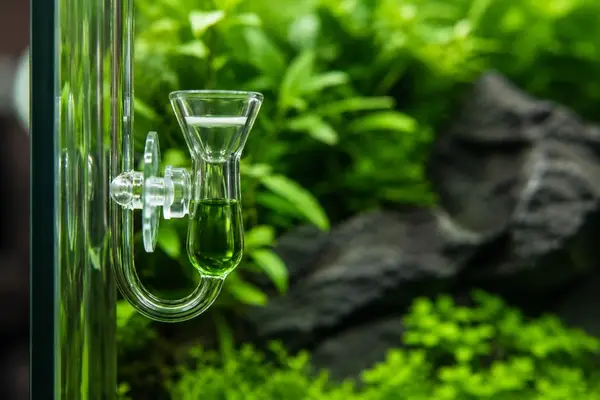
CO₂ Drop Checker Guide: Read Aquarium CO₂ Correctly
Introduction
A CO2 drop checker is one of the simplest visual tools for monitoring carbon dioxide in a planted aquarium. It sits inside the tank, contains a special indicator solution, and changes color depending on the approximate CO₂ level in the surrounding water.
For planted aquariums, CO₂ is not just a technical detail. It is one of the main growth drivers. When light is strong and plants are actively growing, they need enough carbon to use that light and fertilizer properly. If CO₂ is too low, plants may stall, algae may appear, and demanding species may melt or grow poorly. If CO₂ is too high, fish and shrimp can become stressed or even die.
A drop checker helps you avoid guessing. Blue usually means too little CO₂, green usually means a useful target range, and yellow usually means CO₂ may be too high. But the tool has limits. It reacts slowly, shows an approximation, and should never replace watching fish behavior, plant response, flow, timing and overall system balance.
This guide explains how a CO₂ drop checker works, what the colors mean, where to place it, how to use 4 dKH indicator solution, why readings are delayed, and how to avoid the most common mistakes. For the full equipment setup behind CO₂ injection, read the Aquarium CO₂ System Guide. If algae appears after adjusting CO₂ or light, use Aquarium Lighting and Algae to diagnose the whole system.
Quick answer: A CO₂ drop checker uses indicator solution to estimate dissolved CO₂. Blue usually means too little CO₂, green suggests a useful planted-tank range, and yellow means CO₂ may be too high. Because the reading is delayed, adjust CO₂ slowly and always watch livestock behavior.
What You’ll Learn in This Lesson
- What a CO₂ drop checker does in a planted aquarium
- How the indicator solution changes color
- What blue, green and yellow usually mean
- Why 4 dKH solution matters
- Where to place a drop checker inside the tank
- Why drop checker readings are delayed
- How to adjust CO₂ safely based on the reading
- Which mistakes cause false readings, algae or livestock stress
What Is a CO₂ Drop Checker?
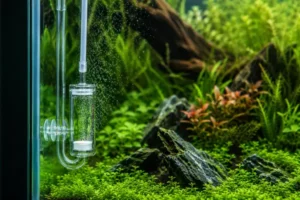
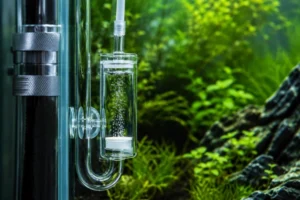
A CO₂ drop checker is a small glass or plastic device placed inside a planted aquarium to estimate dissolved carbon dioxide. It usually has a bulb or chamber filled with indicator solution and a small air gap that separates the solution from direct contact with aquarium water.
As CO₂ levels change in the aquarium, CO₂ gas moves across the air gap and affects the indicator solution. The solution changes color as its pH changes. Because the solution has a known carbonate hardness when prepared correctly, the color can be used as a rough CO₂ guide.
Most aquarists use a drop checker to answer a simple question: is the planted tank receiving too little, enough or too much CO₂?
A drop checker is useful because it gives a visible, continuous reference. It does not require electronics, probes or constant testing. However, it is not a perfect CO₂ meter. It reacts slowly and shows an approximation rather than an instant exact measurement.
| Tool | What It Shows | Main Limitation |
|---|---|---|
| CO₂ drop checker | Approximate CO₂ range through color | Delayed and not exact |
| Bubble counter | Injection rate from the regulator | Does not show actual dissolved CO₂ |
| pH/KH method | Estimated CO₂ from water chemistry | Can be distorted by acids, buffers and substrate |
| Fish behavior | Safety warning for excessive CO₂ | Does not quantify plant-usable CO₂ |
| Plant response | Long-term growth quality | Slow feedback, influenced by light and nutrients too |
The best approach is to use the drop checker as one tool inside a larger CO₂ management system.
How a CO₂ Drop Checker Works
A drop checker works through gas exchange. The indicator solution inside the drop checker does not mix directly with the aquarium water. Instead, CO₂ moves from the aquarium water into the small air space inside the checker, then into the indicator solution.
When CO₂ enters the indicator solution, it lowers the pH of that solution. The pH indicator then changes color. With the correct reference solution, this color gives a rough estimate of the CO₂ level in the aquarium.
This process takes time. The drop checker does not show the CO₂ level at this exact second. It shows a delayed response based on gas exchange between the aquarium water, air gap and indicator solution.
| Step | What Happens | Why It Matters |
|---|---|---|
| CO₂ dissolves in aquarium water | Injected CO₂ spreads through the tank | Plants can use dissolved CO₂ for growth |
| CO₂ reaches the drop checker | Gas moves into the checker’s air gap | Placement and flow affect the reading |
| CO₂ enters indicator solution | The solution’s pH changes | The color starts shifting |
| Color stabilizes | The solution reaches a delayed balance | The visible reading becomes useful |
| CO₂ changes again | The color slowly follows | Fast adjustments are not shown instantly |
This delayed reaction is the reason drop checkers are good for general CO₂ tuning, but not ideal for emergency instant decisions.
What Do CO₂ Drop Checker Colors Mean?
Most CO₂ drop checkers use a blue-to-green-to-yellow color scale. The exact shade depends on the indicator solution, lighting, background, viewing angle and brand, but the general interpretation is consistent.
Blue usually means low CO₂. Green usually means a useful planted-aquarium range. Yellow usually means elevated CO₂ and possible risk for livestock.
| Color | Typical Meaning | What to Do |
|---|---|---|
| Blue | CO₂ is likely too low for demanding plant growth | Increase CO₂ slowly or improve distribution |
| Blue-green | CO₂ may be slightly low or still stabilizing | Check timing, flow and plant response |
| Green | Usually a useful target range for planted tanks | Maintain routine and observe livestock |
| Lime green | CO₂ may be stronger but still possibly acceptable | Watch fish and shrimp carefully |
| Yellow | CO₂ may be too high | Reduce CO₂, increase aeration if livestock show stress |
| Clear or faded | Old solution, contamination or poor readability | Replace indicator solution |
Do not treat the exact color as a rigid law. The drop checker is a guide. A green color does not automatically mean every part of the tank has perfect CO₂, and a slightly blue checker does not prove all plants are carbon-limited. Use the color together with plant growth, algae behavior and livestock safety.
Why Green Is Usually the Target Color
Green is usually the target color because many drop checker solutions are designed around an approximate planted-tank CO₂ range. With a proper 4 dKH reference solution, green often corresponds roughly to the range many aquascapers aim for in high-energy planted tanks.
This does not mean every aquarium needs the same CO₂ concentration. A low-light tank with easy plants may not need as much CO₂ as a high-light aquascape with carpets and red stems. A sensitive fish or shrimp tank may require a more conservative target.
Green should be understood as a useful visual target, not a guarantee of perfection. If plants grow well and livestock behave normally, a stable green reading is usually a good sign. If fish gasp, hide, hang at the surface or become lethargic, CO₂ may be too high even if the color does not look dangerously yellow yet.
The safest CO₂ target is the highest stable level your plants benefit from while livestock remain completely normal.
Why 4 dKH Solution Matters
A drop checker should use a known reference solution, commonly 4 dKH, combined with a pH indicator such as bromothymol blue. This is important because the color interpretation depends on the carbonate hardness of the solution inside the checker.
If you fill the drop checker with aquarium water instead of proper reference solution, the reading can become unreliable. Aquarium water may contain acids, buffers, active substrate effects, tannins, fertilizers, organic compounds and varying KH. These can distort the color and make the result difficult to interpret.
Using 4 dKH solution gives the indicator a controlled starting point. That makes the color more meaningful.
| Solution Type | Reliability | Reason |
|---|---|---|
| 4 dKH reference solution | Best standard option | Known carbonate hardness makes color interpretation useful |
| Premixed drop checker solution | Good if from a trusted aquarium brand | Convenient and usually prepared correctly |
| Aquarium water plus reagent | Often unreliable | Tank water chemistry can distort readings |
| Old indicator solution | Unreliable | Color fades, contamination or evaporation may occur |
| Unknown DIY solution | Variable | Only reliable if prepared accurately |
For most aquarists, premixed 4 dKH drop checker solution is the easiest and safest option.
How to Fill a CO₂ Drop Checker
Filling a drop checker is simple, but small mistakes can cause poor readings. The indicator solution should go inside the chamber, and the checker should be installed so the solution remains trapped inside while the device is submerged.
Always follow the manufacturer’s instructions, because shapes vary. Most glass drop checkers are filled while upside down and then carefully rotated or submerged so the solution stays in the bulb.
Basic Filling Steps
- Remove the drop checker from the aquarium.
- Rinse it with clean water if it is dirty or algae-covered.
- Add premixed 4 dKH indicator solution to the chamber.
- Fill only to the recommended level, usually not completely full.
- Keep an air gap between the solution and aquarium water.
- Install the checker with the opening facing downward.
- Wait for the color to stabilize before judging CO₂.
The air gap is not a flaw. It is part of how the drop checker works. CO₂ moves through that airspace before affecting the indicator solution.
Where Should You Place a CO₂ Drop Checker?
Place the CO₂ drop checker where it can give a useful view of tank-wide CO₂ distribution. It should be visible, away from direct CO₂ bubbles, and located in an area with normal circulation rather than a stagnant dead zone.
Many aquarists place the drop checker on the opposite side of the aquarium from the diffuser. This can help show whether CO₂ is reaching across the tank. However, the best position depends on flow, aquascape layout, plant density and equipment placement.
Avoid placing the drop checker directly above the diffuser or reactor outlet. That may show a high reading because local CO₂ concentration is elevated there, while other areas of the tank may still be low.
| Placement | Usefulness | Why |
|---|---|---|
| Opposite side from diffuser | Often useful | Shows whether CO₂ is reaching across the tank |
| Near plant mass but visible | Useful | Represents where plants need CO₂ |
| Directly above diffuser | Risky | May read artificially high from local bubbles |
| Dead zone behind hardscape | Misleading | May read low because flow is poor |
| Surface corner with poor circulation | Often weak | May not represent plant zones |
| Hidden behind dense plants | Hard to use | Color becomes difficult to read and maintain |
If one area of the tank grows poorly or gets algae, moving the drop checker temporarily can help reveal whether CO₂ distribution is uneven.
How Long Does a Drop Checker Take to Change Color?
A CO₂ drop checker usually has a delay. It often takes about one to two hours to respond meaningfully after CO₂ changes. This delay is normal because CO₂ must move from the aquarium water into the air gap and then into the indicator solution.
This delay is one of the most important things to understand. If you increase CO₂ and look at the drop checker five minutes later, the color may not have changed yet. If you then increase CO₂ again, you may overshoot and put livestock at risk later.
Use the drop checker for trend reading, not instant reaction.
- Make CO₂ changes gradually.
- Wait long enough before judging the new color.
- Do not chase color every few minutes.
- Watch fish and shrimp immediately after adjustments.
- Use plant growth and algae trends over days or weeks.
- Remember that lights, flow and CO₂ timing all affect the result.
The delayed reading makes a drop checker useful for steady tuning, but poor for sudden emergency interpretation.
When Should CO₂ Turn On and Off?
In most planted aquariums with pressurized CO₂, injection starts before the lights turn on. This gives CO₂ time to build up before photosynthesis demand peaks. Many aquarists start CO₂ around one to two hours before the photoperiod, then turn it off before or around lights out.
The exact timing depends on tank size, flow, diffuser efficiency, surface agitation, plant mass and livestock sensitivity. The goal is not to keep CO₂ high all night. Plants mainly use CO₂ during the light period, while livestock still need oxygen and safe gas balance.
| Timing Choice | Typical Purpose | Watch Out For |
|---|---|---|
| CO₂ on before lights | Builds CO₂ before plants need it | Too early or too strong can stress livestock |
| CO₂ on at lights on | Simple timer setup | CO₂ may lag during early photoperiod |
| CO₂ off before lights out | Reduces unnecessary nighttime CO₂ | Turn off too early and plants may run short late in the day |
| CO₂ running overnight | Usually unnecessary for planted tanks | Can increase livestock stress risk |
| CO₂ adjusted daily by hand | Flexible but inconsistent | Timer automation is usually safer |
A drop checker can help you see whether CO₂ is reaching the target during the photoperiod, but it should be combined with plant and livestock observation.
How to Adjust CO₂ Using a Drop Checker
Adjusting CO₂ should be slow and deliberate. The drop checker reacts with delay, and livestock can respond before the color gives you a warning. Small changes are safer than large jumps.
If the drop checker remains blue during the main part of the photoperiod and plants show CO₂-limited growth, you may need more CO₂ or better distribution. If the checker turns yellow and fish show stress, CO₂ is likely too high or oxygen/gas balance is poor.
Safe Adjustment Process
- Start with a conservative CO₂ rate.
- Turn CO₂ on before the lights if using a timer.
- Wait for the drop checker to stabilize during the photoperiod.
- Increase CO₂ only in small increments if needed.
- Wait several hours or until the next photoperiod before judging fully.
- Watch fish and shrimp after every adjustment.
- Improve flow before assuming the whole tank needs more CO₂.
- Reduce CO₂ immediately if livestock show stress.
Do not use the drop checker as permission to ignore livestock. Fish gasping at the surface, rapid breathing, unusual hiding, lethargy or shrimp climbing upward are more urgent than the color in the checker.
Drop Checker vs Bubble Counter
A drop checker and a bubble counter measure different things. A bubble counter shows how much CO₂ gas is being injected into the system. A drop checker shows an approximate response to dissolved CO₂ in the aquarium water.
This difference matters because bubble rate alone does not tell you actual plant-available CO₂. One bubble per second can mean different things depending on tank size, diffuser efficiency, reactor setup, surface agitation, water flow and pressure.
| Tool | Shows | Does Not Show |
|---|---|---|
| Bubble counter | Gas injection rate | Actual dissolved CO₂ in plant zones |
| Drop checker | Approximate dissolved CO₂ trend | Instant exact CO₂ level |
| Regulator needle valve | Controls gas flow | Whether CO₂ reaches all plants evenly |
| Diffuser mist | Visual gas output and distribution pattern | Safe concentration for fish |
| Fish behavior | Safety warning | Precise plant-growth target |
Use the bubble counter to repeat your setting and the drop checker to judge the result. They are complementary, not interchangeable.
Drop Checker vs pH/KH CO₂ Chart
Some aquarists estimate CO₂ using pH and KH. In theory, carbonate hardness and pH can estimate dissolved CO₂. In real aquariums, this method can become inaccurate because aquarium water often contains more than carbonate buffering and CO₂.
Active aquasoil, tannins, organic acids, buffers, fertilizers, rocks and other compounds can affect pH and KH interpretation. This is why a drop checker uses a separate reference solution instead of tank water.
The pH/KH method can still provide clues, especially when tracking pH drop from degassed water to CO₂-injected water. But it should not be the only safety tool.
| Method | Strength | Weakness |
|---|---|---|
| Drop checker | Simple visual long-term indicator | Delayed and approximate |
| pH/KH chart | Useful concept for CO₂ chemistry | Can be distorted by non-carbonate acids and buffers |
| pH drop tracking | Shows CO₂ effect over time | Needs stable baseline and careful interpretation |
| Fish behavior | Direct safety feedback | Only warns when stress may already be happening |
| Plant growth | Best long-term success indicator | Slow and influenced by other factors |
For most aquarists, a drop checker plus careful livestock observation is easier than relying only on water-chemistry calculations.
Common CO₂ Drop Checker Mistakes
Drop checkers are simple, but they are often misused. Most mistakes come from wrong solution, poor placement, overreacting to delayed readings or ignoring livestock behavior.
| Mistake | Why It Causes Problems | Better Approach |
|---|---|---|
| Using aquarium water in the checker | Tank chemistry can distort the result | Use 4 dKH reference solution |
| Placing checker near CO₂ bubbles | May show artificially high CO₂ | Place it in normal circulation away from direct bubbles |
| Chasing color too quickly | The reading is delayed | Wait before adjusting again |
| Ignoring fish behavior | Livestock stress can occur before color is obvious | Watch fish and shrimp closely |
| Using old solution | Color may fade or become unreliable | Replace regularly |
| Assuming green means perfect everywhere | CO₂ distribution may still be uneven | Check flow and plant zones |
| Increasing CO₂ instead of improving flow | Some areas may be low while others are high | Improve circulation first where needed |
The safest drop checker habit is patient interpretation. Make small adjustments, wait for trends, and always prioritize livestock safety.
Why Your Drop Checker Stays Blue
If your drop checker stays blue, the aquarium may have low CO₂, poor CO₂ distribution or a setup problem with the checker itself. Blue does not always mean the regulator must be increased immediately. First, check whether CO₂ is reaching the drop checker and plant zones.
Common reasons a drop checker stays blue include:
- CO₂ injection rate is too low
- CO₂ turns on too late before lights
- Diffuser is clogged or inefficient
- CO₂ bubbles rise straight to the surface
- Flow does not distribute CO₂ across the tank
- Drop checker is in a dead zone
- Surface agitation is driving off too much CO₂
- Indicator solution is old or incorrect
- The tank has high plant demand under strong light
If plants are doing well and algae is low, a slightly blue-green reading may not be urgent in a lower-light tank. If plants stall, algae appears and the checker stays blue during peak lighting, CO₂ or distribution likely needs improvement.
Why Your Drop Checker Turns Yellow
A yellow drop checker usually means CO₂ is elevated. This can be dangerous if livestock show stress. Because the checker is delayed, the tank may already have been high in CO₂ for some time before the color turns yellow.
If fish gasp at the surface, breathe rapidly, become lethargic, hide unusually, lose balance or gather near filter outflow, reduce CO₂ and increase aeration immediately. In shrimp tanks, watch for shrimp climbing upward, becoming inactive or behaving unusually.
Common reasons a drop checker turns yellow include:
- CO₂ injection rate is too high
- CO₂ starts too early or runs too long
- Surface agitation is too low for gas balance
- Drop checker is placed too close to CO₂ output
- Flow concentrates CO₂ in one zone
- Needle valve drifted or regulator setting changed
- Indicator solution is contaminated or incorrect
- Livestock load or oxygen demand is high
Yellow should be treated cautiously. A bright yellow drop checker is not a plant-growth achievement if fish and shrimp are at risk.
CO₂ Drop Checker and Fish Safety
A drop checker is a plant tool, but CO₂ management must always protect livestock. Fish, shrimp and snails depend on safe oxygen and carbon dioxide balance. Too much CO₂ can interfere with respiration even if oxygen is present.
Never increase CO₂ only because plants might grow faster. The safe limit is set by livestock behavior. Some fish are more tolerant than others, but stress is not acceptable as a normal operating condition.
Warning signs of too much CO₂ include:
- Fish gasping at the surface
- Rapid gill movement
- Fish gathering near filter outflow
- Lethargy or unusual hiding
- Loss of balance or erratic movement
- Shrimp climbing upward or becoming inactive
- Snails moving toward the surface
- Sudden stress after CO₂ adjustment
If these signs appear, reduce or stop CO₂, increase surface movement and observe livestock closely. Do not wait for the drop checker to confirm the problem.
CO₂ Drop Checker and Plant Growth
A stable green drop checker can support better plant growth, but it does not guarantee success by itself. Plants also need appropriate light, nutrients, flow, trimming and healthy roots.
If the drop checker is green but plants still struggle, the issue may be somewhere else in the system. Strong light may be too intense. Fertilizer may be missing. Flow may be poor. The substrate may be depleted. New plants may still be transitioning.
| Plant Problem | Possible Cause Beyond Drop Checker Color | Next Step |
|---|---|---|
| Hair algae despite green checker | CO₂ fluctuates, light too strong or organics high | Check timing, flow and cleaning |
| Carpet grows upward | Low substrate PAR or poor CO₂ at substrate | Check Aquarium PAR Explained |
| Stem tops pale | Iron, micros or CO₂ instability | Review fertilizer and CO₂ consistency |
| Old leaves yellow | Nitrogen or magnesium issue | Review nutrient routine |
| Pinholes appear | Potassium shortage or damage | Check fertilizer balance |
| Plants melt after changes | Transition stress, CO₂ swing or parameter change | Stabilize routine |
CO₂ is powerful, but it is only one part of planted aquarium balance.
CO₂ Drop Checker and Algae Problems
Unstable CO₂ is one of the most common hidden causes of algae in high-light planted tanks. A drop checker can help reveal whether CO₂ is consistently low, late, uneven or excessive.
However, the checker alone does not explain every algae issue. Algae often appears when light, CO₂, nutrients, plant mass and maintenance are out of balance. If CO₂ is low but light is strong, plants cannot use the available energy efficiently. If CO₂ fluctuates day to day, plants may struggle even when the drop checker sometimes turns green.
- Keep CO₂ timing consistent with a solenoid and timer.
- Avoid large daily manual changes.
- Make sure CO₂ reaches dense plant groups and carpets.
- Reduce excessive light if CO₂ cannot support it.
- Maintain enough nutrients for plant growth.
- Remove decaying leaves and organic waste.
- Use water changes to restore stability after algae outbreaks.
If algae appears after increasing light or CO₂, diagnose the system with Aquarium Lighting and Algae rather than changing CO₂ alone.
Drop Checker Maintenance
A drop checker needs simple maintenance to stay readable. The solution should be replaced regularly, and the checker should be cleaned when algae, biofilm or mineral deposits make the color hard to see.
Old solution can fade, evaporate, become contaminated or simply become harder to interpret. If the color looks weak, cloudy, clear or strange, replace the solution before adjusting CO₂ based on it.
- Replace indicator solution according to product instructions.
- Clean algae from the glass or plastic body.
- Check suction cups so the checker does not fall.
- Keep the chamber filled to the correct level.
- Use fresh 4 dKH solution or trusted premixed indicator.
- Do not let tank water mix into the chamber.
- Use a white background if color is hard to read.
A clean drop checker is easier to interpret and less likely to cause unnecessary CO₂ adjustments.
Best CO₂ Drop Checker Routine for Beginners
For beginners, the best CO₂ routine is conservative, repeatable and livestock-safe. Do not start with maximum CO₂. Start low, build slowly and watch both plants and animals.
A simple beginner routine looks like this:
- Use premixed 4 dKH drop checker solution.
- Place the checker away from direct CO₂ bubbles.
- Start CO₂ before the lights turn on.
- Use a timer and solenoid for consistency.
- Aim for a stable green or greenish reading during the photoperiod.
- Increase CO₂ only in small steps.
- Wait before judging the new color.
- Watch fish and shrimp after every adjustment.
- Improve flow before simply increasing the bubble rate.
- Reduce light if stable CO₂ cannot support plant demand.
If you also adjust fertilizer or lighting, change only one major factor at a time. CO₂ problems become difficult to diagnose when everything changes at once.
CO₂ Drop Checker Troubleshooting Checklist
Use this checklist if your drop checker reading does not make sense:
- Are you using 4 dKH solution rather than aquarium water?
- Is the indicator solution fresh and clearly visible?
- Is the checker placed away from direct CO₂ bubbles?
- Is the checker in normal circulation rather than a dead zone?
- Has enough time passed for the color to respond?
- Does CO₂ turn on early enough before the lights?
- Is the diffuser clean and producing fine bubbles?
- Is flow distributing CO₂ through the whole tank?
- Are fish or shrimp showing any signs of stress?
- Did algae or plant problems begin after a light or CO₂ change?
- Are nutrients available enough for plants to use CO₂?
- Are you adjusting slowly rather than chasing color?
If the drop checker looks correct but plants still struggle, widen the diagnosis. Check lighting, nutrients, flow, substrate and maintenance.
Final Recommendation
Use a CO₂ drop checker as a visual guide, not as an absolute command. A stable green reading during the main photoperiod is a useful target for many planted aquariums, but plant response and livestock safety matter more than the exact shade.
Always use proper 4 dKH indicator solution, place the checker in a representative flow area, wait for the delayed color response, and adjust CO₂ slowly. Do not chase green if fish or shrimp show stress. Do not assume blue means only the bubble rate is too low; flow, timing and diffuser efficiency may be the real problem.
The best CO₂ setup is stable, repeatable and balanced with light and nutrients. A drop checker helps you see that balance, but it does not replace careful aquarium observation.
Conclusion
A CO₂ drop checker is one of the most useful beginner-friendly tools for planted aquariums with pressurized CO₂. It gives a simple color-based estimate of dissolved CO₂ and helps you avoid running blind.
Blue usually means CO₂ is low, green usually means a useful planted-tank range, and yellow means CO₂ may be too high. But the tool is delayed and approximate. It should be used together with fish behavior, plant growth, flow patterns, lighting intensity, fertilizer balance and maintenance routine.
Use proper 4 dKH solution, place the checker thoughtfully, wait before adjusting, and treat livestock safety as the final limit. When used correctly, a drop checker helps make CO₂ injection more predictable, safer and easier to tune for healthy planted aquarium growth.
💬 Join the Conversation
Are you using a CO₂ drop checker, bubble counter, pH drop method or another way to tune CO₂ in your planted aquarium?
Tag us on Instagram @AquariumLesson — we’d love to see your CO₂ setup, plant growth and aquascape progress.
FAQ
What does a CO₂ drop checker do?
A CO₂ drop checker gives a visual estimate of dissolved CO₂ in a planted aquarium. It uses indicator solution that changes color as CO₂ affects the pH of the solution inside the checker.
What color should a CO₂ drop checker be?
For many planted aquariums, green is the usual target color. Blue usually means CO₂ is low, while yellow usually means CO₂ may be too high. Always watch livestock behavior too.
Why is my CO₂ drop checker blue?
A blue drop checker usually means CO₂ is low, but it can also mean poor placement, weak flow, late CO₂ timing, an inefficient diffuser, old solution or poor distribution across the tank.
Why is my CO₂ drop checker yellow?
A yellow drop checker usually means CO₂ is elevated and may be unsafe. Reduce CO₂ and increase aeration if fish or shrimp show stress such as gasping, rapid breathing or unusual behavior.
Can I use aquarium water in a drop checker?
It is better to use 4 dKH reference solution or trusted premixed indicator solution. Aquarium water can contain buffers, acids and other compounds that distort the reading.
Where should I place a CO₂ drop checker?
Place it in a visible area with normal circulation, away from direct CO₂ bubbles. Many aquarists place it opposite the diffuser to see whether CO₂ reaches across the aquarium.
How long does a CO₂ drop checker take to work?
A drop checker often takes one to two hours to respond meaningfully. Because the reading is delayed, avoid making repeated large CO₂ adjustments in a short time.
Is a CO₂ drop checker accurate?
A CO₂ drop checker is useful but approximate. It shows a delayed color-based estimate, not an instant exact measurement. Use it together with plant growth, fish behavior, flow and lighting balance.
New to AquariumLesson? Start with our complete Aquarium Lessons Hub or return to the homepage at AquariumLesson.com.
References
- Green Leaf Aquariums — How to Install Your Aquarium CO₂ Drop Checker
- Aquarium Gardens — The CO₂ Drop Checker Help Guide
- CO2Art — Things You Need to Know About Drop Checkers
- Aquarium Science — Measuring CO₂
- Aqua Essentials — CO₂ Drop Checkers
- Green Aqua — How to Determine the CO₂ Level in Your Aquarium
- UKAPS — CO₂ Drop Checker Position Discussion