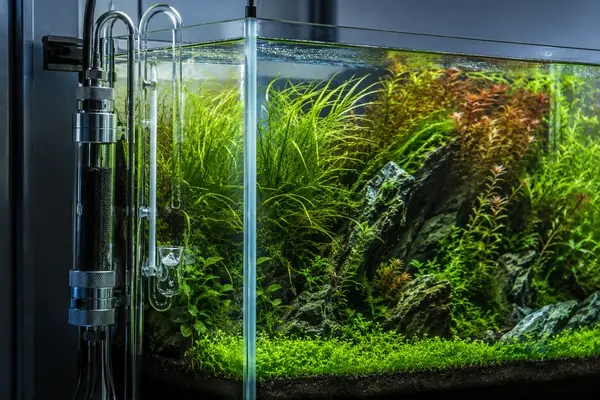
CO₂ Reactor Guide: Efficient CO₂ for Planted Aquariums
Introduction
A CO2 reactor is one of the most efficient ways to dissolve carbon dioxide in a planted aquarium. Instead of releasing visible mist or fine bubbles into the display, a reactor keeps CO₂ in contact with moving water long enough for the gas to dissolve before it returns to the tank.
For aquascapers who dislike microbubbles, want cleaner display glass, run larger planted tanks, or struggle with wasted CO₂ from diffusers, a reactor can be a serious upgrade. It can make CO₂ delivery more efficient, reduce visible mist, and help create a more stable carbon supply for demanding plants.
But a CO₂ reactor is not automatically better for every aquarium. It is larger, more technical, and usually installed outside the tank. It can reduce filter flow if undersized or clogged. It can collect trapped gas if not positioned correctly. It may need a bypass, a dedicated pump, or careful matching with your canister filter. In a small beginner tank, a simple diffuser may still be easier.
This guide explains how aquarium CO₂ reactors work, when they are worth using, how they compare with diffusers and atomizers, how to install them, what flow rate matters, how to avoid gas buildup, and how to troubleshoot common problems. For the full system behind CO₂ injection, start with the Aquarium CO2 System Guide. If you are still comparing delivery methods, read the CO₂ Diffuser Guide.
Quick answer: A CO₂ reactor dissolves injected carbon dioxide inside a chamber before water returns to the aquarium. It is usually more efficient and cleaner-looking than a visible diffuser, but it needs enough flow, correct installation, safe pressure control, and careful monitoring with a drop checker, pH trend and livestock behavior.
What You’ll Learn in This Lesson
- What a CO₂ reactor does in a planted aquarium
- How a reactor dissolves CO₂ differently from a diffuser
- When a reactor is worth using
- When a diffuser or atomizer is still the better choice
- How reactor placement and flow affect performance
- How to install a CO₂ reactor safely
- Why reactors can reduce filter flow or collect trapped gas
- How to troubleshoot poor CO₂, algae, gas buildup and livestock stress
What Is a CO₂ Reactor?
A CO₂ reactor is a device that dissolves carbon dioxide into aquarium water before that water returns to the tank. It is usually connected to a canister filter return line, an external pump loop, or a dedicated circulation system.
Inside the reactor, CO₂ bubbles are slowed down, chopped up, swirled, trapped, or forced through media while water flows around them. This contact time allows more CO₂ to dissolve. The goal is to return CO₂-enriched water to the aquarium with little or no visible mist.
In simple terms, a diffuser releases bubbles into the tank and lets them dissolve on the way. A reactor dissolves the gas inside a chamber first.
| CO₂ Method | Where CO₂ Dissolves | Visible Mist | Typical Use |
|---|---|---|---|
| In-tank diffuser | Inside the aquarium | Often visible | Small to medium tanks and beginner CO₂ systems |
| Inline diffuser | In the filter return line and aquarium | Often fine mist | Clean aquascapes with canister filters |
| Atomizer | Fine mist in water flow | Usually visible mist | High-pressure fine-bubble delivery |
| CO₂ reactor | Inside a reactor chamber | Usually little to none | Large tanks, clean displays and high-efficiency setups |
A reactor is mainly about efficiency and display cleanliness. It is not a replacement for stable CO₂ tuning, good flow, proper lighting or balanced fertilization.
How a CO₂ Reactor Works
A CO₂ reactor works by increasing contact time between gas and water. CO₂ is injected into the reactor chamber. Aquarium water flows through the chamber. The gas is broken into smaller bubbles, held inside the reactor, or circulated until it dissolves.
Different reactor designs achieve this in different ways. Some use internal media, bio-balls, sponges, blades or turbulence. Some create a swirling motion. Some rely on counter-current flow, where water and gas move against each other. The principle is the same: keep CO₂ underwater long enough that less gas escapes unused.
A reactor usually has:
- A water inlet
- A water outlet
- A CO₂ injection point
- An internal chamber where gas and water mix
- Internal media, turbulence or flow path for better dissolution
- External hose connections
- Sometimes a bypass or bleed valve for trapped gas
The reactor’s performance depends heavily on water flow. Too little flow and CO₂ may collect as gas pockets. Too much flow and the reactor may become noisy, restrictive or less controlled depending on design. The correct balance matters.
CO₂ Reactor vs CO₂ Diffuser
The main difference between a CO₂ reactor and a diffuser is where the gas dissolves. A diffuser releases bubbles into the aquarium. A reactor dissolves the gas inside an external chamber before the water returns to the tank.
A diffuser is simpler, cheaper and easier to see. A reactor is usually more efficient, cleaner-looking and better for aquarists who dislike visible CO₂ mist. However, a reactor is also more complex to install and may reduce filter flow if matched poorly.
| Feature | CO₂ Diffuser | CO₂ Reactor |
|---|---|---|
| Installation | Simple in-tank setup | External plumbing or filter-line setup |
| Display look | Visible equipment and bubbles | Cleaner display with little visible mist |
| Efficiency | Good if clean and well placed | Often very efficient when correctly sized |
| Maintenance | Ceramic disc cleaning | Chamber, hose and flow inspection |
| Flow impact | Usually minimal | Can reduce filter flow if restrictive |
| Best for beginners | Usually yes | Usually more advanced |
| Best for large tanks | Possible but can be inefficient | Often stronger choice |
If you want the easiest setup, use a diffuser. If you want cleaner visuals and higher dissolution efficiency, consider a reactor.
CO₂ Reactor vs Inline Diffuser
Inline diffusers and reactors are both installed outside the display, usually on canister filter tubing. This makes both attractive for aquascapers who want minimal visible equipment. The difference is how they deliver CO₂.
An inline diffuser or atomizer creates very fine bubbles in the return line. These bubbles enter the aquarium as mist and continue dissolving there. A reactor tries to dissolve the gas before it reaches the tank, reducing or eliminating visible bubbles.
| Feature | Inline Diffuser | CO₂ Reactor |
|---|---|---|
| Display equipment | Hidden | Hidden |
| Visible CO₂ mist | Often visible | Usually minimal |
| Pressure demand | Often needs higher working pressure | Depends on design and flow |
| Filter flow restriction | Possible if clogged | Possible if undersized or restrictive |
| Dissolution style | Fine mist into tank | Gas dissolved in chamber |
| Best for clean visual display | Good | Very good if installed well |
If you like the fine mist look or want simpler inline installation, choose an inline diffuser. If you want fewer visible bubbles and maximum dissolution, a reactor is usually the cleaner option.
When Should You Use a CO₂ Reactor?
A CO₂ reactor is worth considering when your aquarium needs efficient carbon delivery and you want fewer visible bubbles. It is especially useful in larger tanks, high-tech aquascapes, clean display layouts and systems where diffusers waste too much gas.
Reactors are also useful when a diffuser creates annoying microbubbles, clogs frequently, or cannot distribute CO₂ well in a larger aquarium. A reactor can make the system feel calmer and more invisible.
A reactor may be a good choice if:
- You run a medium to large planted aquarium
- You use a canister filter or external pump loop
- You dislike visible CO₂ mist
- You want higher dissolution efficiency
- Your diffuser wastes bubbles at the surface
- Your inline diffuser creates too much microbubble haze
- You have dense high-tech plant growth
- You want equipment hidden from the display
- You are comfortable with external plumbing and maintenance
A reactor is not required for every CO₂ tank. It is an upgrade when efficiency, aesthetics or scale justify the added complexity.
When a CO₂ Reactor Is Not the Best Choice
A CO₂ reactor is not always the right answer. It may be overkill for small tanks, simple low-tech systems, beginner CO₂ setups or aquariums without external filtration. A simple in-tank diffuser is often easier to install, inspect and clean.
Reactors can also create problems if they are too large, too restrictive, installed incorrectly, or paired with a weak filter. If the reactor reduces circulation too much, plant growth and CO₂ distribution can suffer.
A reactor may be a poor fit if:
- You are setting up your first CO₂ system and want simplicity
- Your aquarium is very small
- You do not use a canister filter or external pump
- Your cabinet has no space for extra equipment
- Your filter flow is already weak
- You do not want to cut or modify hoses
- You need an easy visual check of CO₂ output
- You prefer simple maintenance over hidden equipment
Do not choose a reactor only because it sounds more advanced. Choose it because it solves a real problem in your setup.
Types of CO₂ Reactors
CO₂ reactors come in several forms. Some are commercial external units. Some are inline reactors built into return hoses. Some are DIY chambers made from filter housings or PVC. Some are powered by the canister filter, while others use a dedicated pump.
| Reactor Type | Best For | Main Caution |
|---|---|---|
| External inline reactor | Canister-filter aquascapes | Must match hose size and filter flow |
| Reactor with bypass | Adjustable high-flow systems | More plumbing complexity |
| Dedicated pump reactor | Large tanks or custom setups | Extra pump, wiring and maintenance |
| DIY reactor | Experienced aquarists who want customization | Leak risk and design mistakes |
| Internal reactor | Some compact systems | Visible in tank and may look bulky |
| Canister intake CO₂ mixing | DIY-style setups | Can cause filter noise, gas buildup or impeller stress |
Commercial external reactors are usually the cleanest option for aquarists who want predictable performance. DIY reactors can work well, but they require careful construction and leak-safe plumbing.
CO₂ Reactor Flow Rate
Flow rate is one of the most important parts of reactor performance. The reactor needs enough water movement to dissolve CO₂ and distribute enriched water through the aquarium. If flow is too weak, gas may collect in the chamber. If flow is too strong for the reactor design, it may become noisy or restrictive.
Many aquarists install reactors on the return side of a canister filter. This works well when the filter has enough real-world flow after media, hoses, lily pipes, bends and the reactor itself are considered. Manufacturer flow ratings are often measured without real tank restrictions, so actual flow can be lower.
Good reactor flow should:
- Move enough water through the chamber
- Prevent large trapped gas pockets
- Return CO₂-rich water evenly to the aquarium
- Avoid excessive filter restriction
- Maintain good circulation in plant zones
- Support oxygen exchange and livestock safety
- Stay stable after filter media begins to clog
If your filter flow is already weak, adding a reactor may make the tank worse. In that case, improve filtration flow, use a bypass, or run the reactor on a separate pump loop.
Can a CO₂ Reactor Reduce Filter Flow?
Yes. A CO₂ reactor can reduce filter flow if it is restrictive, undersized, dirty, installed with tight bends, or paired with a weak canister filter. This is one of the biggest trade-offs compared with a simple in-tank diffuser.
Reduced flow can create several problems. CO₂-rich water may not reach the whole tank. Debris may collect behind plants or hardscape. Dead zones may appear. Oxygen exchange may weaken. Algae may increase in low-flow areas.
| Flow Problem | Possible Cause | Better Response |
|---|---|---|
| Filter output weaker after reactor install | Reactor restriction or hose mismatch | Check sizing, hose bends and installation |
| Plants struggle in far corners | CO₂-rich water not distributed well | Improve outflow direction or add circulation |
| Gas collects inside reactor | Flow too weak or CO₂ too high | Reduce gas, increase flow or bleed trapped gas |
| Filter becomes noisy | Gas entering filter or trapped air | Adjust reactor placement and purge air |
| Algae appears after installation | Flow and CO₂ distribution changed | Review circulation before increasing light or nutrients |
A reactor should improve CO₂ delivery without damaging circulation. If flow drops too much, the installation needs correction.
Where to Install a CO₂ Reactor
Most external CO₂ reactors are installed on the filter return line, after the canister filter and before water returns to the aquarium. This allows clean filtered water to pass through the reactor and carry dissolved CO₂ back into the tank.
The exact installation depends on the reactor model. Always follow the manufacturer’s direction arrows, hose sizing and mounting instructions. Incorrect direction or poor mounting can create gas pockets, leaks or weak performance.
Common installation principles:
- Install on the return side, not usually before the filter intake
- Match hose diameter to the reactor fittings
- Keep hose runs as smooth and short as practical
- Avoid tight bends that restrict flow
- Mount the reactor securely and vertically if the design requires it
- Use check valves in the CO₂ line to prevent back-siphoning
- Check every connection for leaks before leaving the system unattended
- Keep the reactor accessible for cleaning and inspection
Do not hide the reactor so deeply in the cabinet that you cannot inspect it. A hidden CO₂ system still needs maintenance access.
CO₂ Reactor With Bypass
A bypass lets some water flow around the reactor instead of forcing all filter return water through it. This can be useful when the reactor is restrictive or when you want to fine-tune the balance between dissolution and flow.
Bypass setups are more advanced because they require extra valves and plumbing. However, they can protect filter flow and make reactor tuning more flexible. Large tanks and high-flow systems often benefit from this approach.
A bypass can help when:
- The reactor reduces filter output too much
- You need more control over contact time
- The reactor produces trapped gas under full flow
- You want to service the reactor more easily
- You run a large tank with strong circulation needs
- You want to balance CO₂ dissolution and overall flow
The downside is complexity. More hoses and valves mean more possible leak points. Build bypass systems carefully and test them thoroughly.
CO₂ Reactor With Dedicated Pump
Some aquarists run a CO₂ reactor on a dedicated pump instead of the main filter. This separates CO₂ dissolution from biological filtration. It can be useful in large tanks, tanks with weak canister filters, or setups where you do not want the reactor to reduce filter flow.
A dedicated pump loop gives more control, but it adds equipment. You need another pump, more tubing, more electricity, more maintenance and another potential point of failure.
| Dedicated Pump Advantage | Trade-Off |
|---|---|
| Does not restrict main filter as much | Adds extra equipment |
| Allows flow to be matched to the reactor | Requires pump sizing |
| Useful for large tanks | More hoses and leak points |
| Can improve circulation if outlet is placed well | More maintenance and energy use |
| Flexible installation | More complex than a simple diffuser |
A dedicated reactor loop is best for experienced aquarists who want control and are comfortable managing extra plumbing.
CO₂ Reactor and Drop Checker Readings
A reactor can change how your drop checker behaves. Because CO₂ is dissolved before entering the tank, you may not see visible mist moving around. This can feel strange if you are used to diffusers. The tank may be receiving CO₂ even when you cannot see bubbles.
Use a drop checker, pH trend and plant response to judge the system. Do not rely on visible bubbles because the reactor’s purpose is to reduce visible gas.
- Place the drop checker away from the return outlet.
- Use fresh 4 dKH indicator solution.
- Allow time for color response.
- Compare readings at different tank zones if needed.
- Watch pH trend after CO₂ turns on.
- Observe plants and livestock during the photoperiod.
- Do not assume invisible CO₂ means no CO₂.
For color interpretation, read the CO₂ Drop Checker Guide. For bubble-rate tuning, use the CO₂ Bubble Rate Guide.
CO₂ Reactor and pH Drop
Because reactors can dissolve CO₂ efficiently, pH may drop more strongly or more smoothly than with a poorly performing diffuser. This can be useful for plant growth, but it also means adjustments should be slow and careful.
Track how pH changes from before CO₂ starts to the middle of the photoperiod. This does not provide perfect CO₂ measurement in every aquarium, because active soil, buffers, tannins and other acids can affect pH. But pH trend is still useful for understanding whether the reactor is changing dissolved CO₂ consistently.
Use pH trend to check:
- How quickly CO₂ builds after the solenoid turns on
- Whether the reactor dissolves CO₂ more efficiently than your old diffuser
- Whether pH changes are stable from day to day
- Whether surface agitation removes CO₂ too quickly
- Whether CO₂ remains safe for livestock
If you use pH and KH to estimate CO₂, compare values carefully with the Aquarium pH CO₂ Calculator. Treat calculator output as guidance, not as a replacement for fish and shrimp observation.
CO₂ Reactor and Livestock Safety
A CO₂ reactor can dissolve gas very efficiently, which means it can also raise dissolved CO₂ quickly if adjusted too aggressively. This is good for plants only when livestock remain safe.
Never increase CO₂ based only on plant ambition. Fish, shrimp and snails set the safety limit. If animals show stress, reduce CO₂ and increase oxygen exchange immediately.
Warning signs of too much CO₂ include:
- Fish gasping at the surface
- Rapid gill movement
- Fish gathering near the filter outflow
- Lethargy or unusual hiding
- Erratic swimming or loss of balance
- Shrimp climbing upward or becoming inactive
- Snails moving to the surface
- Sudden stress after increasing CO₂
If these signs appear, do not wait for a drop checker to confirm the danger. Stop or reduce CO₂, increase surface movement and review your reactor settings.
Common CO₂ Reactor Problems
Most reactor problems come from poor sizing, low flow, trapped gas, installation mistakes or trying to force too much CO₂ through the unit. The reactor may still function, but the tank becomes harder to tune.
| Problem | Likely Cause | What to Check First |
|---|---|---|
| Gas collects inside reactor | Too much CO₂, low flow or poor orientation | Reduce gas, increase flow or bleed trapped gas |
| Filter flow drops | Reactor too restrictive or dirty | Hose size, bends, clogging and bypass options |
| Reactor makes noise | Trapped air or gas turbulence | Purge air and check CO₂ rate |
| Drop checker stays blue | Low CO₂, poor flow or poor return distribution | pH trend, reactor flow and outlet placement |
| Fish stress after installation | CO₂ dissolving more efficiently than before | Reduce bubble rate and increase oxygen exchange |
| Algae appears after switch | Flow pattern changed or CO₂ unstable | Filter flow, light and maintenance |
| Leaks around reactor | Poor hose fit or loose connections | Turn off system and reseal connections safely |
A reactor should make CO₂ easier to manage, not more chaotic. If the system becomes unstable, reduce complexity and solve one issue at a time.
Why Gas Builds Up Inside a CO₂ Reactor
Gas buildup inside a reactor usually means CO₂ is entering faster than water can dissolve it, or the reactor design is trapping gas without enough flow to process it. A small gas pocket may be normal in some designs, but large buildup can reduce efficiency and cause noise.
Gas buildup can happen when:
- The bubble rate is too high
- Filter flow is too weak
- The reactor is oversized for the pump
- The reactor is installed in the wrong orientation
- Air was trapped during setup
- Hoses or media are clogged
- The reactor has no bleed point or purge routine
- Surface agitation or outlet setup changes CO₂ demand
The solution is not always more flow or more CO₂. Often, the best correction is to reduce CO₂ rate, purge trapped gas, improve flow, or match the reactor better to the filter.
CO₂ Reactor and Algae Problems
A CO₂ reactor can help reduce algae if the original problem was poor CO₂ dissolution or unstable carbon availability. But a reactor does not automatically solve algae. Algae often comes from a mismatch between light, CO₂, nutrients, flow, plant mass and maintenance.
After installing a reactor, your flow pattern may change. If filter output drops or CO₂-rich water no longer reaches certain plant zones, algae can appear even though the reactor is efficient internally.
- Do not increase light immediately after adding a reactor.
- Check whether filter flow changed.
- Watch for dead zones behind hardscape or dense stems.
- Keep nutrients available so plants can use improved CO₂.
- Trim plant mass to maintain circulation.
- Use water changes to reset organics during tuning.
- Monitor livestock while adjusting CO₂.
If algae appears after a CO₂ change, use Aquarium Lighting and Algae to diagnose the whole system.
CO₂ Reactor and Fertilizer Demand
If a reactor improves CO₂ efficiency, plants may grow faster. Faster growth increases nutrient demand. This means a better CO₂ system can reveal fertilizer gaps that were hidden before.
After switching from a weak diffuser to an efficient reactor, watch for new deficiency symptoms. Plants may suddenly need more nitrogen, phosphate, potassium, iron, trace elements or magnesium because carbon is no longer the main limiting factor.
Review your fertilizer routine if you see:
- Older leaves yellowing after faster growth
- Green spot algae and stalled growth from low phosphate
- Pinholes from possible potassium shortage
- Pale new growth from iron or trace limitation
- Magnesium-related chlorosis in soft water
- Fast stems growing but losing lower leaves quickly
For nutrient planning, read the Aquarium Fertilizer Guide. CO₂, light and fertilizer should always be tuned together.
CO₂ Reactor Setup Checklist
Use this checklist before running a reactor full-time:
- Is the reactor rated for your aquarium and flow?
- Does the hose diameter match the reactor fittings?
- Is it installed in the correct direction?
- Is it mounted securely?
- Are all hose connections leak-free?
- Is filter flow still strong after installation?
- Can you access the reactor for cleaning?
- Is the CO₂ line protected by a check valve?
- Can trapped gas be purged if needed?
- Is the drop checker placed away from the return outlet?
- Are fish and shrimp behaving normally?
- Are lighting and fertilizer matched to the improved CO₂?
If several answers are uncertain, do not increase CO₂ yet. Stabilize the installation first.
CO₂ Reactor Troubleshooting Checklist
If your reactor does not perform as expected, work through the system step by step:
- Check for leaks in CO₂ tubing and water hoses.
- Confirm the solenoid opens when CO₂ should run.
- Confirm the bubble counter is stable.
- Check whether the reactor is collecting too much gas.
- Inspect filter flow after adding the reactor.
- Clean the reactor if flow or performance has declined.
- Check whether the return outlet distributes CO₂-rich water well.
- Compare drop checker color and pH trend.
- Watch livestock during the entire photoperiod.
- Reduce light if CO₂ stability is still uncertain.
- Review fertilizer if plants grow faster but show deficiencies.
- Make only one adjustment at a time.
Reactors are powerful, but they reward patient tuning. Fast changes make CO₂ harder to diagnose and less safe.
Final Recommendation
Use a CO₂ reactor if you want efficient CO₂ dissolution, minimal visible mist and a cleaner display, especially in medium to large high-tech planted aquariums. It is a strong upgrade when diffusers waste gas, create too much mist or cannot support your tank’s plant demand.
Stay with a diffuser if you want simplicity, easy visual monitoring and minimal plumbing. A good clean diffuser in the right flow path can still work extremely well, especially in small and medium tanks.
The best reactor setup is not the most complicated one. It is the one that dissolves CO₂ efficiently, preserves strong flow, keeps livestock safe and supports stable plant growth without making maintenance harder than necessary.
Conclusion
A CO₂ reactor is one of the most efficient tools for delivering carbon to a planted aquarium. By dissolving CO₂ inside a chamber before water returns to the tank, it can reduce visible bubbles, improve gas efficiency and create a cleaner aquascape.
The trade-off is complexity. A reactor must be sized correctly, installed safely and matched to enough flow. If it restricts the filter, collects gas or changes circulation too much, it can create new problems. Good reactor performance depends on flow, pressure, outlet placement, monitoring and livestock safety.
For advanced planted tanks, a reactor can be an excellent upgrade. For beginner tanks, a diffuser may be easier. Choose the method that fits your aquarium, not the one that sounds most advanced. When CO₂ delivery, lighting, nutrients and flow work together, plants grow more predictably and algae becomes much easier to control.
💬 Join the Conversation
Are you using a CO₂ reactor, inline diffuser, atomizer or classic in-tank diffuser in your planted aquarium?
Tag us on Instagram @AquariumLesson — we’d love to see your CO₂ setup, reactor installation, plant growth and aquascape progress.
FAQ
What does a CO₂ reactor do in an aquarium?
A CO₂ reactor dissolves injected carbon dioxide inside a chamber before water returns to the aquarium. This can improve CO₂ efficiency and reduce visible bubbles or mist in the display.
Is a CO₂ reactor better than a diffuser?
A CO₂ reactor is often more efficient and cleaner-looking than a diffuser, especially in larger tanks. A diffuser is simpler, cheaper and easier for beginners. The better option depends on tank size, flow and setup goals.
Can a CO₂ reactor reduce filter flow?
Yes. A reactor can reduce filter flow if it is restrictive, dirty, undersized or installed with tight hose bends. Always check real filter output after installing a reactor.
Where should I install a CO₂ reactor?
Most external CO₂ reactors are installed on the canister filter return line, after the filter and before water returns to the aquarium. Follow the reactor’s direction arrows and hose-size requirements.
Why is gas collecting inside my CO₂ reactor?
Gas buildup usually means CO₂ is entering faster than the reactor can dissolve it, flow is too weak, the reactor is installed incorrectly, or trapped air has not been purged. Reduce CO₂ and check flow first.
Do CO₂ reactors remove all bubbles?
A well-installed reactor can remove most visible CO₂ mist, but some systems may still release tiny bubbles depending on flow, gas rate and reactor design. The main goal is efficient dissolution, not necessarily absolute zero bubbles.
Do I need a drop checker with a CO₂ reactor?
Yes, a drop checker is still useful because a reactor hides visible bubbles. Use it together with pH trend, plant response and fish behavior to judge whether dissolved CO₂ is safe and effective.
Is a CO₂ reactor good for small tanks?
A reactor can work on small tanks, but it is often more complex than necessary. Small tanks usually do well with a clean ceramic diffuser or small inline diffuser, unless the aquarist specifically wants a mist-free external setup.
New to AquariumLesson? Start with our complete Aquarium Lessons Hub or return to the homepage at AquariumLesson.com.
References
- Green Aqua — The Pros and Cons of Using a CO₂ Reactor
- PlantedBox — CO₂ Reactor or Diffuser?
- Aquasabi — CO₂ External Reactors
- Aquarium Gardens — CO₂ Set Up Guide
- Aquarium Gardens — The CO₂ Drop Checker Help Guide
- CO2Art — Things You Need to Know About Drop Checkers
- UKAPS — CO₂ Reactors Discussion
- UKAPS — CO₂ Reactor Setup Discussion