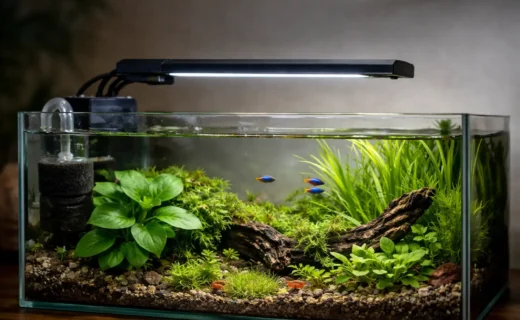
Low Tech Aquarium Lighting Guide: Simple Light for Stable Planted Tanks
Low-tech aquarium lighting is one of the most important variables in a stable planted tank. It influences growth speed, algae pressure, maintenance effort, and even the kind of plants you can realistically keep without turning your aquarium into a high-energy system.
Many aquarists make the same mistake early on: they buy a strong planted-tank light, apply a long photoperiod, skip injected CO₂, and then wonder why algae takes over. In a low-tech setup, success rarely comes from maximum output. It comes from restraint, balance, and matching light to the slower pace of the system.
This Low Tech Aquarium Lighting Guide explains how much light a low-tech aquarium actually needs, how long to run it, how tank depth changes the result, and which plants perform best under moderate energy. If you want the broader foundation behind planted tank lighting, see our Aquarium Lighting Guide. This lesson focuses specifically on the low-tech side of the topic.
What you’ll learn in this lesson
- What defines low-tech aquarium lighting
- How much PAR most low-tech tanks actually need
- The ideal lighting duration for slow-growth planted systems
- How spectrum, spread, and tank depth affect the result
- Which plant categories work best under low-tech conditions
- How to reduce algae by adjusting light intelligently
- Real setup examples for nano tanks, 60 cm tanks, and natural-style layouts
What Is a Low Tech Planted Aquarium?
A low-tech planted aquarium is a freshwater planted tank that runs without injected CO₂ and without aggressively high light intensity. The goal is not to force maximum growth. The goal is to create a calmer, more forgiving ecosystem where plants grow steadily, maintenance remains manageable, and the system stays stable over time.
In practical terms, low-tech usually means moderate light, slower metabolism, realistic plant selection, and fewer sharp imbalances. You can still build beautiful aquascapes in this style, but the plant palette and lighting strategy must match the available carbon and nutrients.
That is the key principle many guides miss: low-tech lighting is not just “weaker lighting.” It is balanced lighting for a lower-energy ecosystem.
Why lighting must be balanced in low-tech tanks
Light acts as the energy input of a planted aquarium. The more light you add, the more demand you create. Plants respond by needing more carbon, stronger nutrient delivery, better circulation, and tighter maintenance. In a high-tech system, injected CO₂ helps support that energy level. In a low-tech system, it does not.
That is why excessive light is often the fastest way to destabilize a low-tech aquarium. Plants may initially look active, but if carbon supply cannot keep up, algae gains the advantage. For this reason, moderate lighting almost always outperforms aggressive lighting in non-CO₂ tanks.
Low-tech rule: if you remove CO₂ injection, you usually need to reduce light intensity as well. Otherwise the system becomes unbalanced very quickly.
How Much Light Low Tech Aquariums Actually Need
The most useful way to think about low-tech lighting is not “bright” versus “dim.” It is whether the available light matches the system’s ability to process that energy. In most low-tech planted tanks, the sweet spot sits in a moderate range that supports healthy growth without forcing the aquarium into high demand.
PAR levels for low-tech tanks
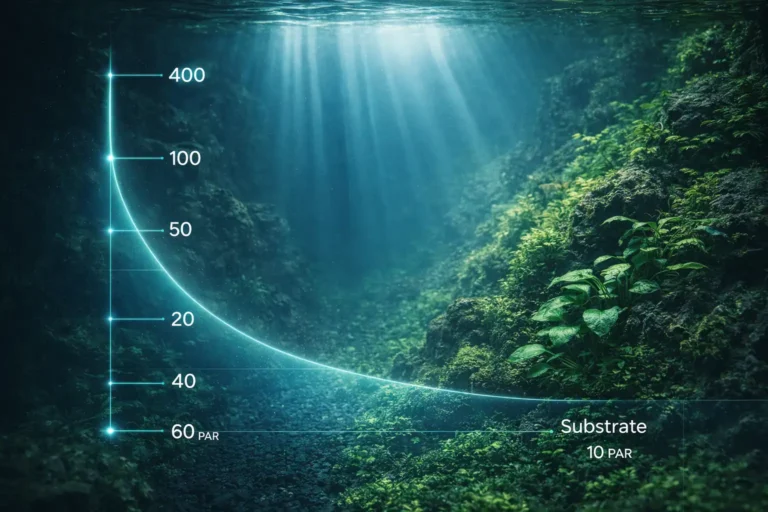
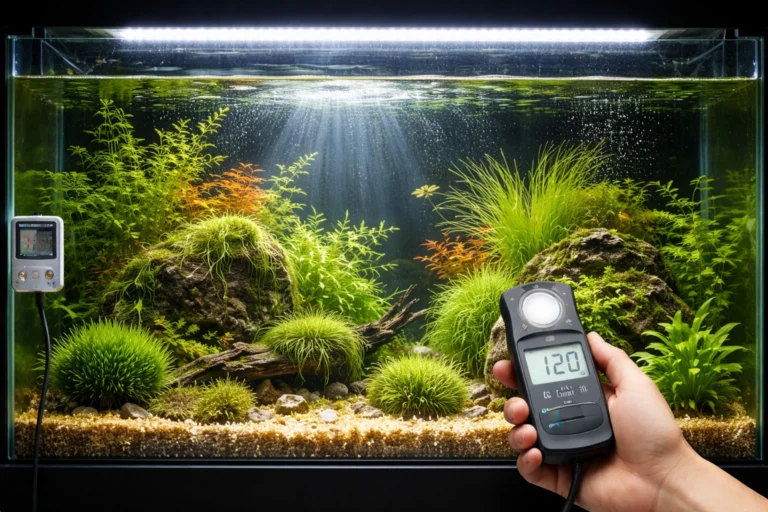
For planted aquariums, PAR is the most useful lighting reference because it describes plant-usable light at the leaf level. In low-tech tanks, the substrate PAR range usually matters most because many easy plants grow low in the layout or close to the hardscape.
| Lighting Category | PAR at Substrate | Typical Use |
|---|---|---|
| Very Low Light | 10–20 PAR | Shade epiphytes, mosses, low-demand setups |
| Low-Tech Standard | 20–40 PAR | Most balanced non-CO₂ planted tanks |
| Upper Edge of Low-Tech | 40–60 PAR | Faster growth, but higher algae risk without strong stability |
For most aquarists, 20–40 PAR at the substrate is the safest and most useful target. It is enough for many easy plants, but not so aggressive that the tank becomes difficult to control.
If you want a deeper explanation of PAR itself, measurement methods, and how PAR charts work, that belongs in the dedicated PAR-focused lessons rather than this guide. Here, the important point is simple: low-tech tanks usually need moderate plant-usable light, not high-output light.
Lumens vs PAR vs watts
Many beginners still compare lights by watts, but this is outdated. Watts only tell you how much electricity the light consumes. They do not tell you how usable that light is for plants. Lumens are slightly more helpful because they reflect visible brightness, but even lumens do not show how much plant-usable light actually reaches the aquascape.
For low-tech tanks, use the metrics like this:
- PAR = best real-world plant metric
- Lumens = useful beginner estimate when PAR is unavailable
- Watts = poor stand-alone comparison metric
If you only have lumen information, many easy planted tanks do well around a moderate lumen-per-liter range, but the final result always depends on tank depth, spread, mounting height, and shading from hardscape or floating plants. That is exactly why low-tech lighting should be judged by outcome, not just by a number on the box.
Beginner formula:
Light intensity: 20–40 PAR
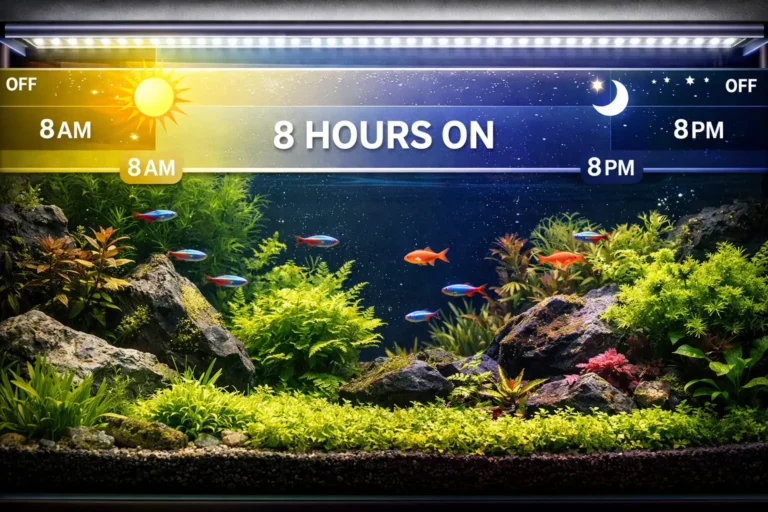
Photoperiod: 6–8 hours
CO₂: natural only
Fertilization: light liquid dosing or root tabs, depending on plant type
Ideal Lighting Duration for Low Tech Aquariums
Photoperiod often matters just as much as intensity. A moderate light run for too long can still create algae pressure. In low-tech aquariums, the best results usually come from a shorter, stable schedule instead of trying to maximize total daily exposure.
Recommended photoperiod
| Tank Stage | Recommended Daily Lighting |
|---|---|
| Fresh setup / cycling phase | 6 hours |
| Stable low-tech planted tank | 6–7 hours |
| Mature, well-balanced tank | 7–8 hours |
A common mistake is assuming that more hours automatically means more growth. In reality, once plant metabolism reaches its useful limit for the day, additional light often increases algae pressure more than plant performance.
Why longer lighting often causes algae
In low-tech systems, carbon availability is the main limiting factor. Once plants run into that limit, extra light does not magically create more healthy growth. Instead, it increases stress and leaves more open opportunity for algae. This is especially visible in tanks with Anubias, Java Fern, Bucephalandra, mosses, and other slow growers, because their leaves remain in the same position for long periods and can collect algae more easily under excessive lighting.
If a low-tech aquarium looks healthy overall but keeps developing algae, reducing intensity is often more effective than constantly shortening the photoperiod. Still, when the tank is new or unstable, reducing both can be useful.
Using timers for stability
Low-tech success depends heavily on consistency. A timer removes daily fluctuations and prevents the common habit of leaving lights on “a bit longer” for viewing. Stable timing creates stable plant behavior, and that stability is one of the biggest advantages of low-tech aquariums.
If you want a full deep dive into photoperiod strategy, that belongs in the dedicated lighting schedule article. For this topic, the short answer is: most low-tech tanks do best with a clean, repeatable 6–8 hour schedule.
Color Temperature and Spectrum
Color temperature is often overemphasized in beginner discussions. It matters visually, and it influences how the aquarium looks to your eye, but in a low-tech tank it is usually not the main reason a setup succeeds or fails. Intensity and duration matter more.
Best Kelvin range for low-tech tanks
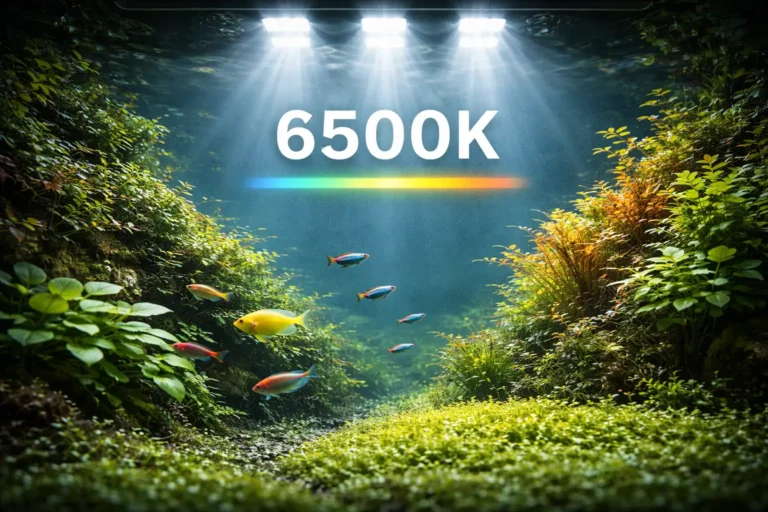
Most planted tank lights in the 6000–8000 K range work very well. Around 6500 K is especially common because it resembles a clean daylight look and keeps greens and hardscape tones natural.
For low-tech aquascapes, there is rarely a need to overcomplicate the Kelvin decision. A good daylight-style planted tank LED is usually more than enough.
White vs RGB lighting
RGB-capable lights offer visual flexibility, richer color rendering, and more control over the look of the aquarium. But in a true low-tech setup, the main question is not whether the light has RGB channels. The main question is whether the output can be controlled to stay within a balanced low-energy range.
If you already own a strong RGB light, it can still work well over a low-tech tank if you dim it appropriately. The problem is rarely the technology itself. The problem is overpowering a non-CO₂ system with more light than it can handle.
Choosing the Right Light for a Low Tech Tank
The best low-tech aquarium light is not necessarily the most advanced one. It is the one that gives you enough usable light, even spread, and preferably some control over brightness. Overpowered lighting without dimming is often a poor fit for low-tech tanks.
Budget LED lights
Many budget-friendly planted tank LEDs are perfectly suitable for low-tech aquariums. In fact, low-tech systems often benefit from moderate-output fixtures because they naturally avoid the aggressive intensity associated with high-tech aquascaping lights.
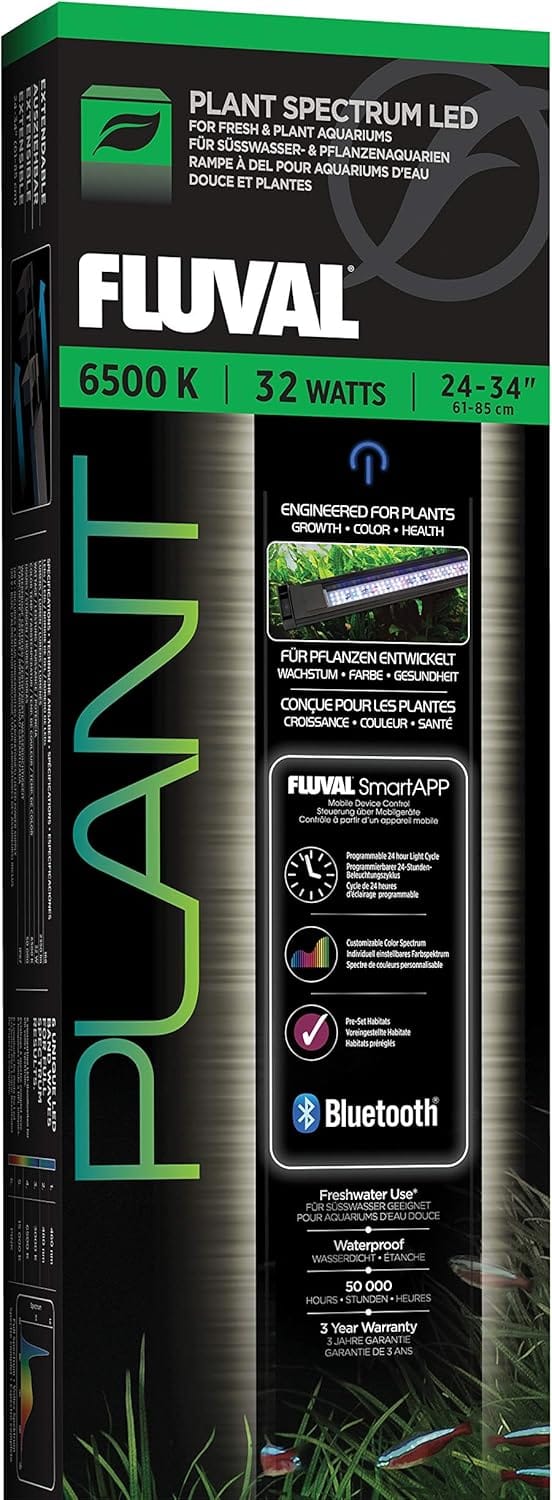
A light like this can work very well over a standard planted aquarium when plant demand, tank depth, and photoperiod are kept realistic.
Premium planted tank lights
Premium fixtures can also be excellent for low-tech tanks, especially if they allow precise dimming and have good spread. The advantage is not that you run them at maximum power. The advantage is that you can tune them down accurately and still keep the benefits of better build quality and coverage.
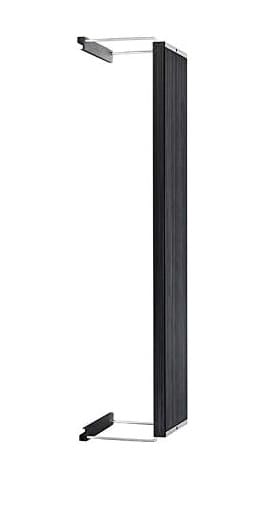
If you use a more powerful light, the key is discipline. Resist the urge to “use all of it” just because it is available.
Spread and coverage matter more than people think
A low-tech tank does not just need moderate intensity. It needs usable distribution. A harsh hotspot in the center and weak edges can create inconsistent plant performance and algae-prone zones. Good spread becomes especially important when you grow epiphytes on wood and rock, because different elevations receive different light levels even in the same aquarium.
That is why hardscape layout and lighting should be considered together. If your layout contains tall wood branches, overhangs, or strong vertical rock structure, some areas may be heavily shaded while others receive direct exposure. For layout planning, see the Aquarium Hardscape Guide.
How Tank Depth Changes Lighting Needs
Tank depth is one of the biggest reasons why the same light can feel perfect on one aquarium and far too weak or too strong on another. Low-tech lighting cannot be judged in isolation. It always depends on how far the light must travel before reaching the plants.
Shallow tanks
Shallow aquariums are naturally well suited to low-tech planting. Because the substrate is closer to the light source, even moderate fixtures can produce enough PAR for many easy species. This is one reason why shallow nature-style aquariums can look lush without becoming high-tech systems.
Standard 60 cm tanks
The classic 60 cm tank is where many aquarists start, and it responds very well to controlled low-tech lighting. This format is ideal for Cryptocoryne layouts, mixed epiphyte compositions, and slow jungle-style planting. It also gives enough room for structured hardscape without requiring extremely strong light to reach the lower layers.
Deep aquariums
Deep tanks are more difficult in low-tech style because light loss becomes more noticeable as depth increases. If you want a deep low-tech aquarium, choose plants strategically. Use tougher, shade-tolerant plants in the lower areas and avoid demanding carpeting ambitions unless the system is designed for more energy.
It is usually better to accept the natural limitation of a deep low-tech tank than to brute-force it with excessive lighting.
Best Plants for Low Tech Lighting
Plant choice is where low-tech tanks are won or lost. Many aquarists blame their lighting when the real issue is mismatched plant demand. A moderate non-CO₂ aquarium can be beautiful, but it should be built around plants that actually enjoy or tolerate those conditions.
Epiphyte plants
Epiphytes are among the best low-tech choices because they naturally tolerate slower growth and moderate light. They attach to wood or rock rather than relying heavily on substrate structure, which makes them perfect for calm aquascapes built around hardscape detail.
- Anubias
- Java Fern
- Bucephalandra
These are especially useful in tanks where you want texture and maturity without high maintenance. For a full breakdown, see Epiphyte Aquarium Plants.
Rosette plants and rooted background support
Cryptocoryne species are classic low-tech plants because they tolerate moderate light and do not require constant aggressive trimming. Amazon swords can also work, although they need more space and stronger nutrient support through the substrate.
If you want to expand beyond simple epiphyte layouts, rooted plants allow you to build fuller compositions with more depth. To understand broader planting logic, see the Aquarium Plants Guide.
Mosses and floating plants
Mosses are naturally suited to lower-energy systems, especially in wood-focused layouts and shrimp tanks. Floating plants are even more strategic: they not only thrive in moderate systems, but also help manage light by creating surface shade.
This makes floaters one of the smartest optimization tools in low-tech aquariums. They soften incoming light, absorb excess nutrients, and often help reduce algae pressure at the same time. For more on that category, see Floating Aquarium Plants.
| Plant Type | Typical Low-Tech PAR Range | Notes |
|---|---|---|
| Anubias | 10–30 PAR | Very algae-prone under excessive light |
| Java Fern | 15–35 PAR | Reliable and tolerant |
| Cryptocoryne | 20–40 PAR | Excellent low-tech rooted plant |
| Mosses | 10–40 PAR | Very versatile, depends on species and layout |
How to Prevent Algae in Low Tech Tanks
Low-tech aquariums are often recommended as algae-resistant, but that only holds true when the light level is appropriate. The most common low-tech algae issue is not that the tank is “too low-tech.” It is that the light is too strong for the rest of the system.
Too much light is the most common trigger
When algae appears in a low-tech tank, the first question should usually be: is the light too intense? Slow-growing plants cannot protect themselves well against strong energy input, especially when their leaves stay exposed in the same position for weeks or months.
In many cases, lowering intensity solves more than shortening duration alone. Dimming the fixture, raising the light, adding floating plants, or choosing a weaker output setting can all help restore balance.
Balance light with nutrients
Low-tech does not mean nutrient-free. Plants still need access to what supports growth. Root-feeding plants may benefit from tabs, while water-column feeders can benefit from light liquid fertilization. The trick is to match nutrient supply to real plant demand instead of forcing a high-energy dosing plan onto a moderate-energy tank.
If you want to refine this side of the system, the best next steps are the Macronutrients Guide, the Micronutrients Guide, and the Aquarium Water Change Guide.
Use floating plants as natural light control
One of the most underrated low-tech strategies is using floating plants to create a natural light filter. This approach mirrors real habitats, where overhead coverage softens direct exposure and creates calmer, more shade-oriented plant zones below. It is especially effective in tanks centered around epiphytes, mosses, and soft jungle-style compositions.
Real Low Tech Lighting Setups
Practical examples make low-tech lighting much easier to understand than theory alone. The following setups are not rigid formulas, but they show how balanced low-tech thinking works in real aquariums.
Nano tank example
Tank: 20 L nano aquarium
Light: compact LED with moderate output
Photoperiod: 7 hours
Plants: Java Fern, moss, Anubias nana petite
Style: wood-focused slow-growth layout
This kind of aquarium does not need aggressive brightness. In fact, nanos are easy to overpower because the plants are close to the light source. Moderate output and simple hardscape planting are usually the most stable path.
60 cm beginner aquarium
Tank: standard 60 cm planted aquarium
Light: medium-output LED
Target: roughly 25–35 PAR at substrate
Photoperiod: 6.5–7 hours
Plants: Cryptocoryne, Java Fern, Bucephalandra, floaters
This is one of the best formats for a low-tech planted tank because it gives enough room to layer plants without forcing extreme intensity. It also allows better spread than many tiny nanos, which helps create a more even result.
Walstad-style natural tank
Tank: natural-style planted aquarium with soil base
Light: restrained daylight-style LED
Photoperiod: 6–7 hours
Plants: floaters, rooted rosettes, stems used conservatively
Approach: ecosystem stability over display speed
This style benefits especially from avoiding excessive light. A natural aquarium works best when plant growth, nutrient recycling, and biological pacing stay in harmony. Trying to push a Walstad-style tank with high light usually works against the whole method.
Common Lighting Mistakes in Low Tech Tanks
- Using a high-tech light at full power even though the tank has no injected CO₂
- Running the photoperiod too long because more viewing time feels better
- Choosing demanding plants that do not match the energy level of the setup
- Ignoring tank depth and assuming the same light works the same way everywhere
- Overlooking spread and focusing only on raw brightness
- Trying to solve every problem with fertilizer when the real issue is excess light
Most of these mistakes come from treating a low-tech aquarium like a weaker version of a high-tech tank. It is better to treat it as its own category with its own logic. A great low-tech aquarium is not a compromised high-tech tank. It is a deliberate, stable, lower-energy ecosystem.
Frequently Asked Questions
How many hours should a low-tech aquarium light run?
Most low-tech tanks do best with 6 to 8 hours of light per day. Newly established tanks often benefit from starting at around 6 hours.
Do low-tech tanks need strong lighting?
No. Strong lighting often creates more problems than benefits in non-CO₂ systems. Moderate lighting is usually the better choice.
Can aquarium plants grow without CO₂ and strong light?
Yes. Many aquarium plants grow very well without injected CO₂ as long as the lighting level and plant selection are realistic.
What light intensity is best for Anubias?
Anubias usually performs best under low to moderate light, often around 10–30 PAR. Too much light can encourage algae on its leaves.
Should I reduce light duration or reduce intensity to fix algae?
In many low-tech tanks, reducing intensity is the more effective fix because it lowers the energy pressure on the whole system. In unstable tanks, reducing both can help.
Can cheap LED lights work for low-tech planted tanks?
Yes. Many affordable LEDs work well in low-tech aquariums if they provide even spread and are not excessively strong for the tank depth and plant mix.
Are floating plants useful in low-tech lighting setups?
Yes. Floating plants help diffuse incoming light, absorb nutrients, and often improve stability in low-tech aquariums.
Conclusion
Low-tech aquarium lighting works best when it is treated as a balancing tool, not a power contest. Most successful non-CO₂ planted tanks thrive under moderate intensity, shorter photoperiods, and carefully chosen plants that suit a slower ecosystem.
If you keep the energy level realistic, many of the usual planted-tank frustrations become easier to manage. Algae pressure drops, plant expectations become more honest, and the aquarium develops at a calmer, more sustainable pace. That is the real strength of low-tech aquascaping: not less beauty, but more stability.
Want to dial in your setup more precisely?
Use the Aquarium Lighting Calculator to estimate PAR, Lux, and a realistic lighting target for your planted tank.
New to AquariumLesson? Start with our complete Aquarium Lessons Hub or return to the homepage at AquariumLesson.com.