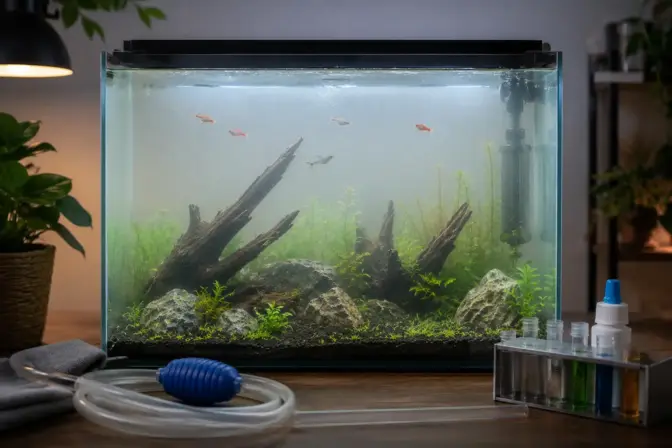
New Tank Syndrome Guide: Symptoms, Causes & Safe Fixes for New Aquariums
New tank syndrome describes the water quality problems that happen when fish, shrimp, or snails are added before a new aquarium is biologically mature. The tank may look clean, the filter may be running, and the water may appear clear — but ammonia and nitrite can still rise to dangerous levels because the biological filter is not ready yet.
This is one of the most common beginner problems in freshwater aquarium keeping. New tank syndrome is not caused by the aquarium being “dirty” in a visible way. It is caused by an immature nitrogen cycle. The tank has not yet developed enough beneficial microorganisms to convert ammonia into nitrite and nitrite into nitrate quickly enough to protect livestock.
If your fish are gasping, hiding, clamping fins, refusing food, or dying shortly after being added to a new aquarium, water quality should be the first thing you check. Many new-tank “disease” situations are actually ammonia or nitrite stress. Medication, extra products, or major layout changes will not fix the root problem if the biological filter is not established.
This guide explains what new tank syndrome is, how to recognize it, how to test for it, how to protect fish during an emergency, and how to prevent it in the future. For the full biological process behind this topic, read the Aquarium Cycling Guide. For the wider water-quality system, start with the Aquarium Water Guide.
Quick Emergency Answer
- Test ammonia and nitrite immediately.
- Do not add more fish.
- Reduce feeding or stop feeding briefly if ammonia or nitrite is present.
- Perform controlled water changes to dilute toxic waste.
- Keep the filter running continuously.
- Increase surface movement or add an air stone.
- Do not replace all filter media.
- Continue testing until ammonia and nitrite stay at 0 ppm.
The goal is not to restart the aquarium. The goal is to protect livestock while the biological filter catches up.
What you’ll learn in this lesson
- What new tank syndrome actually means
- Why clear water can still be unsafe
- How ammonia and nitrite cause problems in new aquariums
- Which symptoms suggest new tank syndrome
- What to test immediately in a new tank emergency
- How to stabilize a tank with fish already inside
- Which mistakes make new tank syndrome worse
- How to prevent new tank syndrome before adding livestock
What Is New Tank Syndrome?
New tank syndrome is the stress, illness, or death of aquarium livestock caused by unstable water quality in a newly set up tank. It usually happens when fish are added before the aquarium has completed cycling. The biological filter is too immature to process waste, so ammonia and nitrite can accumulate.
In a mature aquarium, beneficial microorganisms live mainly in the filter media, but also on substrate, rocks, driftwood, plants, glass, and other surfaces. These organisms process nitrogen waste. They convert ammonia into nitrite and then nitrite into nitrate. This process is called nitrification.
In a new aquarium, this microbial system is still developing. The filter may move water, but that does not mean it is biologically mature. A new filter is often just a clean container with media inside. It becomes a biological filter only after enough beneficial organisms colonize it and begin processing waste consistently.
That is the core of new tank syndrome: the aquarium looks ready before the biology is ready.
Why New Tank Syndrome Happens
New tank syndrome happens because waste production begins faster than biological filtration can handle it. As soon as fish enter the aquarium, they produce waste through respiration, excretion, and feeding. Uneaten food, dying plant leaves, and organic debris add even more waste pressure.
In a cycled tank, ammonia is processed quickly. In an uncycled tank, ammonia can rise. As the first stage of the cycle develops, ammonia may begin to drop, but nitrite may rise. This creates a second danger phase. A tank can survive the ammonia stage and still harm fish during the nitrite stage.
This is why new tank syndrome is often confusing. A beginner may see ammonia improve and assume the aquarium is safe, while nitrite is still building. Or the water may look perfectly clear, while dissolved waste compounds remain invisible.
The basic cause chain
- A new aquarium is set up with a new filter.
- Fish are added before the biological filter is mature.
- Fish waste and uneaten food create ammonia.
- Ammonia rises because the tank cannot process it fast enough.
- Nitrite rises as the first stage of nitrification begins.
- Fish become stressed, gasp, hide, clamp fins, or die.
- The aquarist may mistake the issue for disease instead of water quality.
New tank syndrome is preventable. It usually comes from rushing the stocking process, skipping water tests, or misunderstanding what aquarium cycling means.
New Tank Syndrome Symptoms
The symptoms of new tank syndrome can look similar to disease, stress, poor acclimation, oxygen problems, or poisoning. That is why testing is essential. You cannot diagnose new tank syndrome from fish behavior alone, but fish behavior can tell you when to test immediately.
If symptoms appear in a new aquarium, ammonia and nitrite should be checked before adding medication. Treating fish without testing water can miss the real cause and may add more stress to an already unstable system.
| Symptom | Possible Water Cause | What To Check First |
|---|---|---|
| Fish gasping at the surface | Ammonia, nitrite, low oxygen, high temperature | Ammonia, nitrite, oxygen, temperature |
| Clamped fins | Stress from poor water quality | Ammonia, nitrite, pH, temperature |
| Fish hiding constantly | Stress, unstable water, wrong stocking | Full water test and compatibility |
| Fish refusing food | Water stress, shock, illness | Ammonia, nitrite, temperature |
| Sudden fish deaths | Ammonia spike, nitrite spike, oxygen crash, shock | Ammonia, nitrite, oxygen, recent changes |
| Cloudy water | Bacterial bloom, excess waste, overfeeding | Ammonia, nitrite, feeding amount |
| Fish breathing rapidly | Gill irritation, nitrite stress, low oxygen | Nitrite, ammonia, surface movement |
| Shrimp dying after introduction | Immature tank, ammonia/nitrite, unstable minerals | Ammonia, nitrite, GH, KH, temperature |
These symptoms do not prove new tank syndrome by themselves. But in a new aquarium, they are strong warning signs. Always test before guessing.
Why Clear Water Can Still Be Dangerous
Clear water is not the same as safe water. Ammonia and nitrite are dissolved compounds. They do not make the aquarium visibly dirty. A tank can look beautiful while fish are being exposed to unsafe water chemistry.
This is one of the most damaging beginner assumptions. Many people believe that if the water is clear, the tank is ready. But visual clarity only tells you that the water is not full of visible particles. It does not tell you whether the biological filter can process waste.
Cloudy water can happen in new tanks, especially during bacterial blooms, substrate disturbance, or overfeeding. But cloudy water is not required for new tank syndrome. The most dangerous version is often the invisible one: clear water with measurable ammonia or nitrite.
Ammonia and New Tank Syndrome
Ammonia is usually the first major danger in a new aquarium. It comes from fish waste, uneaten food, dead plant material, hidden dead livestock, and other decomposing organic matter. In an uncycled tank, there may not be enough beneficial microorganisms to convert ammonia quickly.
Ammonia is especially important because its toxicity is influenced by pH and temperature. Higher pH and warmer water can increase the risk associated with ammonia. This means two tanks with the same ammonia reading may not carry exactly the same danger level.
For beginner aquarium care, keep the rule simple: ammonia should be 0 ppm in a stocked aquarium. Any measurable ammonia in a new tank with fish should be treated as a warning sign.
What ammonia stress can look like
- Fish gasping near the surface
- Red or irritated gills
- Rapid breathing
- Clamped fins
- Lethargy
- Refusing food
- Unusual hiding
- Sudden deaths in severe cases
If ammonia is present, reduce waste immediately. Feed less, remove uneaten food, check for dead material, improve oxygenation, and use controlled water changes to dilute the ammonia while the biological filter develops.
Nitrite and New Tank Syndrome
Nitrite is the second major danger in new tank syndrome. It often appears after ammonia begins to drop, which can mislead beginners into thinking the worst is over. In reality, nitrite means the cycle is still incomplete.
A tank with 0 ppm ammonia but measurable nitrite is not fully cycled. Fish may still be at risk. Nitrite can affect the ability of fish to transport oxygen efficiently, which is one reason fish may breathe rapidly or gasp even when the water appears clear.
For practical aquarium care, nitrite should also be 0 ppm in a stable stocked tank. If nitrite is measurable, do not add more livestock. Reduce feeding, improve oxygenation, and continue water changes as needed.
Nitrate: The Later Waste Signal
Nitrate is usually the later-stage product of nitrification. It is less immediately dangerous than ammonia or nitrite, but it still matters. In a new tank, nitrate appearing can be a sign that the cycle is progressing. However, nitrate alone does not prove the aquarium is safe.
A tank is not ready just because nitrate is present. Ammonia and nitrite must also be zero. In planted aquariums, nitrate may stay lower because plants use nitrogen. In some tap water sources, nitrate may already be present before the aquarium cycle is complete.
Once the aquarium is cycled, nitrate becomes part of routine maintenance. Water changes, plant growth, feeding control, stocking level, and filter maintenance all influence nitrate over time. For routine planning, continue with the Aquarium Water Change Guide.
How to Test for New Tank Syndrome
If you suspect new tank syndrome, test the water before doing anything else. The most important tests are ammonia and nitrite. Nitrate, pH, KH, GH, oxygen, and temperature help explain the broader situation.
Do not rely only on test strips if you need precise emergency information. Liquid test kits are often more useful for ammonia and nitrite decisions. Whatever test method you use, follow the instructions carefully and check expiration dates.
| Test | Why It Matters | Emergency Meaning |
|---|---|---|
| Ammonia | Shows whether toxic early waste is present | Any measurable result in a stocked new tank is a concern |
| Nitrite | Shows whether cycling is incomplete | Any measurable result means the tank is not fully stable |
| Nitrate | Shows later-stage waste accumulation | Useful for tracking cycle progress and maintenance needs |
| pH | Affects ammonia risk and livestock comfort | Sudden changes or unsuitable ranges increase stress |
| KH | Shows buffering capacity | Low KH can make pH less stable |
| GH | Shows mineral hardness | Important for shrimp, snails, and fish suitability |
| Temperature | Affects oxygen demand and ammonia context | High temperature can worsen stress |
If ammonia or nitrite is measurable, treat the situation as a water-quality emergency. If both are zero, look at oxygen, temperature, pH shock, acclimation, stocking compatibility, or disease as possible next causes.
How to Fix New Tank Syndrome
Fixing new tank syndrome means reducing immediate toxicity while allowing the biological filter to mature. The mistake is trying to “reset” everything. A full teardown, complete filter replacement, or aggressive cleaning can remove the very biology the tank needs.
The safest approach is controlled stabilization: dilute ammonia and nitrite, reduce new waste input, protect oxygen levels, and keep the filter running.
Step 1: Stop adding livestock
Do not add more fish, shrimp, or snails while ammonia or nitrite is present. More livestock means more waste, and more waste makes the immature biological filter work even harder.
Step 2: Reduce feeding
Food becomes waste. In a new-tank emergency, overfeeding can make ammonia and nitrite worse. Feed very lightly, remove uneaten food, and consider skipping feeding briefly if ammonia or nitrite is rising and livestock condition allows it.
Step 3: Perform controlled water changes
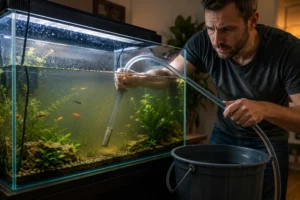
Water changes dilute ammonia, nitrite, and dissolved waste. Use dechlorinated, temperature-matched water. Avoid creating sudden pH, KH, GH, or temperature shocks. In emergencies, repeated controlled water changes are often safer than one chaotic correction.
Step 4: Increase oxygenation
Fish under ammonia or nitrite stress may already be struggling. Beneficial bacteria also need oxygen-rich conditions. Increase surface movement, clean obvious flow blockages, and use an air stone if fish are gasping or the tank is warm.
Step 5: Protect the filter
Do not replace all filter media. Do not scrub everything sterile. Do not switch the filter off. The filter is where much of the biological recovery must happen. If the media is clogged, gently rinse mechanical media in removed aquarium water, not untreated chlorinated tap water.
Step 6: Keep testing
New tank syndrome is not fixed when fish look slightly better for one day. Continue testing ammonia and nitrite until both remain at 0 ppm. Then continue stocking slowly and feeding carefully while the aquarium matures.
Emergency Action Plan
Use this plan if fish are already inside the new aquarium and ammonia or nitrite is measurable.
| Action | Purpose | Important Note |
|---|---|---|
| Stop adding livestock | Prevents extra waste load | Do not add “cleanup crew” to solve the problem |
| Reduce feeding | Lowers ammonia production | Remove uneaten food quickly |
| Water change | Dilutes ammonia and nitrite | Use dechlorinated, temperature-matched water |
| Increase surface movement | Supports oxygen and bacteria | Especially important if fish are gasping |
| Keep filter running | Protects developing biofilter | Do not replace all media |
| Test daily or frequently | Tracks recovery | Focus on ammonia and nitrite first |
If ammonia or nitrite keeps returning, the tank is still cycling under fish load. Continue protective care until the biological filter can handle the waste consistently.
What Not to Do During New Tank Syndrome
Some reactions make new tank syndrome worse. In a panic, beginners often clean too much, replace too much, add too many products, or disturb the tank so heavily that biological stability becomes even harder to achieve.
- Do not replace all filter media. This removes developing beneficial microorganisms.
- Do not wash biological media under untreated tap water. Chlorine can damage microbial life.
- Do not add more fish. More fish means more waste.
- Do not overfeed weak fish. Extra food becomes extra ammonia pressure.
- Do not use medication before testing water. Water quality may be the actual cause.
- Do not chase pH aggressively. Sudden changes can add stress.
- Do not deep-clean the entire tank. You may remove helpful surface biology.
- Do not turn off the filter at night. The filter needs continuous oxygen-rich flow.
New tank syndrome is solved by stabilizing the system, not by constantly restarting it.
New Tank Syndrome vs Normal Cycling
Normal cycling and new tank syndrome are related, but they are not the same experience. Cycling is the planned development of biological filtration. New tank syndrome is what happens when livestock are exposed to the unstable phase of that process.
In a fishless cycle, ammonia and nitrite may rise, but no fish are harmed because livestock are not present. In new tank syndrome, fish are already inside the tank while these compounds rise. That is the difference.
| Situation | Livestock Present? | Main Risk | Best Response |
|---|---|---|---|
| Fishless cycling | No | Waiting too little before stocking | Test until ammonia and nitrite are 0 ppm |
| Fish-in cycling | Yes | Fish exposed to ammonia or nitrite | Water changes, light feeding, oxygen, testing |
| New tank syndrome | Usually yes | Livestock stress or death from immature biofilter | Emergency stabilization and continued cycling |
| Mature aquarium | Yes | Mini-cycle after disruption | Find cause and protect biofilter |
Can New Tank Syndrome Happen in Mature Aquariums?
A mature aquarium can experience a similar problem if the biological filter is damaged or suddenly overloaded. This is often called a mini-cycle or cycle crash rather than classic new tank syndrome, but the symptoms can look similar.
Ammonia or nitrite can reappear in an established aquarium after major filter cleaning, medication, a long power outage, dead livestock, heavy overfeeding, sudden overstocking, or replacing too much biological media at once.
Common mini-cycle triggers
- Replacing filter cartridges or media completely
- Turning off the filter for too long
- Medication affecting biological filtration
- Adding many fish at once
- Overfeeding heavily
- Dead fish hidden behind hardscape
- Deep substrate disturbance in a dirty tank
- Low oxygen or clogged filter flow
If ammonia or nitrite appears in a mature tank, treat it seriously. The same emergency principles apply: reduce waste, improve oxygen, protect the filter, perform controlled water changes, and keep testing.
New Tank Syndrome in Shrimp Tanks
Shrimp tanks deserve extra patience. A tank can be technically cycled but still too young or unstable for sensitive shrimp. Shrimp depend not only on ammonia and nitrite safety, but also on stable GH, KH, temperature, biofilm, and the absence of pollutants such as copper.
New shrimp deaths are often blamed on bad shrimp, but the cause may be immature water, unstable minerals, poor acclimation, or residual ammonia/nitrite. For shrimp, “cycled” is the minimum requirement. “Mature” is often better.
- Wait until ammonia and nitrite are 0 ppm.
- Allow biofilm and algae films to develop naturally.
- Keep GH and KH stable.
- Avoid sudden temperature changes.
- Acclimate shrimp slowly.
- Do not add shrimp immediately after major water chemistry changes.
For broader livestock planning, continue with the Aquarium Fish, Shrimp & Snails Guide.
Do Plants Prevent New Tank Syndrome?
Live plants can reduce the risk of new tank syndrome, but they do not make it impossible. Fast-growing plants can absorb nitrogen, provide surface area for microorganisms, and help stabilize the system. However, plants do not replace a mature biological filter.
In heavily planted aquariums, test results may look different because plants can use nitrogen. Nitrate may not rise as clearly as expected. Some active substrates can also release ammonia early, especially in aquascaping setups. This makes testing even more important, not less.
Good beginner plants can help new tanks settle faster, especially floating plants and hardy fast-growing stems. For plant selection, read the Easy Aquarium Plants Guide, Aquarium Background Plants Guide, and Floating Aquarium Plants Guide.
Does Bottled Bacteria Prevent New Tank Syndrome?
Bottled bacteria may help reduce the risk of new tank syndrome, but it should not be treated as a magic shield. Some products can support faster biological establishment when used correctly, especially with suitable filter media and oxygen-rich flow. But a bottle does not replace testing.
The only way to know whether the tank is safe is to measure ammonia and nitrite. If either one is present, the tank is not fully safe for normal stocking, even if bottled bacteria was added.
Mature filter media from a healthy established aquarium is often more powerful than bottled products because it already contains living biofilm. However, only use media from a disease-free, stable tank.
How to Prevent New Tank Syndrome
Preventing new tank syndrome is much easier than fixing it after fish are already stressed. The key is to cycle the aquarium first, stock slowly, and test water instead of guessing from appearance.
Prevention checklist
- Set up the aquarium completely before buying fish.
- Run the filter continuously during cycling.
- Provide an ammonia source during fishless cycling.
- Test ammonia, nitrite, and nitrate.
- Wait until ammonia and nitrite are 0 ppm.
- Use live plants to support stability, but still test water.
- Add fish gradually after cycling.
- Feed lightly in the first weeks.
- Do not replace all filter media.
- Continue testing after livestock are added.
Common Mistakes That Cause New Tank Syndrome
Most cases of new tank syndrome come from avoidable beginner mistakes. The tank is stocked too early, too heavily, or without testing. Then the aquarist reacts by cleaning too much, adding more products, or changing too many variables at once.
- Adding fish on the same day as setup: the filter is not biologically ready.
- Trusting clear water: dissolved ammonia and nitrite are invisible.
- Skipping test kits: cycling cannot be confirmed by appearance.
- Adding too many fish at once: the waste load overwhelms the filter.
- Overfeeding new fish: uneaten food creates ammonia pressure.
- Replacing filter cartridges: this can remove beneficial bacteria.
- Turning off the filter: biological filtration needs oxygen-rich flow.
- Adding shrimp too early: shrimp often need a more mature tank.
- Using products instead of understanding the cycle: testing still decides readiness.
New Tank Syndrome Troubleshooting Table
Use this table to connect symptoms with likely causes and first actions. It does not replace testing, but it helps you act in the right order.
| Situation | Likely Cause | First Action |
|---|---|---|
| Fish gasping after recent setup | Ammonia, nitrite, low oxygen | Test water, increase surface movement, water change |
| Fish die after first week | Ammonia or nitrite spike | Test ammonia/nitrite, reduce feeding, protect filter |
| Water turns cloudy after adding fish | Bacterial bloom, excess waste | Test ammonia/nitrite, avoid overfeeding |
| Ammonia is zero but fish still stressed | Nitrite, oxygen, pH shock, temperature | Test nitrite and temperature, improve oxygen |
| Nitrite stays high | Cycle incomplete | Continue water changes and testing, do not add fish |
| Tank improves then worsens again | Young filter overloaded | Reduce feeding and stocking pressure |
| Shrimp die in new tank | Immaturity, unstable minerals, ammonia/nitrite | Test ammonia, nitrite, GH, KH, temperature |
New Tank Syndrome Recovery Timeline
Recovery depends on how severe the ammonia or nitrite problem is, how many fish are inside, how strong the filter is, and how quickly you reduce waste pressure. A mild case may stabilize relatively quickly with water changes and careful feeding. A severe case can take longer because the biological filter still needs to mature.
The tank is not recovered just because fish look slightly better after one water change. Recovery means ammonia and nitrite stay at 0 ppm while the aquarium carries its current livestock load.
- First day: test, water change if needed, improve oxygen, reduce feeding.
- Next few days: continue testing ammonia and nitrite frequently.
- Following weeks: allow the biological filter to mature.
- After stabilization: add no new livestock until ammonia and nitrite stay at 0 ppm.
- Long term: stock slowly and maintain a consistent water-change routine.
Quick Takeaways
- New tank syndrome is usually caused by an immature biological filter.
- Clear water does not prove that a new tank is safe.
- Ammonia and nitrite are the main emergency tests.
- Fish gasping, hiding, clamping fins, or dying in a new tank often points to water quality.
- Do not add more livestock during ammonia or nitrite problems.
- Water changes, reduced feeding, oxygenation, and filter protection are the first steps.
- Do not replace all filter media during a new-tank emergency.
- Plants and bottled bacteria may help, but they do not replace testing.
- Shrimp tanks often need extra maturity beyond basic cycling.
- The best prevention is proper cycling before stocking.
Conclusion
New tank syndrome is one of the most common beginner aquarium problems, but it is also one of the most preventable. It happens when livestock are added before the aquarium is biologically ready to process waste. The result is often ammonia or nitrite stress, even when the water looks clear.
The solution is not panic cleaning or adding random products. The solution is water testing, controlled water changes, reduced feeding, strong oxygenation, continuous filtration, and patience while the biological filter develops.
Next step:
If your aquarium is new and fish are acting stressed, test ammonia and nitrite immediately. If either value is measurable, pause stocking, reduce feeding, improve oxygenation, and use controlled water changes until both values stay at 0 ppm.
💬 Join the Conversation
Tag us on Instagram @AquariumLesson — we’d love to see your new aquarium setup and cycling progress.
👉 Have you ever had fish stress in a new tank? What did your ammonia and nitrite tests show?
FAQ
What is new tank syndrome?
New tank syndrome is the stress, illness, or death of aquarium livestock caused by unstable water quality in a new aquarium. It usually happens when fish are added before the biological filter can process ammonia and nitrite safely.
How do I know if my tank has new tank syndrome?
Test ammonia and nitrite. If fish are stressed in a new tank and either ammonia or nitrite is measurable, new tank syndrome is likely. Symptoms can include gasping, clamped fins, hiding, rapid breathing, poor appetite, or sudden deaths.
Can clear water still have new tank syndrome?
Yes. Clear water can still contain ammonia or nitrite. These compounds are dissolved and invisible. Water clarity does not prove that a new aquarium is cycled or safe.
How do you fix new tank syndrome?
Test ammonia and nitrite, stop adding livestock, reduce feeding, perform controlled water changes, increase oxygenation, and keep the filter running. Do not replace all filter media, because that can remove developing beneficial bacteria.
Should I change water during new tank syndrome?
Yes, controlled water changes can dilute ammonia and nitrite. Use dechlorinated, temperature-matched water and avoid sudden pH, KH, GH, or temperature shocks.
Should I stop feeding during new tank syndrome?
You should reduce feeding significantly. Uneaten food becomes waste and can increase ammonia. In some emergencies, skipping feeding briefly may help reduce waste pressure, but continue observing livestock condition.
Can bottled bacteria fix new tank syndrome?
Bottled bacteria may help support the biological filter, but it does not replace water testing or water changes. If ammonia or nitrite is present, you still need to protect livestock while the filter matures.
How long does new tank syndrome last?
It lasts until the biological filter can process waste consistently. Recovery can take days to weeks depending on severity, filter maturity, stocking, feeding, oxygen, and water-change routine. The tank is stable when ammonia and nitrite remain at 0 ppm.
Can fish survive new tank syndrome?
Some fish may survive if the problem is caught early and water quality is corrected quickly. However, ammonia and nitrite stress can cause serious harm. Immediate testing, water changes, reduced feeding, and oxygenation are important.
How do I prevent new tank syndrome?
Cycle the aquarium before adding fish, test ammonia and nitrite, add livestock gradually, feed lightly at first, keep the filter running, avoid replacing all filter media, and continue testing after stocking.
New to AquariumLesson? Start with our complete Aquarium Lessons Hub or return to the homepage at AquariumLesson.com.
References
- U.S. Environmental Protection Agency. Aquatic Life Criteria – Ammonia.
- FAO. The Water Requirements of Aquaculture Rearing Systems.
- FAO. Environment and Fish Health: Water Quality for Aquaculture.
- McKnight et al. Microbial Community Succession of Home Aquarium Biofilters.
- Godzieba et al. Network of Nitrifying Bacteria in Aquarium Biofilters.
Start building your aquarium in My Aquariums
Save this guide so you can return to the diagnosis and treatment steps during maintenance.