Cloudy Aquarium Water: Causes, Types & Safe Fixes
Introduction
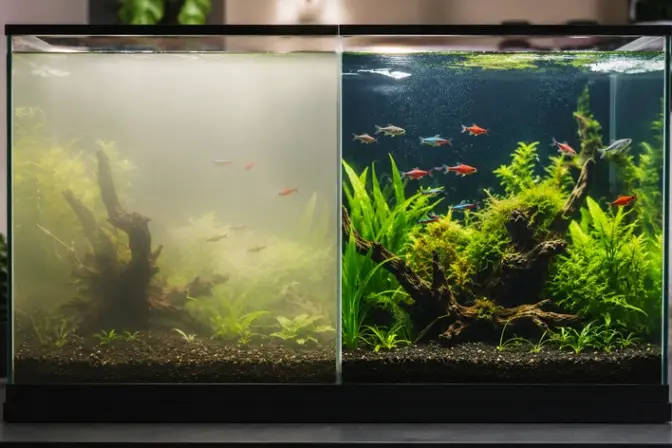
Cloudy aquarium water is one of the most common problems in freshwater aquariums, especially in new tanks. The water may turn white, milky, green, brown, dusty or hazy, and each type of cloudiness can have a different cause. Some cases are harmless and temporary. Others can warn you about ammonia, nitrite, overfeeding, poor filtration, bacterial blooms, algae blooms or disturbed substrate.
The biggest mistake is trying to fix cloudy water only by making the aquarium look clear. Clear water is not always safe water, and cloudy water is not always dangerous. The right response depends on the cause. A new tank bacterial bloom needs different handling than green water algae, substrate dust, tannins from driftwood or cloudy water caused by overfeeding.
This guide explains the main types of cloudy aquarium water, how to identify the likely cause, what to test first, how to fix the problem safely, and what not to do. For the full water-quality foundation, read the Aquarium Water Guide. For testing context, continue with the Aquarium Water Parameters Guide.
Quick Answer
- White or milky cloudy water is often caused by a bacterial bloom, especially in new aquariums.
- Green cloudy water is usually a suspended algae bloom caused by excess light and nutrients.
- Brown or tea-colored water often comes from tannins released by driftwood, leaves or botanicals.
- Dusty cloudy water can come from unwashed substrate, sand, soil or disturbed gravel.
- Cloudy water after overfeeding can indicate excess organic waste and bacterial activity.
- Cloudy water with fish gasping is urgent: increase aeration and test ammonia and nitrite immediately.
- Do not replace all filter media to fix cloudiness, because this can damage biological filtration.
- Do not add random clarifiers before testing, especially in new or stocked tanks.
- The safest first steps are testing, aeration, waste removal and filter-flow checks.
The key rule is simple: identify the type of cloudiness first, then fix the cause instead of only hiding the symptom.
What you’ll learn in this lesson
- Why aquarium water becomes cloudy
- How to identify white, green, brown, dusty and milky water
- When cloudy water is harmless and when it is urgent
- How cloudy water connects to cycling, ammonia and nitrite
- How overfeeding and organic waste trigger bacterial blooms
- How light and nutrients cause green water algae
- How substrate and driftwood affect water clarity
- How to fix cloudy water safely
- Which mistakes can make cloudiness worse
- How to prevent cloudy aquarium water long-term
What Is Cloudy Aquarium Water?
Cloudy aquarium water means the water is no longer visually clear because something is suspended, dissolved or dispersed in the water column. This can be bacteria, algae, fine dust, substrate particles, dissolved organics, tannins or debris.
Cloudiness is not a diagnosis by itself. It is a symptom. The aquarium may be cloudy because it is new and biologically immature, because too much food is decomposing, because algae is blooming, because substrate was disturbed, or because wood is releasing tannins.
The type of cloudiness matters. White water, green water, brown water and dusty water usually point to different causes. Before adding treatments, look at the color, timing, smell, fish behavior and test results.
In simple terms: cloudy water tells you something changed in the aquarium system. Your job is to find out what changed and whether livestock are at risk.
Types of Cloudy Aquarium Water
The fastest way to diagnose cloudy aquarium water is to identify what it looks like. The color and timing often give you the first clue.
| Cloudy Water Type | Likely Cause | First Action |
|---|---|---|
| White or milky water | Bacterial bloom, new tank instability, organic waste | Test ammonia/nitrite and reduce waste |
| Green water | Suspended algae bloom | Reduce excess light and review nutrients |
| Brown or tea-colored water | Tannins from driftwood or botanicals | Usually harmless; use carbon or water changes if unwanted |
| Dusty gray water | Substrate dust, sand, soil or disturbed gravel | Filter mechanically and avoid disturbance |
| Cloudy water after feeding | Overfeeding and bacterial growth | Remove food, reduce feeding, test water |
| Cloudy water with odor | Organic decay, dead livestock, poor maintenance | Find source, water change, test ammonia/nitrite |
| Cloudy water with fish gasping | Oxygen stress, ammonia, nitrite or bacterial oxygen demand | Increase aeration immediately and test |
If fish are gasping, breathing rapidly, hiding unusually, or acting weak, treat cloudy water as a possible water-quality emergency until testing proves otherwise.
White or Milky Cloudy Aquarium Water
White or milky cloudy water is often caused by a bacterial bloom. This is especially common in new aquariums, after overfeeding, after disturbing substrate, after filter disruption or when a lot of organic material enters the water.
A bacterial bloom happens when bacteria multiply quickly in response to available nutrients and dissolved organic waste. In a new tank, the biological system is still finding balance. In an established tank, a sudden bloom often means something fed bacterial growth: too much food, dead plants, dead livestock, dirty substrate, filter problems or heavy organic buildup.
White cloudy water is not always dangerous by itself, but it can become risky if bacterial activity reduces oxygen or if ammonia and nitrite are present. This is why testing matters.
What to do
- Test ammonia and nitrite immediately if livestock are present.
- Increase surface movement if fish breathe rapidly or gather near the surface.
- Remove uneaten food, dead leaves and visible waste.
- Reduce feeding temporarily.
- Check that the filter is running properly.
- Do not replace all filter media.
- Perform a controlled water change if ammonia, nitrite or heavy waste is present.
For new tanks, also read New Tank Syndrome and the Aquarium Cycling Guide.
Green Cloudy Aquarium Water
Green cloudy aquarium water is usually caused by suspended algae. Instead of algae growing only on glass, rocks or plants, microscopic algae float in the water column and turn the entire aquarium green or pea-soup-like.
Green water often appears when excess light and nutrients combine. Long photoperiods, direct sunlight, high nitrate, high phosphate, overfeeding, immature tanks and weak plant competition can all contribute.
Green water is usually not the same as a bacterial bloom. Water may appear green even if the filter is running. The solution is not to deep-clean the entire aquarium. The solution is to correct the light and nutrient imbalance.
What to do
- Reduce lighting duration.
- Avoid direct sunlight hitting the aquarium.
- Test nitrate and review feeding.
- Perform water changes if nitrate or waste is high.
- Remove excess organic debris.
- Add or improve healthy plant growth if appropriate.
- Consider UV sterilization only when basic causes are addressed.
Green water often clears only when the conditions feeding it are corrected. A blackout or UV sterilizer may help in some cases, but if excess light and nutrients remain, the problem can return.
Brown or Tea-Colored Aquarium Water
Brown or tea-colored aquarium water is often caused by tannins from driftwood, leaves, cones or botanicals. This is common in natural-style, blackwater-inspired and driftwood-heavy aquariums.
Tannins are not automatically harmful. In many aquariums, they are part of the intended natural look. However, they can tint the water and slightly influence pH in low-buffered systems. If you did not expect brown water, new driftwood is often the first thing to check.
If the water is brown but fish behave normally, ammonia and nitrite are 0 ppm, and there is no bad smell, tannins may be more of an aesthetic issue than a water-quality emergency.
What to do
- Confirm the color is from wood, leaves or botanicals.
- Test pH and KH if the aquarium is very soft or low-buffered.
- Use regular water changes if you want clearer water.
- Use activated carbon or chemical filtration if you want to remove tint faster.
- Pre-soak or boil driftwood before use when appropriate.
- Accept tannins if you are building a natural blackwater-style aquarium.
For hardscape context, read the Aquarium Driftwood Guide and Aquarium KH and GH Guide.
Dusty Cloudy Water After Adding Substrate
Dusty cloudy water often appears after adding sand, gravel, soil or hardscape. Fine particles can float in the water column when substrate was not rinsed enough, when sand is disturbed, or when aquarium soil breaks down during filling.
This type of cloudiness often looks gray, beige or dusty rather than milky white. It usually appears immediately after setup, planting, rescape work or aggressive substrate cleaning.
Dust is often less dangerous than ammonia or nitrite, but it can irritate fish if extreme and can clog filter media. In new setups without livestock, it is usually a patience and mechanical filtration issue.
What to do
- Keep the filter running with appropriate mechanical media.
- Rinse or replace fine mechanical media when clogged.
- Avoid stirring substrate repeatedly.
- Fill slowly over a plate, bag or diffuser to avoid disturbance.
- Do not add fish until the water clears and cycling is understood.
- Use water changes if dust is severe.
For substrate planning, read the Aquarium Sand Guide and Aquarium Soil Guide.
Cloudy Water in a New Aquarium
Cloudy water is very common in new aquariums. The tank is still biologically immature, bacteria are colonizing surfaces, the filter is developing, substrate may still release dust, and water chemistry is not yet stable.
In a new tank without fish, cloudy water is often not an emergency. In a new tank with fish, it must be taken more seriously because ammonia or nitrite may be present. The difference is livestock risk.
If your new aquarium is cloudy and fish are already inside, test ammonia and nitrite immediately. Do not assume this is just a harmless new-tank bloom. If ammonia or nitrite is measurable, follow a fish-in cycling safety routine.
- Keep the filter running continuously.
- Do not replace all filter media.
- Reduce feeding.
- Test ammonia and nitrite.
- Increase aeration if fish breathe rapidly.
- Perform controlled water changes if toxins are present.
- Wait before adding more livestock.
For timing and readiness, read Fishless Cycle Guide and How Long Does Aquarium Cycling Take.
Cloudy Water After Overfeeding
Overfeeding is one of the most common causes of cloudy aquarium water. Uneaten food breaks down, feeds bacteria, increases ammonia risk, raises dissolved organics and can reduce oxygen stability. A tank may become cloudy within hours or days after excessive feeding.
This situation is more serious if fish are gasping, the water smells bad, or ammonia or nitrite is present. Excess food should be removed quickly instead of left to decay.
What to do
- Remove uneaten food with a siphon, net or turkey baster.
- Reduce or pause feeding temporarily.
- Test ammonia and nitrite.
- Increase aeration and surface movement.
- Perform a controlled water change if water quality is poor.
- Clean only clogged mechanical media, not all biological media.
- Review feeding amount long-term.
For emergency handling, read Emergency Aquarium Water Change.
Cloudy Water After a Water Change
Cloudy water after a water change can happen for several reasons. The refill may have disturbed substrate, the filter may have been cleaned too aggressively, tap water may have different chemistry, debris may have been stirred up, or the biological filter may have been disrupted.
If the cloudiness is dusty and appears immediately after refilling, substrate disturbance is likely. If it becomes milky later, bacterial activity may be involved. If fish act stressed, test water immediately and check temperature, chlorine treatment, ammonia and nitrite.
Do not respond by replacing all filter media or deep-cleaning the entire aquarium. That can make the biological situation worse.
What to check
- Was tap water treated with conditioner?
- Was the replacement water temperature matched?
- Was substrate disturbed heavily?
- Was the filter media replaced or rinsed too aggressively?
- Are fish gasping or hiding?
- Are ammonia or nitrite measurable?
- Is the filter flowing properly after maintenance?
For routine planning, read Aquarium Water Change Mistakes.
Cloudy Water and Ammonia or Nitrite
Cloudy water becomes more urgent when ammonia or nitrite is present. In a stocked aquarium, ammonia and nitrite should normally be 0 ppm. Cloudiness plus measurable ammonia or nitrite often means the biological filter is immature, disrupted or overloaded.
Possible causes include new tank syndrome, overfeeding, dead livestock, filter media replacement, filter shutdown, substrate disturbance or sudden stocking increase. The visual cloudiness may be only one part of the problem.
If ammonia or nitrite is present, protect livestock first. Increase aeration, reduce feeding, perform controlled water changes if needed, keep the filter running and do not add more fish.
For urgent guides, read Ammonia Spike in Aquarium and Nitrite Spike in Aquarium.
Cloudy Water and Low Oxygen
Cloudy water can sometimes connect to oxygen problems. Bacterial blooms, decomposing food, dead plants, dead livestock and organic waste can increase biological oxygen demand. If oxygen becomes low, fish may gasp at the surface, breathe rapidly or gather near filter outlets.
If fish are gasping, increase surface movement immediately. Add an air stone if available. Then test ammonia, nitrite and temperature. Do not wait for the water to clear before helping fish breathe.
Oxygen support is especially important in warm water, overstocked tanks, bacterial blooms, medication treatments and tanks with weak surface agitation.
For oxygen-specific guidance, read Aquarium Oxygen Levels.
How to Fix Cloudy Aquarium Water Safely
The safest way to fix cloudy aquarium water is to correct the cause while protecting biological stability. Do not panic-clean the tank, replace all media or add multiple chemicals before testing.
Step 1: Identify the type of cloudiness
White, green, brown and dusty water usually point to different causes. Look at the color, timing and recent changes.
Step 2: Test the water
Test ammonia, nitrite and nitrate. In new or unstable tanks, these values are more important than visual clarity.
Step 3: Increase aeration if livestock show stress
If fish gasp or breathe rapidly, improve surface movement immediately. Oxygen support is a first response, not a last resort.
Step 4: Remove visible waste
Remove uneaten food, dead leaves, dead livestock and debris pockets. Do not deep-clean the entire aquarium unless the situation requires it.
Step 5: Check filter flow
Make sure the filter is running and not clogged. Rinse mechanical media gently in removed aquarium water if flow is weak. Do not replace all biological media.
Step 6: Use water changes when needed
Water changes help when ammonia, nitrite, nitrate, organic waste or contamination are involved. Use dechlorinated, temperature-matched water.
Step 7: Correct the long-term cause
Reduce overfeeding, fix lighting, improve plant growth, protect the filter, adjust maintenance and avoid disturbing substrate unnecessarily.
What Not to Do When Aquarium Water Is Cloudy
Cloudy water often makes beginners react too aggressively. These mistakes can make the aquarium less stable.
- Do not replace all filter media. This can remove beneficial bacteria and cause ammonia or nitrite spikes.
- Do not deep-clean everything at once. Over-cleaning can destabilize the aquarium.
- Do not add more fish. Wait until the cause is understood and water is stable.
- Do not overfeed to “help” stressed fish. Extra food becomes more waste.
- Do not use untreated tap water. Chlorine or chloramine can harm livestock and bacteria.
- Do not add multiple clarifiers and chemicals blindly. Test first and identify the cause.
- Do not turn off the filter. Flow and oxygen-rich filtration are important.
- Do not ignore fish gasping. Increase aeration immediately.
- Do not assume cloudy water is always harmless. Check ammonia and nitrite.
- Do not assume cloudy water is always dangerous. Brown tannins or substrate dust may be manageable.
Cloudy Aquarium Water Troubleshooting Table
Use this table to match symptoms with likely causes and safe first actions.
| Symptom | Likely Cause | First Action |
|---|---|---|
| Milky water in new tank | Bacterial bloom or immature cycle | Test ammonia/nitrite and keep filter running |
| Green cloudy water | Suspended algae bloom | Reduce light and review nitrate/nutrients |
| Brown tea-colored water | Tannins from wood or botanicals | Use water changes or carbon if unwanted |
| Dusty water after setup | Substrate particles | Use mechanical filtration and avoid disturbance |
| Cloudy water after overfeeding | Organic waste and bacterial activity | Remove food, aerate, test ammonia/nitrite |
| Cloudy water after filter cleaning | Biofilter disruption or disturbed debris | Test water and protect remaining media |
| Cloudy water with bad smell | Decay, dead livestock, waste buildup | Find source, water change, test water |
| Cloudy water with fish gasping | Oxygen stress, ammonia, nitrite, bacterial bloom | Aerate immediately and test |
How to Prevent Cloudy Aquarium Water
Preventing cloudy water is easier than fixing repeated blooms. Most prevention comes down to stable cycling, controlled feeding, appropriate lighting, good filtration and consistent maintenance.
- Cycle the aquarium before full stocking.
- Do not add too many fish at once.
- Feed lightly and remove uneaten food.
- Keep the filter running continuously.
- Protect biological filter media.
- Use moderate lighting, especially in new tanks.
- Avoid direct sunlight on the aquarium.
- Rinse substrate appropriately before setup.
- Fill gently to avoid substrate disturbance.
- Remove dead leaves and livestock quickly.
- Perform regular water changes based on nitrate and stability.
- Test ammonia and nitrite in new or unstable tanks.
Cloudy Water Checklist
Use this checklist before choosing a treatment.
- What color is the cloudiness: white, green, brown or dusty?
- Did the tank start recently?
- Were fish added recently?
- Was the tank overfed?
- Was substrate disturbed?
- Was filter media replaced or cleaned aggressively?
- Is the filter running normally?
- Are fish gasping or behaving strangely?
- What are ammonia and nitrite readings?
- What is nitrate?
- Is the aquarium getting too much light?
- Is driftwood or botanicals releasing tannins?
- Is there a bad smell or hidden dead livestock?
Quick Takeaways
- Cloudy aquarium water is a symptom, not a diagnosis.
- White or milky water often points to bacterial blooms.
- Green cloudy water usually means suspended algae.
- Brown water often comes from tannins in driftwood or botanicals.
- Dusty water often comes from substrate particles.
- Cloudy water in new tanks should be checked with ammonia and nitrite tests.
- Cloudy water with fish gasping is urgent and needs aeration immediately.
- Do not replace all filter media to fix cloudy water.
- Fix the cause: overfeeding, light, waste, cycling, filtration or substrate disturbance.
- Stable maintenance prevents most recurring cloudy water problems.
Conclusion
Cloudy aquarium water can look alarming, but the right solution depends on the cause. White cloudiness may be a bacterial bloom. Green water is usually algae. Brown water may be tannins. Dusty water often comes from substrate. Cloudiness after overfeeding, fish loss, filter disruption or new-tank cycling needs closer attention.
The safest response is to identify the type of cloudiness, test ammonia and nitrite, support oxygen if livestock show stress, remove waste, protect the filter and avoid panic-cleaning the entire aquarium. Clear water is only useful when the aquarium is also biologically stable.
From here, continue with the Aquarium Water Parameters Guide, Aquarium Cycling Guide, a water-change guide, and Aquarium Oxygen Levels.
Next step:
Before adding any treatment, identify the cloudiness color and test ammonia, nitrite and nitrate. If fish are gasping, increase surface movement immediately and treat it as a possible water-quality emergency.
💬 Join the Conversation
Tag us on Instagram @AquariumLesson — we’d love to see your aquarium recovery, water clarity progress and maintenance routine.
👉 What type of cloudy water are you dealing with: white, green, brown, dusty or cloudy after a water change?
FAQ
Why is my aquarium water cloudy?
Aquarium water can become cloudy because of bacterial blooms, algae blooms, substrate dust, overfeeding, organic waste, tannins, filter disruption or new-tank cycling. The color and timing help identify the cause.
Is cloudy aquarium water dangerous for fish?
Cloudy water is not always dangerous, but it can be if ammonia, nitrite, low oxygen or contamination are involved. If fish are gasping or acting stressed, increase aeration and test water immediately.
Why is my new aquarium cloudy?
New aquariums often become cloudy because of bacterial blooms, substrate dust or cycling instability. If fish are present, test ammonia and nitrite to make sure the water is safe.
How do I fix white cloudy aquarium water?
White cloudy water is often a bacterial bloom. Test ammonia and nitrite, reduce feeding, remove waste, keep the filter running, increase aeration if fish show stress and avoid replacing all filter media.
How do I fix green cloudy aquarium water?
Green cloudy water is usually suspended algae. Reduce excess light, avoid direct sunlight, test nitrate, reduce overfeeding, improve maintenance and consider UV only after basic causes are addressed.
Why is my aquarium water brown?
Brown or tea-colored aquarium water often comes from tannins released by driftwood, leaves or botanicals. It is often harmless, but you can reduce the tint with water changes or activated carbon if you dislike the look.
Should I do a water change for cloudy water?
A water change is useful if ammonia, nitrite, high nitrate, organic waste, overfeeding or contamination are involved. For harmless tannins or minor substrate dust, water changes may be optional depending on your goal.
Will cloudy aquarium water go away by itself?
Some new-tank bacterial blooms or substrate dust may clear with time and filtration. However, cloudiness caused by overfeeding, algae, ammonia, nitrite or waste will return or worsen unless the cause is corrected.
Should I clean my filter if the water is cloudy?
Only clean clogged mechanical media gently if flow is reduced. Do not replace or sterilize all filter media, because that can remove beneficial bacteria and make ammonia or nitrite problems worse.
Why are my fish gasping in cloudy water?
Fish may gasp because of low oxygen, ammonia, nitrite, chlorine exposure, CO₂ imbalance or bacterial oxygen demand. Increase aeration immediately, then test ammonia, nitrite and temperature.
Lesson completed!
You've finished this lesson. Keep building your aquarium knowledge, one lesson at a time.
Continue learning →New to AquariumLesson? Start with our complete Aquarium Lessons Hub or return to the homepage at AquariumLesson.com.
References
- University of Florida IFAS. Basic Water Quality Parameters for Aquaculture.
- North Central Regional Aquaculture Center. An Introduction to Water Chemistry in Freshwater Aquaculture.
- U.S. Environmental Protection Agency. Aquatic Life Criteria – Ammonia.
- FAO. Environment and Fish Health: Water Quality for Aquaculture.
- AquariumLesson. Aquarium Water Guide.
Put this guidance into practice.
Keep your aquarium setup, water readings and care routine together in My Aquariums.