Ammonia Spike in Aquarium: Causes, Fish Symptoms & Emergency Fixes
An ammonia spike in an aquarium is one of the most urgent water quality problems in freshwater fishkeeping. It happens when ammonia rises faster than the biological filter can process it. This can stress or kill fish, shrimp, and snails — even if the water looks clear.
Ammonia spikes are especially common in new aquariums, overstocked tanks, overfed tanks, tanks with dead organic material, or aquariums where the filter has been cleaned too aggressively. They can also happen in mature aquariums after a cycle crash, power outage, medication, or sudden stocking increase.
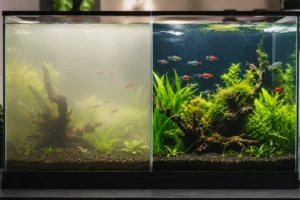
The most important rule is simple: any measurable ammonia in a stocked aquarium should be treated as a warning sign. Do not wait for the water to look dirty. Ammonia is dissolved in the water and cannot be judged by appearance.
This guide explains what causes ammonia spikes, how to recognize ammonia stress, how to reduce ammonia safely, what not to do during an emergency, and how to prevent the problem from coming back. For the wider water-quality system, start with the Aquarium Water Guide. If your tank is new, also read the Aquarium Cycling Guide and New Tank Syndrome.
Quick Emergency Answer
- Test ammonia immediately.
- Test nitrite too, because the cycle may be incomplete.
- Stop adding livestock.
- Reduce or pause feeding temporarily to reduce new waste.
- Remove uneaten food, dead plants, and dead livestock.
- Perform a controlled water change with dechlorinated, temperature-matched water.
- Increase surface movement or add an air stone.
- Keep the filter running continuously.
- Do not replace all filter media.
- Keep testing until ammonia stays at 0 ppm.
The goal is not to restart the aquarium. The goal is to reduce immediate toxicity while protecting the biological filter that will eventually process ammonia naturally.
What you’ll learn in this lesson
- What an ammonia spike means in a freshwater aquarium
- Why ammonia can be dangerous even when water looks clear
- What causes ammonia spikes in new and mature tanks
- How to recognize ammonia stress in fish and shrimp
- How pH and temperature influence ammonia risk
- How to reduce ammonia safely without damaging the cycle
- Which emergency mistakes make ammonia worse
- How to prevent ammonia spikes from returning
What Is an Ammonia Spike?
An ammonia spike means ammonia has risen above safe levels in the aquarium. In a mature, stable freshwater tank, ammonia should normally test at 0 ppm with standard hobby test kits. If ammonia becomes measurable, the aquarium is either producing more waste than the biological filter can handle, or the biological filter has been weakened.
Ammonia enters the aquarium from fish waste, uneaten food, dead plant material, decaying organic matter, dead livestock, and sometimes active aquarium soils or disturbed substrates. In a cycled aquarium, beneficial microorganisms convert ammonia into nitrite and then nitrite into nitrate. This process is part of the nitrogen cycle.
An ammonia spike happens when that balance fails. Waste production exceeds biological processing. The tank may be new and not cycled yet, or it may be mature but suddenly disrupted.
In simple terms, an ammonia spike asks one question: why is the aquarium producing or retaining ammonia faster than the filter can process it?
Why Ammonia Is Dangerous
Ammonia is dangerous because it can interfere with fish health, gill function, respiration, and internal waste regulation. Fish live directly in the water that carries their waste. If the aquarium cannot process ammonia quickly enough, livestock are exposed continuously.
Ammonia toxicity is also context-dependent. Aquarium test kits often measure total ammonia, which includes ammonia and ammonium forms. The more toxic unionized ammonia fraction becomes more important at higher pH and higher temperature. This means the same total ammonia reading can be more dangerous in warm, alkaline water than in cooler, more acidic water.
For practical freshwater aquarium care, however, the safest beginner rule is simple: ammonia should be 0 ppm in a stocked aquarium. If fish, shrimp, or snails are present and ammonia is measurable, act quickly and calmly.
Ammonia vs Ammonium
Many aquarists hear that ammonia can exist as ammonia and ammonium. This is true, but it often creates confusion. In water, ammonia exists in equilibrium between unionized ammonia and ammonium. The balance between these forms is influenced by pH and temperature.
Unionized ammonia is the more toxic form. Ammonium is generally less toxic, but it still belongs to the total ammonia system and should not be ignored. Hobby test kits usually report total ammonia or total ammonia nitrogen, depending on the test.
This is why pH matters during an ammonia spike. A small amount of total ammonia can become more dangerous at higher pH. That does not mean you should aggressively crash pH during an emergency. Sudden pH changes can add more stress. Instead, focus on reducing ammonia, improving oxygen, reducing waste input, and protecting the biological filter.
Common Causes of Ammonia Spikes
Ammonia spikes usually have a cause. Finding that cause is important because water changes may reduce the immediate problem, but the spike can return if the source remains in the aquarium.
The most common causes are new tanks, overfeeding, dead organic material, overstocking, filter disruption, and cycle crashes. In planted aquariums, ammonia can also appear during substrate disturbances, heavy plant melt, or early active-soil phases.
| Cause | Why It Creates Ammonia | First Action |
|---|---|---|
| New uncycled tank | Biological filter is not mature | Test ammonia/nitrite, reduce feeding, water changes |
| Overfeeding | Uneaten food decomposes into waste | Remove food, feed less, test daily |
| Dead fish or shrimp | Rapid decomposition creates ammonia | Remove immediately and test water |
| Plant melt | Decaying leaves add organic waste | Remove melting material and improve stability |
| Filter media replaced | Beneficial bacteria are removed | Protect remaining media and monitor cycle |
| Power outage | Filter bacteria lose oxygen-rich flow | Restore flow, increase oxygen, test water |
| Overstocking | Waste load exceeds filter capacity | Reduce feeding, improve filtration, reassess stocking |
| Active soil release | Some soils release ammonia early | Water changes, plants, cycling before livestock |
Ammonia Spike in a New Aquarium
New aquariums are the most common place to see ammonia spikes. The tank has been filled, the filter is running, and everything may look ready. But the biological filter has not yet developed enough microorganisms to process waste.
This is the same root problem behind New Tank Syndrome. Fish are added too early, waste begins immediately, ammonia rises, and the tank becomes unsafe even though it may look clean.
If the aquarium is new and livestock are already inside, treat it as a fish-in cycling situation. Reduce feeding, test ammonia and nitrite frequently, perform controlled water changes, improve oxygenation, and do not add more livestock until ammonia and nitrite remain at 0 ppm.
If livestock are not yet inside, do not add them during the ammonia stage. Continue cycling until the tank can process ammonia and nitrite reliably. For the full process, read the Aquarium Cycling Guide.
Ammonia Spike in a Mature Aquarium
An ammonia spike in a mature aquarium usually means something has disrupted the balance. A stable tank should normally process ammonia quickly. If ammonia appears suddenly, look for a recent change.
Common triggers include replacing filter media, cleaning the filter too aggressively, adding too many fish, overfeeding, a dead fish hidden behind hardscape, medication, oxygen loss, power outage, or deep substrate disturbance.
This is often called a mini-cycle or cycle crash. The tank may not be completely uncycled, but its biological filter is no longer keeping up with the waste load.
Questions to ask after ammonia appears in a mature tank
- Did you replace or rinse filter media recently?
- Was the filter switched off for several hours?
- Did you add many new fish at once?
- Did feeding increase recently?
- Could a fish, shrimp, snail, or large plant mass be decomposing?
- Did you disturb the substrate deeply?
- Did medication affect the biological filter?
- Is the filter clogged or flow reduced?
- Is oxygen low because of heat or weak surface movement?
Answering these questions helps prevent the spike from returning after the first water change.
Signs of Ammonia Stress in Fish
Fish behavior is often the first warning sign of an ammonia problem, especially if you do not test regularly. However, symptoms are not enough to diagnose ammonia by themselves. Always test the water.
Ammonia stress can look like oxygen stress, nitrite stress, pH shock, poor acclimation, or disease. In new aquariums, ammonia should always be one of the first suspects.
| Symptom | Possible Meaning | What To Test |
|---|---|---|
| Fish gasping at surface | Ammonia, nitrite, low oxygen, high temperature | Ammonia, nitrite, temperature, oxygen/flow |
| Rapid breathing | Gill irritation or oxygen stress | Ammonia, nitrite, oxygen |
| Red or inflamed gills | Possible ammonia irritation | Ammonia immediately |
| Clamped fins | General water stress | Ammonia, nitrite, pH, temperature |
| Lethargy | Stress, poisoning, disease, low oxygen | Full water test |
| Fish hiding suddenly | Stress or unstable conditions | Ammonia, nitrite, recent changes |
| Loss of appetite | Water stress or illness | Ammonia and nitrite first |
| Sudden deaths | Severe water quality issue, shock, disease | Immediate full water test |
If ammonia is present, treat the water first. Medication should not be the first response unless disease is clearly confirmed, because poor water quality can mimic or worsen many health problems.
Ammonia Spike and Shrimp
Shrimp are often more sensitive to instability than many beginner fish. An ammonia spike can be especially dangerous in shrimp tanks because shrimp have small bodies, graze constantly on surfaces, and often live in systems where stability matters more than rapid correction.
In shrimp tanks, ammonia may appear after overfeeding, dead shrimp hidden in moss or hardscape, immature biofilm, disturbed substrate, or a new tank that was stocked too early. Active soils can also release ammonia during the early phase, which is why shrimp tanks often benefit from extra patience before stocking.
If shrimp are dying or behaving unusually in a new tank, test ammonia, nitrite, GH, KH, pH, and temperature. Do not assume the issue is only acclimation. Water quality should always be checked first.
How to Test Ammonia Correctly
Testing ammonia correctly matters because emergency decisions depend on the result. Use a reliable aquarium test kit and follow the instructions exactly. Pay attention to timing, color comparison, expiration dates, and whether the kit reports total ammonia or a specific form.
If you get an unexpected reading, retest. If livestock are stressed and ammonia is measurable, act as though the result is real while confirming it. Do not ignore symptoms because one test looked unclear.
Useful ammonia testing routine
- Test immediately if fish gasp, hide, clamp fins, or die suddenly.
- Test daily during a new tank emergency.
- Test after adding new fish to a young tank.
- Test after major filter cleaning or power outages.
- Test after heavy plant melt or substrate disturbance.
- Test ammonia together with nitrite during cycling problems.
Testing only ammonia can miss the next stage of the problem. If ammonia is present or recently dropped, nitrite may be rising. Always test both during cycling and new-tank emergencies.
How to Lower Ammonia Safely
Lowering ammonia safely means reducing immediate danger without damaging the biological filter. The mistake is to panic-clean the entire tank, replace the filter media, or make sudden chemistry changes. These actions can make the cycle weaker.
The safest emergency response combines dilution, waste reduction, oxygenation, and filter protection.
Step 1: Perform a controlled water change
A water change dilutes ammonia. Use dechlorinated, temperature-matched water. Avoid sudden pH, KH, GH, or temperature swings. If ammonia is high, repeated controlled water changes may be safer than one chaotic correction.
For routine technique, continue with the Aquarium Water Change Guide.
Step 2: Stop adding waste
Food becomes waste. During an ammonia spike, reduce feeding heavily or pause feeding briefly if livestock condition allows. Remove uneaten food quickly. Do not add more fish, shrimp, or snails.
Step 3: Remove the ammonia source
Look for decaying plant leaves, dead fish, dead shrimp, dead snails, rotting food, clogged filter debris, or disturbed substrate waste. Removing the source prevents ammonia from returning immediately after the water change.
Step 4: Increase oxygenation
Ammonia-stressed fish may breathe harder. Beneficial bacteria also need oxygen-rich water. Increase surface movement, clean blocked intakes, and use an air stone if fish are gasping or the tank is warm.
Step 5: Protect the filter
Keep the filter running. Do not replace all media. Do not scrub biological media sterile. If mechanical media is clogged, rinse it gently in removed aquarium water. The biological filter is the long-term solution to ammonia.
Step 6: Keep testing
Ammonia may return if the tank is still uncycled, overstocked, or overloaded with waste. Continue testing ammonia and nitrite until both remain at 0 ppm. Do not assume the problem is solved after one water change.
Emergency Action Plan for an Ammonia Spike
Use this plan if fish or shrimp are already inside the aquarium and ammonia is measurable.
| Action | Why It Helps | Important Warning |
|---|---|---|
| Water change | Dilutes ammonia immediately | Match temperature and dechlorinate water |
| Reduce feeding | Creates less new waste | Do not leave uneaten food |
| Remove dead matter | Stops ammonia source | Check behind hardscape and plants |
| Increase oxygen | Supports fish and bacteria | Use surface movement or air stone |
| Protect filter media | Preserves biological filtration | Do not replace all media |
| Test nitrite | Cycle may still be incomplete | Nitrite can rise after ammonia drops |
| Pause stocking | Prevents more waste | No new livestock until stable |
If ammonia remains measurable after action, continue controlled water changes and investigate the cause. The aquarium is not stable until ammonia stays at 0 ppm under its current livestock load.
What Not to Do During an Ammonia Spike
Ammonia emergencies often become worse because the aquarist reacts too aggressively. The goal is to stabilize, not sterilize. Avoid actions that remove beneficial microorganisms or create sudden chemical swings.
- Do not replace all filter media. This can remove the biological colony.
- Do not deep-clean the entire aquarium. You may remove helpful surface biofilm.
- Do not add more fish. More livestock means more ammonia production.
- Do not overfeed stressed fish. Uneaten food becomes waste.
- Do not chase pH aggressively. Sudden pH changes can add stress.
- Do not turn off the filter. The biofilter needs oxygen-rich water flow.
- Do not ignore nitrite. Nitrite may rise after ammonia starts falling.
- Do not assume clear water means safe water. Ammonia is invisible.
Do Ammonia Detoxifiers Work?
Some aquarium products claim to detoxify ammonia temporarily. These products may be useful as emergency support in certain situations, especially during fish-in cycling or transport stress. However, they should not replace water changes, testing, and biological filtration.
The key word is temporary. Detoxifying ammonia does not remove the underlying waste source. The aquarium still needs a functioning nitrogen cycle. Continue testing, reduce waste input, and protect the filter.
Also read product instructions carefully. Some ammonia-binding products can affect how certain test kits read ammonia. If results seem confusing, confirm with the test-kit manufacturer’s guidance and focus on livestock behavior, repeated testing, and water-quality trends.
Do Live Plants Help With Ammonia?
Live plants can help reduce ammonia pressure, but they are not an emergency cure. Plants can use nitrogen, and fast-growing plants may support stability in new aquariums. Floating plants and fast stems are especially useful because they can grow quickly and absorb nutrients from the water column.
However, plants do not replace cycling. A planted tank can still have an ammonia spike if it is overfed, overstocked, uncycled, disturbed, or filled with melting plant mass. Dead plant material can also contribute to ammonia if it is left to decay.
For plant selection in stable beginner tanks, continue with the Easy Aquarium Plants Guide and Floating Aquarium Plants Guide.
Can Aquarium Soil Cause Ammonia?
Some active aquarium soils can release ammonia or ammonium during the early setup phase. This is one reason many aquascapers perform frequent early water changes and wait before adding livestock. The soil may be excellent for plant growth, but the tank still needs time to stabilize.
If you use active soil, test ammonia before adding fish or shrimp. Do not assume the aquarium is safe because it is heavily planted. Plants may help, but livestock should wait until ammonia and nitrite remain at 0 ppm.
For substrate planning, read the Aquarium Soil Guide.
Ammonia Spike After Water Change
An ammonia spike after a water change can happen for several reasons. The water change may have disturbed substrate waste, exposed decaying material, reduced filter bacteria through overcleaning, or introduced source water with ammonia or chloramine-related readings.
It is also possible that ammonia was already rising before the water change and was only discovered afterward. Testing before and after major maintenance can help you understand what actually changed.
Check these causes
- Did you clean the filter media too aggressively?
- Did you stir a dirty substrate deeply?
- Did you remove too much biological media?
- Did you forget dechlorinator?
- Does your tap water show ammonia or chloramine-related readings?
- Did a dead fish or shrimp remain hidden?
- Did you perform a very large change with mismatched parameters?
If ammonia appears after maintenance, test nitrite too. The biological filter may have been weakened and the tank may enter a mini-cycle.
Ammonia Spike After Adding Fish
An ammonia spike after adding fish usually means the biological filter was not ready for the new waste load. This can happen in new tanks, but it can also happen in mature tanks if too many fish are added at once.
Every new fish increases waste production. A biological filter grows according to the load it has been processing. If the stocking level jumps suddenly, the filter may need time to catch up.
The solution is gradual stocking. Add a small group, feed lightly, test ammonia and nitrite, and wait before adding more.
Ammonia Spike After Filter Cleaning
Filter cleaning is one of the most common causes of ammonia spikes in established aquariums. The filter contains much of the biological media where beneficial microorganisms live. If you replace or sterilize that media, the tank may lose part of its waste-processing ability.
Mechanical filter pads can clog and need cleaning. But biological media should be protected. Rinse clogged media gently in removed aquarium water instead of untreated chlorinated tap water. Replace media gradually if replacement is unavoidable.
For proper filtration planning, continue with the Aquarium Filter Guide.
How Long Does an Ammonia Spike Last?
An ammonia spike can last hours, days, or longer depending on the cause and the maturity of the biological filter. If the spike comes from a dead fish or overfeeding and the tank is mature, it may stabilize quickly after the source is removed and water is changed. If the tank is uncycled, ammonia may continue returning until the biological filter develops.
The aquarium is not recovered just because ammonia drops once. The tank is stable when ammonia remains at 0 ppm under the current livestock and feeding load, and nitrite also remains at 0 ppm.
- Short spike: often caused by a removable waste source in a mature tank.
- Repeated spike: often caused by overfeeding, overstocking, or weak filtration.
- Long spike: often caused by an uncycled tank or damaged biological filter.
- Spike followed by nitrite: usually indicates cycling or mini-cycle progression.
How to Prevent Ammonia Spikes
Preventing ammonia spikes is mostly about protecting the biological filter and controlling waste input. A stable aquarium should process normal waste quietly in the background. Problems appear when waste increases suddenly or the filter is weakened.
Prevention checklist
- Cycle the aquarium before adding livestock.
- Add fish gradually instead of all at once.
- Feed lightly and remove uneaten food.
- Avoid overstocking.
- Keep the filter running continuously.
- Do not replace all filter media at once.
- Clean mechanical media without destroying biological media.
- Remove dead plants, fish, shrimp, or snails quickly.
- Maintain oxygen-rich water flow.
- Test ammonia after major changes or fish stress.
Good aquarium care is not about never having problems. It is about building a system where problems are less likely, easier to detect, and easier to correct before livestock suffer.
Ammonia Spike Troubleshooting Table
Use this table to connect ammonia readings with likely causes and first actions. Always interpret ammonia together with nitrite, pH, temperature, stocking, feeding, and recent maintenance.
| Situation | Likely Cause | First Action |
|---|---|---|
| Ammonia in new tank | Tank not cycled | Fish-in cycling care or continue fishless cycling |
| Ammonia after adding fish | Waste load increased too fast | Reduce feeding, water change, pause stocking |
| Ammonia after filter cleaning | Biofilter weakened | Protect media, test nitrite, avoid overcleaning |
| Ammonia with cloudy water | Bacterial bloom, overfeeding, organic waste | Remove waste, reduce feeding, test daily |
| Ammonia in planted tank | Plant melt, active soil, disturbed substrate | Remove decay, water changes, check cycle |
| Ammonia after power outage | Filter oxygen disruption | Restore flow, increase oxygen, test ammonia/nitrite |
| Ammonia keeps returning | Ongoing waste source or weak biofilter | Find source, reassess stocking and filtration |
Quick Takeaways
- An ammonia spike means ammonia is rising faster than the biological filter can process it.
- Ammonia should normally test at 0 ppm in a stocked freshwater aquarium.
- Clear water can still contain ammonia.
- Higher pH and temperature can increase ammonia risk.
- New tanks, overfeeding, dead organic matter, and filter disruption are common causes.
- Water changes, reduced feeding, oxygenation, and source removal are the first emergency steps.
- Do not replace all filter media during an ammonia spike.
- Always test nitrite too, because the tank may be cycling or mini-cycling.
- The spike is not solved until ammonia stays at 0 ppm under normal conditions.
- Prevention depends on cycling, gradual stocking, careful feeding, and filter protection.
Conclusion
An ammonia spike in an aquarium is serious, but it can be managed if you act in the right order. Test ammonia and nitrite, reduce waste input, remove decaying material, perform controlled water changes, improve oxygenation, and protect the biological filter.
The biggest mistake is panic-cleaning the aquarium and destroying the very bacteria that process ammonia. The long-term solution is not a spotless tank. It is a stable biological filter that can convert waste through the nitrogen cycle.
If your tank is new, continue with the Aquarium Cycling Guide. If fish are already stressed in a young tank, read New Tank Syndrome. For the full water-quality framework, return to the Aquarium Water Guide.
Next step:
If ammonia is measurable, test nitrite too, reduce feeding, perform a controlled water change, increase oxygenation, and keep the filter running. Do not add more livestock until ammonia and nitrite both remain at 0 ppm.
💬 Join the Conversation
Tag us on Instagram @AquariumLesson — we’d love to see your setup, water test results, and recovery progress.
👉 What caused your ammonia spike: new tank, overfeeding, filter cleaning, dead livestock, or something else?
FAQ
What causes an ammonia spike in an aquarium?
Common causes include an uncycled tank, overfeeding, dead fish or shrimp, decaying plants, overstocking, filter media replacement, power outages, medication, disturbed substrate, or a biological filter that cannot handle the waste load.
How do I lower ammonia quickly in a fish tank?
Perform a controlled water change with dechlorinated, temperature-matched water, reduce feeding, remove decaying organic matter, increase oxygenation, and keep the filter running. Continue testing ammonia and nitrite until both stay at 0 ppm.
Is any ammonia safe in an aquarium?
In a stocked freshwater aquarium, ammonia should normally test at 0 ppm. Any measurable ammonia should be treated as a warning sign, especially if fish, shrimp, or snails are showing stress.
Can fish survive an ammonia spike?
Fish may survive a mild ammonia spike if it is caught early and corrected quickly. However, ammonia can cause serious stress and damage. Immediate testing, water changes, oxygenation, and waste reduction are important.
Why did ammonia spike after a water change?
Possible causes include disturbed substrate waste, aggressive filter cleaning, forgotten dechlorinator, ammonia or chloramine-related readings in tap water, hidden dead livestock, or a biological filter that was already struggling before the water change.
Can overfeeding cause ammonia?
Yes. Uneaten food decomposes and adds waste to the aquarium. Overfeeding is one of the most common causes of ammonia spikes, especially in new or heavily stocked tanks.
Should I clean the filter during an ammonia spike?
Do not replace or sterilize all filter media. If the filter is clogged, gently rinse mechanical media in removed aquarium water. Protect biological media because it contains the microorganisms needed to process ammonia.
Does ammonia always mean my tank is not cycled?
In a new tank, measurable ammonia often means the aquarium is not fully cycled. In a mature tank, ammonia can mean the cycle has been disrupted or the waste load suddenly exceeded the filter’s capacity.
Will live plants remove ammonia?
Live plants can help absorb nitrogen and support stability, but they do not replace biological filtration or emergency water changes. A planted tank can still have an ammonia spike if waste input is too high or the tank is not cycled.
How long does it take for ammonia to go down?
It depends on the cause. A mature tank with a removable waste source may recover quickly after a water change and cleanup. An uncycled tank may continue producing ammonia until the biological filter develops. Keep testing until ammonia stays at 0 ppm.
Lesson completed!
You've finished this lesson. Keep building your aquarium knowledge, one lesson at a time.
Continue learning →New to AquariumLesson? Start with our complete Aquarium Lessons Hub or return to the homepage at AquariumLesson.com.
References
- U.S. Environmental Protection Agency. Aquatic Life Criteria – Ammonia.
- U.S. Environmental Protection Agency. Aquatic Life Ambient Water Quality Criteria for Ammonia – Freshwater 2013.
- FAO. Environment and Fish Health: Water Quality for Aquaculture.
- FAO. The Water Requirements of Aquaculture Rearing Systems.
- McKnight et al. Microbial Community Succession of Home Aquarium Biofilters.