Nitrite Spike in Aquarium: Causes, Fish Symptoms & Safe Emergency Fixes
A nitrite spike in an aquarium happens when nitrite rises faster than the biological filter can convert it into nitrate. It is one of the most dangerous stages of an incomplete aquarium cycle because nitrite can stress fish even when ammonia has already dropped and the water looks clear.
This is why nitrite spikes often confuse beginners. The aquarium may seem to be improving because ammonia is lower, but the tank is still not safe. Nitrite is the middle stage of the nitrogen cycle: ammonia has started converting, but the second stage of biological filtration is not mature enough yet.
In a stable freshwater aquarium, nitrite should normally test at 0 ppm. Any measurable nitrite in a stocked aquarium should be treated as a warning sign. Fish, shrimp, and other aquatic animals should not be added while nitrite is present.
This guide explains what causes nitrite spikes, how to recognize nitrite stress, how to reduce nitrite safely, what not to do during an emergency, and how to prevent nitrite from returning. For the broader cycle process, read the Aquarium Cycling Guide. For the full water-quality framework, start with the Aquarium Water Guide.
Quick Emergency Answer
- Test nitrite immediately if fish are gasping, breathing rapidly, hiding, or acting weak.
- Test ammonia too, because both can appear during cycling problems.
- Do not add more livestock.
- Reduce feeding to lower new waste production.
- Perform controlled water changes with dechlorinated, temperature-matched water.
- Increase oxygenation with surface movement or an air stone.
- Keep the filter running continuously.
- Do not replace all filter media.
- Continue testing until nitrite stays at 0 ppm.
The goal is to protect livestock while the second stage of the biological filter matures and begins converting nitrite into nitrate reliably.
What you’ll learn in this lesson
- What a nitrite spike means in a freshwater aquarium
- Why nitrite often rises after ammonia drops
- How nitrite affects fish oxygen transport
- What symptoms can suggest nitrite stress
- What causes nitrite spikes in new and mature aquariums
- How to lower nitrite safely without crashing the cycle
- Why oxygenation and filter protection matter
- How to prevent nitrite spikes from coming back
What Is a Nitrite Spike?
A nitrite spike means nitrite has risen above safe levels in the aquarium. In a cycled freshwater tank, nitrite should normally stay at 0 ppm because beneficial microorganisms convert it into nitrate. If nitrite becomes measurable, the nitrogen cycle is incomplete, disrupted, or overloaded.
Nitrite is produced after ammonia begins to break down. In the first stage of nitrification, ammonia is converted into nitrite. In the second stage, nitrite is converted into nitrate. A nitrite spike usually means the first stage is working, but the second stage has not fully caught up.
This is why nitrite spikes are especially common in new tanks. The aquarium has started cycling, but the biological filter is not mature enough to finish the process safely.
In simple terms, a nitrite spike means: your aquarium is processing ammonia, but it is not yet processing nitrite fast enough.
Why Nitrite Is Dangerous
Nitrite is dangerous because it can interfere with oxygen transport in fish. Even if the aquarium has oxygen in the water, fish affected by nitrite may struggle to use that oxygen properly. This is why nitrite poisoning is often associated with rapid breathing, gasping, weakness, and stress.
Nitrite poisoning is sometimes called brown blood disease because nitrite can affect the blood’s ability to carry oxygen. In practical aquarium care, the exact mechanism matters less than the response: measurable nitrite in a stocked tank should be treated seriously.
Fish may behave as if the aquarium has low oxygen even when surface movement looks acceptable. This is why increased aeration is helpful during a nitrite spike, but it does not replace water changes or biological recovery.
The safest beginner rule is simple: nitrite should be 0 ppm in a stocked freshwater aquarium. If nitrite is measurable, act before fish become severely stressed.
Why Nitrite Often Rises After Ammonia Drops
Many beginners think the tank is safe when ammonia begins to fall. But this is exactly when nitrite may begin rising. The first group of nitrifying organisms has started converting ammonia into nitrite, but the second group that converts nitrite into nitrate is still developing.
This is a normal stage of aquarium cycling, but it becomes dangerous if fish are already inside the tank. In a fishless cycle, a nitrite spike is something to monitor. In a stocked aquarium, it becomes a water-quality emergency.
This is why a tank with 0 ppm ammonia but measurable nitrite is not fully cycled. Both ammonia and nitrite must reach 0 ppm before the aquarium is considered safe for normal stocking.
| Cycle Stage | Test Result Pattern | What It Means | Safe for Fish? |
|---|---|---|---|
| Early cycling | Ammonia rising, nitrite low | Waste is not yet processed well | No |
| Middle cycling | Ammonia dropping, nitrite rising | First stage works, second stage incomplete | No |
| Late cycling | Ammonia 0, nitrite falling, nitrate rising | Cycle is progressing | Not yet, unless nitrite is 0 |
| Cycled tank | Ammonia 0, nitrite 0, nitrate controlled | Biological filter processes normal waste | Yes, gradually |
Common Causes of Nitrite Spikes
Nitrite spikes are usually caused by an incomplete or disrupted nitrogen cycle. They can happen in new aquariums, but they can also appear in mature tanks after the biological filter is damaged or overloaded.
The key question is: why is nitrite being produced faster than it can be converted into nitrate?
| Cause | Why It Creates Nitrite | First Action |
|---|---|---|
| New uncycled aquarium | Second stage of nitrification is not mature | Continue cycling, water changes if livestock are present |
| Ammonia spike just passed | Ammonia is now being converted into nitrite | Test nitrite daily and protect fish |
| Too many fish added | Waste load exceeds filter capacity | Pause stocking, reduce feeding, water change |
| Overfeeding | More ammonia is produced, then more nitrite | Remove food and feed less |
| Filter media replaced | Nitrite-processing bacteria removed or reduced | Protect remaining media and monitor cycle |
| Power outage | Biofilter loses oxygen-rich flow | Restore flow, oxygenate, test ammonia/nitrite |
| Medication or chemical treatment | Biological filter may be weakened | Test daily and protect filter |
| Dead organic matter | Creates ammonia, then nitrite | Remove source and perform water change |
Nitrite Spike in a New Aquarium
A nitrite spike in a new aquarium is usually part of the cycling process. Ammonia has started converting, but nitrite is not yet being converted into nitrate fast enough. This means the tank is still biologically immature.
If there are no fish, shrimp, or snails in the aquarium, continue cycling and keep testing. Do not add livestock until nitrite reaches 0 ppm and stays there. If animals are already inside, treat it as a fish-in cycling emergency.
For new tanks, nitrite is one of the main reasons you should not stock based on the calendar. A tank may have been running for several weeks and still not be safe if nitrite is measurable.
Nitrite Spike in a Mature Aquarium
A nitrite spike in a mature aquarium usually means the biological filter has been disrupted or overloaded. A stable tank should convert nitrite into nitrate quickly enough that nitrite remains undetectable.
If nitrite appears in a mature aquarium, look for a recent change. The cause is often filter cleaning, filter media replacement, overfeeding, dead livestock, medication, power outage, oxygen depletion, or sudden stocking increase.
Questions to ask after nitrite appears in a mature tank
- Did you replace filter media recently?
- Was the filter switched off or clogged?
- Did you add many fish at once?
- Did feeding increase recently?
- Could dead livestock or plant matter be decomposing?
- Did you use medication or chemical treatment?
- Did ammonia spike recently?
- Is surface movement or oxygenation too low?
- Did you disturb the substrate deeply?
A mature aquarium does not show nitrite without a reason. Find the trigger, reduce waste pressure, and protect the biological filter while the tank restabilizes.
Signs of Nitrite Poisoning in Fish
Nitrite poisoning can look like oxygen stress because nitrite interferes with oxygen transport. Fish may appear to suffocate even when the aquarium contains dissolved oxygen. This is why gasping and rapid breathing are major warning signs.
Symptoms alone cannot confirm nitrite poisoning. Ammonia, low oxygen, high temperature, pH shock, or disease can look similar. Always test nitrite and ammonia when fish behave unusually, especially in a new or recently disrupted tank.
| Symptom | Possible Meaning | What To Test |
|---|---|---|
| Fish gasping at the surface | Nitrite stress, low oxygen, ammonia | Nitrite, ammonia, oxygen/flow, temperature |
| Rapid gill movement | Oxygen transport stress | Nitrite and ammonia |
| Lethargy | Water stress or poisoning | Full water test |
| Clamped fins | General stress | Nitrite, ammonia, pH, temperature |
| Darkened coloration | Stress response | Nitrite, ammonia, recent changes |
| Loss of appetite | Stress or illness | Nitrite and ammonia first |
| Sudden deaths | Severe water-quality problem | Immediate full water test |
If nitrite is present, treat the water-quality problem first. Do not assume disease before checking the cycle.
Nitrite and Brown Blood Disease
Nitrite poisoning is often linked with the term brown blood disease. This refers to the effect nitrite can have on the blood’s ability to carry oxygen efficiently. Fish may breathe rapidly, gasp, or become weak because oxygen transport is impaired.
This does not mean every fish with rapid breathing has brown blood disease. It means nitrite should be tested immediately when fish show oxygen-stress symptoms in a new or unstable aquarium.
Because nitrite stress affects oxygen transport, improving aeration is useful during an emergency. More surface movement does not remove nitrite, but it can support fish while water changes and biological filtration reduce the cause.
Nitrite and Chloride: Should You Add Salt?
Chloride can reduce nitrite uptake through the gills of fish, which is why salt is sometimes discussed during nitrite emergencies. However, adding salt is not automatically appropriate for every aquarium. Some fish, shrimp, snails, and plants may be sensitive to salt, and dosage mistakes can create additional stress.
For beginner freshwater aquariums, the first response should still be controlled water changes, reduced feeding, oxygenation, and filter protection. Salt may be considered only when you understand your livestock, plant tolerance, and the correct use case.
Do not use salt as an excuse to ignore nitrite. Chloride may reduce nitrite uptake risk, but it does not mature the biological filter, remove the source of waste, or replace water changes.
How to Test Nitrite Correctly
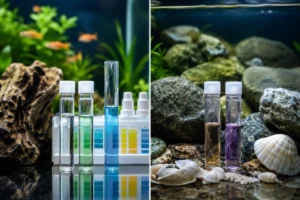
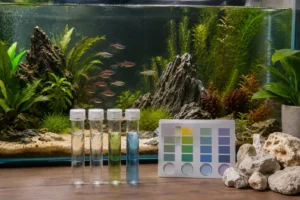
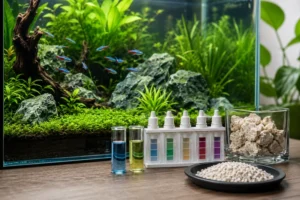
Testing nitrite correctly is essential during cycling and new-tank emergencies. Use a reliable aquarium test kit and follow the instructions carefully. Pay attention to reaction time, color matching, expiration dates, and whether the result is reported as nitrite or nitrite-nitrogen.
If fish are stressed and nitrite is measurable, act immediately. If the color result is hard to read, retest. Do not ignore symptoms because one test result is unclear.
When to test nitrite
- During aquarium cycling.
- After ammonia begins to drop.
- Before adding fish to a new tank.
- After adding fish to a young aquarium.
- After filter cleaning or filter media replacement.
- After a power outage or filter shutdown.
- Whenever fish gasp, breathe rapidly, hide, or act weak.
- After medication or chemical treatment that may affect filtration.
During cycling, always test ammonia and nitrite together. A falling ammonia result can be followed by a rising nitrite result.
How to Lower Nitrite Safely
Lowering nitrite safely means protecting livestock while allowing the biological filter to finish maturing. The main tools are water changes, reduced feeding, oxygenation, and filter protection.
Do not try to solve nitrite by replacing the filter or deep-cleaning the entire aquarium. That can remove the organisms needed to convert nitrite into nitrate.
Step 1: Perform a controlled water change
A water change dilutes nitrite. Use dechlorinated, temperature-matched water. Avoid sudden pH, KH, GH, or temperature swings. If nitrite is high or fish are stressed, repeated controlled water changes may be needed while the cycle catches up.
For technique and routine planning, read the Aquarium Water Change Guide.
Step 2: Reduce feeding
Feeding creates waste. Waste becomes ammonia, and ammonia becomes nitrite. During a nitrite spike, feed lightly or pause feeding briefly if livestock condition allows. Remove uneaten food immediately.
Step 3: Increase oxygenation
Nitrite-stressed fish may struggle with oxygen transport. Increase surface movement, clear blocked flow, and use an air stone if fish are gasping or breathing rapidly. Oxygen also supports beneficial microorganisms in the filter.
Step 4: Protect filter media
Keep the filter running continuously. Do not replace all media. Do not scrub biological media sterile. If media is clogged, gently rinse mechanical media in removed aquarium water. The filter is where the long-term solution develops.
Step 5: Continue testing
Nitrite may stay high for days or longer in an incomplete cycle. Continue testing until nitrite remains at 0 ppm under normal feeding and stocking conditions. Also test ammonia, because both values are linked.
Emergency Action Plan for a Nitrite Spike
Use this plan if fish or shrimp are already inside the aquarium and nitrite is measurable.
| Action | Why It Helps | Important Warning |
|---|---|---|
| Water change | Dilutes nitrite | Use dechlorinated, temperature-matched water |
| Increase oxygen | Supports fish under oxygen-transport stress | Surface movement helps, but does not remove nitrite |
| Reduce feeding | Creates less ammonia and future nitrite | Remove uneaten food quickly |
| Pause stocking | Prevents more waste load | No new fish or shrimp until nitrite is 0 ppm |
| Protect filter media | Preserves nitrifying organisms | Do not replace all media |
| Test ammonia | Cycle may still be unstable | Ammonia and nitrite often appear together |
| Find the cause | Prevents recurrence | Check feeding, filter, dead matter, stocking |
If nitrite keeps returning after water changes, the aquarium is still cycling or the biological filter is overloaded. Continue protective care until the tank can convert nitrite into nitrate reliably.
What Not to Do During a Nitrite Spike
Nitrite emergencies can become worse if the aquarist removes too much biological filtration or adds more stress to the system. The goal is to stabilize the aquarium, not restart it.
- Do not replace all filter media. This can remove nitrite-processing organisms.
- Do not deep-clean the entire tank. Helpful biofilm lives on surfaces.
- Do not add more fish. More livestock increases waste load.
- Do not overfeed stressed fish. More food means more future nitrite.
- Do not ignore ammonia. Ammonia may still be present or return.
- Do not turn off the filter. Nitrifying organisms need oxygen-rich flow.
- Do not rely only on salt. It does not replace water changes or cycling.
- Do not assume nitrate means the tank is safe. Nitrite must also be 0 ppm.
Nitrite Spike After Ammonia Spike
A nitrite spike after an ammonia spike is very common. It usually means the cycle has moved from the first danger stage to the second. Ammonia is being converted, but nitrite is not yet being converted fast enough.
This is why you should not stop testing after ammonia improves. Continue testing nitrite until it reaches 0 ppm. In a new aquarium, the nitrite stage can be the period where beginners become impatient and add fish too soon.
If livestock are already present, treat nitrite as seriously as ammonia. Keep water changes controlled, reduce feeding, increase oxygenation, and pause all new stocking.
Nitrite Spike After Adding Fish
A nitrite spike after adding fish usually means the biological filter was not ready for the new waste load. This can happen in a new tank that was stocked too early, or in a cycled tank where too many fish were added at once.
Every new fish increases ammonia production. That ammonia can become nitrite. If the nitrite-processing stage of the filter cannot keep up, nitrite rises.
The prevention is gradual stocking. Add a small group, feed lightly, test ammonia and nitrite, and wait before adding more.
Nitrite Spike After Filter Cleaning
Filter cleaning can trigger nitrite problems if too much biological media is removed or sterilized. The organisms that convert nitrite into nitrate live in oxygen-rich biofilm, especially inside filter media. If that colony is damaged, nitrite may appear.
Mechanical media can be cleaned when clogged, but biological media should be protected. Rinse gently in removed aquarium water if needed. Replace media gradually, not all at once.
For filter planning and maintenance, continue with the Aquarium Filter Guide.
Nitrite Spike in Shrimp Tanks
Shrimp tanks need extra caution during nitrite problems. Shrimp are often sensitive to immature tanks, sudden changes, unstable minerals, and pollutants. A tank that is technically cycling may still be too unstable for shrimp.
If nitrite is measurable, do not add shrimp. If shrimp are already present, perform controlled water changes, reduce feeding, increase oxygenation, and continue testing. Also check GH, KH, pH, and temperature because shrimp stress is often multi-factorial.
For shrimp-focused planning, connect this article with your livestock hub and shrimp setup content once those satellites are built.
Do Live Plants Help With Nitrite?
Live plants can support water quality, but they are not a reliable emergency solution for nitrite. Plants are more commonly discussed in relation to ammonia, ammonium, nitrate, and general nutrient uptake. Nitrite should still be reduced through water changes and biological filtration.
That said, healthy plant growth supports a more stable aquarium overall. Fast-growing plants reduce waste pressure by using nutrients, providing surface area for microbes, and helping the tank mature. Dead or melting plant matter should be removed because decay can create ammonia, which may later become nitrite.
For beginner plant choices, continue with Easy Aquarium Plants and Floating Aquarium Plants.
How Long Does a Nitrite Spike Last?
A nitrite spike can last days or longer depending on the cause and the maturity of the biological filter. In a new aquarium, nitrite may remain elevated until the second stage of nitrification develops. In a mature aquarium, nitrite may fall faster once the cause is removed and the filter recovers.
The spike is not over when nitrite drops once. It is over when nitrite remains at 0 ppm under normal feeding and stocking conditions.
- Short spike: often caused by a temporary overload in a mature tank.
- Repeated spike: often caused by overfeeding, overstocking, or weak filtration.
- Long spike: often caused by an incomplete cycle or damaged biofilter.
- Nitrite after ammonia: usually means the aquarium is in the middle cycling stage.
How to Prevent Nitrite Spikes
Preventing nitrite spikes means building and protecting the biological filter. The aquarium must be able to process ammonia into nitrite and nitrite into nitrate without either toxic compound accumulating.
Prevention checklist
- Cycle the aquarium fully before adding livestock.
- Wait until both ammonia and nitrite are 0 ppm.
- Add fish gradually after cycling.
- Feed lightly in new and young tanks.
- Do not replace all filter media at once.
- Keep the filter running continuously.
- Maintain good oxygenation and surface movement.
- Remove dead fish, shrimp, snails, and decaying plant matter quickly.
- Test after filter cleaning, medication, power outages, or stocking changes.
- Do regular water changes to control nitrate and dissolved waste.
Most nitrite problems are prevented by patience. The aquarium needs time to build the second stage of the biological filter. Rushing livestock into a tank with measurable nitrite is one of the most avoidable beginner mistakes.
Nitrite Spike Troubleshooting Table
Use this table to connect nitrite readings with likely causes and first actions.
| Situation | Likely Cause | First Action |
|---|---|---|
| Nitrite in new tank | Cycle incomplete | Continue cycling; water changes if livestock are present |
| Nitrite after ammonia drop | Middle stage of cycling | Keep testing and do not stock yet |
| Nitrite after adding fish | Waste load increased too fast | Pause stocking, feed less, water change |
| Nitrite after filter cleaning | Biofilter weakened | Protect media and monitor ammonia/nitrite |
| Nitrite with gasping fish | Oxygen transport stress | Water change and increase aeration |
| Nitrite keeps returning | Ongoing waste overload or immature filter | Review stocking, feeding, filter, and dead matter |
| Nitrite in mature tank | Mini-cycle or filter disruption | Find recent trigger and stabilize system |
Quick Takeaways
- A nitrite spike means nitrite is rising faster than the biological filter can convert it into nitrate.
- Nitrite should normally test at 0 ppm in a stocked freshwater aquarium.
- Nitrite often rises after ammonia begins to fall during cycling.
- A tank with 0 ppm ammonia but measurable nitrite is not fully cycled.
- Nitrite can interfere with oxygen transport in fish.
- Gasping, rapid breathing, weakness, and clamped fins can suggest nitrite stress.
- Water changes, oxygenation, reduced feeding, and filter protection are the first emergency steps.
- Do not replace all filter media during a nitrite spike.
- Salt/chloride may reduce nitrite uptake in some fish situations, but it is not suitable for every aquarium and does not replace fixing the cycle.
- The tank is stable only when nitrite stays at 0 ppm under normal conditions.
Conclusion
A nitrite spike in an aquarium is a serious sign that the nitrogen cycle is incomplete, disrupted, or overloaded. It often appears after ammonia starts dropping, which makes it one of the most misunderstood stages of cycling.
The correct response is controlled and systematic: test nitrite and ammonia, stop adding livestock, reduce feeding, perform water changes, increase oxygenation, and protect the biological filter. Do not restart the aquarium or replace all filter media. The long-term solution is a mature biofilter that can convert nitrite into nitrate reliably.
If your tank is still new, continue with the Aquarium Cycling Guide. If fish were added too early, read New Tank Syndrome. For the full water-quality system, return to the Aquarium Water Guide.
Next step:
If nitrite is measurable, test ammonia too, reduce feeding, perform a controlled water change, increase oxygenation, and keep the filter running. Do not add more livestock until nitrite remains at 0 ppm.
💬 Join the Conversation
Tag us on Instagram @AquariumLesson — we’d love to see your cycling progress, test results, and aquarium recovery.
👉 Did your nitrite spike happen after ammonia dropped, after adding fish, or after filter cleaning?
FAQ
What causes a nitrite spike in an aquarium?
A nitrite spike is usually caused by an incomplete or disrupted nitrogen cycle. Common triggers include new tanks, ammonia spikes, overfeeding, overstocking, filter media replacement, power outages, medication, or damaged biological filtration.
Is nitrite dangerous to fish?
Yes. Nitrite can interfere with oxygen transport in fish and is associated with nitrite poisoning or brown blood disease. In a stocked freshwater aquarium, nitrite should normally test at 0 ppm.
How do I lower nitrite quickly?
Perform a controlled water change with dechlorinated, temperature-matched water, reduce feeding, increase oxygenation, protect the filter media, and continue testing. Do not add more livestock until nitrite stays at 0 ppm.
Why is nitrite high but ammonia is zero?
This usually means the first stage of the nitrogen cycle is working, but the second stage is not mature enough. Ammonia is being converted into nitrite, but nitrite is not yet being converted into nitrate fast enough.
Can I add fish if nitrite is present?
No. Do not add fish while nitrite is measurable. Wait until both ammonia and nitrite repeatedly test at 0 ppm, then add livestock gradually.
How long does a nitrite spike last?
It depends on the cause. In a new aquarium, nitrite may stay elevated until the second stage of the biological filter matures. In a mature tank, it may drop faster once the cause is removed and the filter recovers.
Should I add salt for nitrite poisoning?
Chloride can reduce nitrite uptake in fish, which is why salt is sometimes discussed during nitrite problems. However, salt is not suitable for every aquarium, especially tanks with sensitive plants, shrimp, or salt-sensitive species. Water changes, oxygenation, reduced feeding, and filter recovery remain the core response.
Can live plants remove nitrite?
Live plants can support overall water stability, but they are not a reliable emergency solution for nitrite. A nitrite spike should be handled with water changes, oxygenation, reduced feeding, and biological filter protection.
Why did nitrite spike after cleaning the filter?
Filter cleaning can remove or damage beneficial microorganisms if done too aggressively. If the nitrite-processing biofilm is weakened, nitrite may appear. Avoid replacing all filter media at once and protect biological media during maintenance.
Does nitrate mean nitrite is safe?
No. Nitrate can show that the cycle is progressing, but nitrite must still test at 0 ppm. A tank can have nitrate and still have unsafe nitrite during the middle stage of cycling.
Lesson completed!
You've finished this lesson. Keep building your aquarium knowledge, one lesson at a time.
Continue learning →New to AquariumLesson? Start with our complete Aquarium Lessons Hub or return to the homepage at AquariumLesson.com.
References
- Auburn University / Southern Regional Aquaculture Center. Nitrite Poisoning or Brown Blood Disease: A Preventable Problem.
- FAO. Water Quality Criteria for European Freshwater Fish: Report on Nitrite and Freshwater Fish.
- Purdue University Animal Disease Diagnostic Laboratory. Nitrite Toxicosis in Freshwater Fish or Brown Blood Disease.
- Kroupova et al. Nitrite Influence on Fish: A Review.
- FAO. Acute Toxicities of Ammonia and Nitrite to Clarias batrachus and Their Interaction with Chloride.