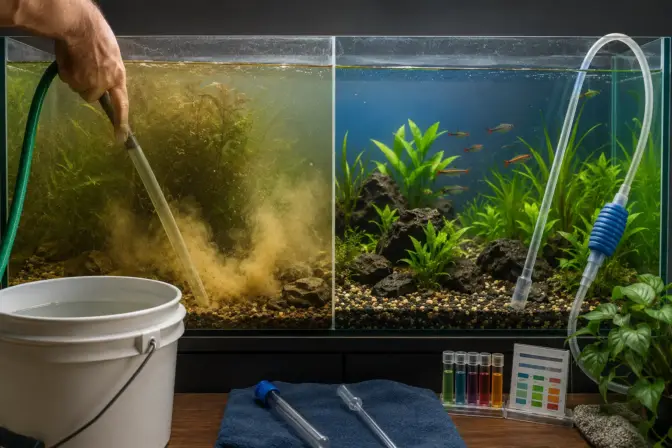
Aquarium Water Change Mistakes: Common Problems & Safe Fixes
Aquarium water change mistakes can turn one of the healthiest maintenance routines into a source of stress, instability, and even fish loss. Water changes are essential, but they must be done correctly. Untreated tap water, temperature shock, large parameter swings, aggressive cleaning, overdraining, filter-media damage, and poor refill technique can all cause problems after a water change.
The important point is this: water changes are not dangerous by themselves. Poorly prepared replacement water, sudden changes, and over-cleaning are the real risks. A calm, consistent partial water change can dilute nitrate, remove waste, improve oxygen stability, and support long-term aquarium health. A rushed or careless water change can shock fish, shrimp, snails, plants, and beneficial bacteria.
This guide explains the most common aquarium water change mistakes, why they happen, how to recognize them, and how to avoid them. For the complete foundation article, read Aquarium Water Changes: Schedule, Amounts & Water Stability. For tools, siphons, hoses, pumps, and DIY systems, continue with the Aquarium Water Change Tools Guide.
Quick Answer
- Never add untreated tap water if your water contains chlorine or chloramine.
- Match temperature before refilling to avoid temperature shock.
- Avoid large parameter swings in pH, KH, GH, and TDS.
- Do not replace all filter media during a water change.
- Do not deep-clean the whole tank at once unless there is a specific emergency reason.
- Do not over-vacuum planted or shrimp tanks if it disturbs roots, substrate, or baby shrimp.
- Do not refill too aggressively because it can stress fish and uproot plants.
- Do not ignore fish gasping after a water change; increase aeration and test ammonia, nitrite, temperature, and chlorine exposure.
- Do not assume clear water means safe water; test when livestock behave abnormally.
The safest routine is simple: prepare replacement water, match temperature, change an appropriate amount, clean only what needs cleaning, protect the filter, refill gently, and observe livestock afterward.
What you’ll learn in this lesson
- The most common aquarium water change mistakes
- Why fish can gasp, hide, or act stressed after a water change
- How untreated tap water affects livestock and filter bacteria
- Why temperature, pH, KH, and GH matching matters
- Why replacing filter media can cause ammonia or nitrite spikes
- How to avoid substrate disturbance and plant damage
- How to make water changes safer for shrimp tanks
- How to troubleshoot problems after a water change
- How to build a safer water change routine
Mistake 1: Adding Untreated Tap Water
Adding untreated tap water is one of the most serious aquarium water change mistakes. Many municipal water supplies contain chlorine or chloramine to make drinking water safer for humans. These disinfectants can harm fish, shrimp, snails, and the beneficial microorganisms that support biological filtration.
The problem is especially dangerous because the water may look perfectly clean. Clear water does not mean aquarium-safe water. If tap water is not treated correctly, livestock may show stress soon after the refill: gasping, rapid breathing, erratic swimming, hiding, weakness, or sudden deaths in severe cases.
The fix is straightforward. Use a suitable aquarium water conditioner when adding tap water. Dose according to the product instructions and the amount of new water being added. If your local water uses chloramine, make sure the conditioner is designed for chloramine, not only chlorine.
Do not rely on “letting water sit” unless you know exactly what your water contains. Chloramine is more persistent than chlorine, and untreated water can still be unsafe.
Mistake 2: Not Matching Temperature
Temperature mismatch can shock fish and shrimp during a water change. If replacement water is much colder or warmer than the aquarium, livestock may react quickly. Fish may clamp fins, hide, gasp, dart around, or become inactive. Shrimp may become weak or stressed after the refill.
This is especially important in small tanks, shrimp tanks, nano aquariums, and large water changes. The smaller the aquarium, the faster replacement water can change the overall temperature.
Use a thermometer instead of guessing by hand. Human skin is not accurate enough for sensitive livestock. Match replacement water as closely as practical to the aquarium temperature, and refill slowly if the tank is sensitive.
Also remember that temperature affects oxygen. Warmer water holds less oxygen, while fish may need more oxygen because metabolism increases. If fish gasp after a warm refill or during summer maintenance, increase surface movement immediately and check temperature.
Mistake 3: Changing Too Much Water With Different Parameters
Large water changes are not automatically bad. In many aquariums, 40–50% water changes can be safe and useful when replacement water is properly prepared. The risk comes from changing a large amount of water when the new water is very different from the aquarium.
If replacement water has very different pH, KH, GH, temperature, nitrate, or dissolved mineral content, a large water change can create a sudden parameter shift. This can stress fish, shrimp, snails, plants, and beneficial bacteria.
This is common when aquarists use tap water with very different chemistry from the tank, switch suddenly to RO water, forget remineralization, or perform a large correction after weeks of neglect.
| Parameter Difference | Possible Result | Safer Approach |
|---|---|---|
| Large temperature difference | Temperature shock | Match temperature before refill |
| Different pH | pH stress or swing | Compare tap and tank pH |
| Different KH | pH instability or rebound | Test KH and adjust gradually |
| Different GH | Mineral shock, shrimp stress | Remineralize consistently |
| Very different TDS | Shrimp or osmotic stress | Refill slowly and match minerals |
| Tap nitrate present | Nitrate does not drop as expected | Test source water |
For water chemistry context, read the Aquarium Water Parameters Guide and the Aquarium KH and GH Guide.
Mistake 4: Replacing All Filter Media During a Water Change
Replacing all filter media during a water change is one of the fastest ways to destabilize an aquarium. Beneficial microorganisms live heavily in filter media, especially where oxygen-rich water flows continuously. These microorganisms help convert ammonia into nitrite and nitrite into nitrate.
If you replace or sterilize all filter media at once, you may remove a major part of the biological filter. The tank may then experience an ammonia spike or nitrite spike, especially if livestock are present and waste production continues normally.
Mechanical media can be cleaned when flow slows. But it should usually be rinsed gently in removed aquarium water, not scrubbed sterile under untreated tap water. Biological media should be protected and replaced only gradually when necessary.
The goal during a water change is to restore flow and remove debris — not to reset the biological filter.
If ammonia or nitrite appears after filter maintenance, read Ammonia Spike in Aquarium and Nitrite Spike in Aquarium.
Mistake 5: Deep-Cleaning the Whole Aquarium at Once
A clean aquarium is good. A sterilized aquarium is not the goal. Beneficial biofilm lives on surfaces, filter media, substrate, rocks, driftwood, plants, glass, and decorations. If you deep-clean everything at once, you can remove too much biological stability and disturb the tank.
This mistake often happens when a beginner sees algae, debris, or cloudy water and decides to “fully clean” the tank: large water change, filter replacement, substrate disturbance, glass scrubbing, decoration washing, plant trimming, and chemical treatment all in the same session.
Too many changes at once make the aquarium less predictable. Livestock may be stressed by parameter shifts, oxygen changes, bacterial disruption, and loss of stable surfaces.
A safer approach is targeted maintenance. Remove visible waste, clean selected areas, restore filter flow, trim dead plant matter, and keep the biological system intact.
Mistake 6: Over-Vacuuming Planted or Shrimp Tanks
Gravel vacuuming can be helpful in many aquariums, especially tanks with gravel, messy fish, or visible waste buildup. But over-vacuuming can be a mistake in planted tanks, aquascapes, shrimp tanks, and tanks with delicate substrate structures.
In planted aquariums, aggressive deep vacuuming can damage roots, uproot carpeting plants, disturb nutrient-rich substrate, release trapped debris, or collapse the layout. In shrimp tanks, baby shrimp may be sucked into the siphon if the intake is not protected.
The right method depends on the setup. Gravel tanks may need deeper cleaning. Sand tanks often need surface hovering. Planted tanks usually need selective cleaning around open areas and visible waste pockets. Shrimp tanks benefit from slow, careful siphoning with a guard or fine mesh.
Do not clean substrate the same way in every aquarium. Match the technique to the tank design.
Mistake 7: Refilling Too Fast or Too Aggressively
Fast refilling can stress livestock and damage the aquascape. Strong water flow can blast substrate, uproot plants, scatter shrimp, push fish around, disturb biofilm, and cloud the water. In sensitive tanks, sudden refill flow can also create localized temperature or parameter shock.
Refilling gently is especially important in nano aquariums, shrimp tanks, aquascapes, sand-bottom tanks, and tanks with carpeting plants. Use a hose clip, diffuser, plate, cup, plastic bag, pump flow control, or slow drip method when needed.
The goal is to return water calmly and evenly. A water change should feel like a controlled refresh, not a storm.
Mistake 8: Ignoring Source Water
Many water change problems begin before the water enters the aquarium. Tap water may contain nitrate, high KH, high GH, low minerals, high pH, low pH, chlorine, chloramine, or seasonal changes from the water supplier. RO water may be too mineral-poor if not remineralized.
If nitrate remains high after water changes, your tap water may already contain nitrate. If pH swings after every water change, source water may differ from tank water. If shrimp react badly, GH, KH, or mineral mismatch may be involved.
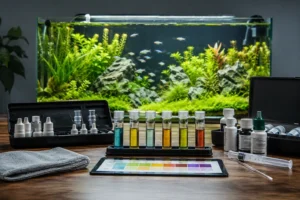
Source water values to test
- pH immediately after drawing
- pH after resting
- KH
- GH
- Nitrate
- Temperature
- Chlorine/chloramine treatment needs
- Prepared RO-water GH and KH
Testing source water makes water changes more predictable. Without this baseline, you may keep blaming the tank for problems caused by replacement water.
Mistake 9: Using RO Water Without Remineralization
Reverse osmosis water can be extremely useful, but using pure RO water directly in most aquariums is a mistake. RO water has very low mineral content and very low buffering. Fish, shrimp, snails, plants, and beneficial bacteria need suitable mineral balance.
Pure RO water can lower KH and GH sharply if used incorrectly. This can destabilize pH, stress shrimp, reduce mineral availability, and create inconsistent water chemistry. The solution is proper remineralization based on the livestock and tank type.
Some remineralizers raise only GH. Others raise both GH and KH. This distinction matters. A Caridina shrimp setup, Neocaridina shrimp setup, planted community tank, and hard-water fish tank may need different prepared water.
If you use RO water, prepare it consistently and test it before adding it to the aquarium.
Mistake 10: Cleaning the Filter With Untreated Tap Water
Cleaning filter media under untreated tap water can damage beneficial microorganisms, especially if the water contains chlorine or chloramine. This does not mean filter media can never touch tap water in any situation, but for routine beginner maintenance, the safer habit is to rinse media in removed aquarium water.
During a water change, keep a bucket of old tank water and gently squeeze or rinse mechanical media there. The goal is to remove clogging debris while preserving the biological filter. Do not make the sponge look brand new. A slightly stained sponge with good flow is normal.
If the filter flow remains weak after rinsing, check impellers, tubing, intakes, and hoses. But avoid replacing all media at once unless there is a specific reason and a plan to protect the cycle.
Mistake 11: Doing Huge Water Changes After Long Neglect
If an aquarium has been neglected for a long time, livestock may have slowly adapted to poor water conditions. Nitrate may be high, KH may have shifted, pH may have drifted, and dissolved waste may have accumulated. A sudden massive water change can create a strong chemical shift.
This does not mean neglected tanks should not be improved. It means they should be corrected carefully. Multiple controlled water changes over time may be safer than one extreme reset, especially if the replacement water differs greatly from the aquarium.
Test nitrate, pH, KH, GH, ammonia, and nitrite before making major corrections. Increase aeration, remove visible waste, and stabilize the system step by step.
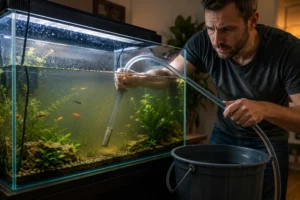
Mistake 12: Walking Away From an Active Siphon or Hose
This mistake is simple but common: walking away while water is draining or refilling. A siphon can overdrain the aquarium. A hose can slip out. A pump can run dry. A bucket can overflow. A faucet-connected system can flood the floor if not monitored.
Always stay near the aquarium during active draining and refilling. Use hose clips, shutoff valves, visible water-level marks, and timers as backup reminders. But do not treat them as permission to ignore the system.
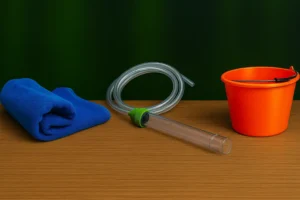
Water change tools make maintenance easier, but they still require attention.
Mistake 13: Changing Too Many Things at Once
A water change is already a maintenance event. If you also replace filter media, move hardscape, deep-clean substrate, add new fish, change fertilizer, adjust CO₂, dose medication, and alter lighting on the same day, it becomes difficult to know what caused any later problem.
Changing too many variables at once makes troubleshooting harder. If fish act stressed after the maintenance session, was it the water change, temperature, filter cleaning, substrate disturbance, CO₂ adjustment, or new livestock?
Keep maintenance structured. Make one major change at a time when possible, especially in sensitive tanks. Routine water changes should be predictable, not chaotic.
Mistake 14: Forgetting Oxygen During and After Water Changes
Water changes can temporarily affect oxygen conditions. Filters may be switched off, surface movement may stop, substrate may release waste, temperature may shift, and organic debris may be disturbed. If fish gasp after a water change, oxygen should be addressed immediately.
Increase surface movement, restart the filter promptly, add an air stone if needed, and test ammonia and nitrite. Gasping is not something to watch passively. It can indicate oxygen stress, chlorine exposure, ammonia, nitrite, temperature shock, or CO₂ imbalance.
For oxygen-specific guidance, read Aquarium Oxygen Levels.
Mistake 15: Treating Every Tank the Same
A beginner community tank, shrimp tank, high-tech planted aquascape, goldfish tank, low-tech planted tank, and soft-water blackwater setup do not need identical water change routines. Each tank has different waste production, mineral needs, plant uptake, sensitivity, and stability requirements.
Shrimp tanks often need smaller, more stable changes. High-tech planted tanks may use larger weekly changes to reset nutrients. High-bioload tanks may need more frequent changes. Soft-water tanks may require careful KH management. Tanks with nitrate in tap water may need source-water planning.
The best routine is not copied from someone else. It is built from your aquarium’s test results and livestock response.
Troubleshooting Problems After a Water Change
If something goes wrong after a water change, act calmly and check the likely causes. Do not immediately add random chemicals. Start with observation, aeration, and testing.
| Problem After Water Change | Likely Cause | First Action |
|---|---|---|
| Fish gasping | Low oxygen, chlorine, ammonia, nitrite, temperature shock, CO₂ | Increase aeration and test water |
| Fish hiding or clamped fins | Temperature, pH, KH/GH swing, chlorine, stress | Check temperature and source-water match |
| Shrimp inactive or dying | Mineral swing, pH/KH/GH mismatch, temperature shock | Compare old and new water parameters |
| Cloudy water | Bacterial bloom, disturbed substrate, overcleaning | Aerate and test ammonia/nitrite |
| Ammonia appears | Filter disruption, dead matter, substrate disturbance | Water change, reduce feeding, protect filter |
| Nitrite appears | Cycle disruption or immature filter | Oxygenate, water change, keep testing |
| Plants uproot | Refill too strong or siphon too aggressive | Refill gently and replant carefully |
| Nitrate stays high | Tap nitrate or change too small | Test source water and adjust routine |
Safer Aquarium Water Change Routine
A safer water change routine is built on preparation and consistency. You do not need to overcomplicate it, but you should avoid sudden changes and protect biological filtration.
Before the water change
- Test nitrate regularly.
- Test ammonia and nitrite in new or unstable tanks.
- Prepare replacement water before removing old water.
- Treat tap water for chlorine or chloramine.
- Match temperature as closely as practical.
- Check KH and GH if livestock are sensitive.
- Prepare RO water with consistent remineralization if used.
During the water change
- Remove only the planned amount.
- Clean visible waste and selected debris pockets.
- Avoid deep-cleaning the entire aquarium.
- Protect shrimp and small fish from the siphon.
- Keep filter media wet.
- Do not replace all filter media.
- Refill gently and slowly where needed.
After the water change
- Restart filter, heater, air stone, and CO₂ as appropriate.
- Check filter flow and surface movement.
- Observe fish, shrimp, and snails.
- Watch for gasping, hiding, or unusual behavior.
- Test water if livestock appear stressed.
- Record the amount changed and any unusual reaction.
Quick Takeaways
- Water changes are beneficial when replacement water is safe and stable.
- Untreated tap water is one of the most dangerous water change mistakes.
- Temperature mismatch can shock fish and shrimp.
- Large changes are risky when new water differs strongly from tank water.
- Do not replace all filter media during a water change.
- Do not deep-clean the whole aquarium at once.
- Planted and shrimp tanks need gentler substrate cleaning.
- RO water must usually be remineralized before aquarium use.
- Fish gasping after a water change requires immediate aeration and testing.
- The safest routine is consistent, prepared, gentle, and based on water tests.
Conclusion
Aquarium water change mistakes usually come from rushing, guessing, or changing too much at once. The water change itself is not the enemy. A well-prepared partial water change is one of the best tools for long-term aquarium stability.
The safest method is simple: treat tap water, match temperature, avoid sudden pH/KH/GH swings, protect filter media, clean selectively, refill gently, and observe livestock afterward. If fish gasp or shrimp react badly, increase aeration and test immediately instead of assuming everything is fine.
From here, continue with Aquarium Water Changes for the full schedule and amount guide, Aquarium Water Parameters Guide for testing, or the Aquarium Water Change Tools Guide if you want to improve your physical workflow.
Next step:
Before your next water change, test your source water for pH, KH, GH, nitrate, and temperature. Then compare it with your aquarium water. Most water change problems become easier to prevent once you know how different the new water really is.
💬 Join the Conversation
Tag us on Instagram @AquariumLesson — we’d love to see your water change routine, planted tank workflow, shrimp tank setup, and maintenance tools.
👉 What was the biggest water change mistake you made as a beginner?
FAQ
What is the most common aquarium water change mistake?
The most common mistake is adding replacement water without preparing it properly. Untreated tap water, temperature mismatch, and pH/KH/GH differences can all stress livestock after a water change.
Why are my fish gasping after a water change?
Fish may gasp after a water change because of low oxygen, chlorine or chloramine exposure, ammonia, nitrite, temperature shock, excess CO₂, or a sudden parameter swing. Increase aeration immediately and test the water.
Can a water change kill fish?
A properly prepared water change should not kill fish. Problems happen when new water is untreated, too cold or warm, chemically very different, added too quickly, or combined with aggressive filter and substrate cleaning.
Should I clean the filter during every water change?
You can rinse clogged mechanical media when needed, but do not replace or sterilize all filter media. Rinse media gently in removed aquarium water to preserve beneficial bacteria while restoring flow.
Is a 50% water change a mistake?
No, not automatically. A 50% water change can be safe if replacement water is treated, temperature-matched, and chemically suitable. It becomes risky when the new water differs strongly from the aquarium.
Can I use tap water directly in my aquarium?
Only if it is made aquarium-safe first. Most tap water should be treated with a suitable water conditioner to neutralize chlorine or chloramine before it is added to the aquarium.
Why did my shrimp die after a water change?
Shrimp may die after water changes because of temperature shock, pH/KH/GH swings, TDS changes, chlorine exposure, ammonia, nitrite, or poorly remineralized RO water. Compare old tank water with replacement water to find the cause.
Should I vacuum the substrate every water change?
It depends on the tank. Gravel tanks may need regular vacuuming, while planted tanks, shrimp tanks, sand tanks, and aquascapes often need gentler selective cleaning.
Can I use pure RO water for a water change?
Pure RO water is usually not suitable by itself because it lacks minerals and buffering. It should normally be remineralized to match the needs of your fish, shrimp, snails, plants, and aquarium style.
What should I do if something goes wrong after a water change?
Increase aeration, check temperature, test ammonia and nitrite, confirm that tap water was treated, and compare pH, KH, and GH between tank water and replacement water. Avoid adding random chemicals before identifying the cause.
Lesson completed!
You've finished this lesson. Keep building your aquarium knowledge, one lesson at a time.
Continue learning →New to AquariumLesson? Start with our complete Aquarium Lessons Hub or return to the homepage at AquariumLesson.com.
References
- FAO. Environment and Fish Health: Water Quality for Aquaculture.
- University of Florida IFAS. Basic Water Quality Parameters for Aquaculture.
- North Central Regional Aquaculture Center. An Introduction to Water Chemistry in Freshwater Aquaculture.
- U.S. Environmental Protection Agency. Aquatic Life Criteria – Ammonia.
- AquariumLesson. Aquarium Water Changes.