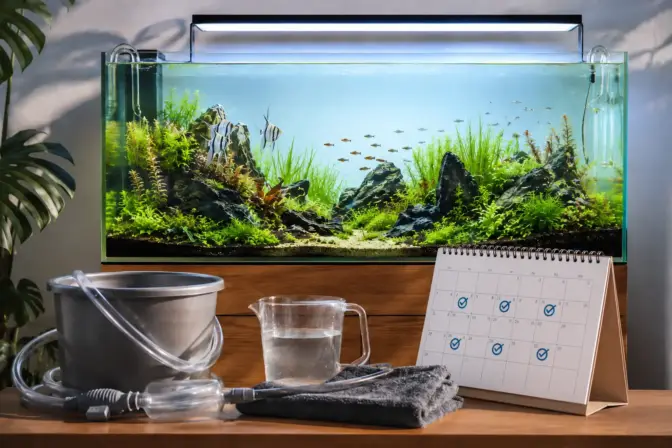
Aquarium Water Change Schedule: How Often & How Much Water to Change
Introduction
Most aquarium water change advice sounds simple: change a fixed amount once per week and everything will be fine.
That advice can help beginners start, but it is not the full picture.
A good aquarium water change schedule is not just a calendar routine. It is a stability system. It controls waste, nitrate, dissolved organics, minerals, pH drift, oxygen pressure, and long-term water quality before fish, shrimp, snails, or plants show stress.
The problem is that every aquarium behaves differently. A lightly stocked planted aquarium does not need the same routine as a high-bioload goldfish aquarium. A shrimp aquarium does not react the same way as a beginner community aquarium. A high-tech planted aquascape with CO₂ and fertilizer may need a larger weekly reset, while a soft-water shrimp setup may need smaller, slower, more careful changes.
This guide explains how often to change aquarium water, how much water to replace, how to adjust the schedule by aquarium type, and how to avoid the common mistakes that make water changes stressful instead of helpful.
For the broader foundation, read the Aquarium Water Guide. To understand the numbers behind your routine, continue with the Aquarium Water Parameters Guide. For equipment, hoses, siphons, pumps, and systems, use the Aquarium Water Change Tools Guide.
What you’ll learn in this lesson
- How often to change aquarium water
- How much water to replace
- Why 20–30% weekly is a strong starting point
- When larger water changes make sense
- Why shrimp aquariums often need smaller changes
- How planted aquariums differ from high-bioload aquariums
- How nitrate, ammonia, nitrite, pH, KH, GH, and source water affect your routine
- How to build a stable schedule instead of copying a fixed rule
- Which water change mistakes can harm livestock
- When an emergency water change is needed
Quick Answer
A good aquarium water change schedule should keep water quality stable between maintenance days.
For many freshwater community aquariums, a practical starting routine is:
20–30% once per week
This is not a universal rule. It is a safe baseline.
Use this quick guide:
| Aquarium Type | Starting Frequency | Starting Amount | Main Goal |
|---|---|---|---|
| Beginner community aquarium | Weekly | 20–30% | General stability |
| Lightly stocked planted aquarium | Weekly to biweekly | 15–30% | Nutrient and mineral balance |
| High-tech planted aquascape | Weekly | 30–50% | Fertilizer reset and consistency |
| Shrimp aquarium | Weekly or biweekly | 10–20% | Gentle mineral stability |
| High-bioload aquarium | Weekly or more often | 30–50% | Strong waste export |
| New aquarium with livestock | Test-based | As needed | Ammonia and nitrite protection |
| Emergency situation | Immediately if needed | Controlled amount | Toxin dilution |
The best schedule is not the largest water change. It is the routine that keeps ammonia and nitrite at 0 ppm, nitrate controlled, pH stable, minerals consistent, oxygen strong, and livestock behaving normally.
What Is an Aquarium Water Change Schedule?
An aquarium water change schedule is a planned routine for removing part of the aquarium water and replacing it with clean, safe, prepared water.
A schedule should answer three practical questions:
- How often should water be changed?
- How much water should be replaced?
- What should be checked before and after the change?
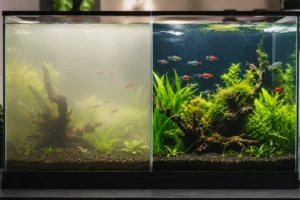
The goal is not only clear-looking water. Clear water can still contain nitrate, dissolved organics, ammonia, nitrite, chlorine, chloramine, or unstable minerals.
A good schedule protects water quality before visible problems appear. Fish waste, uneaten food, decaying leaves, fertilizer, substrate debris, and organic matter all change the aquarium over time. Water changes help reset part of that drift.
In simple terms:
Water changes remove what builds up and replace what gets depleted.
They dilute nitrate and dissolved waste. They refresh minerals. They help prevent long-term pH and hardness drift. They can improve clarity and oxygen conditions by reducing organic load. But they should not destroy the established biological system.
A water change is controlled renewal, not a full reset.
Why Aquarium Water Changes Matter
Even with a strong filter, aquarium water changes over time.
Fish produce waste. Food breaks down. Plants consume nutrients. Fertilizers add minerals. Organic matter collects in the substrate and filter. The nitrogen cycle converts ammonia into nitrite and then nitrate. Plants can use some nitrate, but many aquariums still need water changes to export the excess.
Filters are essential, but most standard freshwater filters do not remove all nitrate from the system. They mainly support biological filtration by helping beneficial bacteria process ammonia and nitrite. Water changes remain one of the easiest ways to dilute nitrate and dissolved waste.
A good water change routine supports:
- lower nitrate accumulation
- better long-term mineral consistency
- more stable pH and buffering
- cleaner substrate areas
- lower dissolved organic buildup
- healthier fish, shrimp, and snails
- stronger plant performance in balanced systems
- fewer surprise water-quality problems
Water changes also create a routine. When you change water, you usually observe livestock, check equipment, remove dead leaves, inspect algae, and notice problems earlier.
That routine matters as much as the water replacement itself.
How Often Should You Change Aquarium Water?
There is no single aquarium water change schedule that fits every aquarium.
The right frequency depends on how quickly waste builds up and how stable the aquarium remains between changes. For many freshwater aquariums, weekly partial water changes are the safest starting point.
A weekly routine works well because it is predictable. It prevents waste from building too far, helps beginners stay consistent, and creates a regular moment to inspect the aquarium.
However, some aquariums need more frequent changes, while others can remain stable with less.
Your schedule depends on:
- aquarium size
- stocking level
- feeding amount
- fish size and waste production
- plant mass
- filtration
- substrate debris
- nitrate trend
- tap or RO water chemistry
- shrimp or sensitive livestock
- fertilizer and CO₂ routine
- algae pressure
- previous water-quality issues
A lightly stocked planted aquarium may stay stable with smaller or less frequent changes. A high-bioload aquarium may need stronger export. A shrimp aquarium may need smaller, slower changes to prevent mineral and temperature swings.
When in doubt, start with a moderate weekly routine and adjust using test results.
How Much Water Should You Change?
For many stable freshwater community aquariums, 20–30% weekly is a practical starting point.
This amount is large enough to dilute waste and refresh water, but not so large that it usually creates major parameter swings when replacement water is prepared correctly.
The right amount depends on two things:
- how much waste needs to be removed
- how different the replacement water is from aquarium water
A larger water change removes more nitrate and dissolved waste. But it also has more potential to shift temperature, pH, KH, GH, and dissolved minerals if the new water does not match well.
That is why a 50% water change is not automatically dangerous. A 50% water change with safe, treated, temperature-matched, chemically suitable water can be very useful in the right setup.
The danger comes from mismatch.
| Water Change Amount | Best Use | Main Caution |
|---|---|---|
| 10–15% | Shrimp aquariums, nano aquariums, sensitive livestock | May be too weak for high waste |
| 20–30% | General freshwater maintenance | Still needs safe replacement water |
| 30–50% | High-tech planted aquariums, high nitrate, high bioload | Parameter matching becomes more important |
| 50%+ | Emergency or controlled reset routine | Not ideal with very different source water |
| 100% | Rare special cases outside normal maintenance | Not suitable for routine stocked aquariums |
The best amount is not the biggest number. It is the amount that keeps the aquarium stable without shocking livestock.
Best Starting Schedule for Beginners
If you are new to freshwater aquariums, start simple.
A good beginner baseline is:
20–30% once per week
This routine works well for many normally stocked freshwater community aquariums. It is easy to remember and strong enough to prevent many avoidable water-quality problems.
Use this beginner routine:
- Test nitrate before the water change.
- In new or unstable aquariums, test ammonia and nitrite too.
- Change 20–30% weekly.
- Treat tap water before adding it.
- Match temperature as closely as practical.
- Remove visible debris and dead leaves.
- Avoid deep-cleaning the entire aquarium.
- Protect filter media.
- Observe fish and shrimp after refilling.
After several weeks, review the pattern.
If nitrate rises quickly, increase the amount or frequency. If livestock react badly, improve water preparation, reduce the amount, or refill more slowly. If the aquarium stays stable, keep the routine consistent.
For broader setup planning, read the Beginner Aquarium Guide.
Use Nitrate to Adjust Your Schedule
Nitrate is one of the best long-term indicators for an aquarium water change schedule.
In a cycled aquarium, ammonia becomes nitrite and nitrite becomes nitrate. Nitrate is usually less immediately toxic than ammonia or nitrite, but it still matters. If nitrate rises steadily, the aquarium is producing more waste than the current export routine can handle.
Test nitrate before your water change for several weeks.
The trend is more useful than a single reading.
| Nitrate Pattern | Likely Meaning | Schedule Adjustment |
|---|---|---|
| Nitrate rises quickly every week | Waste export is too weak | Increase amount or frequency |
| Nitrate stays predictable | Routine may be working | Keep schedule and monitor |
| Nitrate does not drop after changes | Source water may contain nitrate or change is too small | Test replacement water |
| Nitrate is near zero in a planted aquarium | Plants may consume it or nutrients may be limited | Review plant growth and fertilization |
| Nitrate becomes very high | Maintenance gap or waste overload | Use controlled larger or repeated changes |
Do not only solve nitrate with water changes. Also check feeding, stocking, filter waste, plant mass, substrate debris, and source water.
For deeper help, read High Nitrate in Aquarium.
Water Changes and Ammonia or Nitrite
In a stocked aquarium, ammonia and nitrite should normally be 0 ppm.
If either is measurable, do not wait for the next scheduled maintenance day. A controlled water change may be needed immediately to reduce exposure.
Ammonia and nitrite problems often appear in:
- new aquariums
- fish-in cycling
- filter disruptions
- overfeeding events
- dead livestock hidden in the layout
- aggressive filter cleaning
- power outages
- medication stress
- heavy substrate disturbance
Water changes do not replace cycling. They buy time and reduce toxic concentrations while beneficial bacteria continue to develop or recover.
If ammonia or nitrite appears:
- perform a controlled water change
- reduce feeding
- increase aeration
- keep the filter running
- avoid replacing all filter media
- remove decaying matter
- continue testing
For focused troubleshooting, read Ammonia Spike in Aquarium and Nitrite Spike in Aquarium.
Schedule for New Aquariums
New aquariums need a different approach because biological filtration may not be mature yet.
During cycling, ammonia and nitrite are more important than a fixed calendar. If livestock are present, water changes should follow test results. If ammonia or nitrite appears, a controlled water change can protect fish while the biological filter develops.
In fishless cycling, water changes are not always needed on a fixed schedule. They may be useful when values become extremely high, before adding livestock, or when pH stability becomes a problem.
In fish-in cycling, water changes are often necessary because livestock are already exposed.
A new aquarium routine should include:
- frequent ammonia testing
- frequent nitrite testing
- nitrate tracking once the cycle progresses
- careful feeding
- strong oxygenation
- stable temperature
- filter protection
- controlled water changes when needed
The mistake is thinking that water changes stop the cycle. They do not stop beneficial bacteria from colonizing surfaces and filter media. They reduce harmful concentrations while the cycle develops.
For the full process, read the Aquarium Cycling Guide and Fishless Cycle Guide.
Schedule for Planted Aquariums
Planted aquariums can benefit greatly from regular water changes, but the ideal schedule depends on light, CO₂, fertilizer, substrate, plant mass, and livestock.
Plants can use nitrate and other nutrients. But this does not mean planted aquariums never need water changes. Dissolved organics, mineral shifts, fertilizer accumulation, algae pressure, and livestock waste still need management.
Low-tech planted aquariums may need smaller or less frequent changes if stocking is light and plants grow well.
High-tech planted aquascapes often use larger weekly water changes. This is common when fertilizer dosing, strong light, CO₂, and fast plant growth are part of the routine. A larger weekly change can reset nutrients and keep the system predictable.
| Planted Aquarium Type | Starting Schedule | Notes |
|---|---|---|
| Low-tech planted aquarium | 20–30% weekly or biweekly | Adjust by nitrate and plant growth |
| High-tech planted aquascape | 30–50% weekly | Useful for fertilizer reset |
| New active-soil aquascape | More frequent early changes may be needed | Follow water tests |
| Heavily planted shrimp aquarium | 10–20% weekly or biweekly | Prioritize mineral stability |
| Low-light beginner plants | 20–30% weekly | Avoid overfeeding and excess light |
Water changes are not a substitute for balanced light, CO₂, nutrients, and flow. If plants struggle, review the full system.
For nutrients, continue with Macronutrients for Aquarium Plants, Micronutrients for Aquarium Plants, and the Aquarium Fertilizer Dosing Calculator.
Schedule for Shrimp Aquariums
Shrimp aquariums often need smaller, more stable water changes than general community aquariums.
Shrimp can be sensitive to sudden changes in temperature, pH, KH, GH, and dissolved minerals. The water change itself is not usually the problem. The problem is often a fast parameter shift.
A good shrimp aquarium starting routine is:
10–20% weekly or biweekly
This depends on shrimp species, aquarium size, feeding, plant mass, substrate, source water, and mineral stability.
Neocaridina shrimp often tolerate a wider range when parameters are stable. Caridina shrimp setups often rely on active soil and remineralized RO water, so consistency becomes even more important.
For shrimp aquariums:
- match temperature carefully
- prepare replacement water consistently
- test GH and KH if shrimp react after changes
- refill slowly
- avoid sudden mineral shifts
- use a siphon guard for baby shrimp
- avoid large changes with very different water
If shrimp become inactive after water changes, compare old aquarium water with new replacement water. Check temperature, GH, KH, pH, and TDS if you use a TDS meter.
Schedule for High-Bioload Aquariums
High-bioload aquariums produce waste quickly.
This includes aquariums with large fish, messy eaters, heavy feeding, fast growth, crowded stocking, or species that produce a lot of waste. In these systems, a light routine may not be enough.
Signs that your schedule is too weak include:
- nitrate rises quickly
- filter media clogs often
- debris collects heavily
- water smells stale
- algae increases
- fish show stress
- cloudy water appears repeatedly
A high-bioload aquarium may begin with:
30–50% weekly
In some cases, two moderate changes per week may be safer and more stable than one very large change. For example, two 25% changes can reduce stress while improving export.
Water changes help, but they do not fix unrealistic stocking. If the aquarium always needs aggressive maintenance to remain safe, review feeding, filtration, aquarium size, and livestock load.
Use the Aquarium Volume Calculator if you need a clearer idea of actual water volume.
Schedule for Nano Aquariums
Nano aquariums need careful scheduling because small water volumes change quickly.
A small amount of food, waste, evaporation, temperature shift, or fertilizer can affect a small aquarium more strongly than a larger aquarium. This makes consistency especially important.
For many nano aquariums, a good starting routine is:
15–25% weekly
Shrimp or sensitive nano setups may need smaller, slower changes. A heavily stocked nano aquarium may need more frequent maintenance, but the better solution is often lighter stocking and better feeding control.
Nano aquariums should be observed closely after maintenance. Fish, shrimp, and snails should behave normally after refilling. If they hide, gasp, climb, or become inactive, review temperature, chlorine/chloramine treatment, oxygen, pH, KH, GH, and refill speed.
Weekly vs Biweekly Water Changes
Weekly water changes are usually best for beginners because they create a reliable rhythm.
A weekly routine makes it easier to test, clean selected areas, check livestock, inspect equipment, and prevent slow water-quality drift.
Biweekly water changes can work in stable, lightly stocked planted aquariums with predictable nitrate and compatible source water. But they are not ideal for every setup.
| Schedule | Best For | Main Risk |
|---|---|---|
| Weekly | Most beginner and community aquariums | Over-cleaning if done aggressively |
| Twice weekly | High-bioload, emergencies, cycling with livestock | More chances for refill mistakes |
| Biweekly | Stable, lightly stocked planted aquariums | Waste can build if misjudged |
| Monthly | Only very stable low-bioload systems | Often too weak for beginners |
| Test-based only | Advanced aquarists with strong tracking | Beginners may miss trends |
If you are unsure, start weekly. After several weeks of test results, adjust gradually.
Water Changes and pH, KH, and GH Stability
A good aquarium water change schedule should not only control nitrate. It should also protect pH, KH, and GH stability.
Every refill adds water with its own chemistry. If replacement water is very different from aquarium water, a large change can shift parameters quickly.
This matters especially in:
- soft-water aquariums
- shrimp aquariums
- active-soil aquascapes
- RO-water systems
- low-KH aquariums
- mineral-sensitive livestock setups
KH helps buffer pH. GH reflects important minerals such as calcium and magnesium. If KH or GH changes suddenly, livestock can become stressed even when nitrate looks fine.
Test both aquarium water and replacement water. Compare pH, KH, GH, nitrate, and temperature. If values are very different, use smaller changes, better preparation, or slower refilling.
For deeper guidance, read Aquarium KH and GH, Aquarium pH, and Stable Aquarium pH.
How to Prepare Replacement Water
Many water change problems happen during refill.
The removed water is rarely the dangerous part. The replacement water can cause stress if it is untreated, too cold, too warm, chemically different, or added too quickly.
Use this replacement water checklist:
- Use a safe water source.
- Treat tap water for chlorine or chloramine.
- Match temperature as closely as practical.
- Test nitrate in source water if nitrate remains high.
- Test KH and GH for sensitive setups.
- Remineralize RO water before use.
- Avoid sudden pH differences.
- Refill slowly for shrimp and sensitive fish.
- Keep the routine consistent.
For most standard freshwater aquariums, treated tap water can work well if it matches livestock needs. For specialized shrimp or soft-water aquariums, remineralized RO water may be better.
Never add pure RO water as the main replacement water without understanding mineral needs. Pure RO water lacks the buffering and minerals most freshwater livestock require.
Calm Water Change Routine
A water change should feel calm and predictable.
Use this routine:
Test before maintenance
Test nitrate in mature aquariums. In new or unstable aquariums, also test ammonia and nitrite. If pH or hardness problems occur, test pH, KH, and GH before and after the change.
Prepare replacement water
Treat tap water or prepare remineralized RO water. Match temperature. Make sure the new water is suitable before it enters the aquarium.
Turn off exposed equipment
Turn off heaters if they may become exposed to air. Make sure filters do not run dry. Restart equipment immediately after refilling.
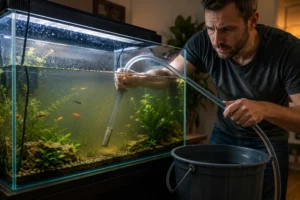
Remove water gently
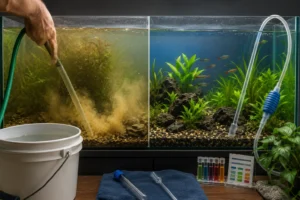
Use a siphon, hose, pump, or water change system. Remove the planned amount. Avoid disturbing livestock, plants, and substrate more than necessary.
Clean selected areas
Remove visible debris, dead leaves, uneaten food, and waste pockets. Do not deep-clean the entire aquarium every time.
Refill slowly
Add replacement water gently. Avoid blasting substrate, uprooting plants, or pushing shrimp and fish around. Use a plate, hose clip, diffuser, pump, or slow pour if needed.
Restart and observe
Check filter flow, heater function, CO₂, air stones, and circulation. Watch livestock behavior after refilling.
Should You Vacuum the Substrate?
Substrate cleaning depends on the aquarium design.
In gravel aquariums with heavy feeding, vacuuming can remove trapped waste before it decomposes. In planted aquariums with rooted plants, deep aggressive vacuuming can damage roots and disturb the substrate.
Use selective cleaning.
Clean open areas, visible debris pockets, and low-flow zones. Avoid tearing through the entire substrate every week unless the setup requires it.
In sand aquariums, hover above the surface instead of pushing deeply into the sand. In aquascapes with carpeting plants, use gentle surface siphoning. In shrimp aquariums, protect baby shrimp with a guard or fine mesh.
The goal is not to sterilize the aquarium. The goal is to remove excess waste while preserving stability.
Should You Clean the Filter During a Water Change?
You can clean filter parts during a water change, but do not destroy biological filtration.
Mechanical media that is clogged with debris can be rinsed gently in removed aquarium water. Biological media should be protected. Do not sterilize it, boil it, replace it all at once, or rinse it aggressively in untreated tap water.
Filter cleaning and water changes are connected because removed aquarium water is useful for rinsing media while preserving beneficial bacteria.
Do not replace all filter media during routine maintenance. Doing so can weaken biological filtration and may trigger ammonia or nitrite problems.
For filtration basics, read the Aquarium Filter Guide and Aquarium Filter Media Guide.
When to Increase Water Change Frequency
Increase water change frequency when your current schedule is not keeping the aquarium stable.
Common signs include:
- nitrate rises too quickly
- ammonia or nitrite appears
- fish gasp, hide, or behave unusually
- shrimp become inactive
- water smells bad
- cloudy water keeps returning
- algae increases with poor maintenance
- visible waste builds up quickly
- filter media clogs often
- overfeeding occurred
- dead livestock or rotting plant matter was found
If ammonia or nitrite appears in a stocked aquarium, do not wait for the scheduled maintenance day. Treat it as an urgent water-quality issue.
You can strengthen a schedule by:
- increasing the amount
- increasing frequency
- doing smaller changes more often
- reducing feeding
- improving filtration
- removing debris
- adding healthy plant mass
- reviewing stocking
Do not rely on water changes alone if the underlying waste load is unrealistic.
When to Reduce Water Change Amount
Reducing the amount can make sense when livestock are stressed by parameter swings.
This is common in shrimp aquariums, soft-water aquariums, active-soil aquascapes, very small aquariums, or setups where replacement water differs strongly from aquarium water.
Reduce the amount or refill more slowly if:
- shrimp become inactive after changes
- fish gasp or hide after refilling
- pH shifts strongly
- KH or GH changes suddenly
- replacement water is very different
- substrate is disturbed during refill
- plants uproot or melt after rough maintenance
Reducing the amount does not mean skipping maintenance. It usually means improving control.
Smaller changes done consistently are often safer than rare large changes done suddenly.
Emergency Aquarium Water Changes
An emergency water change is needed when water quality creates immediate risk.
Common reasons include:
- ammonia
- nitrite
- severe overfeeding
- dead livestock
- contamination
- medication mistake
- oxygen stress linked to organic waste
- very high nitrate
- filter failure
- hidden decay
During an emergency, the goal is to reduce exposure quickly without creating additional shock.
Use safe, treated, temperature-matched water. Increase aeration. Remove the cause if possible. Test ammonia and nitrite. Protect the filter.
| Emergency | Water Change Role | Also Do This |
|---|---|---|
| Ammonia present | Dilutes toxic waste | Reduce feeding, oxygenate, protect filter |
| Nitrite present | Dilutes nitrite | Increase aeration and keep testing |
| Severe overfeeding | Removes dissolved waste | Siphon uneaten food |
| Dead livestock | Dilutes decomposition products | Remove the body immediately |
| High nitrate | Reduces accumulation | Review feeding and stocking |
| Fish gasping | May improve water quality | Increase surface movement immediately |
| Contamination | Dilutes harmful substance | Remove source and use fresh carbon if appropriate |
If fish are gasping, increase surface movement immediately. Do not wait until after testing to improve oxygen conditions.
For detailed help, read Emergency Aquarium Water Change and Aquarium Oxygen Levels.
Common Aquarium Water Change Mistakes
Water changes are helpful when done correctly. Most problems come from sudden differences between old and new water, untreated tap water, aggressive cleaning, or changing too many things at once.
Avoid these mistakes:
- Using untreated tap water: Chlorine or chloramine can harm livestock and beneficial bacteria.
- Not matching temperature: Sudden temperature changes can shock fish and shrimp.
- Changing too much with mismatched water: Large parameter swings can stress livestock.
- Cleaning filter media too aggressively: This can weaken biological filtration.
- Replacing all filter media: This may trigger ammonia or nitrite problems.
- Deep-cleaning the entire aquarium: Too much disturbance can destabilize the system.
- Ignoring source water: Tap water may already contain nitrate or very different KH/GH.
- Skipping tests: You cannot optimize a schedule without trends.
- Overfeeding after maintenance: Extra food quickly becomes waste.
- Leaving hoses unattended: Flooding and overdraining can happen fast.
For a dedicated guide, read Aquarium Water Change Mistakes.
Troubleshooting Table
Use this table when something goes wrong after a water change.
| Problem After Water Change | Likely Cause | First Action |
|---|---|---|
| Fish gasp at the surface | Low oxygen, chlorine, temperature shock, ammonia, or nitrite | Increase aeration and test water |
| Shrimp become inactive | pH, KH, GH, TDS, or temperature swing | Compare old and new water |
| pH changes suddenly | Source water mismatch | Test pH and KH in both waters |
| Cloudy water appears | Bacterial bloom, disturbed substrate, overcleaning | Aerate and test ammonia/nitrite |
| Ammonia appears | Filter disruption, dead matter, substrate disturbance | Change water, reduce feeding, protect filter |
| Nitrate remains high | Change too small or source water nitrate | Test replacement water |
| Plants uproot | Rough siphoning or refill flow | Use gentler technique |
| Filter flow drops | Clogged media or trapped air | Restore flow and inspect equipment |
| Algae increases | Nutrient imbalance, excess light, inconsistent maintenance | Review lighting, feeding, and schedule |
Troubleshooting should always begin with observation and testing. Do not guess blindly.
How to Build Your Own Aquarium Water Change Schedule
The best aquarium water change schedule is built from data and observation.
Start with a safe baseline, track results, and adjust gradually.
Choose a baseline
For many community aquariums, start with 20–30% weekly. For shrimp aquariums, start smaller. For high-tech planted aquariums, start larger if the fertilizer routine depends on weekly reset changes.
Test before the change
Test nitrate before each weekly water change for several weeks. In new aquariums, also test ammonia and nitrite.
Test replacement water
Check tap water or prepared RO water for nitrate, pH, KH, and GH. If replacement water is very different from aquarium water, adjust carefully.
Observe livestock after refilling
Fish, shrimp, and snails should behave normally after a routine water change. If they gasp, hide, climb, or become inactive, investigate temperature, chlorine/chloramine, oxygen, pH, KH, GH, and refill speed.
Adjust one variable at a time
If nitrate remains high, increase amount or frequency. If livestock react badly, improve water matching or reduce change size. Make one clear adjustment and observe for several weeks.
Aquarium Water Change Schedule Checklist
Use this checklist when reviewing your routine:
- Aquarium size is known.
- Stocking level is realistic.
- Feeding is controlled.
- Nitrate is tested before water changes.
- Ammonia and nitrite are tested in new or unstable aquariums.
- Source water nitrate is known.
- Source water pH, KH, and GH are understood.
- Replacement water is treated.
- Replacement water temperature is matched.
- RO water is remineralized if used.
- Shrimp and sensitive livestock get slower changes.
- Filter media is protected.
- Substrate is cleaned appropriately.
- Livestock behavior is observed after refilling.
- The schedule is adjusted based on trends.
Water Changes vs Water Change Tools
This article explains the schedule: how often, how much, and why.
Tools make the routine easier, but they do not decide the schedule. A siphon, hose, pump, bucket, automatic water change setup, or drain kit can make maintenance faster. But the aquarium still needs the right frequency, amount, and replacement water.
If you want to compare equipment, continue with the Aquarium Water Change Tools Guide.
Quick Takeaways
- A good aquarium water change schedule is based on stability, not rigid rules.
- Many freshwater community aquariums start well with 20–30% weekly changes.
- Shrimp aquariums often need smaller, slower, more stable changes.
- High-bioload aquariums may need larger or more frequent changes.
- High-tech planted aquariums often use weekly larger changes to reset nutrients.
- Nitrate trends are one of the best ways to adjust the routine.
- Ammonia or nitrite in a stocked aquarium may require immediate action.
- Replacement water must be treated, temperature-matched, and chemically suitable.
- Large water changes are safer when new water matches aquarium water.
- Do not deep-clean the entire aquarium or replace all filter media.
- The best schedule is consistent, test-based, and adapted to your aquarium.
Conclusion
The best aquarium water change schedule is not copied blindly from another aquarium. It is built around aquarium size, stocking, feeding, plant mass, nitrate trend, source water, filtration, and livestock sensitivity.
For many freshwater community aquariums, 20–30% once per week is a strong starting point. But it is only a starting point.
If nitrate rises quickly, strengthen the schedule. If shrimp or fish react badly, improve water matching and refill technique. If ammonia or nitrite appears, act immediately. If the aquarium stays stable, keep the routine consistent.
Water changes are not about chasing perfection. They are about preventing drift.
A calm, predictable routine keeps the aquarium safer than emergency fixes after problems appear.
From here, continue with the Aquarium Water Guide, Aquarium Water Parameters Guide, High Nitrate in Aquarium, and Aquarium Water Change Mistakes.
Next step:
Test nitrate before your next water change, write down the result, then record how much water you replaced. Repeat this for several weeks. The trend will show whether your current aquarium water change schedule is strong enough.
💬 Join the Conversation
Tag us on Instagram @AquariumLesson — we’d love to see your aquarium maintenance routine, planted aquascape, shrimp setup, or water change system.
👉 What is your current aquarium water change schedule: weekly, biweekly, or based only on test results?
FAQ
What is the best aquarium water change schedule?
For many freshwater community aquariums, a good starting schedule is 20–30% once per week. The best routine depends on nitrate, stocking, feeding, plants, source water, and livestock sensitivity.
How often should I change aquarium water?
Most beginner aquariums benefit from weekly partial water changes. Heavily stocked aquariums may need more frequent changes, while stable lightly stocked planted aquariums may sometimes use a biweekly routine.
How much aquarium water should I change weekly?
A common weekly amount is 20–30% for many freshwater community aquariums. Shrimp aquariums may need 10–20%, while high-bioload or high-tech planted aquariums may need 30–50%.
Is a 50% water change too much?
A 50% water change can be safe if replacement water is treated, temperature-matched, and chemically suitable. It becomes risky when new water differs strongly from aquarium water.
Can I change aquarium water every two weeks?
Biweekly water changes can work in stable, lightly stocked aquariums with predictable nitrate and compatible source water. Beginners are usually safer starting with weekly changes.
Should I change aquarium water if nitrate is high?
Yes, a controlled water change can reduce nitrate. But also check feeding, stocking, plant mass, filter waste, substrate debris, and nitrate in source water.
Should I change water if ammonia or nitrite appears?
In a stocked aquarium, ammonia or nitrite should be treated as urgent. A controlled water change can reduce exposure while you protect and restore biological filtration.
Do planted aquariums need water changes?
Yes, many planted aquariums still benefit from water changes. Plants can use nitrate and nutrients, but water changes help manage dissolved organics, minerals, fertilizer accumulation, and long-term stability.
Are small water changes better for shrimp aquariums?
Often, yes. Shrimp can be sensitive to sudden shifts in temperature, pH, KH, GH, and dissolved minerals. Smaller, slower, better-matched water changes are usually safer.
Should I clean the filter during a water change?
You can rinse clogged mechanical media gently in removed aquarium water, but do not replace all filter media or sterilize biological media. Protect beneficial bacteria.
Lesson completed!
You've finished this lesson. Keep building your aquarium knowledge, one lesson at a time.
Continue learning →New to AquariumLesson? Start with our complete Aquarium Lessons Hub or return to the homepage at AquariumLesson.com.
References
- FAO — Nitrogen and nitrification basics in aquatic systems
- EPA — Chlorine and chloramine considerations for aquariums
- The Fish Site — Ammonia, nitrite, oxygen, and aquaculture water-quality guidance