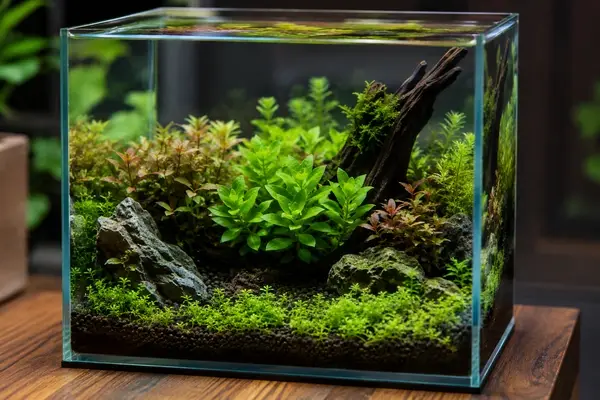
Nano Midground Aquarium Plants: Best Small Plants for Tiny Tanks
Introduction
Nano midground aquarium plants are small plants used in the middle layer of tiny aquariums, shrimp tanks, betta tanks, desktop aquascapes, and compact planted layouts. They sit between the foreground and background, soften rocks and driftwood, create shelter, and make a small tank look deeper than it really is.
In a nano aquarium, plant scale matters more than almost anywhere else. A plant that looks compact in a 90 cm aquascape can become visually huge in a 20 liter tank. Large leaves, tall rosettes, and fast stems can quickly make a nano tank feel crowded. The best nano midground plants stay small, grow slowly or moderately, and help the layout feel detailed instead of overgrown.
This guide focuses specifically on small midground aquarium plants for nano tanks. It does not replace the broader Aquarium Midground Plants Guide. Instead, it explains which plants work best in small aquariums, how to place them, and how to avoid the most common nano-tank mistakes: oversized species, blocked swimming space, shaded carpets, algae on slow leaves, and layouts that lose depth.
If you want a full overview of plant layers first, start with the Aquarium Plants Guide. If your nano tank is low-tech, also read the No CO₂ Planted Tank guide.
Quick answer: The best nano midground aquarium plants include Anubias nana “Petite,” Bucephalandra, small Cryptocoryne species, Cryptocoryne parva, Java Fern “Trident” or “Narrow” in small layouts, mosses, Staurogyne repens, Marsilea, and carefully trimmed compact stems. Choose plants with small leaves and controlled growth so the tank keeps its sense of scale.
What You’ll Learn in This Lesson
- Which nano midground aquarium plants work best in small tanks
- How to choose plants that do not overwhelm the layout
- Why leaf size matters more than plant popularity
- How Anubias Petite, Bucephalandra, Cryptocoryne and mosses compare
- Which nano midground plants grow without CO₂
- How to place small midground plants around rocks and driftwood
- How to create depth in a nano aquascape
- How to avoid algae, overcrowding, blocked swimming space and poor scale
What Makes a Plant Good for the Nano Midground?
A good nano midground plant must fit the scale of the aquarium. In small tanks, the midground may be only a few centimeters deep. There is less space between front glass, hardscape and background plants, so plant size becomes critical.
The best nano midground plants usually have compact leaves, slow to moderate growth, flexible placement, and a final size that can be controlled. They should add texture and depth without hiding the entire hardscape or crowding the livestock.
Good nano midground plants usually have these traits:
- Small or medium-small leaves
- Controlled height
- Slow to moderate growth
- Compatibility with low to moderate light
- Ability to attach to hardscape or stay compact in substrate
- Low trimming demand
- Strong visual texture at small scale
- Minimal risk of taking over the entire tank
A plant is not automatically good for a nano tank just because it is sold small. Many aquarium plants are sold as young specimens. The real question is how large they become after several months.
Best Nano Midground Aquarium Plants Compared
The best nano midground plants depend on your tank size, light level, CO₂ setup, hardscape, and livestock. Shrimp tanks often benefit from mosses and Bucephalandra. Betta nano tanks need open swimming space and soft cover. Aquascapes with stones need compact plants that make the hardscape look larger instead of smaller.
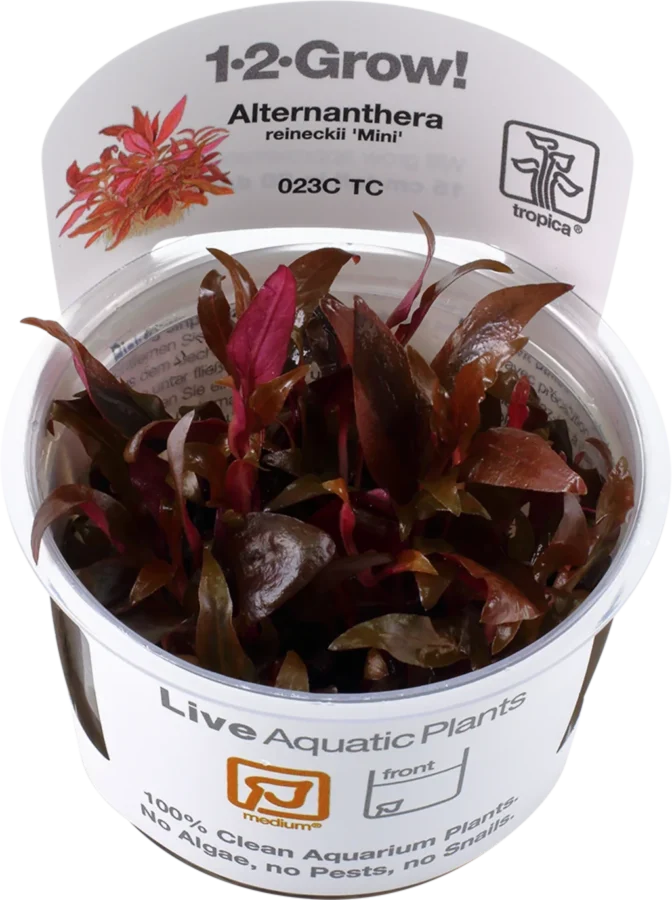 Intermediate
Alternanthera reineckii 'Mini'


 17–25°C
 Medium Light
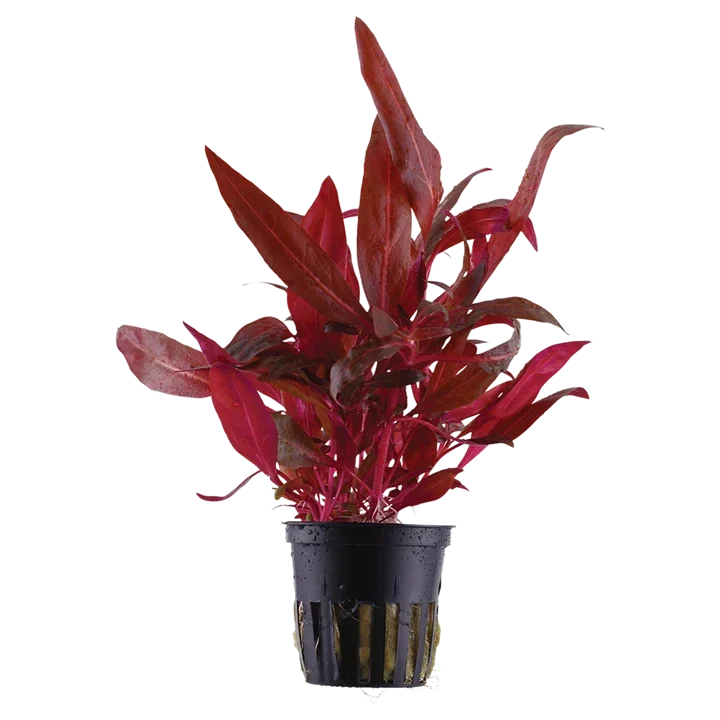 Intermediate
Alternanthera reineckii 'Rosanervig'
17–25°CMedium Light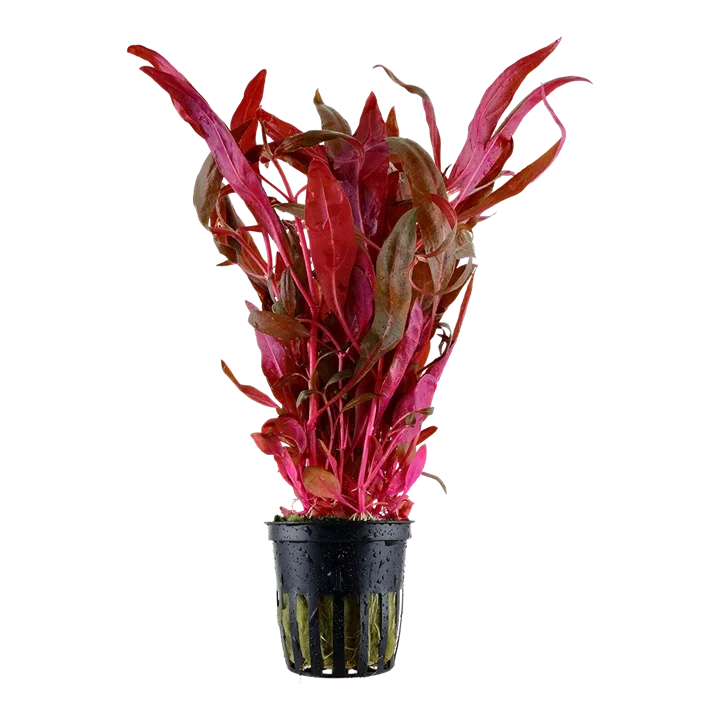 Intermediate
Alternanthera reineckii "Rosaefolia"
 17–25°CMedium Light
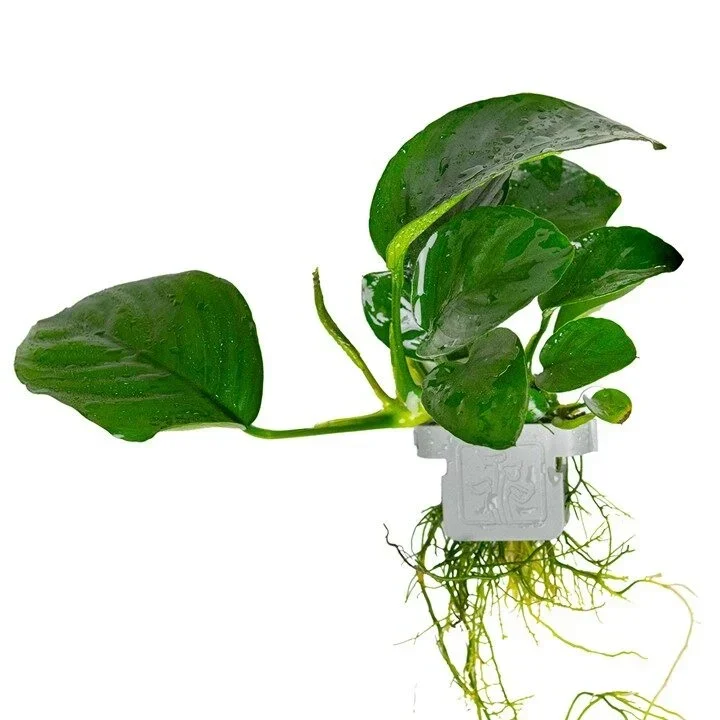 Beginner
Anubias barteri var. caladiifolia
 22–26°C
 Low Light
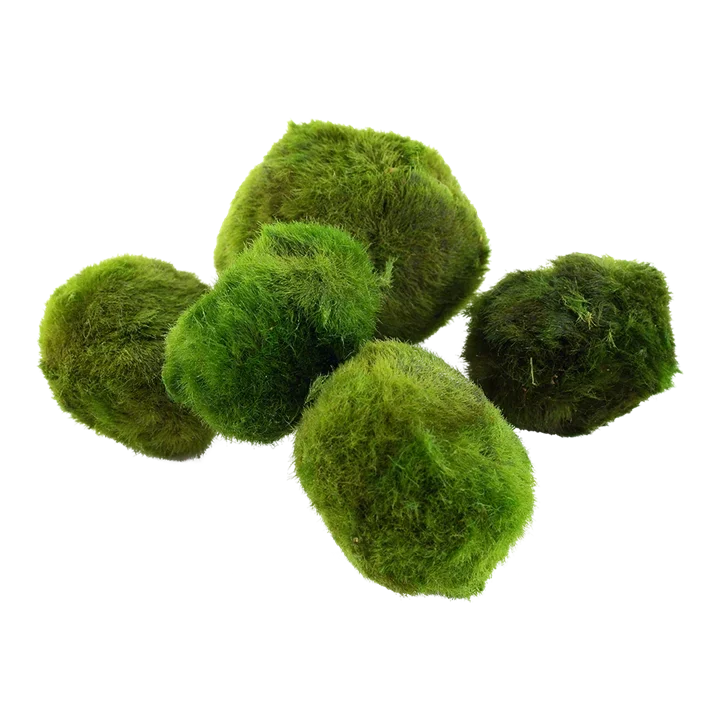 Beginner
Aegagropila linnaei

 15–24°CLow Light
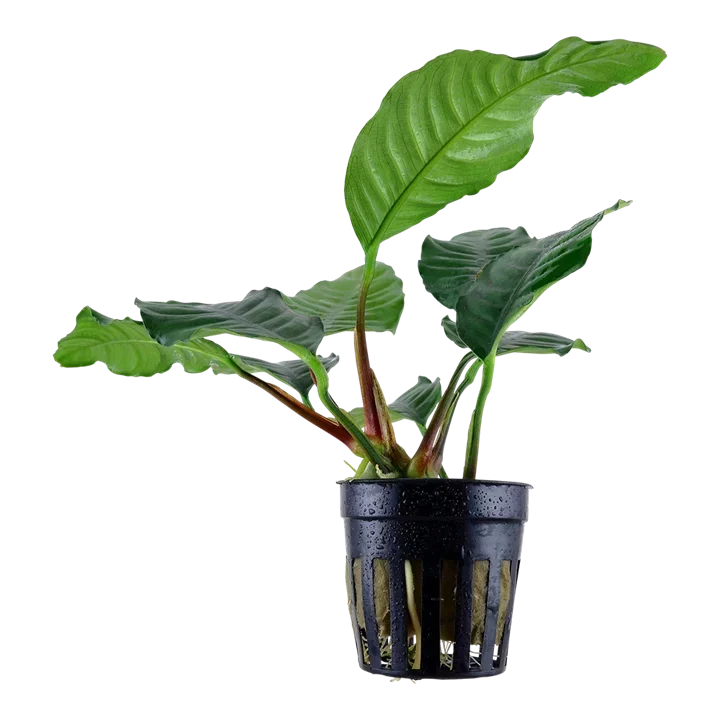 Beginner Friendly
Anubias barteri var. coffeifolia
22–26°CLow Light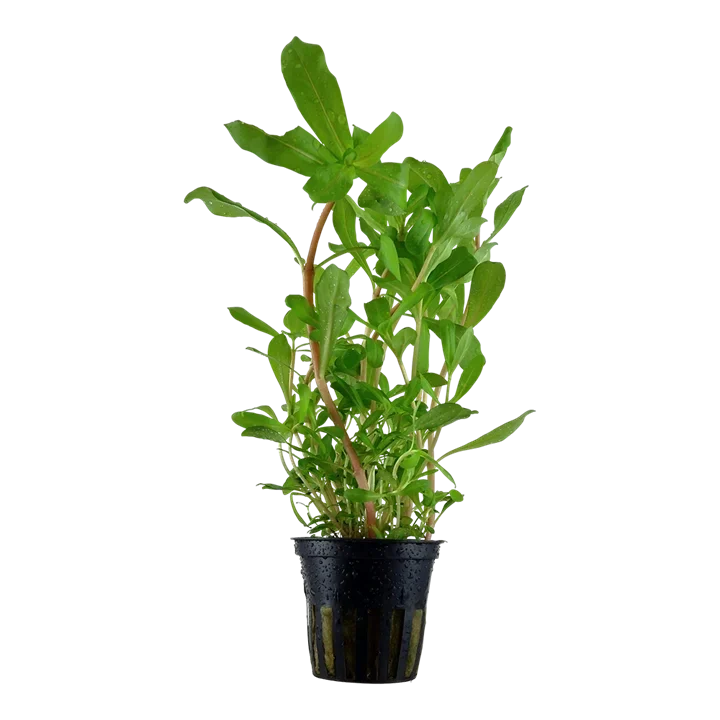 Advanced
Ammannia crassicaulis
 22–28°C
 High Light
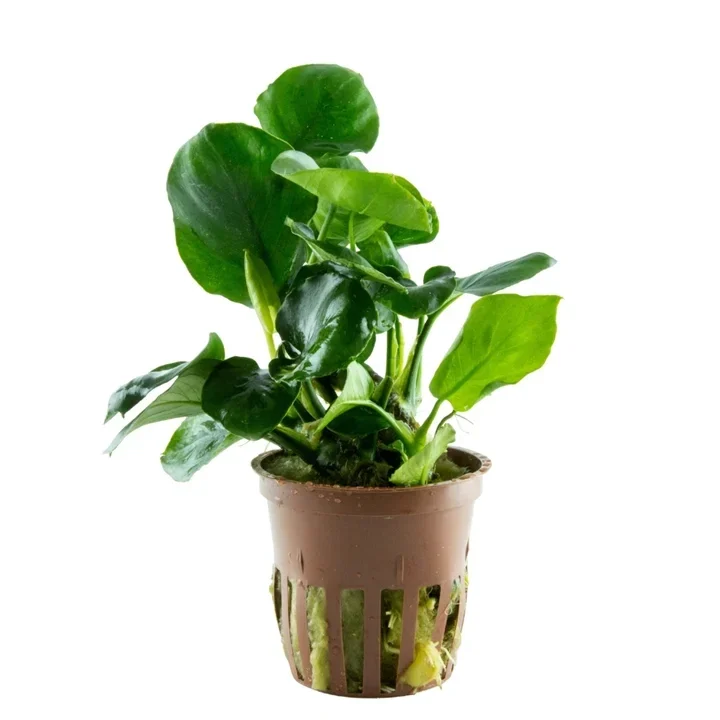 Beginner Friendly
Anubias barteri 'Coin Leaf'
Low Light| Plant | Best Nano Use | Difficulty | Scale Note |
|---|---|---|---|
| Anubias nana “Petite” | Hardscape bases, foreground-to-midground transition | Easy | Excellent small leaves for nano tanks |
| Bucephalandra | Rock detail, shrimp tanks, shaded hardscape | Easy to medium | Compact leaves and premium detail |
| Cryptocoryne parva | Low foreground-to-midground patches | Easy but slow | Very small and stable with patience |
| Small Cryptocoryne wendtii forms | Warm low-tech midground groups | Easy | Choose compact forms, not large rosettes |
| Java Fern “Trident” or “Narrow” | Wood and background-midground transition | Easy | Use small forms carefully in nano tanks |
| Mosses | Wood, stones, shrimp cover, fine texture | Easy to medium | Trim often to avoid messy clumps |
| Staurogyne repens | Low bush around hardscape | Easy to medium | Trim to keep compact |
| Marsilea | Natural low patches and transition zones | Easy to medium | Slow, small and natural-looking |
| Pogostemon helferi | Textured accent in brighter nano tanks | Medium | Use as a small focal group |
If this is your first nano tank, start with Anubias nana “Petite,” Bucephalandra, Cryptocoryne parva, mosses, and small Java Fern forms. These plants stay manageable and are easier to place around hardscape than fast stems.
Anubias Nana “Petite”: The Safest Nano Midground Plant
Anubias nana “Petite” is one of the best nano midground aquarium plants because it stays compact, has small leaves, tolerates low light, and attaches beautifully to stones and driftwood. It can be used at the base of hardscape, along the edge of a sand path, or as a tiny midground cluster in shrimp and betta tanks.
The most important care rule is the same as with all Anubias: keep the rhizome exposed. Do not bury the thick horizontal rhizome in substrate. Attach it to a small stone or piece of wood, then place that hardscape piece where you want the plant.
- Best for: beginner nano tanks, shrimp tanks, low-tech aquascapes, shaded hardscape.
- Light: low to moderate.
- CO₂: not required.
- Placement: attached to rocks, wood or tiny hardscape details.
- Growth speed: very slow.
- Main mistake: burying the rhizome or placing it under harsh direct light.
Anubias nana “Petite” is ideal when you want a plant that will not outgrow the tank quickly. For broader care rules, read the Anubias Aquarium Plant Guide.
Bucephalandra: Premium Detail for Nano Hardscape
Bucephalandra is one of the strongest plants for nano aquascaping because many varieties stay small and detailed. It can show subtle green, blue, purple, bronze or metallic tones, and it looks especially good on rocks, driftwood and shaded hardscape.
In a nano tank, Bucephalandra is often more useful than larger Anubias forms because its leaves can be smaller and more refined. It works well in shrimp tanks, stone layouts, and aquascapes where you want plant detail without losing hardscape scale.
- Best for: rock detail, shrimp tanks, nano aquascapes, shaded midground accents.
- Light: low to moderate.
- CO₂: optional, not required.
- Placement: attach to stone, wood, cracks or small hardscape pieces.
- Growth speed: slow.
- Main mistake: expecting fast growth or placing it under too much direct light.
Bucephalandra is not a fast filler, but it is one of the best plants for making a small aquascape look mature and detailed. For full care, read the Bucephalandra Aquarium Plant Guide.
Cryptocoryne Parva: Slow but Perfectly Scaled
Cryptocoryne parva is one of the smallest Cryptocoryne plants and can work beautifully in the nano foreground-to-midground transition. It is not fast, but its compact size makes it valuable in small aquariums where larger Crypts would dominate the layout.
Cryptocoryne parva grows from the substrate and benefits from nutrient-rich soil or root support. It can tolerate low to moderate light, but very weak light may make it grow extremely slowly. The main requirement is patience.
- Best for: slow low-tech foreground-to-midground patches, small planted tanks, shrimp aquariums.
- Light: low to moderate.
- CO₂: not required.
- Placement: planted in substrate in small groups.
- Growth speed: very slow.
- Main mistake: expecting fast carpeting behavior.
Cryptocoryne parva is best for aquarists who want a stable, compact plant that will not take over a small tank.
Small Cryptocoryne Forms for Nano Tanks
Cryptocoryne plants are excellent low-tech midground plants, but not every Crypt is suitable for nano tanks. Some forms grow too large and can quickly dominate the aquascape. For nano layouts, choose compact varieties and plant them with enough space.
Small Cryptocoryne wendtii forms, Cryptocoryne parva, and other compact Crypts can create natural midground groups with warm green, brown, bronze or red tones. They work well around rocks and wood, especially in low-tech aquariums.
- Use smaller Crypts for 20–40 liter tanks.
- Avoid large rosette forms in very small aquariums.
- Plant Crypts once and avoid moving them repeatedly.
- Expect possible Crypt melt after planting or major changes.
- Use root tabs if the substrate is inert.
- Remove melted leaves and wait for new growth.
Cryptocoryne is one of the best plant groups for natural nano tanks because it grows slowly and creates stable rooted structure.
Small Java Fern Forms for Nano Midgrounds
Java Fern can work in nano aquariums, but variety choice matters. Standard Java Fern may become too large for very small tanks. Smaller forms such as narrow leaf, trident or compact Java Fern varieties usually fit better.
Java Fern is useful on driftwood and rocks because it attaches to hardscape and does not need substrate. It can add vertical texture behind smaller Bucephalandra, Anubias Petite, mosses or low Crypts. In nano tanks, use small portions rather than large mature clumps.
- Best for: driftwood, back-midground transition, low-tech nano tanks.
- Light: low to moderate.
- CO₂: not required.
- Placement: attach rhizome to hardscape.
- Growth speed: slow to moderate.
- Main mistake: using standard Java Fern in a tiny tank and losing scale.
Use Java Fern carefully in nano aquascapes. It can be excellent, but only if the final leaf size supports the layout. For full care, read the Java Fern Aquarium Plant Guide.
Mosses for Nano Midground Texture
Mosses are extremely useful in nano tanks because they create fine texture at small scale. They can be attached to driftwood, stones, mesh, shrimp shelters or tiny branches. They also provide grazing surfaces and shelter for shrimp and fry.
The challenge is maintenance. Moss can look beautiful when trimmed, but messy when ignored. In a small tank, overgrown moss can quickly hide hardscape, trap debris, reduce flow and make the layout look smaller.
- Use moss in thin layers, not thick clumps.
- Attach it to rocks or wood with thread, glue or mesh.
- Trim before it becomes a tangled mass.
- Remove loose trimmings after cutting.
- Keep debris from collecting inside dense moss.
- Use moss to soften hardscape, not to cover everything.
Java moss is easiest, Christmas moss looks more structured, and Fissidens can create a refined detail effect. In nano tanks, less moss usually looks better than too much moss.
Staurogyne Repens as a Nano Bush Plant
Staurogyne repens can work as a low bushy nano midground plant when trimmed regularly. It has larger leaves than Bucephalandra or Anubias Petite, but it can create a fresh green transition around rocks and wood.
In nano aquariums, Staurogyne repens should be used in small groups. If allowed to grow too tall or too dense, it can crowd the layout. Trim the tops to encourage compact side growth and remove lower leaves if debris collects around the base.
- Best for: low green bushes, hardscape bases, foreground-to-midground transitions.
- Light: moderate is best.
- CO₂: not required, but helpful for compact growth.
- Placement: planted in substrate in small groups.
- Growth speed: moderate.
- Main mistake: not trimming it until it becomes oversized.
Staurogyne repens is a good choice when you want more active plant growth than slow epiphytes but still want a manageable midground.
Marsilea for Low Nano Transitions
Marsilea is often used as a carpeting plant, but in nano aquariums it can also work as a low transition plant between the foreground and midground. It creates a natural clover-like or small-leaf look and grows more slowly than many demanding carpets.
This makes Marsilea useful when you want a soft foreground edge around stones or driftwood without committing to a high-tech carpet. It works especially well in low-tech aquariums where patience is more important than speed.
- Best for: low natural transitions, small foreground patches, low-tech nano tanks.
- Light: low to moderate, better spread with moderate light.
- CO₂: not required.
- Placement: planted in substrate in small separated portions.
- Growth speed: slow to moderate.
- Main mistake: expecting instant carpet coverage.
Marsilea is a strong choice if you want small-scale texture that remains calm and natural. For low-tech carpet planning, read Carpet Plants Without CO₂.
Pogostemon Helferi as a Nano Accent Plant
Pogostemon helferi can be a striking nano midground accent because of its curly, star-like leaves. It creates strong texture in a small footprint and can look excellent beside rocks or along open foreground edges.
It is not as forgiving as Anubias or Java Fern. It usually needs better light, stable nutrients and a planted substrate. In very low-light nano tanks, it may become weak or lose compact shape.
- Best for: textured accent groups, rock bases, brighter nano aquascapes.
- Light: moderate to strong.
- CO₂: optional but helpful.
- Placement: planted in substrate in small groups.
- Growth speed: moderate when stable.
- Main mistake: using it in deep shade or unstable new tanks.
Pogostemon helferi is best as a controlled accent, not as the only easy plant in a beginner nano tank.
Nano Midground Plants Without CO₂
Many nano midground plants grow well without CO₂. This is one reason small planted tanks can be successful with simple equipment. The key is choosing plants that match low-tech conditions instead of forcing demanding species into a tiny system.
The best no-CO₂ nano midground plants include Anubias Petite, Bucephalandra, Java Fern small forms, Cryptocoryne parva, compact Cryptocoryne forms, mosses, Marsilea and Staurogyne repens. These plants do not need pressurized CO₂, although CO₂ can improve growth speed and compactness for some species.
| No-CO₂ Plant | Why It Works | Care Tip |
|---|---|---|
| Anubias Petite | Small, hardy, slow-growing and shade-tolerant | Attach to hardscape |
| Bucephalandra | Compact detail and strong nano scale | Keep algae pressure low |
| Cryptocoryne parva | Very small and stable once established | Use root support and patience |
| Small Java Fern | Hardy texture on wood and rocks | Choose compact forms |
| Mosses | Fine texture and shrimp cover | Trim regularly |
| Marsilea | Low natural transition plant | Allow slow spreading |
| Staurogyne repens | Low green bush without high-tech demands | Trim to maintain scale |
In no-CO₂ nano tanks, avoid chasing speed. Slow, stable growth is usually easier to manage than fast growth in a small water volume.
Lighting for Nano Midground Plants
Lighting behaves differently in nano aquariums. Because the tank is small and shallow, even modest lights can be relatively strong. This can help plant growth, but it can also trigger algae if the light is too intense for the plant mass, nutrients and CO₂ level.
Many nano midground plants prefer low to moderate light. Slow plants like Anubias, Bucephalandra and Java Fern do not need harsh direct lighting. Compact rooted plants like Staurogyne repens and Pogostemon helferi usually appreciate more light, but they also need stable nutrients.
| Lighting Situation | Best Nano Plants | Care Tip |
|---|---|---|
| Low light | Anubias Petite, Java Fern, Buce, mosses, Crypts | Growth is slower but manageable |
| Moderate light | Staurogyne, Marsilea, Crypts, Buce, mosses | Best all-round nano range |
| Strong light | Pogostemon, compact stems, brighter aquascapes | May need CO₂ or careful dosing |
| Direct harsh light | Algae risk on slow leaves | Use shade or reduce intensity |
| Floating plant shade | Good for Anubias and Buce, bad for carpets if excessive | Keep light windows open |
For better planning, use the Aquarium Plant Light Requirements, Aquarium Lighting Guide, and Aquarium Lighting Calculator.
Substrate for Nano Midground Plants
Substrate choice depends on whether your nano midground plants are rooted or attached to hardscape. Epiphytes such as Anubias, Bucephalandra and Java Fern do not need nutrient-rich substrate because they are usually attached to wood or rocks. Rooted plants such as Cryptocoryne, Staurogyne, Marsilea and Pogostemon benefit from a stable root zone.
In nano tanks, substrate depth and grain size matter. Very coarse gravel can make it difficult to anchor small plants. Fine soil or fine gravel is usually easier for small plugs and compact rooted plants.
| Substrate Type | Best Nano Use | Care Note |
|---|---|---|
| Aquarium soil | Cryptocoryne, Staurogyne, Marsilea, Pogostemon | Best root support for planted nano aquascapes |
| Fine sand | Open foregrounds with attached epiphytes nearby | Root tabs may help rooted plants |
| Fine gravel | Hardy rooted plants and low-tech setups | Easier than coarse gravel for small plants |
| Coarse gravel | Hardscape-focused tanks only | Small plants may float or root poorly |
| Hardscape-only planting | Anubias, Buce, Java Fern, mosses | Great for shrimp and low-tech nano tanks |
For substrate planning, compare the Aquarium Soil Guide and the Aquarium Sand Guide.
How to Place Nano Midground Plants
Placement is more important in a nano tank because every plant has a stronger visual effect. A few centimeters can change whether the layout looks deep, crowded, balanced or flat.
The best nano midground placement usually follows the hardscape. Place small plants where rocks meet substrate, where wood enters the foreground, or where shadows naturally occur. Avoid planting a straight line across the middle of the tank.
- Use the smallest plants near the front and larger ones slightly behind them.
- Attach Anubias Petite and Buce to small stones before placing them.
- Use moss sparingly to soften hardscape edges.
- Place Cryptocoryne and Staurogyne in staggered groups, not straight rows.
- Keep the center of the tank partly open for depth.
- Leave swimming space for bettas, shrimp and nano fish.
- Use darker or larger plants slightly behind smaller bright plants to create depth.
In nano aquascaping, empty space is not wasted space. It is what makes the plants and hardscape feel larger.
Nano Midground Layout Ideas
A small aquarium can feel much larger when the midground is planned correctly. Instead of filling the tank with plants, use the midground to create transitions, shadows and scale.
| Layout Idea | Best Plants | Why It Works |
|---|---|---|
| Rock island nano scape | Bucephalandra, Anubias Petite, mosses | Plants make the stones look aged and natural |
| Shrimp hardscape tank | Buce, mosses, Crypt parva, Anubias Petite | Creates grazing surfaces and tiny shelters |
| Betta nano tank | Anubias Petite, small Java Fern, Crypts, mosses | Provides cover without blocking surface access |
| Low-tech plant island | Cryptocoryne, Staurogyne, Marsilea, Anubias | Easy plants with controlled growth |
| Sand path layout | Buce, mosses, Crypt parva, Marsilea | Open sand increases depth and scale |
| Mini forest layout | Small Java Fern, mosses, Buce, Crypts | Creates shaded detail around wood |
The best nano layouts usually repeat a few plant species instead of using too many different plants. Repetition makes the tank look intentional.
Nano Midground Plants for Shrimp Tanks
Shrimp tanks are one of the best uses for nano midground plants. Small epiphytes, mosses and Crypts create grazing surfaces, shelter and microhabitats without needing strong equipment.
Bucephalandra, mosses, Anubias Petite and Cryptocoryne parva are especially useful for shrimp tanks. They create surface area for biofilm and make the aquarium feel natural while staying small enough for compact layouts.
- Use moss in small controlled patches.
- Attach Bucephalandra to rocks or wood.
- Use Anubias Petite for low-maintenance structure.
- Add Cryptocoryne parva for rooted low patches.
- Avoid fast plants that crowd the tank quickly.
- Remove decaying leaves before they affect water quality.
- Keep open spaces where shrimp can forage visibly.
For shrimp tanks, stable plant growth is better than aggressive plant growth. Slow nano midground plants often fit perfectly.
Nano Midground Plants for Betta Tanks
Betta nano tanks need careful plant placement because the fish needs swimming space, surface access and resting areas. Nano midground plants should create cover without turning the whole tank into a wall of leaves.
Anubias Petite, small Java Fern, Cryptocoryne and mosses can work well in betta tanks. They provide shade and resting structure while staying manageable. Avoid large rosette plants that crowd the center or tall hardscape plants that block surface movement.
- Keep open swimming space in the front or center.
- Use Anubias leaves as resting structure near calm areas.
- Place plants around hardscape edges instead of filling all space.
- Keep the surface accessible if floating plants are also used.
- Use low to moderate light to reduce stress and algae.
- Remove sharp or overcrowded plant masses that trap long fins.
In betta tanks, midground plants should make the tank feel secure, not cramped.
Common Problems With Nano Midground Plants
Nano plant problems often appear quickly because small tanks have less space and less water volume. A plant that grows too large, melts, or collects algae can affect the entire layout fast.
| Problem | Likely Cause | What to Check |
|---|---|---|
| Plants look too large | Wrong species or variety for nano scale | Replace with smaller forms or trim harder |
| Tank looks crowded | Too many plants or no open space | Remove excess growth and restore negative space |
| Algae on Anubias or Buce | Too much direct light on slow leaves | Use shade, reduce intensity or improve maintenance |
| Crypts melt after planting | Transition stress or sudden changes | Remove decaying leaves and wait for regrowth |
| Moss traps debris | Moss layer too thick or flow too weak | Trim and siphon gently |
| Foreground becomes shaded | Midground plants too large or too dense | Trim or move larger plants backward |
| Fish have no swimming space | Plant mass too central | Open the front and center of the tank |
In a nano tank, the solution is often removal, trimming or simplification. More plants are not always better.
Common Mistakes With Nano Midground Plants
Most nano midground mistakes happen because aquarists choose plants based on popularity rather than final size and layout role.
| Mistake | Why It Causes Problems | Better Approach |
|---|---|---|
| Using standard-size plants in tiny tanks | Leaves overwhelm the layout | Choose petite, mini or compact forms |
| Planting too many species | The tank looks chaotic | Repeat fewer species intentionally |
| Burying rhizome plants | Anubias, Buce and Java Fern can rot | Attach rhizomes to hardscape |
| Letting moss grow too thick | It hides hardscape and traps debris | Trim small patches regularly |
| Ignoring negative space | The tank feels smaller and crowded | Keep open sand or swimming areas |
| Using too much light on slow plants | Algae grows on leaves | Use moderate light and shaded placement |
| Choosing fast stems for tiny midgrounds | They require constant trimming | Use slow compact plants instead |
The best nano aquascapes are not packed with plants. They are scaled carefully.
Best Nano Midground Plant Combinations
Choosing combinations is easier than choosing one perfect plant. A good nano midground often uses one hardscape-attached plant, one rooted compact plant and one fine texture plant.
| Goal | Plant Combination | Why It Works |
|---|---|---|
| Beginner low-tech nano | Anubias Petite + Cryptocoryne parva + moss | Hardy, slow and easy to manage |
| Shrimp detail tank | Bucephalandra + moss + Crypt parva | Great grazing surfaces and tiny shelter |
| Rock aquascape | Bucephalandra + Marsilea + Anubias Petite | Strong scale around stones |
| Driftwood nano tank | Small Java Fern + moss + Anubias Petite | Natural wood texture and shade |
| Brighter aquascape | Staurogyne repens + Pogostemon helferi + Buce | More texture and active growth |
| Betta nano tank | Anubias Petite + Crypts + small Java Fern | Cover and resting structure without extreme trimming |
These combinations work because each plant has a role. Avoid choosing five plants that all want to dominate the same tiny midground space.
Final Recommendation
If this is your first nano planted tank, start with Anubias nana “Petite,” Bucephalandra, Cryptocoryne parva and a small amount of moss. This combination is compact, beginner-friendly, low-tech compatible and visually detailed.
If you want more active growth, add Staurogyne repens or Marsilea. If you want stronger texture and have enough light, use Pogostemon helferi as a small accent. If you want wood-based structure, choose a small Java Fern form instead of standard Java Fern.
The best nano midground aquarium plant is not the rarest or most dramatic one. It is the plant that keeps the aquarium in scale, supports the hardscape, and stays manageable in a small space.
Conclusion
Nano midground aquarium plants are essential for making small planted tanks look mature, balanced and deep. They connect the foreground to the background, soften hardscape, create shelter and add detail without needing a large aquarium.
The best choices include Anubias nana “Petite,” Bucephalandra, Cryptocoryne parva, small Cryptocoryne forms, compact Java Fern varieties, mosses, Marsilea, Staurogyne repens and carefully used Pogostemon helferi. Most of these plants can grow without CO₂ and work well in low to moderate light when placed correctly.
Success comes from scale. Choose small leaves, controlled growth and intentional placement. Attach rhizome plants to hardscape, keep rooted plants supported, trim moss before it becomes messy, and leave open space so the tank feels larger. When the midground is scaled correctly, even a very small aquarium can look like a complete aquascape.
💬 Join the Conversation
Which nano midground aquarium plants are you using — Anubias Petite, Bucephalandra, Cryptocoryne, Java Fern, mosses, Staurogyne, Marsilea or something else?
Tag us on Instagram @AquariumLesson — we’d love to see your nano aquascape, shrimp tank, hardscape details and small planted tank progress.
FAQ
What are the best nano midground aquarium plants?
The best nano midground aquarium plants include Anubias nana “Petite,” Bucephalandra, Cryptocoryne parva, compact Cryptocoryne forms, small Java Fern varieties, mosses, Marsilea, Staurogyne repens and Pogostemon helferi in brighter tanks.
What is the easiest nano midground plant?
Anubias nana “Petite” is one of the easiest nano midground plants because it stays small, tolerates low light, grows slowly and attaches well to rocks or driftwood. Bucephalandra and mosses are also strong choices.
Do nano midground plants need CO₂?
Most nano midground plants do not need CO₂. Anubias, Bucephalandra, Java Fern, Cryptocoryne, mosses and Marsilea can grow in low-tech nano tanks. CO₂ can improve growth, but it is not required for many species.
Can Java Fern grow in a nano aquarium?
Yes, Java Fern can grow in a nano aquarium, but smaller forms such as narrow leaf, trident or compact varieties usually fit better than standard Java Fern. Large Java Fern can overwhelm very small tanks.
Is Bucephalandra good for nano tanks?
Yes. Bucephalandra is excellent for nano tanks because it stays compact, attaches to rocks and wood, grows slowly and creates fine hardscape detail. It is especially useful in shrimp tanks and stone layouts.
What plants should I avoid in a nano midground?
Avoid plants that become too large, grow too fast or need constant trimming unless you are prepared to maintain them. Large swords, oversized Cryptocoryne forms, standard Java Fern in tiny tanks and tall stem plants can overwhelm nano layouts.
How do I make a nano aquarium look bigger with plants?
Use small-leaved plants, keep open foreground space, place larger plants slightly farther back, repeat fewer species and avoid overcrowding. A scaled midground with Anubias Petite, Bucephalandra, small Crypts and mosses can make a nano tank feel deeper.
New to AquariumLesson? Start with our complete Aquarium Lessons Hub or return to the homepage at AquariumLesson.com.
References
Start building your aquarium in My Aquariums
Save this lesson and keep plant care guidance connected to your aquarium setup.