Aquascaping Contests: Competitions, Judging & Preparation
Introduction
Aquascaping contests can give an aquarium project a clear goal and a useful opportunity for comparison. The first decision, however, is not which dramatic layout to copy. It is which competition and category fit your aquarium—and whether the work can meet the entry conditions.
This guide covers three important starting points: IAPLC, the AGA International Aquascaping Contest and EAPLC. Use it to choose a suitable event and organize your preparation, then check the organizer’s full rules before entering.
Rules checked: November 4, 2026. The dated details below refer to the 2026 season. All three listed submission windows have ended. Do not reuse those dates or requirements for a later season without checking the official pages.
What you’ll learn in this lesson
- How to choose a competition and category for the aquarium you want to build.
- Why eligibility, publication and photo-editing rules need separate checks.
- How to prepare the layout, records and image without relying on a last-minute makeover.
- How to learn from the result without treating a ranking as a complete assessment of your aquarium.
Choose the competition before committing to an entry plan
Begin with the aquarium’s actual purpose. A plant-led display, a miniature landscape and a habitat-specific biotope do not necessarily belong in the same category or reward the same decisions.
Then write down the practical constraints: your location, the aquarium’s dimensions, whether the layout has appeared publicly, whether it has been entered elsewhere and when you can realistically prepare the submission.
These checks can change the plan before you invest in a particular presentation. It is better to discover a category mismatch at the sketch stage than after preparing the final image.
Use the aquarium styles guide to distinguish the approaches. The main aquascaping guide covers the design and setup sequence for a new project.
IAPLC, AGA and EAPLC: where to begin
| Competition | Useful starting question | Official source |
|---|---|---|
| IAPLC | Does this freshwater planted aquarium fit the entry, publication and image requirements? | IAPLC guidelines |
| AGA International Aquascaping Contest | Which category best represents the purpose and planting approach of this composition? | AGA guidelines |
| EAPLC | Do I meet the residency requirement, and which size category fits the aquarium? | EAPLC guidelines |
IAPLC: check the whole entry sequence
The 2026 IAPLC rules cover freshwater planted aquariums, accept one entry per person and require a frontal photograph of the whole aquarium. They also impose unpublished-work conditions and restrict entry into other competitions. Read the full sequence before sharing or submitting the layout elsewhere. [1]
AGA: choose the category, not just the contest name
AGA’s categories include Aquatic Garden, Classic, Biotope, Dutch, Paludarium, Wabi-Kusa and Riparium. Its 2026 Classic category emphasizes plant husbandry and a natural, less perspective-driven presentation. A layout built around an exaggerated miniature landscape should not be assigned to Classic merely because it contains healthy plants. [2] [3]
EAPLC: residency and volume both matter
EAPLC’s 2026 rules specify European residency and six volume categories, from Nano at 0–30 liters to 2X-Large at 301 liters and above. They permit one layout per category. Confirm the category using the organizer’s method rather than infer it from a product name. [4]
Treat dates as seasonal information
| Competition | Published 2026 submission window | Status on November 4, 2026 |
|---|---|---|
| IAPLC | April 1–May 31, with the stated closing time in JST | Window ended. [1] |
| AGA | August 1–October 4 | Window ended. [3] |
| EAPLC | June 1–July 31 | Window ended. [4] |
For the next season, confirm the official opening, closing date, time zone and any technical submission cutoff before making a calendar. A previous season’s deadline may change.
Keep a dated rules record with the project. Save the relevant official pages or documents for your own reference and note when you checked them. If an organizer changes a requirement, compare the change with your planned submission rather than rely on memory.
Use what you learn in My Aquariums
Follow a new aquarium through cycling or see how water readings and care change over time in an established setup.
Understand the judging criteria for your category
Use the judging criteria to decide what to check in your aquarium before photographing it.
The IAPLC’s published secondary-screening criteria give the largest allocation to recreating a suitable natural habitat for fish. The other areas include long-term maintainability, technical skills, originality and impression, natural atmosphere, and composition and planting balance. The page describes a multi-stage process, so those secondary-screening allocations should not be presented as the entire final-ranking calculation. [5]
That framework is a useful reminder to inspect the aquarium as a living system rather than only a photograph. A striking scene should not require an unsuitable temporary arrangement of plants or animals to make the image work.
Make a preparation checklist
| Review area | Ask yourself | Record something concrete |
|---|---|---|
| Overall impression | Can the main idea be understood without an explanation? | The first feature noticed from the intended view |
| Composition | Do the main masses and openings support each other? | A specific competing outline or unresolved gap |
| Plant presentation | Are the groups appropriate to the intended design and visibly maintained? | Areas needing attention, not a vague “plants: good” |
| Habitat and inhabitants | Does the aquarium support the animals’ requirements? | Any husbandry issue that must take priority |
| Maintainability | Can the arrangement be kept in this condition? | The recurring tasks needed to preserve it |
| Originality | What did you develop rather than reproduce from a reference? | Your own decisions and their purpose |
| Photo readiness | Can the real aquarium be represented clearly within the rules? | Reflections, framing or technical issues to solve |
Use this checklist for your own preparation. The organizers’ criteria determine the judging; the checklist does not predict a ranking.
Match the design to the category’s purpose
Do not assume that the most exaggerated perspective is always the strongest choice. A category may reward a different relationship between plants, materials and habitat.
For a plant-centered composition, investigate Dutch-style aquariums and the relevant category criteria. For a miniature landscape, use the diorama guide and depth and perspective lesson. For a habitat-specific entry, begin with the biotope guide and verify the ecological basis separately.
A useful exercise is to write the category’s purpose at the top of your design brief. Then identify any major feature that works against it. Changing the category may be more sensible than forcing an already coherent aquarium toward a different aesthetic.
Read publication rules before posting the aquarium
Sharing progress is an enjoyable part of the hobby, but it needs to fit the competition’s conditions. Check restrictions on finished images, progress images, prior publication, commercial use and simultaneous entries separately. Do not assume that a smaller crop or a different angle is automatically exempt.
IAPLC’s 2026 rules define unpublished work broadly and allow simultaneous submission only under specified conditions involving authorized contests. EAPLC states that it is ADA-authorized, but that does not remove the need to comply with both sets of rules. [1] [4]
When wording is unclear, send the organizer a precise question before posting or submitting. Describe the situation without assuming that informal social-media advice overrides the rules. Keep the response with your entry records.
The same caution applies to a public aquarium profile or an article about the setup. Visibility outside Instagram still counts as publication when the rules say so.
Follow the correct photo rules—not a generic editing checklist
A technique permitted in one contest can be prohibited in another. Preserve the original camera file and work from a separate copy when preparing any allowed export.
| Competition | Important 2026 photo distinction | Official source |
|---|---|---|
| IAPLC | JPEG under 5 MB, at least 1500 px wide. Trimming/cropping, reversal and retouching are prohibited; brightness, color-tone correction and resizing are allowed. | [1] |
| AGA | One to three images; the main view is frontal. Camera originals must be retained. Limited edits do not permit cloning or compositing. | [2] |
| EAPLC | One frontal photo; minimum 1920 × 1080 px and under 25 MB. Basic color correction and cropping/straightening are permitted; composites and AI-generated images are prohibited. | [4] |
The table highlights differences; it is not the complete rulebook. Follow the current official instructions for the season and category you enter.
AGA’s FAQ explicitly identifies adding fish from another image and cloning background elements as examples of disqualifying manipulation. Keep the submitted image faithful to the aquarium and within the contest’s editing rules. [6]
Treat generated submission images, AI-assisted editing and teaching illustrations as different cases. EAPLC’s 2026 rules expressly reject AI-generated entry images. Where an event does not name a particular tool, check the operation against its editing limits and ask about ambiguity; do not assume that every AI-assisted adjustment is either allowed or forbidden.
Prepare the physical photograph
Take a test photograph early enough to discover framing and reflection problems while they are still easy to address. Check that the intended composition fits in the required view and that the export preserves the whole area the rules require.
Separate photographic preparation from structural changes. Cleaning the glass, checking the room’s reflections and choosing the permitted camera position are different tasks from altering the aquarium. Do not rush a major replant or equipment change merely because the image session is approaching.
Use Aquascape Photography for camera, exposure and reflection control, and the final-photo workflow for plant development and session preparation. Keep the original files and verify every editing step against the relevant event rules.
Plan backward from readiness, not an arbitrary plant-growth deadline
Do not assume every aquascape will peak a fixed number of weeks after planting. Use stages that can be observed in your own tank and allow the actual development to guide the schedule.
Rules and concept. Confirm eligibility, category, publication conditions and the intended composition before committing to the entry.
Construction and establishment. Build the aquarium with appropriate materials, equipment and planting. Follow the cycling guide and suitable livestock planning rather than let a contest deadline dictate readiness.
Composition review. Compare the actual plant groups with the design brief. Identify a few important boundaries or openings to preserve. The design principles lesson is useful here.
Photo rehearsal. Make a permitted test image, assess the real framing and check the technical file requirements. Keep this separate from public sharing until the relevant rules allow publication.
Final check. Review the aquarium’s condition, category and image requirements. Keep its routine stable rather than making avoidable last-minute changes.
Submission and records. Keep the confirmation, exact submitted file, original camera file, entry description and dated rules record together.
Adapt these stages to your aquarium. A mature display may already be ready for a photo rehearsal, while a new planting needs time to establish.
Prepare an accurate entry record
Keep the aquarium’s dimensions, plant names, materials and other requested information in one place. Use the organizer’s definitions and fields rather than substitute a marketing description of the tank.
In your notes, label advertised capacity, calculated volume and measured water volume separately. They describe different quantities.
Use the Aquarium Volume Calculator for calculations when helpful, but enter the quantity the competition asks for. AGA explicitly describes measuring dimensions up to the waterline for its volume reporting. [2]
Review the final entry text for accidental identifying details when the rules require anonymous judging. Make sure the image, description and category all refer to the same submitted composition.
Check the entry before submitting
A final check can catch the wrong file, an ineligible entry or a missed requirement before you submit.
Before submitting, verify that the correct season is open, the category is appropriate, the file meets the stated requirements and the work’s publication history is eligible. Recheck any rules about entering the same layout elsewhere.
Then compare the final uploaded file with the intended one. Do not assume the portal accepted the correct image merely because an upload finished. Keep whatever submission acknowledgment the organizer provides.
Finally, read the agreement governing use of the image. The fact that you created an aquarium does not mean every later promotional or editorial use is unrestricted after entering a contest. Consult the actual terms before promising the image to another publication or campaign. [1]
Learn from the result without rebuilding around a ranking
Start with the written feedback when available and compare it with the criteria for the entered category. Identify observations you can act on rather than speculate about a judge’s private preferences.
A ranking is comparative: it places an entry among the work considered in that event. It is not a complete description of the aquarium’s value to its owner, nor does it explain which single change would have produced a different place.
Choose one design or maintenance question for the next project. For example, you might test a more readable foreground opening or a plant group that can hold its intended outline more comfortably. Keeping that question specific makes the next build a learning exercise rather than a copy of the winning photograph.
Do not assume beginner status automatically means a separate judging track. AGA’s FAQ says submissions are judged on their merits rather than split into novice and professional groups. [6]
Conclusion
Choose the contest and category before planning the entry in detail. Check publication rules before sharing, use the correct photo requirements and keep the original records. Build a sustainable aquarium rather than a temporary image.
The most useful result of a competition can be a clearer understanding of your own decisions: what worked, what did not, and what you will investigate next.
💬 Join the Conversation
Which competition or category are you considering, and what part of preparation feels unclear? Discuss the plan in the AquariumLesson Community, but do not post restricted layout images before the relevant organizer permits publication.
Frequently asked questions
Can a beginner enter an aquascaping contest?
Check the event’s eligibility rules. Experience alone should not be assumed to create a separate class; choose an appropriate category and judge readiness against its actual requirements, not against an imagined professional standard.
Can I submit the same aquascape to more than one competition?
Sometimes, but permission must be compatible across every event involved. One organizer allowing multiple entries elsewhere does not override another organizer’s restrictions. Check the current conditions before either submission.
Can I post the aquarium on Instagram before entering?
Do not assume so. Check the competition’s publication rules first, including how they treat progress images and alternative views. Ask the organizer when the wording does not clearly cover your situation.
Can I crop or use AI editing on the submission photo?
There is no single rule for every contest. Use the event-specific comparison above as a warning that requirements differ, then read the current official wording. Do not replace real content with generated or composited elements.
Does an aquascape need extreme depth to do well?
Not every category is designed around a miniature-landscape illusion. Read the criteria for the chosen category and build an arrangement that serves its purpose rather than add forced perspective by default.
Are the listed 2026 dates also the dates for 2027?
No. The table records the 2026 windows only. A later season needs its own verified dates, eligibility conditions and submission requirements.
Lesson completed!
You've finished Aquascaping Contests: Competitions, Judging & Preparation. Continue learning or put this guidance into practice.
Continue learning →References
[1] International Aquatic Plants Layout Contest / ADA — IAPLC Guidelines and Rules — 2026. Accessed November 2, 2026.
[2] Aquatic Gardeners Association — AGA International Aquascaping Contest: General Guidelines. Accessed November 2, 2026.
[3] Aquatic Gardeners Association — 2026 AGA International Aquascaping Contest. Accessed November 2, 2026.
[4] European Aquatic Plants Layout Contest — EAPLC Application Guidelines — 2026. Accessed November 2, 2026.
[5] International Aquatic Plants Layout Contest / ADA — IAPLC Judging Criteria. Accessed November 2, 2026.
[6] Aquatic Gardeners Association — AGAIAC Frequently Asked Questions. Accessed November 2, 2026.
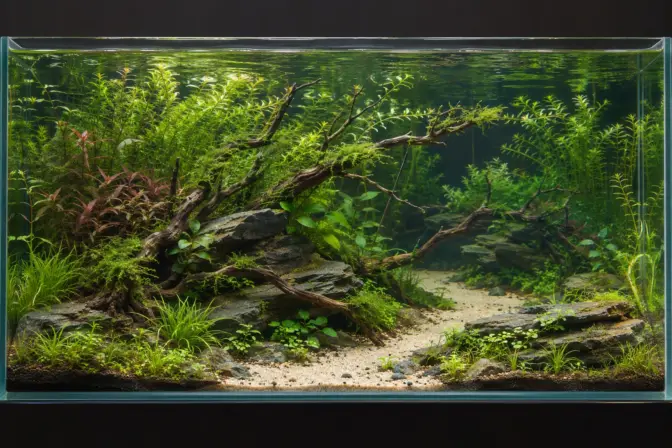
Aquascape illustration created with AI. Not a competition entry.