
Aquascaping Mistakes: Why a Layout Looks Wrong & How to Fix It
Introduction
Aquascaping mistakes are easier to fix when you name the problem precisely. “The aquarium looks wrong” gives you little direction. “The opening disappeared after the plants grew” suggests a very different response from “the main rock was never visible from the sofa.”
This guide deals with composition and layout problems: a flat appearance, weak hierarchy, clutter, mismatched scale and planting that undermines the original idea. It does not replace our beginner aquarium mistakes lesson, which covers broader setup and care issues.
Not every centered object, flat substrate or unusual material choice is a mistake. First decide what the aquarium is intended to do. Then change the smallest relevant part rather than rebuild the tank to satisfy a design rule.
What you’ll learn in this lesson
- How to distinguish a design problem from a preference or a husbandry issue.
- How to investigate ten common layout difficulties without assuming a single cause.
- Which adjustments are relatively easy to test and which require a planned rebuild.
- How to review the result without changing several variables at once.
Diagnose the problem before touching the aquarium
Write one sentence describing what you see and one sentence describing what you want instead. For example: “The two plant groups have grown together; I want to see the wood junction between them.” That is specific enough to test.
Take a reference photograph from the position where the problem matters. Compare with an earlier photograph if you have one. Was the feature never visible, or did it disappear as the tank developed?
If animals show distress, equipment is malfunctioning or a structure is unstable, address that issue before improving the composition. A design review is not the right response to an aquarium-health problem. Use the relevant care lessons, including fish stress signs, when needed.
| Type of issue | Start with | Avoid starting with |
|---|---|---|
| A change after plant growth | Compare the old and new outlines | Moving every rock |
| A weak focal area | Identify competing points of emphasis | Adding another prominent object |
| A blocked view | Check the actual viewing position | Judging only from above |
| Inaccessible maintenance areas | Map the required tool and equipment routes | Concealing the problem with more planting |
| An unsafe structure | Plan safe correction around the actual tank and inhabitants | Moving heavy load-bearing pieces casually in a stocked tank |
1. The aquascape looks flat
What to check: Are the main elements arranged in a row? Does the foreground hide everything behind it? Are the different plant masses merging into one continuous outline?
A flat appearance can come from several relationships, not just a level substrate. Try identifying a near form and a farther form in a front-view photograph. If they are impossible to distinguish, investigate their overlap, separation and visibility.
What to try: In an established aquarium, first check whether planting is closing a useful gap. In an unplanted arrangement, compare a modest repositioning of one group before adding more substrate. The depth and perspective lesson explains how to test the viewpoint and layers.
When it is not a mistake: A plant-focused or deliberately shallow composition may not aim to resemble a distant landscape. Judge it against that intention rather than demand dramatic forced perspective.
2. Nothing stands out—or everything does
What to check: Name the intended focal area. Then list the other features competing with it: a second peak, a vivid plant, exposed equipment, a bright patch of sand or an opening with a stronger outline.
Adding another “statement piece” can make this problem harder to diagnose. You may already have enough emphasis, distributed among too many unrelated places.
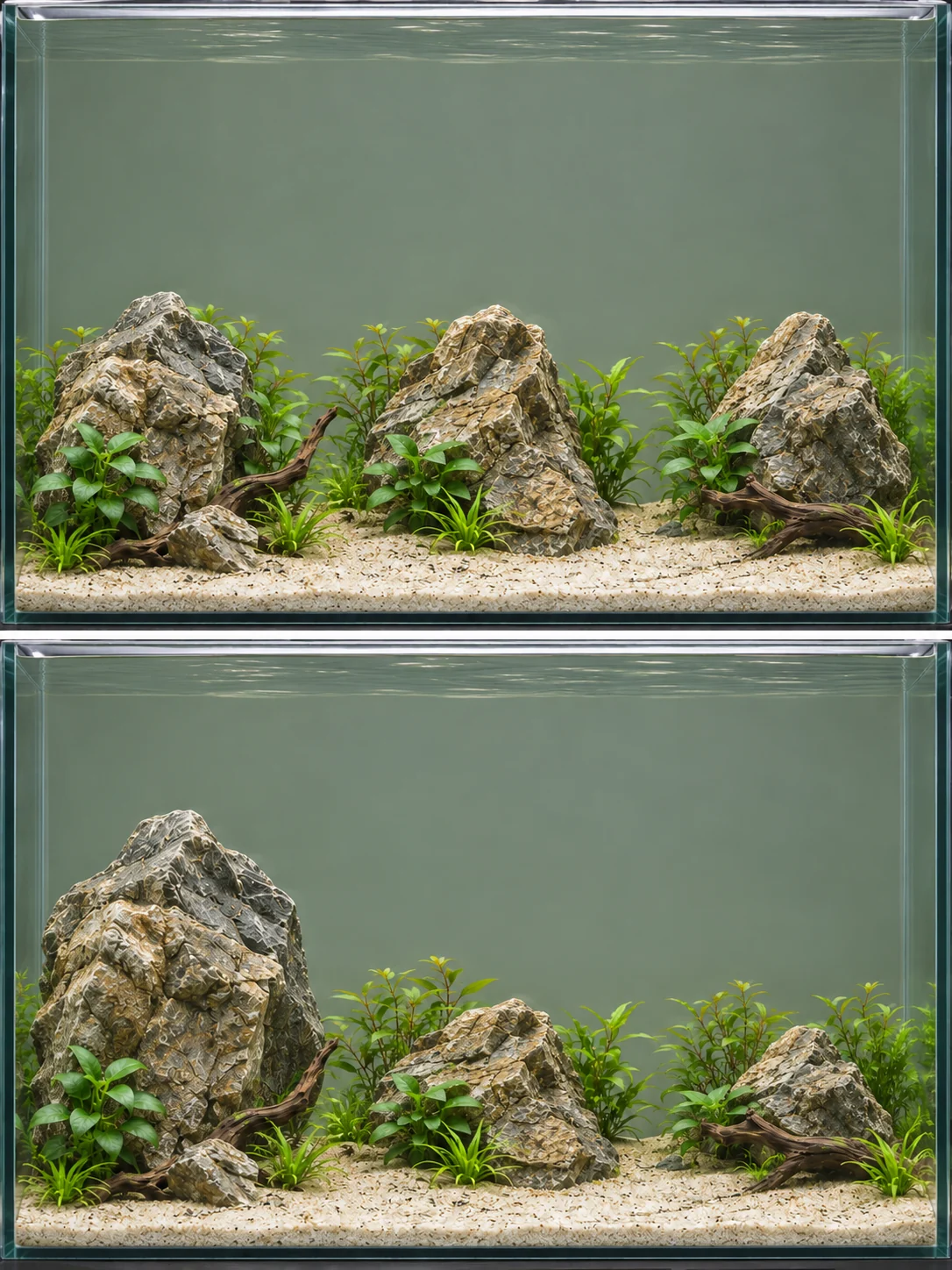
What to try: Compare the layout with one competing accent reduced or visually integrated into a larger group. During dry planning, remove a nonessential piece and photograph the result. In an established tank, consider a restrained planting adjustment before structural changes.
When it is not a mistake: A composition can support several areas of interest. The issue is whether they belong to a coherent arrangement, not whether there is exactly one object to look at. Use design principles to assess that hierarchy.
Use what you learn in My Aquariums
Follow a new aquarium through cycling or see how water readings and care change over time in an established setup.
3. The hardscape seems too small
What to check: Is the material itself too slight for its role, or has the planting hidden the part that originally gave it presence? Did you plan for a large visible structure or a mostly planted scene with subtle hardscape?
What to try: Compare an early photograph with the current outline. If the structure once read clearly, investigate the surrounding plant masses. If it never carried the intended composition, try a stronger grouping in a dry plan rather than scatter additional small pieces through the foreground.
When it is not a mistake: Some styles intentionally give plants more importance than the hardscape. Small exposed stones are not inherently inadequate; they may be doing exactly the supporting job you intended.
The hardscape guide is the place to assess materials and construction. Do not add heavy pieces to an established structure merely to satisfy a size impression.
4. The plants have swallowed the layout
What to check: Has an important branch junction disappeared? Have two groups merged across a planned gap? Did the original layout account for the established size of the planting?
What to try: Identify the one boundary that would restore the design most clearly. Use a plant-appropriate trim or thinning approach there, then review the effect before making further changes. Tropica’s trimming guidance distinguishes stems, rosettes, runners and rhizomes; the same cut is not appropriate for every growth form. [1]
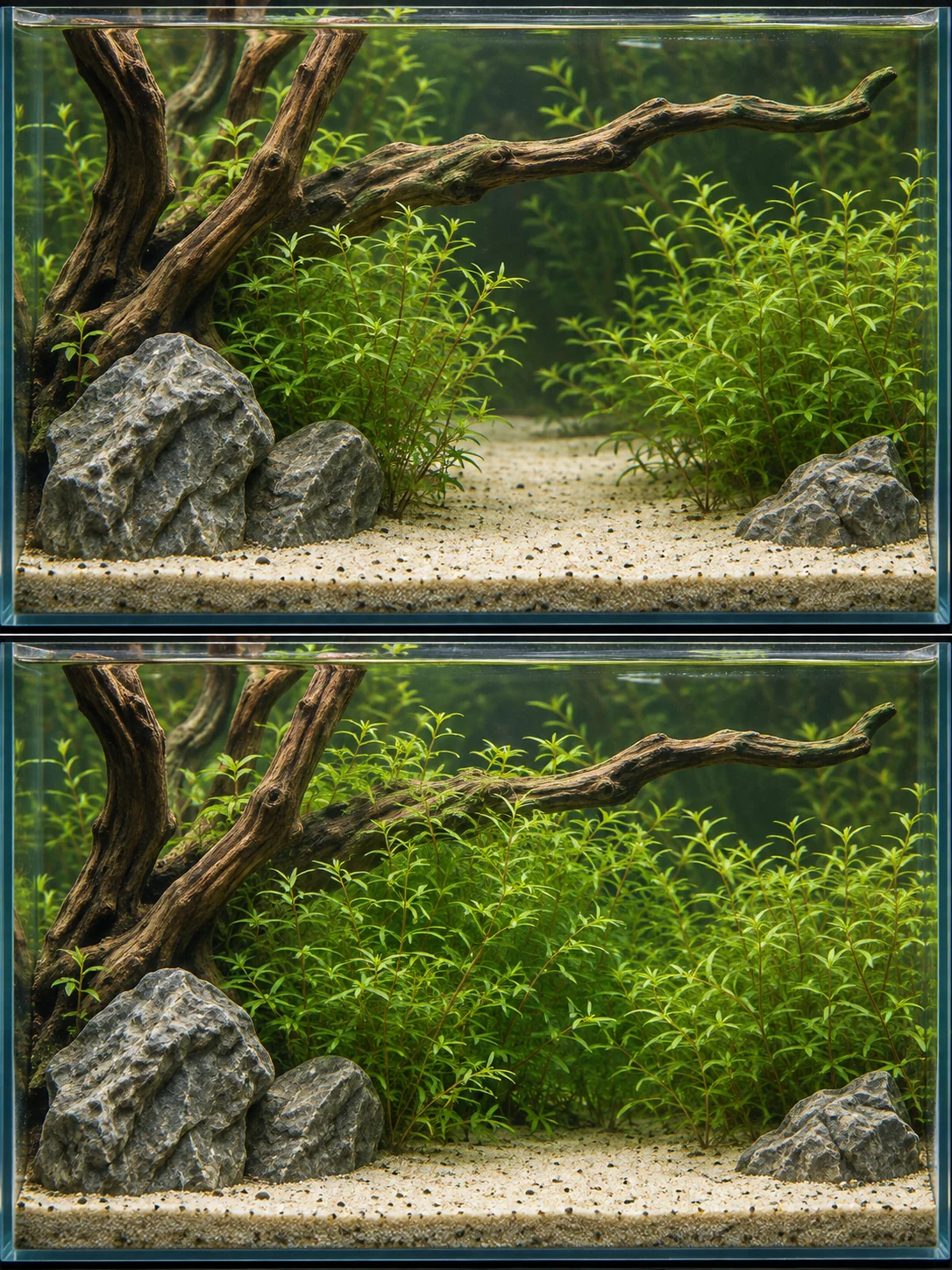
How to prevent a repeat: Draw or photograph the plant envelope you want to maintain. A design that depends on keeping a vigorous group permanently in an inaccessible sliver of space may need a different planting position or plant choice.
Use the midground plants guide when the missing transition between foreground and background is the main issue.
5. The sand path stops reading as a path
What to check: Is the route blocked in the front view, hidden under growth or divided into disconnected patches? Was it designed from above without checking the normal viewing height?
What to try: Compare the route in plan view and front view. Before changing its entire course, see whether a local plant boundary or one nonstructural obstruction is hiding the important bend. Make a physical change only when it is safe and practical for the established aquarium.
When it is not a mistake: A route may disappear partly behind a form intentionally. The design question is whether enough of it is visible to suggest continuation. A visible strip leading straight to the back glass is not automatically more convincing.
For substrate selection and separation, use the sand guide. For the visual route itself, use depth and perspective.
6. The aquarium feels cluttered
What to check: Does each small stone, branch and plant patch have a role, or were they added to fill leftover spaces? Is there an area where the eye can rest?
A layout can be densely planted without being visually incoherent. The issue may be the number of unrelated boundaries rather than the total amount of material.
What to try: During planning, group related elements and compare the result with a few unnecessary details removed. In an established aquarium, first investigate the shape and separation of plant groups rather than assume you must reduce the total planting dramatically.
When it is not a mistake: A deliberately exuberant plant garden may suit the brief. Do not force it into a minimalist stone composition because a photograph of a different style looks cleaner.
The styles guide helps separate these intentions. The nano aquascaping lesson applies the same question where the footprint leaves less room for competing ideas.
7. The scale looks inconsistent
What to check: Are you trying to create a miniature landscape? If so, do the leaf sizes, branch thicknesses and material textures support that interpretation together? A convincing rock arrangement can be undermined by a nearby feature that implies a very different scale.
ADA demonstrates a leaf-size gradient between plant groups as a depth device. That is one example of coordinated scale, not a universal requirement to arrange all plants from large leaves to small. [2]
What to try: Identify the element that contradicts the intended scene most strongly. Change that relationship in a sketch before replacing several species or rebuilding the structure. Consider whether a less literal planted composition would suit the actual materials better.
When it is not a mistake: An aquarium can present plants and wood at their actual scale. Not every layout needs to persuade the viewer that a small branch is a full-size forest tree.
8. The layout only works from the camera position
What to check: Does the foreground obscure everything when you sit down? Does a convincing miniature scene look awkward from the side where you normally enter the room?
A strongly directional perspective design may depend on a specific view. That is a choice, but it should be deliberate. A competition photograph and a home aquarium viewed from several positions can present different design priorities.
What to try: Choose the view that matters most and compare what you can see from each position. In a new build, test both the main and secondary views before fixing materials. In an established aquarium, start by checking whether plant outlines can improve the secondary view without disturbing the structure.
When it is not a mistake: A display intentionally designed for one frontal position can reasonably favor that view. The mistake is assuming it will work equally from every angle without checking.
9. A design rule is making the aquarium worse
What to check: Did you move an effective focal area just to put it on a thirds line? Have you labeled an asymmetrical arrangement “unbalanced” solely because the objects differ in size? Are you adding a slope because you have heard that flat substrate is always wrong?
What to try: Return to the design brief and compare the alternatives without the overlay. Explain what each version does for the main mass, the opening and the planting. Keep the version that serves those relationships.
A useful distinction: Mathematical constructions can be exact while their application remains optional. The thirds grid and golden-ratio grid have different positions, but neither selects the best rock for your aquarium or decides where a maintenance route belongs.
Use aquascaping design principles to understand the tools. Do not treat them as a checklist of compulsory visual features.
10. The layout cannot be maintained as designed
What to check: Can you reach the rear glass? Remove equipment for servicing? Trim the plant that borders the focal opening? Clean an open substrate area without dislodging its edge?
A layout that needs repeated dismantling for routine care has a practical design problem, even when it looks convincing in a photograph.
What to try: Identify the most important access route and test it during dry planning. For an established aquarium, decide whether a small planting change restores access or whether a properly planned partial rebuild is needed. Follow equipment and tank instructions; do not hide an intake or heater in a way that compromises its function.
How to prevent a repeat: Include equipment footprints and the required removal routes in the plan. The plant tools guide can help you think about reach, but a longer tool does not make every inaccessible arrangement sensible.
Distinguish design failure from plant-health trouble
A plant group can look poor because its conditions are unsuitable, not because it sits on the wrong compositional line. Do not solve unhealthy or unsuitable planting by repeatedly rearranging it for appearance alone.
Review plant requirements, lighting, carbon supply and care through the plant guide, lighting guide and CO₂ troubleshooting guide where relevant. The plant deficiency lesson provides a separate starting point for investigating symptoms.
Once you understand the care problem, reconsider the design. Replacing a demanding plant with an appropriate alternative can require a different group shape, but that is a more useful compromise than trying to maintain an unsuitable reference image indefinitely.
If the problem appears only in photographs, compare the real viewing position with the camera height, distance and reflections first. The photography guide can help separate an image problem from a layout change.
Use a repair sequence that gives you information
First, record the intended change. Write something testable: “make the rear opening visible from the sofa,” not “make the aquascape better.” Keep a reference photo.
Second, choose a low-disruption test. A planning sketch, temporary dry arrangement or a plant-appropriate boundary adjustment can tell you more than an immediate rebuild. Do not experiment with the stability of a loaded structure.
Third, change one main relationship. If you move materials, alter lighting and replace plants together, it becomes difficult to tell which change addressed the original design issue.
Fourth, check whether the change helped. Compare the same viewing position and look for the feature you intended to restore. Where growth is involved, watch how the plants respond rather than working to a fixed recovery date.
Finally, decide whether the brief needs to change. Sometimes the honest solution is a different layout or planting approach for the tank you have. That is a design decision, not a failure to follow enough rules.
Conclusion
Name what you want to improve, check the likely causes and start with the smallest safe adjustment. Consider the intended style and the aquarium’s health before calling a feature a mistake.
A useful correction restores a relationship—between masses, spaces, scale or access. It does not merely add another decorative object.
💬 Join the Conversation
Share one photograph and one specific question in the AquariumLesson Community. Mention whether the issue was present from the start or appeared after the plants grew; that context makes layout feedback much more useful.
Frequently asked questions
Why does my aquascape look flat even with a steep substrate slope?
The foreground may block the rear, the groups may merge into one outline or the intended route may be invisible from your viewing position. A slope addresses elevation; it does not automatically resolve every spatial relationship.
Is a centered rock a beginner mistake?
No. Central placement can be deliberate. Check whether the surrounding mass and open space support it before moving the rock to satisfy a rule.
Should I add more hardscape when the aquarium looks empty?
First decide whether the space is useful and whether the intended planting will occupy it. Additional materials are appropriate only when they solve a defined problem and remain safe and maintainable.
Do too many plant species always ruin an aquascape?
No. A varied plant garden can be coherent. Assess the groups, contrasts and maintenance rather than use a fixed species count as a quality test.
When does an aquascape need a complete rescape?
A complete rescape is one option when the fundamental structure, plant approach or access cannot meet the brief. Diagnose the issue first, and plan any major work around the animals, equipment and stability of the aquarium rather than treat a rebuild as a casual visual experiment.
Lesson completed!
You've finished Aquascaping Mistakes: Why a Layout Looks Wrong & How to Fix It. Continue learning or put this guidance into practice.
Continue learning →References
[1] Tropica Aquarium Plants — Trimming. Accessed November 2, 2026.
[2] Aqua Design Amano — Nature in the Glass: Fine Summer Breeze. Accessed November 2, 2026.
AI-generated comparison: loose foreground stones above, open sand below.