
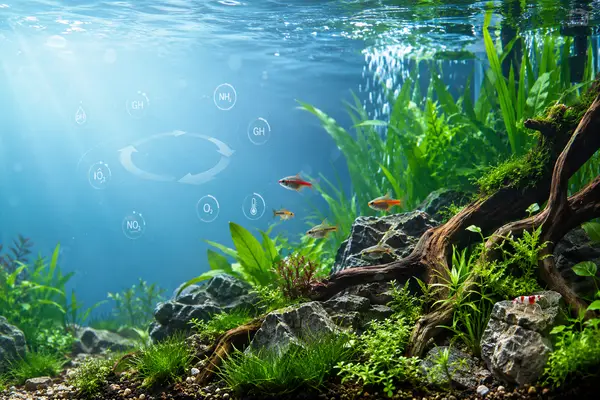
Aquarium Water Guide: Parameters, Cycling & Stability for Healthy Freshwater Tanks
Aquarium water is the foundation of every healthy freshwater tank. Clear water alone does not mean stable water. A tank can look clean while ammonia, nitrite, pH instability, low oxygen, or poor mineral balance quietly stress fish, shrimp, snails, and aquarium plants.
This guide explains how aquarium water actually works: cycling, biological filtration, ammonia, nitrite, nitrate, pH, KH, GH, oxygen, temperature, and water changes. It is designed as the central water hub for AquariumLesson — the place where beginners learn the system behind stable water, and where more advanced aquarists can connect water chemistry to plant growth, livestock health, algae prevention, and long-term aquascape performance.
If you only remember one principle, make it this: aquarium water stability matters more than chasing perfect numbers. Most freshwater fish, shrimp, snails, and plants can adapt to a reasonable range. They struggle when water changes suddenly, waste builds up, oxygen drops, or the biological filter is not ready.
That is why aquarium water should never be treated as an isolated topic. It connects directly to your filter, substrate, hardscape, CO₂ system, fertilizer routine, livestock choices, and maintenance rhythm. A beautiful aquascape is not held together by plants and rocks alone. It is held together by water stability.
What you’ll learn in this guide
- What aquarium water parameters actually mean
- How the nitrogen cycle converts ammonia into nitrite and nitrate
- Why ammonia and nitrite are dangerous in new aquariums
- How pH, KH, and GH affect freshwater stability
- Why oxygen and temperature influence water quality
- How planted tanks change nitrate and nutrient management
- How water changes reset stability without shocking livestock
- Which AquariumLesson tools and guides support better water planning
Essential Aquarium Water Parameters
Aquarium water quality is not one single number. It is a connected system. Ammonia, nitrite, nitrate, pH, KH, GH, oxygen, temperature, and dissolved organics all influence how safe and stable the aquarium feels to its inhabitants.
Many beginners focus only on pH because it is easy to test and appears on almost every water test kit. But pH is only one part of the picture. A tank with a “perfect” pH can still be dangerous if ammonia or nitrite is present. A tank with slightly unusual pH can still be healthy if it is stable, cycled, well-oxygenated, and matched to suitable livestock.
The most useful way to understand aquarium water is to separate the parameters into three groups: waste parameters, stability parameters, and environmental parameters.
- Waste parameters include ammonia, nitrite, and nitrate.
- Stability parameters include pH, KH, GH, and sometimes TDS.
- Environmental parameters include oxygen, temperature, flow, and dissolved organics.
Together, these values tell a story. A single test result is only a snapshot. A stable aquarium is built by recognizing patterns over time.
| Parameter | What It Tells You | Why It Matters | Main Action |
|---|---|---|---|
| Ammonia | Waste pressure and cycling status | Highly toxic, especially in unstable or high-pH water | Cycle tank, reduce feeding, improve filtration |
| Nitrite | Incomplete biological filtration | Toxic to fish and a warning sign in new tanks | Do water changes, protect livestock, continue cycling |
| Nitrate | End product of nitrification | Less urgent than ammonia or nitrite, but should not accumulate endlessly | Water changes, plants, stocking control |
| pH | Acidity or alkalinity | Affects livestock comfort and ammonia toxicity | Keep stable; avoid sudden corrections |
| KH | Carbonate buffering capacity | Helps stabilize pH | Adjust carefully if pH swings occur |
| GH | Calcium and magnesium level | Important for fish, shrimp, snails, and plants | Match to livestock and plant needs |
| Oxygen | Gas exchange and respiration support | Needed by fish, shrimp, and beneficial bacteria | Improve surface movement and circulation |
| Temperature | Metabolism and toxicity context | Affects oxygen demand and ammonia risk | Keep species-appropriate and stable |
Pick Your Aquarium Water Focus
Aquarium water is a broad topic, so it helps to divide it into clear learning modules. This pillar organizes water knowledge into five practical areas: cycling, water parameters, pH, KH/GH, and water changes.
Each area solves a different user intent. A beginner setting up a new tank needs cycling first. A hobbyist with stressed fish needs emergency water quality checks. A planted tank keeper may need to understand CO₂, pH, KH, nitrate, and nutrient balance. A shrimp keeper may care more about mineral stability and sudden parameter shifts.
- I am setting up a new tank → learn aquarium cycling and biological filtration first.
- My fish or shrimp look stressed → check ammonia, nitrite, oxygen, and temperature.
- My water test results confuse me → understand core water parameters before changing anything.
- My pH keeps moving → focus on KH, CO₂, and buffering stability.
- I want a stable maintenance routine → continue with the Aquarium Water Change Guide.
This structure also prevents a common beginner mistake: treating every water problem as a single isolated issue. Cloudy water, algae, plant melt, fish gasping, pH swings, and nitrate buildup often share the same underlying causes — immature filtration, too much waste, poor flow, low oxygen, or inconsistent maintenance.
Ready to set up your own tank?
Create a free account to save lessons, plan your setup, and use the Tank Hub to turn ideas into a real aquarium.
Choose Your Water Focus
Each module below leads to a complete in-depth guide. Start with the area you want to improve first.
Aquarium Cycling: The Biological Foundation
Aquarium cycling is the process of establishing biological filtration before the tank carries a full livestock load. In a new aquarium, fish waste, leftover food, dying plant matter, and organic debris can create ammonia. Beneficial microorganisms in the filter and on aquarium surfaces gradually convert ammonia into nitrite, then nitrite into nitrate.
This process is called nitrification. It is the reason a mature aquarium becomes much safer than a brand-new tank. The filter is not only a mechanical device that traps particles. It is also a biological habitat where beneficial organisms process dissolved waste.
That is why filter care matters so much. Replacing all filter media, rinsing biological media under untreated tap water, or cleaning too aggressively can weaken the very system that keeps ammonia and nitrite under control. For filter setup, media choice, and flow planning, continue with the Aquarium Filter Guide.
The basic nitrogen cycle
- Waste enters the system through fish respiration, fish waste, uneaten food, decaying plants, and organic debris.
- Ammonia appears as one of the first dangerous waste compounds in a new or overloaded tank.
- Ammonia-oxidizing microbes convert ammonia into nitrite.
- Nitrite-oxidizing microbes convert nitrite into nitrate.
- Nitrate is controlled through water changes, plant uptake, careful feeding, and reasonable stocking.
A cycled aquarium should normally show no measurable ammonia and no measurable nitrite with standard hobby test kits. Nitrate may be present, especially in stocked tanks, but it should remain controlled and predictable.
Why new tanks are unstable
New aquariums do not become stable because water has been sitting in the tank for a few days. They become stable when the filter, substrate, hardscape, glass, and plant surfaces develop enough biological activity to process waste. This takes time.
This is why adding many fish too early often creates trouble. The tank receives more waste than the young biological filter can process. Ammonia or nitrite may rise, livestock become stressed, and the aquarist reacts with emergency corrections. A slower setup is usually safer.
The same principle applies after major disruptions. A tank can become unstable after a filter has been switched off for too long, after a deep substrate disturbance, after medication, after sudden overfeeding, or after replacing too much filter media at once. A mature tank is resilient, but it is not indestructible.
Ammonia, Nitrite, and Nitrate Explained
Ammonia, nitrite, and nitrate are the three core nitrogen compounds every freshwater aquarist should understand. They are connected, but they do not mean the same thing. The mistake many beginners make is treating them as “bad water values” without understanding where they appear in the cycle.
Think of them as a sequence. Ammonia is the urgent waste signal. Nitrite is the incomplete-cycle signal. Nitrate is the accumulation signal. Each one asks for a different response.
Ammonia
Ammonia is one of the most urgent warning signs in an aquarium. It often appears in new tanks, overstocked tanks, tanks with dead organic material, or systems where filtration has been disrupted. Ammonia risk is not only about the test result itself. pH and temperature influence how dangerous ammonia becomes to aquatic life.
In practical aquarium care, measurable ammonia should be treated seriously. Immediate steps include reducing feeding, checking for dead livestock or rotting plant matter, improving oxygenation, testing nitrite, and performing controlled water changes when livestock are present.
Do not try to solve ammonia by adding more fish, changing many variables at once, or replacing the filter. The first goal is always to reduce waste pressure and protect the biological filter. The second goal is to understand why ammonia appeared in the first place.
Nitrite
Nitrite usually appears after ammonia begins to be processed, but before the second stage of nitrification is fully mature. It is especially common during cycling or after a biological filter disruption. Like ammonia, nitrite should normally read zero in a stable aquarium.
If nitrite appears in a stocked aquarium, treat it as a stress signal. Avoid adding new fish, reduce feeding, protect oxygen levels, and use water changes to reduce concentration while the biological filter catches up.
Nitrite is especially important because it can create serious stress before the tank looks visually dirty. You may not see a problem in the water clarity, but fish behavior can change quickly.
Nitrate
Nitrate is the final common product of aerobic nitrification. It is usually less immediately dangerous than ammonia or nitrite, but that does not mean it should be ignored. Rising nitrate often indicates that waste input is higher than export through plants, water changes, and maintenance.
Planted aquariums complicate nitrate advice because plants can use nitrogen as a nutrient. Some planted tanks intentionally maintain measurable nitrate for plant growth, while heavily stocked non-planted tanks may need stronger water-change discipline. This is why nitrate should be interpreted in context: livestock, plant mass, feeding level, fertilizer strategy, and water-change routine all matter.
For plant-focused nutrient planning, continue with Macronutrients for Aquarium Plants, Micronutrients for Aquarium Plants, and the Fertilizer Dosing Calculator.
Ammonia vs Nitrite vs Nitrate
| Compound | Typical Meaning | Risk Level | Best Response |
|---|---|---|---|
| Ammonia | Waste is not being processed safely | Very high | Reduce waste, water change, protect filter, improve oxygen |
| Nitrite | Cycle is incomplete or disrupted | High | Water change, reduce feeding, avoid new livestock |
| Nitrate | Waste is being processed but accumulating | Moderate, context-dependent | Water changes, plants, maintenance, stocking control |
pH in Freshwater Aquariums
pH measures how acidic or alkaline the water is. It matters because fish, shrimp, snails, plants, and beneficial bacteria all evolved within certain water conditions. But pH is often misunderstood. Most aquarium problems are not solved by forcing pH to a “perfect” number.
For many freshwater community tanks, a stable pH is more important than an exact target. Sudden pH changes can stress livestock more than a slightly different but stable value. The better question is not “How do I change my pH immediately?” but “Why is my pH unstable, and does my livestock actually require a different range?”
Aquarium pH should always be interpreted together with KH, CO₂, substrate, hardscape, water source, and livestock selection. A planted aquascape with active soil behaves differently from a hard-water livebearer tank. A blackwater-inspired aquarium behaves differently from a high-tech aquascape with pressurized CO₂.
Why pH changes
- KH level influences buffering capacity and pH stability.
- CO₂ injection can lower pH during the photoperiod in planted tanks.
- Active aquarium soil can reduce pH and KH, especially in shrimp or aquascaping setups.
- Rocks and substrate may raise hardness and alkalinity if they release minerals.
- Organic acids from wood, botanicals, or blackwater setups can soften the overall chemistry.
- Photosynthesis and respiration can create natural daily pH movement in planted systems.
If you run a planted tank with injected CO₂, pH should not be interpreted alone. It becomes part of the CO₂/KH relationship. For CO₂-specific setup guidance, read the Aquarium CO₂ System Guide and use the pH / CO₂ Calculator.
Stable pH beats perfect pH
One of the most common beginner mistakes is trying to “fix” pH too quickly. A hobbyist tests pH, sees a number that looks different from a care sheet, and immediately adds a pH-adjusting product. The number changes quickly, then drifts again. This creates repeated swings that stress livestock more than the original value.
Instead, build a baseline. Test your tap water after it has rested, test your aquarium, check KH, and observe whether pH is stable from week to week. If the tank is stable and the livestock are suitable for that range, correction may not be needed.
KH and GH: The Stability Minerals
KH and GH are two of the most important but most confusing water parameters for freshwater aquariums. They are often mentioned together, but they describe different things.
KH is mostly about buffering and pH stability. GH is mostly about minerals such as calcium and magnesium. Both influence the aquarium, but they do not solve the same problem.
KH: carbonate hardness
KH describes carbonate buffering capacity. In simple terms, it helps resist sudden pH movement. When KH is very low, pH can become easier to shift. When KH is higher, pH is usually more resistant to change.
This matters in planted tanks, shrimp tanks, and blackwater-inspired setups. Some aquariums intentionally run low KH, but low KH requires consistency and awareness. It is not automatically bad, but it leaves less room for uncontrolled swings.
In CO₂-injected aquariums, KH also helps interpret pH movement. A pH drop during CO₂ injection can be expected, but the meaning of that drop depends on the buffering context. This is one reason why planted tank keepers should not copy CO₂ bubble rates blindly from other tanks.
GH: general hardness
GH mainly reflects dissolved calcium and magnesium. These minerals matter for fish osmoregulation, shrimp molting, snail shell health, and plant growth. In a planted aquarium, magnesium and calcium are not decorative chemistry terms — they are part of the nutrient environment.
Different livestock prefer different hardness ranges. Soft-water species, hard-water livebearers, Caridina shrimp, Neocaridina shrimp, snails, and African cichlids do not all ask for the same mineral profile. Before changing GH, identify the needs of the animals you actually keep.
GH is also relevant when using reverse osmosis water. RO water can be useful for advanced setups, but it usually needs remineralization. Pure or extremely low-mineral water is not automatically better. It must be rebuilt to match the livestock and plants.
KH vs GH quick comparison
| Parameter | Main Meaning | Most Relevant For | Common Mistake |
|---|---|---|---|
| KH | Carbonate buffering | pH stability, CO₂ interpretation | Changing pH without understanding buffering |
| GH | Calcium and magnesium hardness | Fish, shrimp, snails, plants | Ignoring minerals because water looks clear |
Oxygen and Surface Movement
Oxygen is often invisible until something goes wrong. Fish gasping at the surface, shrimp gathering near flow, livestock becoming inactive, or sudden problems after lights-off can all point toward oxygen stress or poor gas exchange.
Beneficial bacteria also need oxygen. A strong biological filter is an aerobic system. If oxygen drops, the tank does not only become harder for fish — it can also become less efficient at processing waste.
Oxygen problems are especially likely when several stress factors combine: high temperature, heavy stocking, weak surface movement, dirty filter media, decaying organic material, bacterial blooms, or dense plant mass during the night.
How to improve oxygenation
- Increase surface movement without creating extreme turbulence.
- Keep filter flow from becoming blocked by debris.
- Avoid overstocking and overfeeding.
- Remove decaying plant matter before it breaks down.
- Be careful with high temperatures, because warmer water holds less oxygen.
- Use an air stone or stronger circulation during emergencies.
In aquascaped tanks, oxygen and flow planning should be considered together. Dense plants, hardscape walls, and carpeting layouts can create dead zones. Good water movement keeps oxygen, CO₂, heat, and nutrients distributed more evenly.
This is why filtration is not only about “how many liters per hour” the filter claims on the box. Real circulation inside the aquarium matters. Hardscape, plant mass, clogged media, lily pipe position, and surface agitation all affect how water actually moves.
Temperature and Water Quality
Temperature is usually discussed as a livestock comfort parameter, but it also affects water quality. Warmer water changes metabolism, oxygen demand, and ammonia risk. Fish and bacteria become more active within suitable ranges, but oxygen availability can become more limited as temperature rises.
This is why summer heat waves can expose weak systems. A tank that looked stable at a moderate temperature may become stressful when the room warms up, oxygen drops, feeding remains high, and biological demand increases.
A heater should keep temperature stable, not constantly swing between extremes. For better planning, match your heater size to real tank volume and room conditions. If you are still calculating tank size, start with the Aquarium Volume Calculator.
Water Changes: Reset Without Shock
Water changes are one of the most important aquarium maintenance habits. They dilute nitrate and dissolved waste, refresh minerals, remove accumulated organics, and help restore consistency. But water changes should be done with control, not panic.
The goal is not to create dramatic chemical swings. The goal is to replace part of the aquarium water with clean, temperature-matched, dechlorinated water that keeps the system within a stable range.
For the full routine, continue with the dedicated Aquarium Water Change Guide.
What water changes actually do
- They dilute nitrate and dissolved waste.
- They remove excess dissolved organics.
- They refresh mineral balance when using suitable tap or remineralized water.
- They reduce the concentration of some unwanted compounds.
- They help maintain predictable long-term water chemistry.
Water changes do not replace cycling. They support the system, but they do not create a mature biological filter by themselves. A tank with poor filtration and heavy waste input will still struggle even if water changes are frequent.
Common water change mistakes
- Changing too much too suddenly when pH, KH, GH, or temperature are very different.
- Forgetting dechlorinator when using treated tap water.
- Cleaning all filter media at once and weakening biological filtration.
- Only changing water when there is a crisis instead of keeping a routine.
- Using water changes to hide overfeeding rather than reducing the waste source.
- Matching volume but not temperature, creating avoidable livestock stress.
A good water-change routine should feel boring. It should be predictable, repeatable, and adjusted to your tank’s real conditions. Highly stocked tanks, messy feeders, new aquariums, and high-energy planted tanks often need more attention than lightly stocked low-tech setups.
Water Quality in Planted Aquariums
Planted aquariums add another layer to water quality. Plants can absorb nitrogen, compete with algae, release oxygen during photosynthesis, and stabilize the tank visually and biologically. But plants also need light, carbon, macro nutrients, micro nutrients, and flow.
A planted tank is not automatically low-maintenance. A bright aquascape with demanding plants can become less stable than a simple low-tech tank if CO₂, nutrients, and water changes do not match the light intensity.
The important principle is balance. Light increases plant demand. CO₂ supports carbon availability. Fertilizers supply nutrients. Filtration and flow distribute everything. Water changes reset accumulation. When one part is pushed harder than the others, instability appears.
For broader plant planning, use the Aquarium Plants Guide. For lighting balance, continue with the Aquarium Lighting Guide and the Aquarium Lighting Calculator.
Low-tech planted tanks
Low-tech planted tanks usually benefit from restrained light, stable water changes, slow-growing plants, and realistic expectations. Without injected CO₂, plant growth is slower. That is not a weakness. It can make the tank easier to manage if lighting and nutrients are kept in balance.
The danger in low-tech systems is usually overpowering the light. Strong light increases demand for CO₂ and nutrients. If those demands are not met, algae often appears before plants can respond.
High-tech planted tanks
High-tech aquariums with pressurized CO₂ can support stronger light, faster growth, carpeting plants, and more demanding aquascapes. But they also require more consistency. CO₂ should start before the light reaches full intensity, circulation should distribute it throughout the tank, and nutrients should not bottom out unexpectedly.
In high-energy systems, water quality problems often appear as plant symptoms: melting, stunting, algae on older leaves, weak carpets, or poor red coloration. These symptoms may look like plant-only issues, but the cause is often system balance.
Water Quality for Fish, Shrimp, and Snails
Different animals react differently to water conditions. Fish may tolerate a range of pH and hardness values if they are stable, but ammonia, nitrite, oxygen stress, and temperature swings can cause fast problems. Shrimp are often more sensitive to sudden changes in GH, KH, TDS, and pollutants. Snails need enough minerals to maintain healthy shells.
This is why stocking decisions should follow water reality. Do not choose livestock first and force the water later unless you are prepared to manage that chemistry long-term. In most cases, the safer path is to understand your tap water, then choose fish, shrimp, and plants that fit it.
For livestock planning, continue with the Aquarium Fish, Shrimp & Snails Guide.
Fish
Most community fish need stable, oxygen-rich, fully cycled water more than they need constant chemical adjustment. Before adding fish, confirm that ammonia and nitrite are not measurable and that temperature, pH, and hardness are suitable for the species you want to keep.
Shrimp
Shrimp are especially sensitive to sudden changes. For shrimp tanks, GH, KH, temperature, copper exposure, and acclimation matter greatly. Neocaridina shrimp are generally more forgiving than many Caridina setups, but both benefit from stable mineral balance and clean water.
Snails
Snails need minerals for shell growth. Very soft or unstable water can lead to shell erosion, poor growth, and long-term weakness. If you keep snails, do not focus only on nitrate and pH. GH, KH, and calcium availability also matter.
Tap Water, RO Water, and Remineralization
Your source water determines the starting point for every aquarium. Some aquarists have soft tap water. Others have hard alkaline water. Some tap water contains nitrate or phosphate. Some water is excellent for community fish but less ideal for specialized shrimp or blackwater setups.
Before changing anything, test your source water. Let a sample sit for several hours, then measure pH, KH, GH, and nitrate. This gives you a more realistic baseline than testing only the aquarium after substrate, rocks, plants, livestock, and fertilizers have already influenced the water.
When tap water works well
Tap water is often the simplest and most stable choice if it matches your livestock. Many beginner community aquariums, planted tanks, and Neocaridina shrimp tanks can work well with conditioned tap water when parameters are consistent and appropriate.
When RO water makes sense
Reverse osmosis water can be useful when tap water is too hard, too variable, or unsuitable for specialized livestock. However, RO water is not “better” by default. It removes many dissolved minerals, so it usually needs remineralization before use.
RO water is especially common in advanced shrimp keeping, soft-water aquascapes, and setups where the aquarist wants precise control. It requires discipline. You must rebuild GH and sometimes KH intentionally, not randomly.
Beginner Aquarium Water Routine
A beginner routine should be simple, repeatable, and focused on the parameters that actually prevent disaster. You do not need to test everything every day forever. But in the first weeks, you should understand what is happening.
During cycling
- Test ammonia and nitrite regularly.
- Do not add a full livestock load immediately.
- Keep the filter running continuously.
- Avoid replacing all filter media.
- Feed very carefully if livestock are already present.
- Watch behavior, not only test numbers.
- Record test results so you can see patterns.
After the tank is stable
- Test nitrate, pH, KH, and GH when building your baseline.
- Perform regular water changes based on stocking, feeding, and plant mass.
- Watch livestock behavior, not only test numbers.
- Clean mechanical filter media without destroying biological media.
- Adjust slowly when changing water chemistry.
- Check source water occasionally if your tap water changes seasonally.
If you are still planning tank size or water volume, start with the Aquarium Volume Calculator. Real volume affects dosing, water changes, stocking, temperature stability, and emergency decisions.
How to Read Aquarium Test Results
Test kits are helpful, but they can also create confusion if you treat every number as an emergency. The goal of testing is not to panic. The goal is to understand the direction of the tank.
A single nitrate result means less than a trend. A single pH result means less than whether pH changes suddenly. A single GH result means less than whether your livestock are suited to that mineral profile. Testing is most powerful when it is connected to observation.
Useful testing workflow
- Test your tap water baseline.
- Test the aquarium during cycling.
- Record ammonia, nitrite, nitrate, pH, KH, GH, and temperature.
- Compare numbers with livestock behavior.
- Retest after major changes such as new livestock, filter cleaning, substrate changes, or heavy pruning.
- Adjust slowly and avoid changing multiple variables at once.
In a stable aquarium, testing can become less frequent. But after problems, new livestock, medication, unexplained algae, or sudden fish stress, testing should become more focused again.
Troubleshooting Aquarium Water Problems
When something looks wrong, do not guess from appearance alone. Cloudy water, algae, surface film, bad smell, fish gasping, or plant melt can have different causes. Start with the basics: ammonia, nitrite, nitrate, pH, temperature, oxygen, filter flow, and recent changes.
The best troubleshooting question is: What changed recently? New livestock, more food, a dead fish, deep filter cleaning, new substrate, new rocks, CO₂ adjustment, light schedule changes, medication, or a missed water change can all shift the system.
| Problem | Possible Water Cause | First Check |
|---|---|---|
| Fish gasping at surface | Low oxygen, ammonia, nitrite, high temperature | Oxygen, ammonia, nitrite, filter flow |
| Cloudy water | Bacterial bloom, disturbed substrate, overfeeding | Ammonia, nitrite, recent setup changes |
| Bad smell | Organic decay, dead livestock, poor flow | Dead zones, filter, substrate, ammonia |
| pH swings | Low KH, CO₂ changes, active soil | KH, CO₂ timing, water source |
| Plant melt | Transition stress, unstable CO₂, nutrient imbalance | CO₂, light, nitrate, potassium, micros |
| Algae outbreak | Excess light, waste, unstable CO₂, low plant mass | Light duration, nitrate, CO₂, maintenance |
| Shrimp deaths | Sudden parameter shift, copper, ammonia, unstable GH/KH | Ammonia, nitrite, GH, KH, recent changes |
| Snail shell erosion | Low minerals, acidic water, poor calcium availability | GH, KH, pH, diet |
Good troubleshooting is systematic. Test first, identify the likely cause, then correct slowly. Fast chemical corrections often create a second problem before the first one is solved.
Common Aquarium Water Mistakes
Most water problems are not caused by one dramatic event. They build slowly from small repeated mistakes. The good news is that the same patterns are easy to prevent once you recognize them.
- Adding fish before the tank is cycled creates ammonia and nitrite risk.
- Overfeeding adds waste faster than the system can process it.
- Cleaning filter media too aggressively weakens biological filtration.
- Chasing pH creates instability instead of solving the cause.
- Ignoring KH and GH makes pH and mineral issues harder to understand.
- Running too much light increases plant demand and algae risk.
- Skipping water changes allows nitrate and dissolved organics to accumulate.
- Using regular furniture for heavy tanks creates safety risks if water volume and total weight are underestimated.
For structural planning, use the Aquarium Stand Guide. For technical setup planning, use the Aquarium Equipment Guide.
Quick Aquarium Water Checklist
Use this checklist whenever you set up a new aquarium, troubleshoot a problem, or prepare for livestock.
- Is the aquarium fully cycled?
- Are ammonia and nitrite at zero?
- Is nitrate controlled and predictable?
- Is the pH stable from week to week?
- Do KH and GH match your livestock?
- Is the temperature stable?
- Is there enough surface movement and oxygen?
- Is the filter running continuously?
- Are water changes consistent?
- Does your source water match the aquarium plan?
If the answer to several of these questions is unclear, slow down before adding more livestock. Stability first, expansion second.
Quick Takeaways
- Clear water is not the same as healthy water.
- Ammonia and nitrite should normally be zero in a mature aquarium.
- Nitrate is less urgent but still needs long-term control.
- pH should be stable before it is “perfect.”
- KH stabilizes pH; GH supplies important minerals.
- Oxygen supports fish, shrimp, snails, and beneficial bacteria.
- Water changes work best as routine maintenance, not emergency panic.
- Planted tanks connect water quality to light, CO₂, and nutrients.
- Source water determines your starting point.
- The best aquariums are managed through patterns, not isolated test results.
Conclusion
Aquarium water is the invisible system behind every successful tank. Lighting, plants, fish, shrimp, hardscape, and equipment all depend on it. When water is stable, the aquarium becomes easier to manage. When water is unstable, even expensive equipment and beautiful aquascaping cannot prevent long-term problems.
The best approach is not to chase isolated numbers. Build a cycled filter, keep ammonia and nitrite under control, understand nitrate, maintain stable pH, respect KH and GH, protect oxygen, and use water changes as a steady reset mechanism.
From here, continue with the Aquarium Water Change Guide, check your real tank volume with the Aquarium Volume Calculator, and use the pH / CO₂ Calculator if you run a planted tank with CO₂.
Next step:
Test your aquarium water, write down ammonia, nitrite, nitrate, pH, KH, GH, and temperature, then compare the numbers with your livestock behavior. Stable aquariums are built from patterns — not from one isolated test result.
💬 Join the Conversation
Tag us on Instagram @AquariumLesson — we’d love to see your freshwater setups, planted tanks, and water-testing routines.
👉 Which water parameter confused you most when you started: pH, KH, GH, ammonia, nitrite, or nitrate?
FAQ
What are the most important aquarium water parameters?
The most important aquarium water parameters are ammonia, nitrite, nitrate, pH, KH, GH, oxygen, and temperature. In new tanks, ammonia and nitrite are the most urgent. In mature tanks, nitrate control, pH stability, mineral balance, and oxygen are key long-term factors.
Does clear aquarium water mean the tank is healthy?
No. Clear water can still contain ammonia, nitrite, high nitrate, low oxygen, or unstable pH. Always test water during cycling, after problems, after livestock loss, or when fish and shrimp behave unusually.
What should ammonia be in an aquarium?
In a mature freshwater aquarium, ammonia should normally test at zero with standard hobby test kits. Any measurable ammonia in a stocked tank should be treated as a warning sign.
What should nitrite be in an aquarium?
Nitrite should normally be zero in a cycled aquarium. Measurable nitrite often means the biological filter is not fully established or has been disrupted.
Is nitrate always bad in a planted aquarium?
No. Nitrate is a plant nutrient and may be intentionally present in planted aquariums. The goal is not always absolute zero. The goal is a stable level that supports plants without allowing waste to accumulate uncontrollably.
Should I change pH quickly if it is not ideal?
Usually no. Stability is more important than sudden correction. Before changing pH, check KH, livestock requirements, CO₂ use, substrate type, and your tap water baseline.
What is the difference between KH and GH?
KH is carbonate hardness and helps buffer pH. GH is general hardness and mainly reflects calcium and magnesium. KH is closely tied to pH stability, while GH is important for fish, shrimp, snails, and plant mineral needs.
How often should I change aquarium water?
It depends on tank size, stocking, feeding, plant mass, nitrate level, and water chemistry. Many freshwater tanks benefit from a regular weekly or biweekly routine, but the best schedule should be based on test results and livestock behavior.
Can I use tap water for my aquarium?
Yes, many freshwater aquariums can run well on conditioned tap water if the parameters are stable and suitable for the livestock. Always use dechlorinator when needed and test your source water so you understand its pH, KH, GH, and nitrate baseline.
Do planted tanks need different water parameters?
Planted tanks need stable water, available nutrients, suitable light, and enough carbon. They do not all need the same pH or hardness, but plant growth depends strongly on balance between light, CO₂, nutrients, flow, and maintenance.
Start building your aquarium with the Tank Hub
Save your favorite lessons, organize your setup, and track your aquarium step by step in your personal Tank Hub.
New to AquariumLesson? Start with our complete Aquarium Lessons Hub or return to the homepage at AquariumLesson.com.
References
- U.S. Environmental Protection Agency. Aquatic Life Criteria – Ammonia.
- U.S. Environmental Protection Agency. National Recommended Aquatic Life Criteria Table.
- FAO. Environment and Fish Health: Water Quality for Aquaculture.
- McKnight et al. Microbial Community Succession of Home Aquarium Biofilters.
- AquariumLesson. Aquarium Water Change Guide.