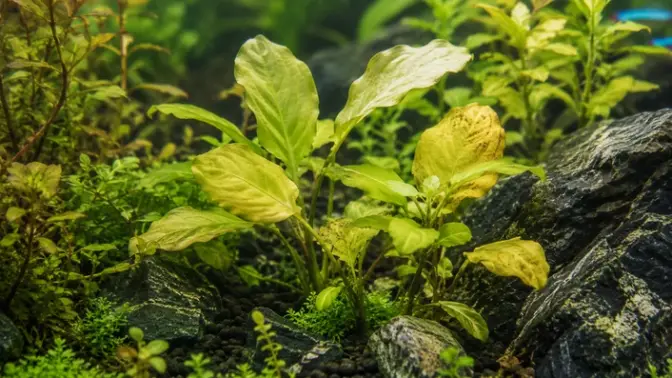
Nitrogen Deficiency in Aquarium Plants: Symptoms & Fixes
Introduction
Nitrogen deficiency in aquarium plants is one of the most common nutrient problems in planted tanks. It often shows up as older leaves turning yellow, pale, transparent, weak, or slowly dying while the plant struggles to produce strong new growth.
This can be confusing because many aquarists are taught that nitrate is always bad. In fish-only aquariums, high nitrate is usually treated as a waste-control issue. In planted aquariums, nitrate is also a plant nutrient. If a tank has strong plant growth, bright lighting, low fish load, large water changes, or many fast-growing plants, available nitrogen can become too low for healthy growth.
Nitrogen deficiency does not mean you should randomly dump fertilizer into the aquarium. It means you should read the symptoms, test nitrate carefully, compare nitrogen with other possible deficiencies, and adjust fertilization in a controlled way. The goal is stable plant growth, not extreme nutrient levels.
This guide explains how to recognize aquarium plant nitrogen deficiency, how it differs from iron, potassium and phosphate problems, why nitrate can become too low, how to fix it safely, and how to prevent it from returning. For the broader nutrient system, read Macronutrients for Aquarium Plants. For trace nutrients and iron, use Micronutrients for Aquarium Plants.
Quick answer: Nitrogen deficiency usually affects older leaves first. They may turn yellow, pale, translucent, weak, or slowly die back. Growth becomes smaller and slower. In planted tanks, the fix is usually stable nitrate availability through balanced fertilization, feeding/stocking review, and consistent maintenance.
What You’ll Learn in This Lesson
- What nitrogen does for aquarium plants
- How nitrogen deficiency looks in planted tanks
- Why older leaves often show symptoms first
- How to tell nitrogen deficiency apart from iron, potassium and phosphate issues
- Why nitrate can become too low in aquariums
- How to test nitrate without misreading the problem
- How to fix nitrogen deficiency safely
- How to prevent yellow leaves, weak growth and recurring nutrient gaps
What Nitrogen Does for Aquarium Plants
Nitrogen is a macronutrient. That means plants need it in relatively large amounts compared with trace elements. In planted aquariums, nitrogen is usually discussed as nitrate, because nitrate is one of the main nitrogen forms measured and managed by aquarists.
Aquarium plants use nitrogen for new growth, leaf development, proteins, enzymes, chlorophyll production and overall plant metabolism. Without enough nitrogen, the plant cannot build healthy tissue efficiently. Growth slows, leaves weaken, and the plant may begin moving stored nitrogen from older leaves to support new growth.
This is why nitrogen deficiency often appears first in older leaves. Nitrogen is mobile inside the plant. When the plant does not receive enough nitrogen from the aquarium, it can relocate nitrogen from older growth into newer growth. The older leaves then become pale, yellow, translucent or damaged.
In planted tanks, nitrogen balance depends on several inputs and outputs:
- Fish food and livestock waste add nitrogen to the system.
- Biological filtration converts ammonia and nitrite into nitrate.
- Plants consume nitrogen as they grow.
- Water changes remove nitrate and other dissolved nutrients.
- Fertilizers can add nitrate or other nitrogen forms.
- Fast-growing plants can consume nitrogen quickly.
A nitrogen deficiency usually happens when plant demand is higher than nitrogen supply.
Nitrogen Deficiency Symptoms in Aquarium Plants
Nitrogen deficiency can look slightly different depending on plant species, light level and tank conditions. But the classic pattern is older leaves yellowing or becoming pale first while new growth becomes smaller, slower or weaker.
Because nitrogen is mobile, the plant sacrifices old growth to keep new growth alive. This helps separate nitrogen deficiency from some micronutrient problems, which often appear more clearly in new growth first.
| Symptom | What It May Look Like | Why It Matters |
|---|---|---|
| Older leaves turn yellow | Lower or older leaves lose green color | Classic nitrogen deficiency sign |
| Leaves become translucent | Old leaves look thin, weak or glassy | Plant tissue is breaking down |
| Slow new growth | Plants produce fewer or smaller leaves | Nitrogen is needed for active growth |
| Stunted tips | Stem plants stop pushing strong tops | Growth energy is limited |
| Premature leaf loss | Older leaves detach or decay | The plant is abandoning old growth |
| Some plants become redder | Green plants show stronger red or orange tones | Can happen under nitrogen limitation, but is not always healthy |
| Algae appears with weak growth | Hair, fuzz or filamentous algae may increase | Plant growth is no longer competing well |
One yellow leaf does not automatically mean nitrogen deficiency. Old leaves naturally age. The stronger warning sign is a pattern: multiple older leaves yellowing, slower new growth, and nitrate readings that are consistently too low for the plant load and light level.
Which Leaves Show Nitrogen Deficiency First?
Nitrogen deficiency usually appears first in older leaves. This is one of the most useful diagnostic clues. If the newest leaves are yellow while old leaves look normal, nitrogen is not the first deficiency to suspect. Iron or other micronutrient issues may be more likely in that case.
In stem plants, nitrogen deficiency may show as yellowing lower leaves, weak lower sections, smaller tops and slower vertical growth. In rosette plants, older outer leaves may yellow first. In epiphytes such as Anubias, Java Fern or Bucephalandra, older leaves may fade slowly, but symptoms can be harder to read because these plants naturally grow slowly.
| Plant Type | Common Nitrogen Deficiency Pattern | Diagnostic Note |
|---|---|---|
| Stem plants | Older lower leaves yellow, tops become smaller | Often easiest plants for spotting nutrient trends |
| Carpeting plants | Patchy growth, pale old leaves, poor spreading | Can be confused with weak light or CO₂ issues |
| Rosette plants | Outer leaves yellow or deteriorate | Root nutrition and substrate should also be checked |
| Epiphytes | Old leaves fade slowly or become weak | Algae and low light can mimic deficiency |
| Floating plants | Pale leaves, small new leaves, weak spreading | Floaters can reveal water-column nutrient shortages quickly |
Always compare old growth and new growth. That comparison is more useful than looking at one leaf in isolation.
Nitrogen Deficiency vs Other Plant Problems
Aquarium plant symptoms overlap. Yellow leaves can come from nitrogen deficiency, iron deficiency, potassium deficiency, poor lighting, CO₂ instability, old age, melting, root damage or algae pressure. The best diagnosis comes from combining leaf position, tank history, nitrate testing and growth behavior.
Nitrogen deficiency is most likely when older leaves yellow first and overall growth slows. Iron deficiency is more likely when new leaves turn pale while older leaves remain greener. Potassium problems often show holes or edge damage. Phosphate deficiency may show slow growth, darkening, weak roots or poor recovery, but it can be harder to identify visually.
| Problem | Typical Leaf Pattern | How It Differs From Nitrogen Deficiency |
|---|---|---|
| Nitrogen deficiency | Older leaves yellow first, growth slows | Mobile nutrient; old growth often suffers first |
| Iron deficiency | New leaves become pale or yellow | Newest growth is usually more affected |
| Potassium deficiency | Pinholes, edge damage, weak older leaves | Damage and holes are more typical than simple yellowing |
| Phosphate deficiency | Slow growth, poor recovery, darker or stressed leaves | Often less visually obvious and easy to confuse |
| Low light | Weak, leggy or melting growth in shaded areas | Symptoms follow light zones, not only old leaves |
| CO₂ instability | Algae, melting, poor high-light growth | Often worst in high-energy tanks |
| Natural aging | Only a few old leaves decline | New growth remains strong and nitrate may be stable |
If you are unsure, do not correct every nutrient at once. Change one clear variable, observe new growth, and keep maintenance stable.
Why Nitrogen Deficiency Happens in Planted Aquariums
Nitrogen deficiency is common in planted aquariums that have more plant demand than nitrogen supply. This can happen even when the aquarium looks clean and healthy.
Many beginners assume nitrate only comes from fish waste, but planted tanks can consume nitrate quickly. In a heavily planted aquarium with strong lighting, floating plants, fast stems, carpets or CO₂ injection, plants can use available nitrate faster than the tank naturally produces it.
Common causes include:
- Very low fish load in a heavily planted tank
- Many fast-growing stem plants or floating plants
- Strong lighting that increases plant demand
- CO₂ injection that accelerates growth
- Large or frequent water changes with very low-nitrate water
- Using only micronutrient fertilizer without nitrogen
- Trying to keep nitrate at zero to prevent algae
- New aquascapes with lots of plants but little livestock
- Very clean shrimp tanks with low feeding and low waste
- Dense plant mass after weeks of strong growth
The irony is that nitrogen deficiency can appear in tanks that look “too clean.” A planted aquarium does not need dirty water, but plants do need available macronutrients.
Can Nitrate Be Too Low in a Planted Tank?
Yes. In a planted aquarium, nitrate can be too low for the plant mass and light level. This does not mean high nitrate is good. It means zero nitrate is not automatically the goal in a planted tank.
The right nitrate level depends on the aquarium style. A low-light, lightly planted tank needs less nitrogen than a high-light aquascape with CO₂ and dense stems. A shrimp tank may need cautious dosing. A high-energy aquascape may need regular nitrate fertilization to avoid stalling plant growth.
| Tank Type | Nitrogen Risk | Practical Note |
|---|---|---|
| Low-light beginner tank | Usually lower demand | Nitrogen deficiency is possible but less aggressive |
| High-light planted tank | Higher demand | Low nitrate can quickly limit growth |
| CO₂ aquascape | High demand | Balanced macronutrient dosing is important |
| Shrimp tank | Often low natural nitrogen | Dose cautiously and avoid sudden changes |
| Floating plant-heavy tank | Can consume nitrate fast | Floaters may become pale when nitrogen runs low |
| Fish-heavy tank | May produce enough or too much nitrate | Check against plant growth and water quality |
If your issue is the opposite and nitrate is too high, use the High Nitrate Aquarium guide. Nitrogen management is about balance, not always raising or always lowering nitrate.
How to Test for Nitrogen Deficiency
Testing nitrate is useful, but test results must be interpreted carefully. A nitrate test tells you what is present in the water at the time of testing. It does not show how quickly plants consume nitrate between tests or whether other nutrients are also limiting growth.
If nitrate repeatedly reads zero or very low in a planted tank with strong lighting and visible deficiency symptoms, nitrogen deficiency becomes more likely. If nitrate is measurable but plants still struggle, the problem may be light, CO₂, potassium, phosphate, micronutrients, substrate nutrition or general instability.
Testing Checklist
- Test nitrate before a water change.
- Test again after dosing if you use fertilizer.
- Shake liquid nitrate test bottles exactly as instructed.
- Compare results across several days, not one reading only.
- Check whether nitrate drops quickly after plant growth increases.
- Look at plant symptoms and new growth, not only the number.
- Review light, CO₂ and fertilization together.
Do not diagnose nitrogen deficiency from nitrate alone. Use nitrate testing as one clue inside the full plant-growth picture.
How to Fix Nitrogen Deficiency in Aquarium Plants
The safest way to fix nitrogen deficiency is to restore stable nitrogen availability without shocking the aquarium. That usually means using a complete planted tank fertilizer or a nitrate-containing macronutrient fertilizer, then observing new growth over time.
Old damaged leaves usually do not turn perfect again. The real sign of recovery is healthier new growth, stronger leaf size, better plant color and fewer old leaves declining prematurely.
Step-by-Step Fix
- Confirm symptoms are strongest on older leaves.
- Test nitrate carefully and record the result.
- Check whether your fertilizer actually contains nitrogen.
- Start with a conservative nitrate-containing fertilizer dose.
- Keep lighting stable while correcting the deficiency.
- Do not increase light at the same time.
- Remove heavily decaying leaves so they do not pollute the tank.
- Retest and observe new growth after several days to weeks.
- Adjust dosing gradually based on plant response and nitrate readings.
If you are calculating fertilizer additions, use the Fertilizer Dosing Calculator as a controlled planning tool instead of guessing.
Should You Add More Fish Instead of Fertilizer?
Adding more fish is not the best way to fix nitrogen deficiency. Fish food and waste do add nitrogen, but they also increase bioload, oxygen demand, waste production and maintenance needs. Stocking should be based on animal welfare and tank capacity, not only plant fertilizer needs.
In a lightly stocked planted tank, it is usually cleaner and more controllable to fertilize plants directly. That way, you can adjust nutrients without forcing the aquarium to carry more livestock than it should.
| Approach | Advantage | Risk |
|---|---|---|
| Adding fertilizer | Precise and adjustable nutrient control | Requires careful dosing and observation |
| Adding more fish | Increases natural nutrient input | Can overload tank or create welfare issues |
| Feeding more | Raises nutrient input quickly | Can cause waste, algae and water quality problems |
| Reducing plant mass | Lowers nutrient demand | May weaken aquascape function and stability |
| Reducing light | Lowers nutrient demand | May slow plant growth if overdone |
Fertilizer is usually the most controlled solution. Stocking changes should be made for livestock goals, not as a nutrient shortcut.
Nitrogen Deficiency in Low-Tech Aquariums
Low-tech aquariums can still develop nitrogen deficiency, especially if they are heavily planted, lightly stocked or filled with fast-growing floating plants. However, the correction should be moderate because low-tech tanks have slower plant demand than high-energy CO₂ aquascapes.
In low-tech tanks, avoid dramatic dosing changes. Plants respond more slowly, and excess nutrients combined with inconsistent maintenance can create algae problems. The goal is steady availability, not aggressive dosing.
- Use moderate light rather than excessive light.
- Choose low-demand plants if you do not want regular dosing.
- Use complete liquid fertilizer if plants show deficiency signs.
- Watch floating plants because they can consume nitrate quickly.
- Keep water changes consistent but not extreme.
- Do not chase zero nitrate as a planted tank goal.
For system planning, read the Aquarium Plant Light Requirements guide and compare nutrient demand with your lighting level.
Nitrogen Deficiency in High-Tech Aquascapes
High-tech planted tanks have stronger nutrient demand because light and CO₂ push plants to grow faster. In these aquariums, nitrogen deficiency can appear quickly when nitrate dosing falls behind plant uptake.
Dense stem plants, carpeting plants, red plants and fast floating plants can consume nutrients rapidly. If nitrogen becomes limiting, growth may stall even though light and CO₂ are strong. That stalled growth can then make algae more likely.
- Keep nitrate measurable and stable for your chosen dosing method.
- Do not run strong light with inconsistent macronutrients.
- Watch fast stems and carpets for early warning signs.
- Trim and replant healthy tops to maintain active growth.
- Coordinate nitrogen with phosphate, potassium, micros and CO₂.
- Use PAR knowledge to avoid overpowering the system.
For light balance, use Aquarium PAR Explained and Aquarium Lighting and Algae.
Can Nitrogen Deficiency Cause Algae?
Nitrogen deficiency can contribute to algae indirectly. The problem is not that low nitrate feeds algae. The problem is that nitrogen-limited plants stop growing well. When plant growth stalls, the aquarium loses one of its strongest defenses against algae.
In high-light tanks, weak plant growth can quickly lead to imbalance. Algae may take advantage of light, organic waste and unstable conditions while plants are unable to compete effectively.
This is why “starving algae” by starving plants often backfires. Healthy plant growth is usually a better long-term algae-control strategy than pushing nutrients to zero.
- Do not keep nitrate at zero in a planted tank just to fight algae.
- Reduce excessive light if nutrients and CO₂ are not stable.
- Remove decaying leaves quickly.
- Keep plant growth active and predictable.
- Use water changes to remove waste, not to starve plants.
- Fix the underlying imbalance rather than only removing algae manually.
If algae is already present, use Aquarium Lighting and Algae to diagnose whether light demand is exceeding plant growth capacity.
Nitrogen Deficiency vs High Nitrate: Finding the Balance
Nitrogen management has two opposite problems. Too little available nitrogen can limit plant growth. Too much nitrate can indicate excessive waste, overfeeding, poor maintenance or too much bioload for the system.
The solution is not to label nitrate as always good or always bad. In planted aquariums, nitrate is both a nutrient and a water-quality signal. Context matters.
| Situation | Likely Meaning | Best Response |
|---|---|---|
| Zero nitrate with yellow old leaves | Possible nitrogen deficiency | Consider controlled nitrate fertilization |
| Zero nitrate with healthy slow plants | May be acceptable in low-demand tanks | Observe growth before changing |
| High nitrate with weak plants | Waste issue or another limiting factor | Check light, CO₂, potassium, phosphate and maintenance |
| High nitrate with algae | Possible overfeeding or maintenance imbalance | Use water changes and stocking/feeding review |
| Stable moderate nitrate with strong growth | Balanced plant uptake and supply | Maintain routine |
If nitrate is too high, do not use this nitrogen deficiency guide as an excuse to raise it further. Use High Nitrate Aquarium instead.
Best Fertilizer Strategy for Nitrogen Deficiency
The best fertilizer strategy depends on your aquarium style. A simple beginner tank may only need a complete all-in-one fertilizer. A high-tech aquascape may need separate macronutrient dosing or a structured method. A shrimp tank may need a gentler approach.
Before dosing, read the fertilizer label. Some fertilizers contain mainly micronutrients and little or no nitrogen. Others contain nitrate, phosphate and potassium. If your plants are nitrogen deficient, a fertilizer without nitrogen will not solve the core problem.
| Tank Style | Recommended Strategy | Care Note |
|---|---|---|
| Beginner planted tank | Complete fertilizer with macronutrients | Start conservatively and observe growth |
| Low-tech tank | Moderate regular dosing | Avoid sudden large changes |
| High-tech aquascape | Structured macro and micro dosing | Match dosing to light and CO₂ |
| Shrimp tank | Gentle, cautious fertilization | Prioritize stability and avoid overdosing |
| Fish-heavy tank | Test before adding nitrogen | Natural nitrate may already be enough |
| Floating plant-heavy tank | Regular water-column nutrients | Floaters can consume nitrate quickly |
Use a consistent routine rather than random correction doses. Plants respond best to stability.
What to Watch After Fixing Nitrogen Deficiency
After correcting nitrogen deficiency, focus on new growth. Old yellow leaves may not recover. This is normal. The plant’s future growth is the real progress indicator.
Over the next one to three weeks, watch for stronger new leaves, better color, improved stem growth, stronger floating plant spread, and fewer older leaves declining prematurely. Some slow plants may take longer to show a clear response.
- New leaves should become larger and healthier.
- Stem tips should grow more consistently.
- Older leaf loss should slow down.
- Floating plants may become greener and multiply better.
- Carpets may begin spreading more actively if light and CO₂ are adequate.
- Algae should become easier to control if plant growth improves.
- Nitrate should remain stable rather than swinging from zero to excessive.
If there is no improvement, reassess the diagnosis. The limiting factor may be phosphate, potassium, micronutrients, light, CO₂, substrate or general plant transition stress.
Common Mistakes When Fixing Nitrogen Deficiency
Nitrogen deficiency is fixable, but many aquarists create new problems by correcting it too aggressively or diagnosing it too quickly.
| Mistake | Why It Causes Problems | Better Approach |
|---|---|---|
| Assuming every yellow leaf means nitrogen deficiency | Yellowing has many causes | Check leaf age, nitrate, light and new growth |
| Chasing zero nitrate | Plants may become nitrogen-limited | Keep nutrients available for planted tanks |
| Dosing a fertilizer with no nitrogen | Does not fix nitrogen shortage | Read the fertilizer label |
| Increasing light while plants are deficient | Raises demand and algae risk | Fix nutrients before increasing light |
| Overdosing suddenly | Creates instability and possible algae pressure | Adjust gradually and retest |
| Expecting old leaves to heal | Damaged leaves often stay damaged | Judge new growth instead |
| Ignoring CO₂ in high-light tanks | Plants may still stall despite nitrate dosing | Balance light, CO₂ and nutrients together |
The best fix is controlled and boring: stable dosing, stable lighting, stable water changes and careful observation.
Final Nitrogen Deficiency Checklist
Use this checklist before changing your fertilization routine:
- Are older leaves yellowing before new leaves?
- Is new growth smaller, slower or weaker than before?
- Is nitrate repeatedly very low or zero?
- Does the tank have strong light, CO₂, floating plants or fast stems?
- Is the aquarium lightly stocked or heavily planted?
- Are you using a fertilizer that contains nitrogen?
- Could the problem instead be iron, potassium, phosphate, CO₂ or light?
- Have you changed only one variable at a time?
- Are you judging recovery by new growth rather than old leaves?
If several answers point toward nitrogen limitation, a controlled nitrate-containing fertilizer routine is usually the right next step.
Conclusion
Nitrogen deficiency in aquarium plants is most often recognized by older leaves turning yellow, pale, translucent or weak while overall growth slows. Because nitrogen is a mobile macronutrient, plants often pull it from older leaves to support newer growth when the aquarium does not provide enough.
The most common cause is a mismatch between plant demand and nitrogen supply. Strong light, CO₂, fast-growing plants, floating plants, low stocking, large water changes and incomplete fertilizers can all contribute. The solution is not random dosing, but stable nutrient management based on symptoms, nitrate testing and plant response.
Do not chase zero nitrate in a planted aquarium. Healthy plants need available macronutrients. At the same time, do not ignore high nitrate as a water-quality issue. The goal is balance: enough nitrogen for strong plant growth, not so much that the aquarium becomes overloaded or unstable.
💬 Join the Conversation
Are your aquarium plants showing yellow older leaves, weak new growth, pale stems, floating plant decline or possible nitrate limitation?
Tag us on Instagram @AquariumLesson — we’d love to see your planted tank progress, nutrient routine and plant recovery updates.
FAQ
What does nitrogen deficiency look like in aquarium plants?
Nitrogen deficiency usually causes older leaves to turn yellow, pale, translucent or weak. Plant growth may become slower, new leaves may be smaller, and old leaves may die back earlier than normal.
Does nitrogen deficiency affect old or new leaves first?
Nitrogen deficiency usually affects older leaves first because nitrogen is mobile inside the plant. The plant can move nitrogen from old leaves into newer growth when supply is too low.
Can nitrate be too low in a planted aquarium?
Yes. In planted aquariums, nitrate can become too low for healthy plant growth, especially in heavily planted tanks with strong lighting, CO₂, fast-growing plants, floating plants or low fish load.
How do I fix nitrogen deficiency in aquarium plants?
Confirm the symptoms, test nitrate, check whether your fertilizer contains nitrogen, then dose a nitrate-containing macronutrient fertilizer gradually. Keep lighting stable and judge recovery by new growth.
Can nitrogen deficiency cause algae?
Nitrogen deficiency can contribute to algae indirectly by weakening plant growth. When plants stop growing well, they compete less effectively and algae can take advantage of light, waste and instability.
Is zero nitrate good for planted tanks?
Zero nitrate is not automatically good in a planted tank. Plants need nitrogen to grow. Some low-demand tanks may run very low nitrate, but heavily planted or high-light tanks usually need measurable nutrient availability.
Will yellow leaves turn green again after dosing nitrogen?
Old damaged leaves often do not fully recover. The real sign of success is healthier new growth, stronger leaf size, better color and fewer older leaves declining prematurely.
Is nitrogen deficiency the same as iron deficiency?
No. Nitrogen deficiency usually affects older leaves first. Iron deficiency usually appears more clearly in new growth, where young leaves become pale or yellow while older leaves may remain greener.
New to AquariumLesson? Start with our complete Aquarium Lessons Hub or return to the homepage at AquariumLesson.com.
References
- Aquasabi — Deficiency Symptoms in Aquatic Plants
- Aquasabi — Lowering the Nitrate Levels
- Aquasabi — Water Tests in a Planted Aquarium
- Aquarium Co-Op — Nutrient Deficiencies: Why Your Aquarium Plants Are Dying
- Buce Plant — Nutrient Deficiencies in Aquatic Plants
- Green Aqua — Common Plant Deficiency Symptoms in the Aquarium