
Phosphate Deficiency in Aquarium Plants: Symptoms & Fixes
Introduction
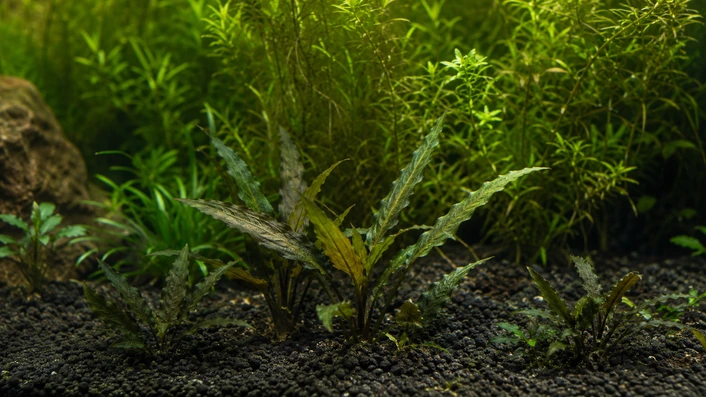
Phosphate deficiency in aquarium plants is one of the harder nutrient problems to diagnose because the symptoms are often less obvious than nitrogen or iron deficiency. Instead of one clear dramatic sign, phosphate limitation usually appears as slow growth, smaller shoot tips, weak recovery, darker or duller leaves, and sometimes stubborn green spot algae on glass or older leaves.
This can feel confusing because many aquarists are told that phosphate causes algae. In reality, phosphate is also an essential plant macronutrient. Aquarium plants need phosphorus for energy transfer, cell development, root growth, new shoots, and overall metabolism. If phosphate becomes too low in a planted tank, plants may slow down even when lighting, CO₂, nitrate, and micronutrients seem available.
The key is balance. A planted aquarium does not need uncontrolled phosphate buildup, but it also should not be starved to zero. When phosphate is missing, plant growth can stall. When plant growth stalls, algae can become more difficult to control because the plants are no longer using light and nutrients efficiently.
This guide explains how to recognize aquarium plant phosphate deficiency, how it differs from nitrogen, potassium and iron problems, why green spot algae is often linked with low phosphate, how to test phosphate, and how to fix the issue safely. For the broader nutrient system, read the Macronutrients for Aquarium Plants guide. If your symptoms look more like yellow old leaves, compare this article with Nitrogen Deficiency in Aquarium Plants.
Quick answer: Phosphate deficiency often causes very slow plant growth, smaller shoot tips, poor recovery after trimming, darker or duller leaves, weak roots, and sometimes green spot algae. The fix is controlled phosphate availability through balanced macronutrient fertilization, stable lighting, and consistent maintenance.
What You’ll Learn in This Lesson
- What phosphate does for aquarium plants
- How phosphate deficiency looks in planted tanks
- Why phosphate deficiency can be difficult to identify
- How phosphate deficiency differs from nitrogen, potassium and iron issues
- Why green spot algae is often linked to low phosphate
- Why phosphate can become too low in planted aquariums
- How to test phosphate without overreacting to one result
- How to fix and prevent recurring phosphate deficiency safely
What Phosphate Does for Aquarium Plants
Phosphate is the aquarium hobby’s practical measurement form of phosphorus. Phosphorus is a macronutrient, meaning plants need it in relatively large amounts compared with trace elements. In fertilizer labels and aquarium tests, it is usually discussed as phosphate, often written as PO₄.
Plants use phosphorus in essential growth processes. It is involved in energy transfer, cell division, root development, shoot formation, photosynthesis support, and the plant’s ability to build new tissue. When phosphate is missing, the plant may still look alive, but growth becomes restricted and inefficient.
In practical planted aquarium terms, phosphate supports:
- Healthy new shoot development
- Strong plant recovery after trimming
- Root growth and establishment
- Consistent stem plant growth
- Carpet spreading and foreground recovery
- Balanced use of nitrate and potassium
- Stable high-light and CO₂-driven growth
- Overall plant metabolism and energy movement
Phosphate deficiency is rarely just a “leaf color” issue. It is often a growth-performance issue. Plants may simply stop doing what they should be doing: spreading, branching, rooting, recovering, and producing healthy new mass.
Ready to set up your own tank?
Create a free account to save lessons, plan your setup, and use the Tank Hub to turn ideas into a real aquarium.
Phosphate Deficiency Symptoms in Aquarium Plants
Phosphate deficiency is often harder to spot than nitrogen deficiency because the visual signs can be subtle. The clearest pattern is usually slow growth combined with small shoot tips, weak new development, poor recovery, and sometimes darker or duller leaves.
Fast-growing stem plants are usually the easiest plants for spotting phosphate limitation because they respond quickly when growth stalls. Slow epiphytes such as Anubias, Java Fern and Bucephalandra can show problems too, but symptoms are harder to separate from light, algae, age and general slow growth.
| Symptom | What It May Look Like | Why It Matters |
|---|---|---|
| Very slow growth | Plants stop expanding even when light seems adequate | Classic phosphate limitation pattern |
| Smaller shoot tips | Stem plant tops become smaller or weaker | New growth is not developing normally |
| Poor trimming recovery | Plants do not branch back strongly after cutting | Growth energy is limited |
| Darker or duller leaves | Leaves may look unusually dark, muted or stressed | Can appear with phosphorus limitation |
| Older leaves deteriorate | Leaves may fade, brown, develop weak patches or die back | Often overlaps with other macro deficiencies |
| Green spot algae | Hard green spots on glass or older leaves | Often associated with low phosphate and high light imbalance |
| Weak root development | New plants anchor slowly or recover poorly | Phosphorus supports root growth and energy transfer |
One slow-growing plant does not prove phosphate deficiency. Look for a pattern across several plants, especially fast growers, combined with low phosphate test results or a fertilization routine that does not add phosphorus.
Why Phosphate Deficiency Is Hard to Diagnose
Phosphate deficiency is difficult because it often looks like “plants are not doing much.” Unlike nitrogen deficiency, which commonly causes older yellow leaves, phosphate deficiency may simply make plants smaller, slower, darker or less responsive.
That symptom pattern overlaps with many other problems. Weak light, unstable CO₂, low nitrate, low potassium, poor substrate, poor flow, algae pressure and normal plant transition can all slow growth. This is why phosphate deficiency should not be diagnosed from one leaf or one algae spot alone.
Phosphate deficiency becomes more likely when several clues appear together:
- Fast-growing plants slow down noticeably.
- Shoot tips become smaller or weaker.
- Plants recover poorly after trimming.
- Green spot algae appears repeatedly under strong light.
- Phosphate tests repeatedly show very low or zero readings.
- Your fertilizer contains nitrate and potassium but little or no phosphate.
- The tank has strong light, CO₂, and fast plant mass.
- Other likely causes have been checked first.
The safest approach is not to guess aggressively. Test, observe, adjust gradually, and judge the result by new growth over time.
Phosphate Deficiency vs Nitrogen, Potassium and Iron Deficiency
Many plant deficiency symptoms overlap, especially when more than one nutrient is low. The best way to narrow the issue is to compare which leaves are affected, how growth changes, and what your testing and fertilization routine show.
Phosphate deficiency usually shows as slow growth and small shoot tips. Nitrogen deficiency often shows yellowing older leaves. Potassium deficiency often produces pinholes, edge damage or leaf deterioration. Iron deficiency usually affects new growth first, causing pale or yellow young leaves.
| Problem | Typical Pattern | How It Differs From Phosphate Deficiency |
|---|---|---|
| Phosphate deficiency | Very slow growth, smaller shoot tips, green spot algae, dull or dark leaves | Often more about stalled growth than one clear yellowing pattern |
| Nitrogen deficiency | Older leaves turn yellow, pale or translucent | Yellow old leaves are usually more obvious |
| Potassium deficiency | Pinholes, edge damage, weak old leaves | Physical holes and tissue damage are more typical |
| Iron deficiency | New leaves turn pale or yellow | Newest growth is usually most affected |
| CO₂ instability | Melting, algae, weak growth under strong light | Often appears in high-energy tanks and changes through the day |
| Weak light | Leggy growth, upward growth, shaded zones failing | Symptoms follow light distribution and shadowed areas |
If your older leaves are clearly yellowing first, compare with Nitrogen Deficiency in Aquarium Plants. If the issue is pale new growth, the Micronutrients for Aquarium Plants guide may be more relevant.
Phosphate Deficiency and Green Spot Algae
Green spot algae is one of the most common clues aquarists associate with low phosphate. It appears as hard green dots on glass, slow leaves, rocks, or older plant leaves. It is often stubborn and does not wipe away as easily as soft dust algae.
Low phosphate can contribute to green spot algae because plant growth becomes limited while light remains available. In strong light, this imbalance can make green spot algae more persistent. However, green spot algae does not automatically prove phosphate deficiency. It can also appear with excessive light, low CO₂, poor maintenance, slow plant growth, or long photoperiods.
| Green Spot Algae Situation | Possible Meaning | Best Check |
|---|---|---|
| Green spots with zero phosphate reading | Possible phosphate limitation | Test PO₄ and review fertilizer |
| Green spots under strong light | Light may exceed plant balance | Check intensity and photoperiod |
| Green spots on slow plants | Slow leaves are exposed too long | Use shade and improve plant growth |
| Green spots with unstable CO₂ | Carbon limitation may be involved | Check CO₂ timing and consistency |
| Green spots after nutrient starvation | Plants may be weakened | Restore balanced fertilization |
If green spot algae is your main issue, phosphate may be part of the solution, but it should not be the only thing you check. Use Aquarium Lighting and Algae to review the full light-nutrient balance.
Why Phosphate Becomes Too Low in Planted Aquariums
Phosphate deficiency usually happens when plant demand is higher than phosphate input. This is common in planted aquariums with strong light, CO₂, fast-growing plants, frequent trimming, large plant mass, or fertilization routines that do not include phosphorus.
Fish food and waste can add phosphate to an aquarium. But in heavily planted tanks, plants may consume available phosphate faster than the system naturally produces it. Large water changes can also remove phosphate if the replacement water is low in phosphorus and no fertilizer replaces it.
Common causes include:
- Using fertilizer that contains little or no phosphate
- High plant mass with strong growth
- High light that increases nutrient demand
- CO₂ injection that accelerates growth
- Fast-growing stem plants or carpeting plants
- Large or frequent water changes with low-phosphate source water
- Very low fish load in a heavily planted aquarium
- Trying to keep phosphate at zero to prevent algae
- Using phosphate-removing filter media unnecessarily
- New aquascapes with active substrate and many plants
In planted aquariums, phosphate should be treated as a nutrient to manage, not simply a pollutant to eliminate.
Can Phosphate Be Too Low in a Planted Tank?
Yes. Phosphate can be too low for healthy plant growth, especially in aquariums with strong lighting and fast plant growth. A zero phosphate reading is not automatically good in a planted tank.
The right phosphate level depends on the tank style. A low-light, lightly planted tank has lower demand. A CO₂-injected aquascape with carpets and stems has much higher demand. Shrimp tanks may need careful and conservative dosing, while high-tech aquascapes may need more structured macronutrient fertilization.
| Tank Type | Phosphate Demand | Practical Note |
|---|---|---|
| Low-light beginner tank | Low to moderate | Deficiency is possible but usually slower to appear |
| Low-tech planted tank | Moderate if plant mass is high | Use gentle complete fertilization if needed |
| High-light aquascape | High | Low phosphate can quickly limit growth |
| CO₂-injected tank | High when plant growth is strong | Macronutrient balance becomes important |
| Shrimp tank | Often low natural input | Dose carefully and avoid sudden swings |
| Fish-heavy community tank | May already receive phosphate from feeding | Test before adding more |
Phosphate management is contextual. The goal is not a universal magic number. The goal is enough available phosphate for plants to grow without creating unstable nutrient accumulation.
How to Test Phosphate in an Aquarium
A phosphate test can be useful, but it should be interpreted carefully. A test shows the phosphate present in the water at the moment you test. It does not directly show how quickly plants are consuming phosphate, how much is bound in substrate or debris, or whether another nutrient is limiting growth first.
Still, phosphate testing is helpful when symptoms point toward phosphate limitation. Repeated very low or zero readings in a high-growth planted tank are more meaningful than one isolated result.
Testing Checklist
- Test phosphate before a water change.
- Test again after dosing if you add phosphate fertilizer.
- Follow the test instructions exactly.
- Compare results across several days or weeks.
- Check whether phosphate drops quickly after dosing.
- Review whether your fertilizer contains phosphate.
- Compare phosphate with nitrate, potassium, light and CO₂.
- Judge recovery by new growth, not only by test numbers.
Do not diagnose phosphate deficiency from a test kit alone. Use the test together with plant symptoms, fertilizer routine, light level and tank history.
How to Fix Phosphate Deficiency in Aquarium Plants
The safest way to fix phosphate deficiency is to restore stable phosphate availability through balanced fertilization. This usually means using a complete macronutrient fertilizer or a phosphate supplement in a controlled way.
Do not make several major changes at once. If you increase phosphate, keep lighting, CO₂ and water changes stable while observing plant response. The most important recovery sign is stronger new growth, better shoot size, improved trimming response and reduced recurring green spot algae pressure.
Step-by-Step Fix
- Confirm that symptoms match phosphate limitation.
- Test phosphate and record the result.
- Check whether your fertilizer contains phosphorus or phosphate.
- Review nitrate and potassium so you are not fixing the wrong macronutrient.
- Start with controlled phosphate-containing fertilization.
- Do not increase lighting at the same time.
- Remove heavily damaged leaves and green spot algae where possible.
- Retest and observe new growth over the following weeks.
- Adjust gradually based on plant response and test trends.
For precise fertilizer planning, use the Fertilizer Dosing Calculator instead of guessing. Controlled dosing is safer than random correction doses.
Should You Use a Complete Fertilizer or a Phosphate Supplement?
The best option depends on your tank. If multiple nutrients may be low, a complete fertilizer with macronutrients may be the simplest solution. If everything else is stable and phosphate is clearly the missing nutrient, a separate phosphate supplement can be more precise.
Before choosing, read the fertilizer label. Some products are mainly micronutrient fertilizers and do not add meaningful nitrogen, phosphorus or potassium. Others are all-in-one fertilizers with macronutrients included. High-tech aquascapes often benefit from more structured dosing, while beginner tanks usually need simplicity and consistency.
| Fertilizer Approach | Best For | Main Caution |
|---|---|---|
| Complete all-in-one fertilizer | Beginner and low-tech planted tanks | Check whether it actually includes phosphate |
| Separate phosphate supplement | Targeted correction when PO₄ is clearly low | Avoid overdosing or changing too quickly |
| Structured macro dosing | High-tech aquascapes and dense plant mass | Requires regular testing and routine |
| Fish food and livestock input | Fish-heavy tanks with moderate plants | Not precise and can increase waste |
| Root tabs only | Root feeders in inert substrate | Usually not enough for water-column phosphate management |
For most aquarists, the best routine is the one they can keep stable. Plants respond better to consistency than to occasional aggressive corrections.
Phosphate Deficiency in Low-Tech Aquariums
Low-tech aquariums can develop phosphate deficiency, especially when they are heavily planted, lightly stocked or maintained with large frequent water changes. However, low-tech tanks usually need slower and more moderate correction than high-energy aquascapes.
Because growth is slower without CO₂, dramatic phosphate dosing is rarely necessary. The goal is steady availability. If plants are low-demand and growing slowly, very low phosphate may not cause obvious problems. If growth stalls, green spot algae appears and tests show zero phosphate repeatedly, correction becomes more reasonable.
- Use moderate light to keep nutrient demand realistic.
- Use a complete fertilizer if several nutrients may be low.
- Do not chase strong high-tech growth without CO₂.
- Watch slow leaves like Anubias for green spot algae.
- Check phosphate if plant growth stalls despite nitrate availability.
- Keep water changes consistent rather than extreme.
For light planning in low-tech systems, read Aquarium Plant Light Requirements. Many nutrient problems become worse when light demand is too high for the system.
Phosphate Deficiency in High-Tech Aquascapes
High-tech aquascapes have higher phosphate demand because strong light and CO₂ increase plant growth. Dense stem plants, carpets, red plants and frequent trimming all increase nutrient consumption. In these tanks, phosphate deficiency can appear as stalled growth even when the system looks technically advanced.
High-tech aquariums are also less forgiving because strong light exposes imbalance quickly. If phosphate is low, plants may stop using light efficiently. This can lead to green spot algae, weak trimming recovery and poor shoot development.
- Keep phosphate available according to your dosing method.
- Coordinate phosphate with nitrate and potassium.
- Keep CO₂ stable before increasing light.
- Watch fast stem tips for shrinking or stalled growth.
- Observe carpets after trimming for recovery strength.
- Do not reduce phosphate to zero just to fight algae.
- Use water changes to reset excesses without starving plants.
For high-light balance, read Aquarium PAR Explained and Aquarium Lighting and Algae.
Phosphate Deficiency in Carpeting Plants
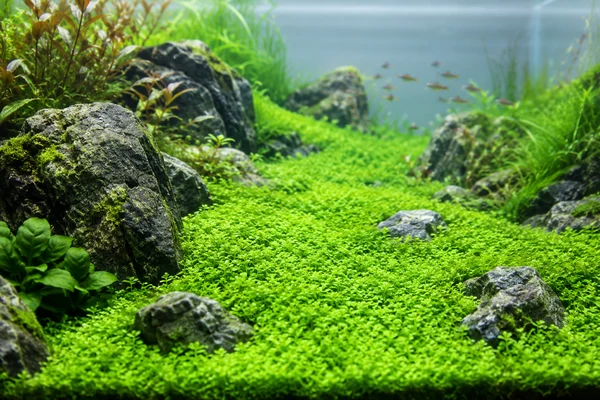
Carpeting plants can be affected by phosphate deficiency because they rely on strong, consistent growth to spread across the substrate. If phosphate is limited, carpets may stall, recover poorly after trimming, or remain patchy even when light and CO₂ seem good.
However, carpet problems are often caused by light or CO₂ rather than phosphate alone. A carpet growing upward usually suggests weak substrate light. A carpet covered in algae may suggest too much light for the available CO₂ and nutrients. Phosphate is one possible piece of the puzzle, not the only one.
- Check substrate-level light before blaming phosphate.
- Check CO₂ stability in high-light carpet tanks.
- Use complete macronutrient dosing for high-growth carpets.
- Remove debris trapped in the carpet.
- Trim before the lower layer browns.
- Watch whether the carpet recovers after trimming.
For carpet-specific planning, use the Aquarium Carpeting Plants Guide and Carpet Plants Without CO₂.
Phosphate Deficiency in Stem Plants
Stem plants are often the best indicators of phosphate deficiency because they grow quickly and show changes faster than slow plants. When phosphate is limited, stem plants may produce smaller shoot tips, thinner stems, slower branching and weaker trimming recovery.
Fast stems can also expose nutrient imbalance in high-tech aquascapes. If nitrate, potassium, light and CO₂ are present but the tops still shrink and recovery is weak, phosphate should be checked.
- Watch shoot tip size after trimming.
- Compare new growth with older healthy growth.
- Look for stalled branching in stem groups.
- Check whether phosphate reads zero before the next dose.
- Do not confuse low phosphate with weak CO₂ under strong light.
- Use stable macronutrient dosing rather than occasional corrections.
Stem plants are useful diagnostic tools because they respond quickly. If they improve after stable phosphate dosing, the diagnosis becomes more likely.
Phosphate Deficiency in Slow Plants
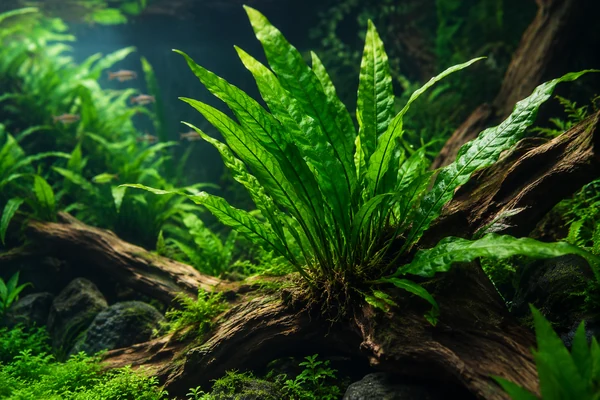
Slow plants such as Anubias, Java Fern and Bucephalandra can suffer from nutrient imbalance, but symptoms appear slowly and are easy to confuse with algae, age, low light or poor placement. Green spot algae on older Anubias leaves is a common reason aquarists suspect low phosphate.
With slow plants, avoid overreacting. A slow leaf that has algae is not always a phosphate deficiency. It may simply be under too much direct light or growing in a tank where maintenance and CO₂ are not balanced.
- Check whether slow plants are under harsh direct light.
- Remove old leaves that are already damaged.
- Provide stable water-column nutrients.
- Use shade or hardscape placement for slow epiphytes.
- Do not expect old leaves to recover fully.
- Judge progress by new leaves staying cleaner and healthier.
For slow plant placement and care, compare the Anubias Aquarium Plant Guide, Java Fern Aquarium Plant Guide, and Bucephalandra Aquarium Plant Guide.
Can Too Much Phosphate Cause Problems?
Phosphate is necessary for plants, but that does not mean more is always better. Excess phosphate may indicate overfeeding, excessive waste, poor maintenance or unbalanced dosing. In planted tanks, the issue is rarely one nutrient in isolation. It is the relationship between light, CO₂, plant mass, feeding, filtration and water changes.
Aquarists often fear phosphate because of algae. But algae problems are usually caused by imbalance, not simply by the presence of phosphate. A healthy planted tank can contain measurable phosphate without algae taking over when plants are growing well and maintenance is consistent.
| Situation | Likely Meaning | Best Response |
|---|---|---|
| Zero phosphate with stalled plants | Possible phosphate limitation | Consider controlled phosphate dosing |
| Measurable phosphate with strong plant growth | May be normal for planted tanks | Maintain routine |
| High phosphate with poor maintenance | Possible waste or overfeeding issue | Review feeding and water changes |
| High phosphate with algae and weak plants | System imbalance | Check light, CO₂, plant health and waste |
| Rising phosphate after overfeeding | Food input may exceed system use | Reduce waste and improve maintenance |
Phosphate should be managed as part of the whole planted aquarium system. Neither zero nor uncontrolled accumulation should be treated as the automatic goal.
What to Watch After Fixing Phosphate Deficiency
After correcting phosphate deficiency, do not judge success by old damaged leaves. Those leaves may stay damaged or continue to decline. The real sign of recovery is improved new growth.
Fast-growing plants may show improvement within days to weeks. Slow plants may take longer. Watch shoot tips, trimming response, root development, carpet spread and whether green spot algae becomes less persistent over time.
- Stem plant tops should become stronger and less reduced.
- Plants should recover better after trimming.
- New leaves should appear healthier and less stunted.
- Carpets may spread more steadily if light and CO₂ are adequate.
- Green spot algae may become less aggressive after balance improves.
- Old damaged leaves may not heal and can be removed gradually.
- Phosphate readings should stop crashing to zero if dosing is adequate.
If nothing improves, phosphate may not have been the main limiting factor. Recheck nitrate, potassium, micronutrients, CO₂, substrate and light distribution before increasing the dose further.
Common Mistakes When Fixing Phosphate Deficiency
Phosphate deficiency is fixable, but it is easy to create new problems by treating phosphate as either always bad or always the missing answer.
| Mistake | Why It Causes Problems | Better Approach |
|---|---|---|
| Assuming phosphate always causes algae | Plants need phosphate to grow | Manage balance instead of chasing zero |
| Assuming green spot algae always means low phosphate | Light and CO₂ may also be involved | Check the full system |
| Dosing phosphate without testing or symptoms | May not fix the real issue | Use symptoms, tests and routine review together |
| Using fertilizer with no macronutrients | Does not correct phosphate limitation | Read the label carefully |
| Increasing light while plants are limited | Raises demand and algae pressure | Fix nutrients before increasing light |
| Changing nitrate, phosphate, CO₂ and light at once | Makes diagnosis impossible | Adjust one main variable at a time |
| Expecting old leaves to heal | Damaged leaves often remain damaged | Judge new growth instead |
The best correction is stable and measured. Phosphate deficiency is not an emergency that requires chaotic dosing. It is a system-balance issue.
Final Phosphate Deficiency Checklist
Use this checklist before changing your fertilizer routine:
- Are fast-growing plants slowing down despite enough light?
- Are shoot tips becoming smaller or weaker?
- Do plants recover poorly after trimming?
- Is green spot algae recurring on glass or older leaves?
- Does your phosphate test repeatedly read very low or zero?
- Does your fertilizer actually contain phosphate?
- Are nitrate and potassium already available?
- Is CO₂ stable if the tank uses strong light?
- Could the issue be light, CO₂ or another nutrient instead?
- Are you judging recovery by new growth rather than old leaves?
If several answers point toward phosphate limitation, controlled phosphate fertilization is usually the next logical step.
Conclusion
Phosphate deficiency in aquarium plants is often subtle. Instead of one dramatic symptom, it usually appears as slow growth, smaller shoot tips, poor trimming recovery, dark or dull leaves, weak roots, and sometimes stubborn green spot algae.
Phosphate is not just an algae-related number. It is a key macronutrient for planted aquariums. Plants need phosphorus for energy transfer, new growth, roots and recovery. When phosphate is pushed too low, plants can stall even if other nutrients appear available.
The solution is balance. Test phosphate, review your fertilizer, compare symptoms with nitrogen, potassium and iron deficiencies, and correct gradually. Do not chase zero phosphate in a planted tank, but do not ignore uncontrolled buildup either. A healthy aquarium keeps phosphate available enough for plants to grow while maintaining stable light, CO₂, feeding and water changes.
💬 Join the Conversation
Are your aquarium plants showing slow growth, small shoot tips, green spot algae, poor trimming recovery or possible phosphate limitation?
Tag us on Instagram @AquariumLesson — we’d love to see your planted tank recovery, nutrient routine and before-and-after plant growth.
FAQ
What does phosphate deficiency look like in aquarium plants?
Phosphate deficiency often causes very slow growth, smaller shoot tips, poor recovery after trimming, darker or duller leaves, weak roots and sometimes green spot algae on glass or older plant leaves.
Does phosphate deficiency cause green spot algae?
Low phosphate is often linked with green spot algae, especially in bright planted tanks. However, green spot algae can also involve strong light, low CO₂, slow plant growth and maintenance imbalance, so phosphate is only one factor to check.
Can phosphate be too low in a planted aquarium?
Yes. Phosphate can become too low in planted aquariums, especially tanks with strong lighting, CO₂ injection, fast-growing plants, large plant mass or fertilizers that do not include phosphorus.
How do I fix phosphate deficiency in aquarium plants?
Confirm symptoms, test phosphate, check your fertilizer label, then use a phosphate-containing macronutrient fertilizer or complete planted tank fertilizer. Adjust gradually and judge recovery by new growth.
Is phosphate bad for aquariums?
Phosphate is not automatically bad. It is an essential plant nutrient. Excess phosphate can indicate overfeeding or waste, but zero phosphate can limit plant growth in planted aquariums. Balance matters more than elimination.
Is phosphate deficiency the same as nitrogen deficiency?
No. Nitrogen deficiency often causes older leaves to turn yellow or translucent. Phosphate deficiency more often shows as very slow growth, smaller shoot tips, weak recovery and sometimes green spot algae.
Should I add more fish to raise phosphate?
No. Stocking should be based on animal welfare and tank capacity, not fertilizer needs. If plants need phosphate, controlled fertilization is usually safer and more precise than adding more fish or feeding more heavily.
Will damaged leaves recover after phosphate dosing?
Old damaged leaves often do not fully recover. The best sign that phosphate deficiency is fixed is healthier new growth, stronger shoot tips, better trimming recovery and less recurring green spot algae pressure.
Start building your aquarium with the Tank Hub
Save your favorite lessons, organize your setup, and track your aquarium step by step in your personal Tank Hub.
New to AquariumLesson? Start with our complete Aquarium Lessons Hub or return to the homepage at AquariumLesson.com.
Continue learning
References
- Aquasabi — Deficiency Symptoms in Aquatic Plants
- Aquasabi — Water Tests in a Planted Aquarium
- Buce Plant — Nutrient Deficiencies in Aquatic Plants
- Aquarium Co-Op — Nutrient Deficiencies: Why Your Aquarium Plants Are Dying
- Green Aqua — Common Plant Deficiency Symptoms in the Aquarium
- Rotala Butterfly — Aquarium Plant Deficiencies