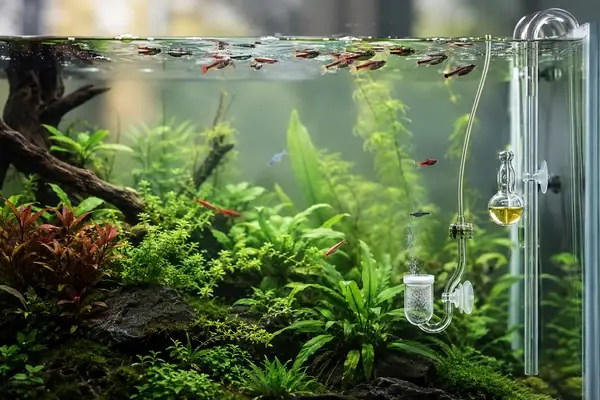
Signs of Too Much CO₂ in Aquariums: Safety Guide
Introduction
The signs of too much CO2 in an aquarium should be taken seriously. Pressurized CO₂ can transform a planted tank, but excessive carbon dioxide can stress fish, shrimp and snails very quickly if the system is pushed too far.
In planted aquariums, CO₂ is used to support stronger photosynthesis, healthier carpets, faster stem growth and better plant density. But CO₂ is not only a plant tool. It also changes gas balance in the aquarium. If too much CO₂ accumulates, livestock may struggle to breathe normally even when the tank looks clean and the plants seem to be doing well.
The most important warning signs are fish gasping at the surface, rapid breathing, unusual lethargy, shrimp climbing upward, snails moving toward the waterline, or a drop checker turning yellow. If these signs appear after CO₂ starts or after a CO₂ adjustment, treat it as a safety issue first and a plant-growth issue later.
This guide explains how to recognize too much CO₂, what to do immediately, how to distinguish CO₂ stress from low oxygen or water-quality problems, and how to prevent future incidents. For the full setup foundation, read the Aquarium CO₂ System Guide. For broader diagnosis, use the CO₂ Troubleshooting Guide.
Quick answer: Too much CO₂ often shows as fish gasping at the surface, rapid gill movement, fish gathering near filter outflow, shrimp climbing upward, snails moving to the waterline, lethargy, erratic swimming or a yellow drop checker. If livestock show stress, reduce or stop CO₂ immediately and increase surface agitation.
What You’ll Learn in This Lesson
- The most common signs of too much CO₂ in aquariums
- How fish, shrimp and snails react to excessive CO₂
- What a yellow drop checker means
- What to do immediately during a CO₂ overdose
- How to tell CO₂ stress from low oxygen, ammonia or nitrite problems
- Why CO₂ timing, flow and surface agitation matter
- How to prevent CO₂ accidents with safer tuning
- When to reduce bubble rate, improve flow or lower light intensity
Why Too Much CO₂ Is Dangerous
CO₂ is useful for aquatic plants, but fish and shrimp still need safe gas balance. When dissolved CO₂ becomes too high, livestock can have difficulty releasing carbon dioxide from their bodies. This creates respiratory stress and can become dangerous quickly.
This is why a planted aquarium can look beautiful and still become unsafe. Strong plant growth does not prove that CO₂ is safe. A bright green aquascape with pearling plants can still push livestock too far if CO₂ is excessive, oxygen exchange is weak, or surface movement is too low.
Too much CO₂ is especially risky when:
- The bubble rate was increased too quickly
- CO₂ starts too early before lights turn on
- CO₂ runs too long or overnight
- Surface movement is almost completely still
- The aquarium is heavily stocked
- Water temperature is high
- Filter flow is weak or blocked
- A diffuser or reactor suddenly becomes more efficient after cleaning
- A regulator, needle valve or solenoid fails
The goal is not maximum CO₂. The goal is stable, plant-usable CO₂ that remains safe for livestock every day.
Main Signs of Too Much CO₂
The clearest signs of too much CO₂ usually appear in livestock behavior. A drop checker can help, but fish and shrimp are the real safety warning system.
| Warning Sign | What It May Mean | Urgency |
|---|---|---|
| Fish gasping at the surface | Respiratory stress from CO₂, low oxygen or water-quality issue | High |
| Rapid gill movement | Fish are working harder to breathe | High |
| Fish gathering near filter outflow | They may seek higher oxygen or better gas exchange | High |
| Fish become lethargic | CO₂ or water stress may be affecting behavior | High |
| Erratic swimming or loss of balance | Severe stress and possible emergency | Very high |
| Shrimp climbing upward | Shrimp may be escaping poor gas conditions | High |
| Snails moving to the waterline | Possible poor gas exchange or stress | Moderate to high |
| Drop checker turns yellow | CO₂ may be too high | Moderate to high |
If several signs appear together while CO₂ is running, do not wait. Reduce CO₂ and improve gas exchange immediately.
Fish Gasping at the Surface
Fish gasping at the surface is one of the most urgent signs that something is wrong. In a CO₂-injected planted tank, it may mean the CO₂ level is too high, oxygen exchange is too weak, or another water-quality issue is affecting respiration.
Surface gasping often appears because the top layer of the aquarium has better gas exchange with the air. Fish may move upward because they are trying to access more breathable conditions.
If fish gasp shortly after CO₂ starts, after a bubble-rate increase, after diffuser cleaning, or after switching to a reactor, assume CO₂ is involved until proven otherwise.
Immediate actions:
- Turn CO₂ down or off.
- Increase surface agitation.
- Point the filter outlet slightly upward if needed.
- Add temporary aeration if fish remain stressed.
- Check ammonia, nitrite and temperature.
- Perform a water change if the situation is severe.
- Do not restart CO₂ at the same setting.
Fish gasping should never be treated as normal CO₂ tuning. Healthy CO₂ injection should not force livestock to the surface.
Rapid Gill Movement
Rapid gill movement is another important warning sign. Fish may look as if they are breathing faster than usual, even if they are not yet at the surface. This can happen before the situation becomes obvious.
Rapid breathing after CO₂ starts suggests that the gas level may be too high or that oxygen exchange is not strong enough. It can also appear with ammonia, nitrite, disease, high temperature or poor water quality, so always check the full system.
Watch especially during these periods:
- One to three hours after CO₂ starts
- After increasing bubble rate
- After cleaning or replacing a diffuser
- After installing a CO₂ reactor
- After reducing surface agitation
- During hot weather or higher tank temperatures
- After heavy feeding or organic waste buildup
If gill movement is faster than normal and CO₂ is running, reduce CO₂ first. Then test water quality to rule out other causes.
Fish Gathering Near the Filter Outflow
Fish gathering near the filter outflow can be a sign that they are seeking better gas exchange or higher oxygen conditions. Filter outlets often create more movement, more oxygen exchange and stronger circulation than still corners of the tank.
This behavior is especially suspicious if many fish gather there at the same time after CO₂ starts. A few fish enjoying current is normal. A whole group clustering near the outflow while breathing quickly is not normal.
Possible causes include:
- CO₂ concentration is too high
- Surface movement is too low
- Filter flow is weak elsewhere
- Dead zones are trapping CO₂-rich water
- Oxygen demand is high because of temperature or stocking
- Water quality is affecting respiration
Improve surface movement and circulation before increasing CO₂ again. For flow design, use the Aquarium Filter Flow Guide.
Lethargic or Unusual Fish Behavior
Too much CO₂ does not always start with dramatic gasping. Sometimes fish simply become quiet, hide unusually, stay near the bottom, stop schooling normally or look less responsive.
This is why knowing your livestock’s normal behavior matters. Some species naturally rest in certain areas. But if behavior changes after CO₂ adjustments, the timing is important.
Possible CO₂-related behavior changes include:
- Fish stop schooling normally
- Active fish become unusually still
- Fish hang near the surface or outflow
- Bottom fish leave the bottom and move upward
- Fish hide during the CO₂ period but recover after lights out
- Fish show poor appetite during CO₂ injection
- Fish appear disoriented after bubble-rate changes
If behavior changes line up with the CO₂ schedule, reduce CO₂ and watch whether behavior normalizes.
Erratic Swimming or Loss of Balance
Erratic swimming, wobbling, rolling, sudden dashing or loss of balance can indicate severe stress. This should be treated as urgent, especially if CO₂ is running or was recently increased.
At this stage, do not continue diagnosing slowly. Stabilize the animals first.
Emergency response:
- Stop CO₂ immediately.
- Increase surface agitation strongly.
- Add temporary aeration.
- Check temperature, ammonia and nitrite.
- Perform a partial water change with matched, dechlorinated water if needed.
- Keep lights lower while livestock recover.
- Restart CO₂ only later from a much lower setting.
Severe behavior changes are not part of normal planted tank optimization. CO₂ should be tuned long before livestock reach this point.
Signs of Too Much CO₂ in Shrimp
Shrimp can be sensitive to unstable gas balance and sudden CO₂ changes. They may react differently from fish, so shrimp behavior deserves separate attention.
Possible signs of too much CO₂ or poor gas exchange in shrimp include:
- Shrimp climbing toward the surface
- Shrimp gathering near filter outflow
- Shrimp becoming unusually inactive
- Shrimp leaving normal grazing zones
- Shrimp swimming erratically
- Shrimp hanging high on plants or hardscape
- Sudden losses after CO₂ adjustments
Shrimp tanks should be tuned conservatively. If shrimp are part of the aquarium, do not chase aggressive high-tech CO₂ levels unless the setup is very stable and well monitored.
In shrimp tanks, smaller CO₂ adjustments, reliable surface movement and stable water chemistry matter more than maximum plant speed.
Signs of Too Much CO₂ in Snails
Snails can also provide clues. If snails repeatedly move toward the waterline, leave lower surfaces, become unusually inactive or gather near oxygen-rich zones while CO₂ is running, gas balance may be poor.
Snails moving upward does not always prove CO₂ overdose. They may also react to food, water quality, medication, temperature or low oxygen. But if the timing matches CO₂ injection, take it seriously.
Watch for:
- Snails climbing to the waterline during CO₂ injection
- Snails gathering near the outflow
- Snails becoming inactive after CO₂ starts
- Snails repeatedly leaving the substrate or glass lower zones
- Snail behavior returning to normal after CO₂ stops
Snail behavior is not as precise as a test, but it can support the larger pattern when fish or shrimp also show stress.
What a Yellow Drop Checker Means
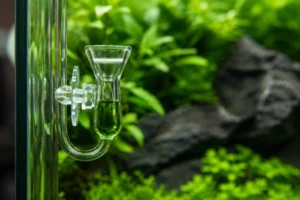
A yellow drop checker usually means CO₂ may be too high. This does not automatically prove an emergency, because drop checkers are approximate and placement matters. But yellow should always make you check livestock immediately.
A drop checker can also turn yellow if it is placed too close to direct CO₂ bubbles or a CO₂-rich return outlet. In that case, it may be reading a local high-CO₂ zone rather than the whole aquarium.
Still, never ignore a yellow checker if animals look stressed.
| Drop Checker Color | Typical Meaning | Action |
|---|---|---|
| Blue | CO₂ likely low or not reaching checker | Check timing, flow and diffusion |
| Green | Often useful planted-tank range | Maintain if livestock behave normally |
| Lime green | CO₂ stronger, may still be acceptable | Watch fish and shrimp carefully |
| Yellow | CO₂ may be too high | Check livestock and reduce CO₂ if any stress appears |
| Faded or unclear | Old solution or poor readability | Replace solution before making major decisions |
For detailed interpretation, read the CO₂ Drop Checker Guide.
Too Much CO₂ vs Low Oxygen
Too much CO₂ and low oxygen can look similar because both affect breathing. Fish may gasp, breathe rapidly or gather near the surface in both situations. In real aquariums, the two issues can also overlap.
For example, a tank with very low surface movement may conserve CO₂ but also reduce oxygen exchange. A heavily stocked warm aquarium may already have high oxygen demand, making CO₂ tuning less forgiving.
| Clue | More Likely CO₂ Issue | More Likely Oxygen Issue |
|---|---|---|
| Symptoms begin after CO₂ starts | Yes | Possible if gas exchange is weak |
| Symptoms worsen after bubble-rate increase | Yes | Possible |
| Symptoms appear early morning before CO₂ | Less likely | More likely low night oxygen or water quality |
| Strong surface agitation improves symptoms | Yes, because CO₂ off-gasses | Yes, because oxygen exchange improves |
| Drop checker yellow | More likely | Not direct proof |
| Tank is hot and heavily stocked | Possible | More likely also oxygen-related |
In an emergency, you do not need to perfectly separate the two. Stop or reduce CO₂, increase surface movement and stabilize livestock first.
Too Much CO₂ vs Ammonia or Nitrite Problems
Gasping and rapid breathing can also be caused by ammonia or nitrite. This is why water testing matters. If fish show breathing stress, do not assume CO₂ is the only possible cause.
CO₂ stress often follows the CO₂ schedule. Ammonia and nitrite problems may persist even when CO₂ is off. However, a stressed aquarium can have multiple problems at once, especially after filter issues, overfeeding, medication, new tank syndrome or heavy organic waste.
| Problem | Common Clues | Immediate Check |
|---|---|---|
| Too much CO₂ | Symptoms after CO₂ starts or after adjustment | Turn down CO₂ and watch response |
| Low oxygen | Morning stress, warm water, weak surface movement | Increase aeration and surface ripple |
| Ammonia | New tank, filter damage, red gills, lethargy | Test ammonia immediately |
| Nitrite | New or disrupted cycle, gasping despite oxygen | Test nitrite immediately |
| Disease or gill parasites | Breathing issues persist despite stable parameters | Observe symptoms and seek expert diagnosis |
If breathing stress appears, test ammonia and nitrite even when CO₂ seems like the obvious cause. Livestock safety comes before assumptions.
Why CO₂ Overdose Happens
CO₂ overdose usually happens because the system changes faster than the aquarist realizes. A small needle valve movement, a cleaned diffuser, a stronger reactor or a reduced surface ripple can all raise dissolved CO₂ more than expected.
Common causes include:
- Bubble rate increased too quickly
- Needle valve adjusted too aggressively
- CO₂ starts too early before lights
- CO₂ runs overnight
- Solenoid fails open
- Diffuser cleaned and suddenly becomes more efficient
- Reactor installed without reducing the old bubble rate
- Surface agitation reduced too much
- Filter flow changes after maintenance
- Drop checker placed too close to CO₂ output
- Aquarium temperature rises
- Plant mass, livestock load or oxygen demand changes
Most accidents come from changing more than one variable at once or assuming yesterday’s bubble rate is still safe after equipment changes.
Emergency Steps for Too Much CO₂
If you suspect too much CO₂, act quickly and calmly. The goal is to remove excess CO₂, improve gas exchange and stabilize livestock.
Immediate Emergency Checklist
- Turn off CO₂ immediately.
- Increase surface agitation.
- Point filter outflow toward the surface.
- Add an air stone temporarily if livestock are stressed.
- Open the tank lid if safe to improve gas exchange.
- Check that the solenoid actually stopped gas flow.
- Check ammonia, nitrite and temperature.
- Perform a partial water change if symptoms are severe.
- Keep lights moderate while livestock recover.
- Do not restart CO₂ at the same bubble rate.
After livestock recover, retune from a lower bubble rate. Do not treat the incident as a one-time mystery. Identify what changed so it does not happen again.
How to Restart CO₂ After an Overdose
After a CO₂ incident, restart carefully. Do not return immediately to the previous setting. That previous setting was either unsafe or became unsafe because something changed.
A safer restart process:
- Wait until livestock behave normally again.
- Confirm ammonia and nitrite are safe.
- Check diffuser, reactor, tubing, regulator and solenoid.
- Restore normal but safe surface movement.
- Start at a lower bubble rate than before.
- Use a fresh drop checker solution if needed.
- Watch the tank through the entire photoperiod.
- Increase only in small steps over several days.
- Do not increase light during CO₂ retuning.
- Record the final safe bubble rate and timing.
For safer adjustment, use the CO₂ Bubble Rate Guide and compare your pH trend with the Aquarium pH CO₂ Calculator.
Preventing Too Much CO₂
The best way to handle too much CO₂ is to prevent it. A safe CO₂ system is stable, repeatable and monitored. It should not depend on daily manual guessing.
Prevention habits:
- Use a reliable regulator and needle valve.
- Use a solenoid and timer.
- Start CO₂ before lights, but not excessively early.
- Turn CO₂ off before or around lights out.
- Keep gentle surface ripple for gas exchange.
- Clean diffusers regularly.
- Check reactor gas buildup and filter flow.
- Use a drop checker with fresh 4 dKH solution.
- Track livestock behavior after every adjustment.
- Adjust bubble rate slowly.
- Retune after major equipment changes.
- Do not run excessive light before CO₂ is stable.
Safe CO₂ is not about one perfect number. It is about predictable delivery every day.
CO₂ Timing and Safety
CO₂ timing has a major safety impact. Many aquarists start CO₂ before lights turn on so plants have carbon available when photosynthesis begins. This can work well, but starting too early or injecting too strongly before plants are active can stress livestock.
Most planted tanks do not need CO₂ running overnight. Plants mainly use CO₂ during the photoperiod. At night, animals and plants respire, and oxygen exchange becomes more important.
| Timing Choice | Risk | Safer Approach |
|---|---|---|
| CO₂ starts at lights on | Plants may be carbon-limited early | Start earlier if needed, but monitor livestock |
| CO₂ starts 1–2 hours before lights | Usually workable, but tank-specific | Use pH trend and livestock behavior |
| CO₂ starts many hours before lights | Higher livestock stress risk | Shorten pre-light period |
| CO₂ runs overnight | Usually unnecessary and riskier | Use solenoid timer |
| CO₂ turns off too late | May stay high into low-oxygen period | Turn off before or around lights out |
If fish look stressed before the lights are fully active, your pre-light CO₂ period may be too strong or too long.
Surface Agitation and CO₂ Safety
Surface agitation affects both CO₂ and oxygen. Too much agitation can drive off CO₂ quickly. Too little agitation can reduce oxygen exchange and make CO₂ tuning less forgiving.
The safest planted tank usually has a gentle surface ripple, not a completely still surface and not heavy splashing. The right balance depends on livestock, stocking, temperature, plant mass and CO₂ intensity.
Increase surface movement when:
- Fish gasp or breathe rapidly
- Shrimp climb upward during CO₂ injection
- The tank is warm
- The aquarium is heavily stocked
- CO₂ was recently increased
- Nighttime oxygen may be low
- Surface film reduces gas exchange
Do not eliminate all surface movement just to save CO₂. Livestock safety is more important than gas efficiency.
Bubble Rate and Too Much CO₂
Bubble rate is useful for repeatability, but it does not directly measure dissolved CO₂. One bubble per second in one tank can be very different from one bubble per second in another tank.
Bubble rate becomes dangerous when aquarists copy another setup or increase gas too quickly. A better approach is to start low, observe livestock, track drop checker color, review pH trend and adjust slowly.
Reduce bubble rate if:
- Fish gasp or breathe rapidly
- Shrimp climb upward
- Drop checker turns yellow
- pH drops much faster than usual
- Livestock stress appears after diffuser cleaning
- A reactor upgrade made CO₂ more efficient
- Surface agitation was reduced recently
For careful tuning, use the CO₂ Bubble Rate Guide. Bubble rate is a control knob, not a safety guarantee.
Diffuser and Reactor Changes Can Cause CO₂ Spikes
CO₂ delivery equipment changes can make your old bubble rate unsafe. A dirty diffuser may have been wasting gas. After cleaning, the same bubble rate may dissolve more CO₂. A reactor may dissolve gas much more efficiently than a diffuser. An inline atomizer may distribute fine mist differently.
Retune CO₂ after:
- Cleaning a ceramic diffuser
- Replacing a diffuser
- Installing an inline diffuser
- Switching to a CO₂ reactor
- Changing filter outflow direction
- Increasing filter flow
- Reducing surface agitation
- Changing tubing, check valves or regulator settings
After any delivery upgrade, start lower than before and observe. For equipment-specific help, read the CO₂ Diffuser Guide and CO₂ Reactor Guide.
Too Much CO₂ and Aquarium Lighting
Strong light increases plant demand for CO₂, but it also tempts aquarists to push CO₂ harder. This can be risky if livestock safety is ignored.
If a tank needs dangerously high CO₂ to keep up with the light, the light may be too strong for the system. Reducing intensity or photoperiod can be safer than forcing more gas.
Consider lowering light when:
- Fish stress appears before plants stabilize
- Algae appears whenever CO₂ is reduced to a safe level
- Carpets demand more CO₂ than livestock tolerate
- The tank has sensitive fish or shrimp
- Surface agitation must stay high for safety
- You cannot maintain stable CO₂ every day
Use Aquarium PAR Explained and Aquarium Lighting and Algae to match light demand to safe CO₂ delivery.
Too Much CO₂ Prevention Checklist
Use this checklist before increasing CO₂:
- Are fish and shrimp behaving normally?
- Is the drop checker green rather than yellow?
- Is the drop checker placed away from direct bubbles?
- Is the indicator solution fresh?
- Is surface movement visible as a gentle ripple?
- Does CO₂ turn off reliably?
- Is the solenoid working properly?
- Is the bubble rate stable from day to day?
- Was the diffuser or reactor recently cleaned or changed?
- Is filter flow strong enough across the tank?
- Is the aquarium temperature normal?
- Are ammonia and nitrite safe?
- Is light intensity realistic for the livestock-safe CO₂ level?
If several answers are uncertain, do not increase CO₂ yet. Stabilize the system first.
Final Recommendation
Too much CO₂ is a livestock safety problem before it is a plant-growth problem. If fish gasp, shrimp climb, snails move upward, breathing becomes rapid or the drop checker turns yellow, reduce CO₂ and improve gas exchange immediately.
Do not tune CO₂ by chasing maximum plant growth. Tune it by finding a stable level that plants can use and animals can tolerate comfortably every day. If that safe level is not enough for your lighting, lower the light rather than forcing more gas.
The safest CO₂ system is controlled, repeatable and conservative enough that livestock behavior stays normal from lights on to lights out.
Conclusion
The signs of too much CO₂ in an aquarium are usually visible in livestock behavior before anything else. Fish gasping, rapid breathing, gathering near the outflow, shrimp climbing upward, snails moving to the waterline and yellow drop checker readings all deserve immediate attention.
CO₂ is one of the most powerful tools in planted aquariums, but it must be used with respect. A beautiful aquascape is not successful if the animals inside it are stressed. Safe CO₂ depends on stable bubble rate, reliable timing, clean diffusion, good flow, balanced surface agitation and realistic lighting.
Use CO₂ to support plant growth, not to overpower the aquarium. When in doubt, protect livestock first, lower CO₂, improve gas exchange and retune slowly. A stable, safe CO₂ system will always outperform an aggressive system that pushes the tank to the edge.
💬 Join the Conversation
Have you ever seen signs of too much CO₂ in your planted aquarium, such as fish gasping, shrimp climbing or a yellow drop checker?
Tag us on Instagram @AquariumLesson — we’d love to see your CO₂ setup, drop checker placement and planted tank progress.
FAQ
What are the first signs of too much CO₂ in an aquarium?
The first signs are often fish breathing faster, gathering near the surface or filter outflow, shrimp climbing upward, snails moving toward the waterline or a drop checker turning yellow.
Why are my fish gasping after CO₂ starts?
Fish gasping after CO₂ starts may mean CO₂ is too high, oxygen exchange is too weak or water quality is poor. Turn down CO₂, increase surface agitation and test ammonia and nitrite immediately.
Is a yellow drop checker dangerous?
A yellow drop checker usually means CO₂ may be too high. It is not always an emergency by itself, but if livestock show stress, reduce CO₂ and improve gas exchange immediately.
Can too much CO₂ kill fish?
Yes. Excessive CO₂ can cause serious respiratory stress and can kill fish or shrimp if not corrected. Livestock behavior is the most important safety signal during CO₂ tuning.
What should I do if I added too much CO₂?
Turn off CO₂, increase surface agitation, add temporary aeration if needed, check water quality and perform a partial water change if livestock are severely stressed. Restart later from a lower setting.
Can shrimp tolerate CO₂ injection?
Shrimp can live in CO₂-injected planted tanks, but tuning must be conservative and stable. Sudden CO₂ changes, low oxygen exchange or aggressive bubble rates can stress shrimp quickly.
Does surface agitation remove too much CO₂?
Strong splashing can drive off CO₂, but some surface movement is important for oxygen and safety. A gentle surface ripple is often the best balance in planted CO₂ aquariums.
Should I lower light if CO₂ stresses fish?
Yes, if plants need more CO₂ than livestock can safely tolerate, lower the light intensity or shorten the photoperiod. Light demand should match a safe CO₂ level, not force unsafe gas injection.
New to AquariumLesson? Start with our complete Aquarium Lessons Hub or return to the homepage at AquariumLesson.com.
References
- Practical Fishkeeping — CO₂: Striking the Balance
- The Spruce Pets — Why Is Your Fish Gasping for Air?
- Aquarium Gardens — CO₂ Set Up Guide
- Aquarium Gardens — The CO₂ Drop Checker Help Guide
- UKAPS — CO₂ Measurement Using a Drop Checker
- Aquarium Science — Measuring CO₂
- Green Leaf Aquariums — Aquarium CO₂ Installation & Monitoring Guide
- Aquarium Co-Op Forum — Identifying and Responding to CO₂ Gassing