
Potassium Deficiency in Aquarium Plants: Symptoms & Fixes
Introduction
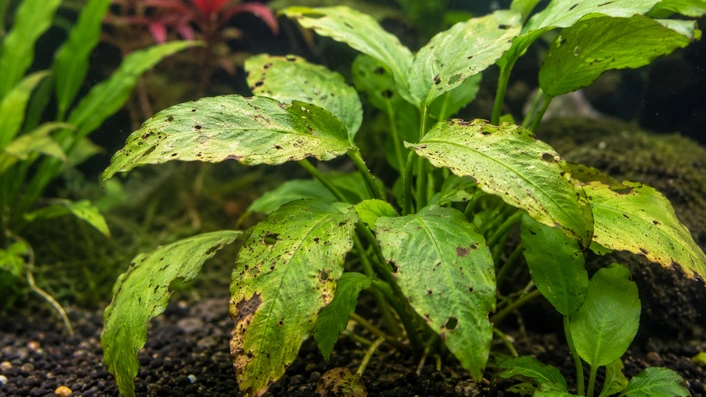
Potassium deficiency in aquarium plants is one of the most recognizable macronutrient problems in planted tanks. It often appears as tiny pinholes, dark spots, yellow or brown edges, weak older leaves, transparent patches, and tissue damage that slowly expands into visible holes.
This makes potassium deficiency different from many other nutrient problems. Nitrogen deficiency often looks like older yellow leaves. Iron deficiency usually affects new growth. Phosphate deficiency often appears as stalled growth and poor recovery. Potassium deficiency is strongly associated with damaged leaf tissue: small dots, holes, necrosis, brown margins, and leaves that look physically weakened.
The tricky part is that holes in aquarium plants can have several causes. Fish, snails, shrimp, melting, mechanical damage, old age, poor flow, CO₂ instability, and general nutrient imbalance can all damage leaves. That means potassium should not be diagnosed from one damaged leaf alone. You need to look for the full pattern: older leaves developing pinholes or dark spots, damage expanding over time, slower growth, and a fertilization routine that may not provide enough potassium for the plant mass.
This guide explains how to recognize aquarium plant potassium deficiency, how it differs from nitrogen and phosphate issues, why Java Fern and Anubias often show symptoms clearly, how to fix potassium shortage safely, and how to prevent it from returning. For the broader nutrient system, start with Macronutrients for Aquarium Plants. If your main symptom is yellow older leaves without holes, compare this article with Nitrogen Deficiency in Aquarium Plants.
Quick answer: Potassium deficiency usually appears on older or mature leaves as tiny pinholes, dark spots, yellow or brown-edged holes, necrotic tissue, weak leaf edges, transparent patches and slower growth. The fix is stable potassium availability through a complete planted tank fertilizer or a controlled potassium supplement.
What You’ll Learn in This Lesson
- What potassium does for aquarium plants
- How potassium deficiency looks in planted tanks
- Why pinholes and necrosis often point toward potassium shortage
- How potassium deficiency differs from nitrogen, phosphate and iron issues
- Why Java Fern, Anubias and fast growers often show symptoms clearly
- Why potassium becomes too low in planted aquariums
- How to fix potassium deficiency safely
- How to prevent recurring holes, weak leaves and stalled growth
What Potassium Does for Aquarium Plants
Potassium is a macronutrient. Aquarium plants need it in meaningful amounts for healthy growth, even though it is not usually discussed as often as nitrate or phosphate. In fertilizer labels, potassium is often shown as K.
Plants use potassium for many internal processes. It helps regulate water movement inside plant cells, supports enzyme activity, contributes to photosynthesis, helps transport nutrients and sugars, and supports overall tissue strength. In simple aquarium terms, potassium helps plants build and maintain strong leaves.
When potassium is missing, plant tissue becomes weaker. Leaves may develop small dark dots, pinholes, yellow-edged holes or necrotic patches. The plant may continue growing for a while, but the older leaves begin to show visible structural damage.
Potassium supports:
- Strong leaf tissue
- Healthy older leaves
- Stable plant metabolism
- Photosynthesis support
- Nutrient transport inside the plant
- Recovery after trimming
- Growth in high-light planted tanks
- Overall resistance to stress and tissue breakdown
In planted aquariums, potassium is not only a “color” nutrient. It is a structural and functional nutrient. A shortage often shows as physical damage rather than simple paleness.
Ready to set up your own tank?
Create a free account to save lessons, plan your setup, and use the Tank Hub to turn ideas into a real aquarium.
Potassium Deficiency Symptoms in Aquarium Plants
The most classic potassium deficiency symptom is small pinholes in older or mature leaves. These may begin as tiny dark specks, black dots or yellow-edged spots. Over time, the damaged tissue dies and expands into visible holes.
Potassium deficiency can also cause yellowing, brown edges, transparent patches, brittle leaves, reduced growth and general weakness. In many cases, the damage is easier to see on broad-leaved plants such as Java Fern, Anubias, swords, Cryptocoryne or Hygrophila than on very fine-leaved plants.
| Symptom | What It May Look Like | Why It Matters |
|---|---|---|
| Small pinholes | Tiny holes appear in older or mature leaves | Classic potassium deficiency clue |
| Dark spots | Small black or brown dots before holes form | Early tissue damage may be developing |
| Yellow-edged holes | Holes have yellow or brown margins | Leaf tissue is dying around the damaged area |
| Necrosis | Dead patches appear on older leaves | Potassium shortage can weaken leaf tissue |
| Transparent patches | Leaves look thin, weak or see-through | Can happen when tissue breaks down |
| Brown leaf edges | Margins become damaged or scorched-looking | Older leaves may be losing structural strength |
| Slower growth | Plants continue growing, but less strongly | Potassium supports overall metabolism and transport |
One hole does not automatically mean potassium deficiency. Look for repeated symptoms across multiple leaves, especially older leaves, and compare the pattern with livestock damage, melting and other nutrient problems.
Which Leaves Show Potassium Deficiency First?
Potassium deficiency usually appears on older or mature leaves first. This makes it different from many micronutrient problems that show most clearly in new growth. The plant can still produce new leaves for a while, but older leaves begin to deteriorate.
In Java Fern, potassium deficiency may appear as dark spots, holes, yellowing or damaged mature leaves. In Anubias, holes or yellow-edged damage may appear on older leaves. In fast-growing stem plants, the lower older leaves may show damage while the top continues growing. In carpeting plants, symptoms can be harder to diagnose because melting, shading and CO₂ issues can look similar.
| Plant Type | Common Potassium Deficiency Pattern | Diagnostic Note |
|---|---|---|
| Java Fern | Dark spots, pinholes, brown patches on older leaves | Often shows potassium issues clearly |
| Anubias | Pinholes, yellow edges, slow leaf deterioration | Can be confused with algae or old leaf aging |
| Stem plants | Older lower leaves develop holes or necrosis | Fast growers show trends quickly |
| Cryptocoryne | Older leaves weaken, yellow or develop damaged patches | Can overlap with Crypt melt or substrate issues |
| Carpeting plants | Weak patches, poor recovery, tissue decline | Light and CO₂ should also be checked |
| Floating plants | Weak, pale or damaged older leaves | Water-column nutrient shortage can appear quickly |
Always compare old growth with new growth. If new leaves are pale but older leaves are intact, potassium is probably not the first nutrient to suspect.
Potassium Deficiency vs Nitrogen, Phosphate and Iron Deficiency
Potassium deficiency overlaps with other nutrient problems, but it has one useful clue: tissue damage. Pinholes, necrosis and expanding holes are more typical of potassium shortage than simple nitrogen or iron deficiency.
Nitrogen deficiency often causes older leaves to turn yellow or translucent. Phosphate deficiency often appears as slow growth, small shoots, poor recovery and sometimes green spot algae. Iron deficiency usually affects new growth first, causing pale or yellow young leaves. Potassium deficiency often causes older leaves to become physically damaged.
| Problem | Typical Pattern | How It Differs From Potassium Deficiency |
|---|---|---|
| Potassium deficiency | Pinholes, dark spots, necrosis, yellow-edged holes on older leaves | Physical leaf damage is the strongest clue |
| Nitrogen deficiency | Older leaves turn yellow, pale or translucent | Usually more general yellowing than holes |
| Phosphate deficiency | Very slow growth, small shoots, poor trimming recovery | Usually less obvious tissue holes |
| Iron deficiency | New leaves become pale or yellow | Newest growth is usually affected first |
| CO₂ instability | Melting, algae, weak high-light growth | Often affects new growth and system balance broadly |
| Livestock damage | Irregular tears, bite marks or shredded edges | Damage may appear suddenly and unevenly |
If your main problem is yellow old leaves without holes, compare Nitrogen Deficiency in Aquarium Plants. If growth has simply stalled and green spot algae is appearing, compare Phosphate Deficiency in Aquarium Plants.
Why Potassium Deficiency Happens in Planted Aquariums
Potassium deficiency happens when plant demand is higher than potassium supply. This can happen in low-tech and high-tech aquariums, but it is especially common in tanks with high plant mass, strong lighting, CO₂ injection, fast growth or incomplete fertilization.
Unlike nitrate and phosphate, potassium is not always added in large amounts through fish waste and food. Some tap water contains useful potassium, but many aquariums still need potassium from fertilizer. If your fertilizer is incomplete, or if plant growth is fast, potassium may become limiting.
Common causes include:
- Using a fertilizer that does not provide enough potassium
- High plant mass and fast growth
- Strong lighting that increases nutrient demand
- CO₂ injection that accelerates plant uptake
- Large water changes with low-potassium source water
- High demand from Java Fern, Anubias or fast-growing plants
- Relying only on fish waste for plant nutrition
- Using root tabs but no water-column potassium
- Heavy floating plant growth consuming water-column nutrients
- Trying to run a planted tank with very lean fertilization
Potassium deficiency is not always a sign of poor maintenance. It can also be a sign that plants are growing strongly enough to need more complete nutrition.
Why Java Fern and Anubias Often Show Potassium Deficiency
Java Fern and Anubias are often mentioned when aquarists talk about potassium deficiency. They are slow-growing, broad-leaved epiphytes, which makes holes, black spots, yellow edges and older-leaf damage easier to see.
Because these plants grow slowly, old leaves remain visible for a long time. That means symptoms accumulate and become obvious. A fast stem plant may shed damaged lower leaves quickly, but Java Fern or Anubias may hold damaged leaves long enough for the problem to be noticed.
However, not every damaged Java Fern or Anubias leaf is potassium deficiency. These plants also collect algae under excessive light, suffer when rhizomes are buried, and show old-leaf decline naturally over time.
- Check whether the rhizome is buried or rotting.
- Check whether the plant is under harsh direct light.
- Check whether damage appears repeatedly on older leaves.
- Check whether new leaves are healthy after dosing.
- Remove badly damaged leaves gradually.
- Do not expect old damaged leaves to repair fully.
If you are growing epiphytes, potassium should be part of the water-column nutrient plan because these plants are not feeding heavily from substrate.
Holes in Aquarium Plants: Is It Always Potassium?
No. Holes in aquarium plants are commonly associated with potassium deficiency, but they are not proof by themselves. Several other problems can create holes or damaged leaves.
Before dosing potassium aggressively, look at the shape, timing and location of the damage. Nutrient-related pinholes often begin as small dark spots or tiny holes that expand slowly on older leaves. Livestock damage may look more torn, irregular or sudden. Melting may create transparent tissue that dissolves more broadly.
| Cause of Holes | What It Looks Like | What to Check |
|---|---|---|
| Potassium deficiency | Small pinholes, dark spots, yellow-edged holes on older leaves | Fertilizer, plant pattern and new growth after dosing |
| Snail or fish grazing | Irregular bite marks, shredded tissue or missing edges | Livestock behavior and leaf softness |
| Melting | Transparent tissue dissolves after planting or changes | Recent planting, water changes or transition stress |
| Old leaf aging | Only a few old leaves deteriorate slowly | Whether new growth is healthy |
| Mechanical damage | Tears, bent leaves or damaged edges | Handling, trimming and filter flow |
| CO₂ or nutrient imbalance | Mixed symptoms, algae and weak growth | Light, CO₂, macro and micro routine |
Potassium deficiency is likely when holes appear as a repeated pattern across older leaves, especially when plants are otherwise receiving enough light and the fertilizer routine may be low in potassium.
Can Potassium Be Too Low in a Planted Tank?
Yes. Potassium can become too low in planted aquariums, especially in tanks where plants are growing actively. This is common in high-light tanks, CO₂ aquascapes, dense low-tech tanks and aquariums with many epiphytes or fast-growing stems.
Unlike nitrate, potassium is not usually monitored by beginners. Many aquarists test ammonia, nitrite, nitrate and sometimes phosphate, but never test potassium. This means potassium deficiency is often diagnosed from symptoms and fertilizer review rather than regular testing.
| Tank Type | Potassium Demand | Practical Note |
|---|---|---|
| Low-light beginner tank | Low to moderate | Complete fertilizer may be enough |
| Epiphyte-heavy tank | Moderate | Java Fern and Anubias may show symptoms clearly |
| High-light planted tank | High | Demand rises with light intensity |
| CO₂ aquascape | High | Fast growth can consume potassium quickly |
| Shrimp tank | Variable | Dose cautiously and prioritize stability |
| Fish-heavy tank | Still possible | Fish waste does not guarantee enough potassium |
Potassium is part of the full macronutrient balance. It should not be ignored just because nitrate and phosphate are measurable.
How to Test for Potassium Deficiency
Potassium test kits exist, but many aquarists do not use them because they are less common than nitrate or phosphate tests. Testing can be useful in advanced planted tanks, but for many hobbyists, diagnosis starts with symptoms and fertilizer review.
If you do use a potassium test, treat it as one clue rather than the entire diagnosis. Test results can vary, and plant demand changes with light, CO₂, plant mass and water changes. A repeated pattern is more useful than one isolated result.
Testing and Review Checklist
- Check whether symptoms appear on older or mature leaves.
- Look for pinholes, dark spots, yellow-edged holes and necrosis.
- Review whether your fertilizer contains potassium.
- Check if you recently increased light or CO₂.
- Check if plant mass has increased significantly.
- Compare symptoms with nitrogen and phosphate deficiencies.
- Watch whether new damage stops after stable potassium dosing.
- Use a potassium test if you want more precise control.
Because potassium symptoms are visible on leaves, plant observation is especially important. Test numbers are helpful, but the plant’s new growth tells you whether the correction is working.
How to Fix Potassium Deficiency in Aquarium Plants
The safest way to fix potassium deficiency is to provide stable potassium availability through a complete planted tank fertilizer or a dedicated potassium supplement. The right choice depends on whether your aquarium lacks only potassium or may be low in several nutrients.
Old damaged leaves usually do not heal. Pinholes and necrotic patches will not close up. The real sign of recovery is that new leaves grow cleaner, stronger and without fresh pinholes.
Step-by-Step Fix
- Confirm the pattern: pinholes, dark spots or necrosis on older leaves.
- Check whether livestock or mechanical damage could explain the holes.
- Review your fertilizer label for potassium content.
- Start with a complete fertilizer if multiple nutrients may be low.
- Use a potassium supplement if potassium is clearly the missing nutrient.
- Keep light and CO₂ stable while correcting the issue.
- Remove badly damaged leaves gradually.
- Watch new growth over the next several weeks.
- Adjust dosing slowly instead of making large sudden changes.
If you need dosing support, use the Fertilizer Dosing Calculator instead of guessing. Controlled dosing is safer than random corrections.
Complete Fertilizer vs Potassium Supplement
A complete fertilizer is usually the best first choice when you are unsure which nutrient is missing. Many symptoms overlap, and plants often need several nutrients corrected together. A complete planted tank fertilizer can restore nitrogen, phosphate, potassium and trace nutrients depending on the product.
A dedicated potassium supplement is more useful when the tank already has stable nitrate, phosphate and micronutrients, but potassium symptoms remain. This is more common in high-tech tanks or aquariums where the fertilization routine is already structured.
| Fertilizer Approach | Best For | Main Caution |
|---|---|---|
| Complete all-in-one fertilizer | Beginner and low-tech tanks with uncertain deficiency | Check that it includes potassium and macronutrients |
| Dedicated potassium supplement | Clear potassium symptoms with otherwise stable nutrients | Avoid dosing blindly without observing response |
| Structured macro dosing | High-tech aquascapes and dense plant tanks | Requires routine and consistency |
| Root tabs only | Root feeders in inert substrate | May not solve water-column potassium shortage |
| Relying on fish waste | Fish-heavy low-demand tanks | Does not guarantee enough potassium |
Read fertilizer labels carefully. Some products are mainly micronutrient fertilizers and may not provide enough potassium for a planted tank with high demand.
Potassium Deficiency in Low-Tech Aquariums
Low-tech aquariums can develop potassium deficiency, especially when they are heavily planted, have many epiphytes, receive large water changes, or use fertilizers that are too lean. The correction should usually be moderate and consistent rather than aggressive.
Because low-tech plants grow more slowly, improvement may take time. Do not judge success after one or two days. Look at the newest leaves over several weeks and check whether fresh pinholes stop appearing.
- Use moderate lighting to keep nutrient demand realistic.
- Use a complete fertilizer if several symptoms overlap.
- Watch Java Fern and Anubias for pinholes and dark spots.
- Do not increase light while plants are nutrient-limited.
- Remove heavily damaged leaves slowly, not all at once.
- Keep water changes consistent.
- Judge improvement by new growth.
For low-tech plant planning, review Aquarium Plant Light Requirements. Too much light can make nutrient shortages appear faster.
Potassium Deficiency in High-Tech Aquascapes
High-tech aquascapes have higher potassium demand because strong light and CO₂ drive faster plant growth. In these tanks, potassium can become limiting even when nitrate and phosphate are dosed regularly.
Dense carpets, fast stem plants, red plants and frequent trimming all increase nutrient demand. If potassium falls behind, older leaves may develop holes and tissue damage while growth becomes less reliable.
- Coordinate potassium with nitrate and phosphate dosing.
- Do not run strong light with incomplete macronutrient support.
- Watch fast stems for older-leaf damage after strong growth phases.
- Observe carpets after trimming for weak recovery.
- Use stable CO₂ before increasing light intensity.
- Consider potassium testing in advanced high-energy tanks.
- Keep dosing consistent rather than reactive.
For high-light planning, compare Aquarium PAR Explained and Aquarium Lighting and Algae.
Can Too Much Potassium Cause Problems?
Potassium is necessary, but more is not automatically better. Excessive dosing can contribute to nutrient imbalance, especially if it is added blindly while other nutrients remain limiting. In planted aquariums, nutrients work together. Potassium should support growth, not become a random overdose.
Most aquarists are more likely to underdose potassium than dangerously overdose it, but the principle still matters: dose with a routine, not panic. If you add large amounts of potassium while nitrate, phosphate, CO₂ or light remain unbalanced, the tank may still struggle.
| Situation | Likely Meaning | Best Response |
|---|---|---|
| Pinholes with weak fertilization | Possible potassium deficiency | Add complete fertilizer or potassium gradually |
| Pinholes despite strong potassium dosing | May be another cause | Check livestock, CO₂, melting and other nutrients |
| Strong potassium but weak growth | Another factor may be limiting | Check nitrate, phosphate, micros, light and CO₂ |
| Random large potassium corrections | Unstable routine | Move to consistent dosing |
| No new pinholes after dosing | Correction may be working | Maintain stable routine and monitor new growth |
The goal is not maximum potassium. The goal is enough potassium inside a balanced nutrient system.
What to Watch After Fixing Potassium Deficiency
After correcting potassium deficiency, do not expect damaged leaves to repair. Holes, necrotic tissue and brown patches usually remain. The best sign of recovery is that new leaves grow clean and older leaves stop developing fresh pinholes.
Fast-growing plants may show improvement sooner than slow plants. Java Fern, Anubias and Bucephalandra may take longer because they produce new leaves slowly. Be patient and watch the next generation of growth.
- New leaves should appear stronger and cleaner.
- Fresh pinholes should stop forming.
- Older leaves should decline more slowly.
- Stem plants should recover better after trimming.
- Epiphytes should produce healthier new leaves over time.
- Algae pressure may decrease if plant growth improves.
- Existing damaged leaves may need gradual removal.
If fresh holes continue to appear after several weeks of stable potassium dosing, reassess the diagnosis. The damage may come from livestock, melting, CO₂ instability or another nutrient imbalance.
Common Mistakes When Fixing Potassium Deficiency
Potassium deficiency is usually easy to improve, but mistakes happen when aquarists diagnose too quickly or dose without checking the full system.
| Mistake | Why It Causes Problems | Better Approach |
|---|---|---|
| Assuming every hole means potassium deficiency | Livestock, melting and old leaves can also cause holes | Check the full pattern before dosing |
| Expecting damaged leaves to heal | Necrotic tissue does not repair fully | Judge new growth instead |
| Using micronutrients only | May not add enough potassium | Use complete macro support if needed |
| Dosing potassium while ignoring nitrate and phosphate | Another macro may remain limiting | Balance all macronutrients |
| Increasing light during deficiency | Raises demand and algae risk | Fix nutrients before increasing light |
| Removing too many slow-plant leaves at once | Weakens Anubias, Java Fern or Buce | Remove damaged leaves gradually |
| Changing everything at once | Makes diagnosis impossible | Adjust one major factor at a time |
The cleanest fix is stable fertilizer, stable light, stable water changes and careful observation of new growth.
Final Potassium Deficiency Checklist
Use this checklist before changing your routine:
- Are older or mature leaves developing small pinholes?
- Do holes begin as dark spots or yellow-edged patches?
- Is the damage appearing on multiple plants, not only one old leaf?
- Could fish, snails, shrimp or mechanical damage explain the holes?
- Does your fertilizer clearly contain potassium?
- Are nitrate and phosphate also available?
- Have you recently increased light or CO₂?
- Are Java Fern or Anubias showing repeated older-leaf damage?
- Are you judging recovery by new leaves instead of old damaged leaves?
- Can you correct the routine gradually instead of dosing randomly?
If several answers point toward potassium shortage, stable potassium-containing fertilization is the next logical step.
Conclusion
Potassium deficiency in aquarium plants is most often recognized by pinholes, dark spots, yellow-edged holes, brown patches, necrosis and weak older leaves. Unlike some nutrient deficiencies that mainly change leaf color, potassium shortage often damages leaf tissue itself.
The most important step is diagnosis. Holes can also come from livestock, melting, old leaves or mechanical damage, so look for a repeated pattern across older leaves and compare it with your fertilizer routine. If potassium is missing or too low, use a complete planted tank fertilizer or a dedicated potassium supplement in a controlled way.
Do not expect old damaged leaves to heal. Watch new growth. If new leaves stay clean, strong and free of fresh pinholes, your correction is working. In planted aquariums, potassium is not optional background chemistry — it is part of the core macronutrient balance that keeps plant tissue healthy and growth stable.
💬 Join the Conversation
Are your aquarium plants showing pinholes, yellow-edged damage, black spots, weak Java Fern leaves, Anubias holes or possible potassium deficiency?
Tag us on Instagram @AquariumLesson — we’d love to see your planted tank recovery, nutrient routine and before-and-after plant growth.
FAQ
What does potassium deficiency look like in aquarium plants?
Potassium deficiency often appears as small pinholes, dark spots, yellow or brown-edged holes, necrotic patches, transparent areas and damaged older leaves. Growth may also become slower or weaker.
Does potassium deficiency cause holes in aquarium plants?
Yes, potassium deficiency is strongly associated with pinholes and expanding holes in older leaves. However, holes can also come from livestock damage, melting, old leaves or mechanical damage, so check the full pattern before dosing.
Which leaves show potassium deficiency first?
Potassium deficiency usually appears on older or mature leaves first. New growth may continue for a while, while older leaves develop small holes, dark spots, yellow edges or dead tissue patches.
How do I fix potassium deficiency in aquarium plants?
Review your fertilizer, confirm the symptoms, then dose a complete planted tank fertilizer or a dedicated potassium supplement gradually. Keep lighting and CO₂ stable, and judge improvement by new growth rather than old damaged leaves.
Is potassium deficiency common in Java Fern?
Java Fern often shows potassium deficiency clearly because its older leaves can develop dark spots, holes or damaged patches. However, algae, old leaf age, rhizome problems and lighting issues should also be checked.
Can Anubias get potassium deficiency?
Yes. Anubias can show potassium deficiency as pinholes, yellow-edged damage or slow deterioration on older leaves. Because Anubias grows slowly, damaged leaves may stay visible for a long time.
Can potassium deficiency cause yellow leaves?
Potassium deficiency can cause yellowing around damaged tissue or older leaves, but plain yellow older leaves without holes may point more strongly toward nitrogen deficiency. Look for pinholes, necrosis and edge damage.
Will holes in leaves heal after potassium dosing?
No. Existing holes and dead tissue usually do not heal. The sign that potassium deficiency is fixed is healthier new growth and fewer fresh holes appearing on leaves after the routine is corrected.
Start building your aquarium with the Tank Hub
Save your favorite lessons, organize your setup, and track your aquarium step by step in your personal Tank Hub.
New to AquariumLesson? Start with our complete Aquarium Lessons Hub or return to the homepage at AquariumLesson.com.
Continue learning
References
- Aquasabi — Deficiency Symptoms in Aquatic Plants
- Aquarium Co-Op — Nutrient Deficiencies: Why Your Aquarium Plants Are Dying
- Aquarium Co-Op — When Should I Dose Potassium in My Planted Aquarium?
- ARKA Biotech — Optimal Plant Growth
- Green Aqua — The Most Common Plant Deficiency Symptoms in the Aquarium
- Rotala Butterfly — Aquarium Plant Deficiencies