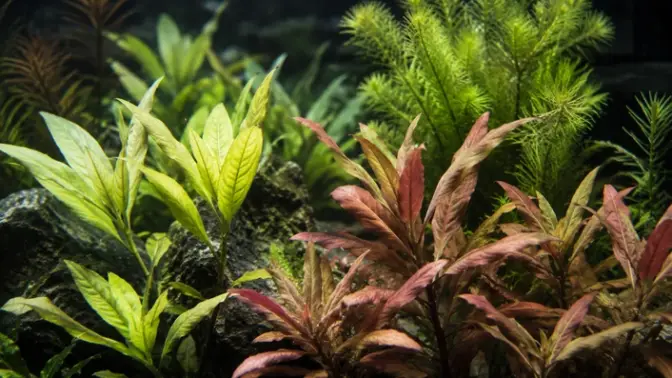
Iron Deficiency in Aquarium Plants: Symptoms & Fixes
Introduction
Iron deficiency in aquarium plants is one of the most common micronutrient problems in planted tanks. It usually appears as pale, yellow, light green, or almost white new growth while older leaves remain comparatively normal. This pattern is important because iron is not very mobile inside the plant, so new leaves suffer first when available iron is too low.
Iron deficiency is often described as chlorosis. In aquarium plants, chlorosis means the leaf loses green color because chlorophyll production is limited. On young leaves, the tissue between the veins may turn yellow while the veins remain darker. In stronger cases, the whole new leaf can become pale, glassy, stunted, or damaged.
This deficiency can be confusing because yellow leaves do not always mean iron shortage. Nitrogen deficiency often affects older leaves first. Magnesium deficiency can also cause interveinal chlorosis, especially on older leaves. Poor lighting, CO₂ instability, transition melt, hard water chemistry, weak fertilizer routines, or general plant stress can also create pale growth.
This guide explains how to recognize aquarium plant iron deficiency, how it differs from nitrogen, potassium, phosphate and magnesium issues, why iron can become unavailable even when you dose fertilizer, and how to fix the problem safely. For the broader nutrient system, start with Micronutrients for Aquarium Plants. If your symptoms affect old leaves instead, compare this article with Nitrogen Deficiency in Aquarium Plants.
Quick answer: Iron deficiency usually affects new growth first. Young leaves may become pale, yellow, light green or white, often with darker veins. The fix is stable micronutrient fertilization, suitable iron availability, balanced light, and avoiding conditions that make iron unavailable to plants.
What You’ll Learn in This Lesson
- What iron does for aquarium plants
- How iron deficiency looks in planted tanks
- Why new leaves usually show symptoms first
- How iron deficiency differs from nitrogen, potassium, phosphate and magnesium issues
- Why iron can be unavailable even when fertilizer is added
- How lighting, CO₂, pH and nutrients affect iron demand
- How to fix iron deficiency safely
- How to prevent pale new growth, chlorosis and recurring micronutrient problems
What Iron Does for Aquarium Plants
Iron is a micronutrient. Aquarium plants need it in smaller amounts than macronutrients such as nitrogen, phosphorus and potassium, but that does not make it unimportant. Without available iron, plants cannot maintain healthy chlorophyll production and strong new growth.
Iron is involved in enzyme systems, photosynthesis-related processes, chlorophyll formation, pigment development and the growth of new plant tissue. It is especially important in actively growing shoot tips, new leaves and fast-growing stem plants.
In planted aquarium terms, iron supports:
- Healthy green color in new leaves
- Chlorophyll production
- Strong shoot tip development
- Normal leaf expansion
- Good growth in fast stem plants
- Color development in some red plants
- Stable micronutrient balance
- Recovery after trimming when new growth resumes
Iron is not needed in huge quantities, but it must remain available. A tank can contain iron that plants cannot use well because of water chemistry, precipitation, old fertilizer, wrong dosing rhythm or poor chelation stability.
Iron Deficiency Symptoms in Aquarium Plants
The classic symptom of iron deficiency is pale new growth. Young leaves may appear light green, yellow, yellow-white or nearly white. In many cases, the veins stay darker while the tissue between the veins becomes pale. This is called interveinal chlorosis.
Because iron is relatively immobile inside plants, older leaves usually stay greener while the newest growth suffers first. This makes iron deficiency different from nitrogen and potassium deficiencies, which often affect older leaves more clearly.
| Symptom | What It May Look Like | Why It Matters |
|---|---|---|
| Pale new leaves | Young leaves appear light green, yellow or white | Classic iron deficiency pattern |
| Darker veins on pale leaves | Leaf veins remain greener than the surrounding tissue | Interveinal chlorosis often points to iron or similar micronutrient issues |
| Stunted new growth | New leaves stay small or weak | Severe deficiency affects active growth |
| Glassiness in young leaves | New leaves look thin or translucent | Can occur when deficiency becomes stronger |
| Shoot tips lose color | Stem plant tops become pale or yellow | Fast growers often reveal iron problems quickly |
| Red plants lose intensity | Color becomes weaker or washed out | Iron may be part of the color system, but light and CO₂ matter too |
| Necrosis in severe cases | Damaged or dying tissue appears on new leaves | Usually a more advanced deficiency or mixed problem |
One pale new leaf does not automatically prove iron deficiency. Look for repeated pale new growth across several plants, especially fast-growing species, while older leaves remain comparatively normal.
Why Iron Deficiency Appears on New Leaves First
Iron deficiency usually appears on new leaves because iron is not easily moved from old leaves to new growth. Once iron is locked into older plant tissue, the plant cannot simply relocate it efficiently when new leaves need it.
This is why iron deficiency is different from nitrogen deficiency. Nitrogen is mobile, so plants can move nitrogen from old leaves into new growth. That is why nitrogen deficiency usually damages older leaves first. Iron is much less mobile, so the newest leaves show symptoms first.
This old-growth versus new-growth comparison is one of the most useful diagnostic tools in planted aquariums:
| Leaf Pattern | More Likely Problem | Reason |
|---|---|---|
| New leaves pale, old leaves normal | Iron or other immobile micronutrient issue | New growth cannot receive enough available iron |
| Old leaves yellow first | Nitrogen deficiency | Nitrogen is mobile and moved from old leaves |
| Old leaves develop pinholes | Potassium deficiency | Older tissue often shows damage |
| Growth stalls broadly | Phosphate, CO₂, light or general nutrient limitation | Not always a clear leaf-position symptom |
| New leaves twisted or deformed | Calcium, boron, severe micros or growth stress | New tissue formation is disrupted |
Before dosing iron, check whether the newest leaves are truly the most affected. If old leaves are the main issue, another deficiency may be more likely.
Iron Deficiency vs Nitrogen, Potassium, Phosphate and Magnesium Deficiency
Yellowing can be caused by several nutrient problems. The key is not just the color, but where the symptom appears and what kind of damage develops.
Iron deficiency usually causes pale young leaves with darker veins. Nitrogen deficiency causes older leaves to yellow. Potassium deficiency creates pinholes and necrotic damage, usually on older leaves. Phosphate deficiency often shows as slow growth, poor trimming recovery and sometimes green spot algae. Magnesium deficiency can also cause chlorosis, but often appears on older leaves because magnesium is mobile.
| Problem | Typical Pattern | How It Differs From Iron Deficiency |
|---|---|---|
| Iron deficiency | Pale new leaves, yellow young shoots, darker veins | Newest growth is usually most affected |
| Nitrogen deficiency | Older leaves turn yellow, pale or translucent | Old growth usually shows symptoms first |
| Potassium deficiency | Pinholes, dark spots, yellow-edged holes, necrosis | Physical tissue damage is more typical |
| Phosphate deficiency | Slow growth, smaller shoots, poor recovery, green spot algae | Often less about pale new leaves and more about stalled growth |
| Magnesium deficiency | Interveinal chlorosis, often on older leaves | Can resemble iron deficiency but usually affects older leaves more |
| CO₂ instability | Melting, algae, weak high-light growth | Usually linked to system imbalance, not just pale new leaves |
| Weak light | Leggy growth, shaded leaves decline, slow development | Symptoms follow light zones and shading patterns |
If your symptoms are mostly pinholes and damaged mature leaves, read Potassium Deficiency in Aquarium Plants. If the main issue is stalled growth and green spot algae, read Phosphate Deficiency in Aquarium Plants.
Why Iron Deficiency Happens in Planted Aquariums
Iron deficiency can happen for two broad reasons: there is not enough iron being added, or the iron being added is not staying available to plants long enough. Both situations can happen in planted aquariums.
Many aquariums receive little iron from fish waste or tap water. Plants rely on liquid fertilizer for micronutrients. If the fertilizer is incomplete, dosed too rarely, expired, unstable or not matched to the tank’s demand, new growth may become pale.
Iron can also become unavailable because of water chemistry. Depending on pH, hardness, chelation and nutrient interactions, iron may precipitate or bind in forms plants cannot use efficiently. This is why some tanks show iron deficiency symptoms even when iron is being dosed.
Common causes include:
- No regular micronutrient fertilizer
- Using only macronutrient fertilizer without trace elements
- Very fast plant growth from strong light and CO₂
- High plant mass consuming micronutrients quickly
- Hard or high-pH water reducing iron availability
- Iron fertilizer that is not stable in the tank’s water conditions
- Large water changes without replacing micronutrients
- Heavy use of chemical filtration or adsorbing media
- Old or poorly stored fertilizer
- Trying to run bright red plants with very lean micros
Iron deficiency is often not a single-plant issue. It is usually a sign that the tank’s micronutrient routine is not matching plant demand.
Yes. Iron can be present in the aquarium but unavailable to plants. This is one reason iron deficiency can be frustrating.
Many aquarium fertilizers use chelated iron. Chelation helps keep iron soluble and plant-available for longer. Different chelates perform differently depending on pH and water chemistry. In some aquariums, especially harder or higher-pH systems, certain iron forms may become less available faster.
Iron can also interact with phosphate and other compounds. This does not mean phosphate is bad or iron is impossible to dose. It means the dosing routine should be stable and designed for the whole nutrient system, not random correction doses.
| Situation | Possible Effect | Better Approach |
|---|---|---|
| High pH or hard water | Some iron forms may become less available | Use a suitable complete micro fertilizer and observe new growth |
| Old fertilizer | Reduced effectiveness or instability | Use fresh product stored correctly |
| Very rare dosing | Iron availability drops between doses | Dose smaller amounts more consistently if needed |
| Strong light and CO₂ | Plants consume micros faster | Match micro dosing to plant demand |
| Phosphate and iron dosed chaotically | Possible instability or precipitation concerns | Use a consistent routine rather than random corrections |
If you dose iron but new leaves stay pale, do not only add more. Check pH, fertilizer type, dosing frequency, light intensity, CO₂ stability and whether the issue might actually be magnesium or another micronutrient problem.
Iron Deficiency and Red Aquarium Plants
Iron is often associated with red plants, but it is not the only reason plants turn red. Red plant color depends on genetics, light intensity, nitrate balance, CO₂ stability, overall nutrition and plant health. Iron supports healthy growth and pigment systems, but adding iron alone will not automatically make every plant red.
If a red plant becomes pale, yellow or weak at the shoot tips, iron may be part of the issue. But if a red plant is simply green under low light, the main limitation may be light intensity rather than iron. If the plant is algae-covered, stunted or melting, CO₂ and macronutrient balance may be involved.
- Use iron to support healthy new growth, not as a magic red-color booster.
- Strong red color usually needs enough light.
- High light needs stable CO₂ and macronutrients.
- Excessive iron does not replace good system balance.
- Judge red plant health by new shoot quality, not color alone.
For light-driven plant color, read Aquarium Plant Light Requirements and Aquarium PAR Explained.
Iron Deficiency in Stem Plants
Stem plants often show iron deficiency clearly because they grow quickly and produce visible shoot tips. If iron is limited, the newest tops may turn pale, yellow, washed out or smaller than normal.
Fast stems in high-light aquariums can consume micronutrients quickly. After trimming, they need enough iron and trace elements to produce strong new tips. If regrowth is pale while old leaves stay greener, iron deficiency becomes more likely.
- Watch the newest shoot tips first.
- Compare new growth with older healthy leaves.
- Check whether pale tops appear across several stem species.
- Review micro fertilizer dosing frequency.
- Keep CO₂ stable before increasing light.
- Do not confuse pale tops with severe nitrate or phosphate limitation.
Stem plants are useful diagnostic plants because they respond faster than slow epiphytes. If new shoot color improves after stable micro dosing, iron availability was likely part of the problem.
Iron Deficiency in Anubias, Java Fern and Bucephalandra
Slow epiphytes can show iron deficiency, but they are harder to diagnose because they grow slowly. Anubias, Java Fern and Bucephalandra may produce pale new leaves if iron or trace elements are unavailable. However, old leaves with algae, holes or dark spots may point to other problems.
With epiphytes, focus on the newest leaf. If the newest Anubias or Bucephalandra leaf opens pale while older leaves remain normal, iron or another immobile micronutrient may be limited. If older leaves are full of holes, potassium or age-related damage may be more relevant.
- Check whether the newest leaves are pale.
- Keep rhizomes exposed and healthy.
- Avoid harsh direct light on slow leaves.
- Use stable water-column micronutrients.
- Remove old algae-covered leaves gradually.
- Do not expect slow plants to recover overnight.
For epiphyte care, compare Anubias Aquarium Plant Guide, Java Fern Aquarium Plant Guide and Bucephalandra Aquarium Plant Guide.
Iron Deficiency in Low-Tech Aquariums
Low-tech aquariums can develop iron deficiency, especially when they are heavily planted, have many fast growers, or use no complete fertilizer. However, the correction should usually be moderate because plant demand is lower than in high-tech tanks.
In low-tech setups, iron deficiency often appears when plants grow slowly but new leaves are consistently pale. This is especially common if the aquarium has low fish load, regular water changes and no liquid micronutrient routine.
- Use a complete liquid fertilizer if no micros are currently dosed.
- Keep light moderate so plant demand stays realistic.
- Do not overdose iron to force faster growth.
- Watch new leaves over several weeks.
- Check whether yellowing is actually on old leaves instead.
- Use regular water changes to keep the system predictable.
For low-tech planning, read No CO₂ Planted Tank. Iron works best when the whole low-tech system is balanced, not when one nutrient is pushed aggressively.
Iron Deficiency in High-Tech Aquascapes
High-tech aquascapes have higher micronutrient demand because strong light and CO₂ drive faster growth. In these tanks, iron deficiency can appear quickly if micro dosing is too lean or inconsistent.
Fast stem plants, red plants, carpeting plants and frequent trimming all increase nutrient demand. If iron is limited, new shoot tips may become pale and regrowth after trimming may look weak.
- Use a consistent micro fertilizer routine.
- Coordinate iron with macronutrients, not separately from the full system.
- Keep CO₂ stable before increasing light.
- Watch fast stem tips after trimming.
- Do not run high light with very lean micronutrients.
- Monitor plant response rather than chasing a perfect test number.
For high-light balance, read Aquarium Lighting and Algae. Many “iron problems” become worse when light demand is higher than the complete nutrient system can support.
How to Test Iron in an Aquarium
Iron test kits exist, but they can be difficult to interpret. A test may not show all forms of iron equally, and a zero or low reading does not always mean plants are deficient. Iron can be used quickly, chelated, bound, precipitated or present in forms the test does not read well.
Because of this, plant symptoms and fertilizer routine are often more useful than chasing an exact iron number. Testing can still help advanced aquarists, but for most hobbyists, the best indicator is whether new growth becomes healthier after a stable micronutrient routine.
Iron Testing Checklist
- Test at the same time relative to dosing if you want trend data.
- Do not panic over one low reading.
- Check whether symptoms match iron deficiency first.
- Review fertilizer type, frequency and storage.
- Compare iron symptoms with magnesium and nitrogen symptoms.
- Watch new growth over several weeks after changes.
- Use testing as a clue, not the whole diagnosis.
In planted aquariums, perfect test numbers matter less than stable plant growth. If new leaves are healthy, the iron routine is probably working.
How to Fix Iron Deficiency in Aquarium Plants
The safest way to fix iron deficiency is to restore stable micronutrient availability. In most aquariums, that means using a complete liquid fertilizer that includes iron and trace elements. In tanks with clear iron-specific symptoms and otherwise balanced nutrition, a dedicated iron supplement may be useful.
Do not correct iron deficiency by making several major changes at once. If you increase iron, keep light, CO₂, water changes and macronutrient dosing stable while watching new growth.
Step-by-Step Fix
- Confirm that the newest leaves are the most affected.
- Compare symptoms with nitrogen, potassium, phosphate and magnesium deficiency.
- Check whether your fertilizer includes iron and trace elements.
- Start with a consistent complete micronutrient fertilizer routine.
- Use an iron supplement only if iron appears clearly limiting.
- Keep lighting stable during correction.
- Do not increase CO₂, macros and iron all at once unless your full routine was missing.
- Remove leaves that are badly damaged or algae-covered.
- Judge recovery by healthier new growth, not by old leaves.
For controlled dosing, use the Fertilizer Dosing Calculator instead of guessing. Iron dosing should be consistent, not reactive and random.
Complete Micronutrient Fertilizer vs Iron Supplement
A complete micronutrient fertilizer is usually the best first choice when you are not completely sure the issue is iron alone. Many trace nutrients interact, and several micronutrient deficiencies can produce similar pale new growth.
A dedicated iron supplement is more precise when the tank already receives balanced nutrients but new growth still shows clear iron symptoms. This is more common in higher-demand planted tanks, red plant setups, or aquariums where the standard fertilizer is too lean for the plant mass.
| Fertilizer Approach | Best For | Main Caution |
|---|---|---|
| Complete micro fertilizer | Most beginner and low-tech planted tanks | Make sure the product includes iron and trace elements |
| All-in-one fertilizer | Tanks that may lack both macros and micros | Check the full label, not just marketing claims |
| Dedicated iron supplement | Clear iron symptoms with otherwise balanced nutrition | Avoid using iron as a cure for every yellow leaf |
| Root tabs only | Root feeders in inert substrate | May not solve water-column iron needs for stems and epiphytes |
| Fish waste only | Very low-demand tanks | Usually unreliable for micronutrient balance |
If you are unsure, start with complete nutrition rather than isolated iron. Iron deficiency often appears inside a broader micronutrient routine problem.
Can Too Much Iron Cause Problems?
More iron is not always better. Plants need iron, but overdosing one trace element does not fix poor lighting, unstable CO₂, missing macronutrients or weak plant health. Excessive iron dosing can also contribute to imbalance and may create unnecessary algae concerns in poorly balanced tanks.
Most aquarists are better served by consistent complete dosing than by large iron correction doses. If new growth improves with a modest routine, there is usually no need to keep increasing iron.
| Situation | Likely Meaning | Best Response |
|---|---|---|
| Pale new growth with no micro fertilizer | Likely micronutrient shortage | Start complete micro dosing |
| Pale new growth despite iron dosing | Iron may be unavailable or another nutrient may be missing | Check pH, fertilizer type, magnesium, macros and CO₂ |
| Green older leaves but yellow new tops | Iron or immobile micronutrient issue is plausible | Improve micro routine gradually |
| Old yellow leaves only | Probably not iron first | Check nitrogen or magnesium pattern |
| Algae after aggressive dosing | System imbalance or overcorrection | Return to stable dosing and review light |
The goal is enough available iron for healthy new growth, not maximum iron in the water.
What to Watch After Fixing Iron Deficiency
After correcting iron deficiency, watch new growth. Existing pale leaves may not become perfect again, especially if the deficiency was severe. New leaves are the best recovery indicator.
Fast stem plants may show improvement relatively quickly. Slow plants such as Anubias, Java Fern and Bucephalandra may take longer because they produce new leaves slowly.
- New leaves should become greener and healthier.
- Shoot tips should stop appearing pale or white.
- Interveinal chlorosis should reduce on new growth.
- Stem plants should recover better after trimming.
- Red plants may look healthier, but color still depends on light and CO₂.
- Old damaged leaves may remain pale or need removal.
- Algae pressure may improve if plant growth becomes stronger.
If new growth remains pale after several weeks of stable micronutrient dosing, reassess the diagnosis. Magnesium, manganese, CO₂, light, pH or macronutrient imbalance may be involved.
Common Mistakes When Fixing Iron Deficiency
Iron deficiency is usually fixable, but many aquarists misdiagnose it because “yellow leaves” are too broad as a symptom. The biggest mistake is dosing iron for every plant problem without checking leaf age, growth pattern and the full nutrient routine.
| Mistake | Why It Causes Problems | Better Approach |
|---|---|---|
| Assuming every yellow leaf means iron deficiency | Old yellow leaves often point to nitrogen or magnesium | Check whether new or old leaves are affected first |
| Adding iron but no complete micros | Other trace elements may still be missing | Use balanced micronutrient fertilization |
| Increasing light during deficiency | Raises plant demand and algae risk | Fix nutrients before increasing light |
| Expecting old leaves to heal | Damaged leaves often stay damaged | Judge new growth instead |
| Ignoring pH and water chemistry | Iron may become less available | Use fertilizer suitable for your water conditions |
| Using expired or poorly stored fertilizer | Micronutrients may be less reliable | Use fresh fertilizer and store it correctly |
| Changing iron, CO₂, macros and light all at once | Makes diagnosis impossible | Adjust one main variable at a time |
The cleanest correction is stable and measured: complete nutrition, appropriate light, consistent water changes and careful observation of new leaves.
Final Iron Deficiency Checklist
Use this checklist before changing your fertilizer routine:
- Are the newest leaves pale, yellow, light green or white?
- Do older leaves look more normal than new growth?
- Are the veins on new leaves darker than the surrounding tissue?
- Is the problem visible on several plants, especially fast growers?
- Does your fertilizer include iron and trace elements?
- Are you dosing micros consistently enough for the plant mass?
- Could magnesium, nitrogen, CO₂ or lighting explain the symptoms better?
- Is your water hard or high in pH, making iron availability more challenging?
- Are you judging recovery by new leaves rather than old damaged leaves?
- Can you correct the routine gradually instead of overreacting?
If several answers point toward iron limitation, stable micronutrient fertilization is the next logical step.
Conclusion
Iron deficiency in aquarium plants usually appears as pale, yellow, light green or white new growth. Because iron is not very mobile inside plants, the newest leaves suffer first while older leaves may remain comparatively normal. This makes leaf position the most important diagnostic clue.
The most common pattern is interveinal chlorosis on young leaves: pale tissue with darker veins. In stronger cases, new growth may become stunted, glassy or damaged. However, not every yellow leaf is iron deficiency. Nitrogen, magnesium, potassium, phosphate, light and CO₂ problems can all create overlapping symptoms.
The best fix is stable, balanced micronutrient availability. Use a complete fertilizer when the whole micro routine is weak, and use dedicated iron only when iron is clearly the missing factor. Keep light and CO₂ stable while correcting the issue, and judge success by healthy new growth. When iron is available in the right balance, planted aquariums produce stronger, greener and more reliable new leaves.
💬 Join the Conversation
Are your aquarium plants showing pale new leaves, yellow shoot tips, white growth, darker veins or possible iron deficiency?
Tag us on Instagram @AquariumLesson — we’d love to see your planted tank recovery, nutrient routine and new growth updates.
FAQ
What does iron deficiency look like in aquarium plants?
Iron deficiency usually appears as pale, yellow, light green or white new leaves. The veins may remain darker than the surrounding tissue. Older leaves often stay more normal at first.
Does iron deficiency affect new or old leaves first?
Iron deficiency usually affects new leaves first because iron is not very mobile inside the plant. Older leaves cannot easily send iron to new growth when supply is too low.
Is yellowing always caused by iron deficiency?
No. Yellowing can be caused by nitrogen deficiency, magnesium deficiency, poor light, CO₂ instability, transition stress or old leaf aging. Iron deficiency is most likely when the newest leaves are pale while old leaves remain greener.
How do I fix iron deficiency in aquarium plants?
Use a consistent liquid fertilizer that includes iron and trace elements. If iron is clearly the only missing nutrient, a dedicated iron supplement may help. Keep lighting stable and judge recovery by new growth.
Can too much iron cause algae?
Iron alone is rarely the whole algae story, but excessive or unstable dosing can contribute to imbalance in a poorly balanced tank. Light, CO₂, macronutrients, maintenance and plant health matter more than one nutrient alone.
Why are my red aquarium plants not red?
Red plant color depends on genetics, light intensity, CO₂, nitrate balance and overall nutrition. Iron supports healthy growth, but adding iron alone will not automatically make plants red if light or CO₂ is limiting.
Can iron be unavailable even if I dose fertilizer?
Yes. Iron availability depends on fertilizer type, chelation, pH, water chemistry, dosing frequency and interactions with other nutrients. Some tanks need a more stable or more suitable micronutrient routine.
Will pale leaves turn green again after iron dosing?
Some mild chlorosis may improve, but badly damaged leaves often do not fully recover. The best sign that iron deficiency is fixed is healthier new leaves that grow greener and stronger.
New to AquariumLesson? Start with our complete Aquarium Lessons Hub or return to the homepage at AquariumLesson.com.
References
- Aquasabi — Deficiency Symptoms in Aquatic Plants
- Aqua Rebell — Iron Fe Nutrient Information
- Aqua Rebell — Deficiency Symptoms
- Aquarium Co-Op — Nutrient Deficiencies: Why Your Aquarium Plants Are Dying
- Buce Plant — Nutrient Deficiencies in Aquatic Plants
- Dennerle — Iron Deficiency in the Aquarium
- Green Aqua — Common Plant Deficiency Symptoms in the Aquarium