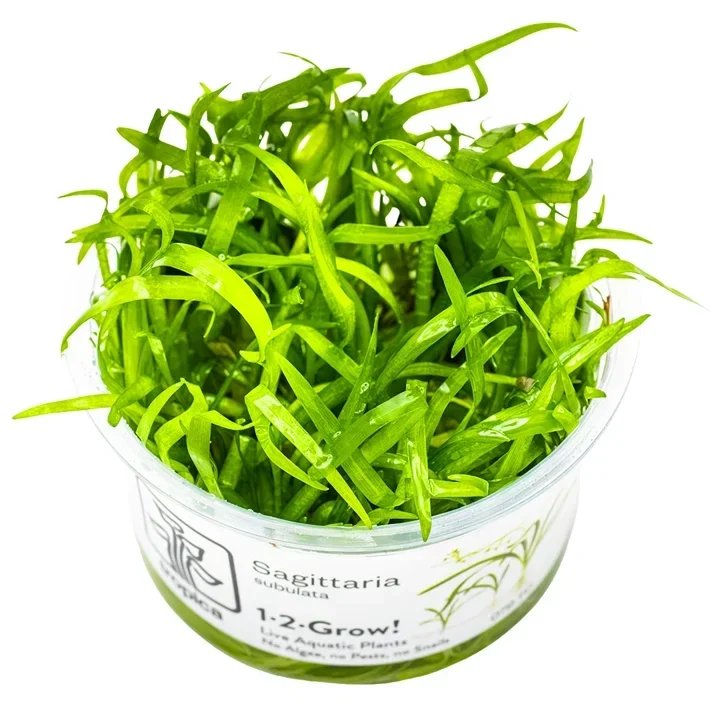
Sagittaria subulata "Needle Leaf"
Sagittaria subulata (L.) Buchenau complex
Save this plant or add it directly to one of your aquariums.
Need help with Sagittaria subulata "Needle Leaf"?
Ask what this plant needs or what might explain a change in its leaves or growth.
Planting & care
This plant suits beginners. Give it moderate light. It can grow without added CO₂.
Suitable for long-term aquarium use.
About this plant
Very narrow-leaved Sagittaria from an old cultivated lineage, provisionally assigned to the Sagittaria subulata species complex. It has also circulated as Sagittaria filiformis, Sagittaria sp. Needle and Nadel-Pfeilkraut. The exact original locality is unknown; the S. subulata complex is native to eastern and southeastern North America. Submerged leaves are commonly around 10 cm long and 1.5–2 mm wide without CO2, but with abundant macro-nutrients and CO2 they may reach about 30 cm and 3 mm width. Colour is medium to olive green and can become light brown-red under strong light. It is easy, forms underground runners, and benefits from root-zone nutrition. Published hobby data give pH 5–8, KH 2–21 and a broad temperature tolerance of about 4–30 °C.
Water conditions
Plant reference ranges, not dosing instructions or measurements from your aquarium. Consider livestock needs and measured conditions.
- Temperature
- 39–86°F (4–30°C)
- pH
- 5–8
- Carbonate hardness
- 2–21 °dKH
- Recorded CO₂ (mg/L)
- 0–20 mg/L
Growth & placement
- Growth rate
- Medium
- Width
- 2–3.9" (5–10 cm)
- How to propagate
- Separate young plants from runners
- Color
- Green
- Ways to use it
- Small aquariums
Grow it successfully
What you’ll need to grow Sagittaria subulata "Needle Leaf"
Start with this plant’s documented care needs, then use an AquariumLesson calculator to size the setup for your aquarium.
Substrate
A suitable substrate or targeted root nutrition can support this plant's growth habit.
Calculate how much substrate you needTaxonomy
- Major group
- Angiosperms
- Family
- Alismataceae
- Genus
- Sagittaria
- Botanical name
- Sagittaria subulata (L.) Buchenau complex
- Also known as
- Sagittaria subulata, Dwarf Sagittaria, Dwarf Sag, Sag
- Origin
- North America, Eastern United States, Caribbean, South America
- Order
- Alismatales