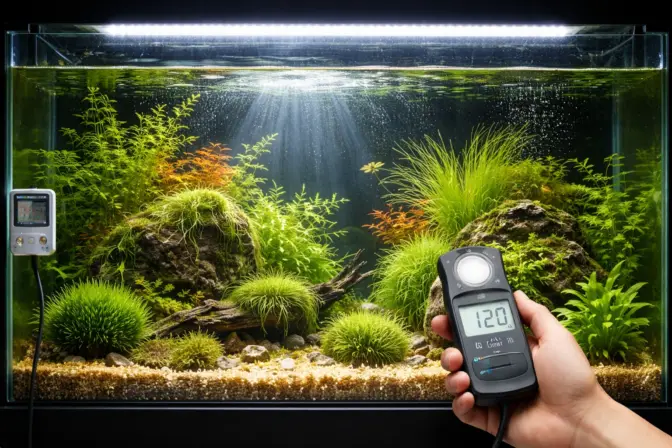
How Much Light Do Aquarium Plants Need?
Aquarium plant light requirements determine whether plants grow healthy, compact, and vibrant — or become weak and algae-prone. Many aquarists assume plants simply need strong lighting, but aquarium plants do not need “as much light as possible.” They need the right amount of light for their species, tank depth, and system balance.
This is why one of the most important questions in aquascaping is also one of the most misunderstood: How much light do aquarium plants actually need? The answer is never just “buy a stronger lamp.” It depends on whether you are growing low-light epiphytes, mid-energy stem plants, or demanding carpeting species — and on how much light still reaches the substrate after passing through the water column.
In this lesson, we focus specifically on plant light requirements. We are not rebuilding a full lighting guide from scratch. Instead, this article helps you estimate how much light your plants truly need, how to judge whether your current setup is too weak or too strong, and how to make practical decisions for real planted tanks. For broader lighting fundamentals, see the Aquarium Lighting Guide.
What you’ll learn in this lesson
- How much light aquarium plants actually need in practical terms
- The difference between low, medium, and high light plant demand
- Why PAR matters more than brightness at the water surface
- How tank depth changes real plant light availability
- How many hours of light most planted aquariums should get
- How CO₂, fertilizer, and plant mass influence lighting tolerance
- How to recognize if your tank is underlit or overlit
Why Aquarium Plants Need Light
Aquarium plants use light to drive photosynthesis. That is the core reason lighting matters. Without enough usable light, plants cannot efficiently convert carbon dioxide and nutrients into new tissue. Growth slows down, leaves become weak, and the plant stops behaving like a strong competitor inside the aquarium.
In practice, light determines much more than survival. It influences compactness, leaf size, internode spacing, coloration, carpeting ability, and the overall visual quality of a planted layout. A stem plant grown under insufficient light often becomes thin and elongated. The same species under appropriate intensity usually develops tighter growth and a more attractive form.
Photosynthesis in aquatic plants
Submerged plants are working in a more demanding environment than terrestrial plants. Light must travel through glass, water, surface agitation, and often shadows from driftwood, rocks, or taller plants before it reaches the leaves that need it most. This is why the same light fixture may perform very differently over a shallow tank and a deeper aquascape.
It also explains why looking only at marketing brightness claims is not enough. Plants respond to the light that reaches their actual position in the aquarium, not to the number printed on the box.
The three drivers of plant growth
Plant growth in aquariums is controlled by three main forces:
- Light as the energy input
- CO₂ as the carbon source
- Nutrients as the material for growth
The higher the light, the stronger the demand for the other two. This is one of the most important principles in planted tank design. Strong light without stable carbon and nutrients rarely creates better growth. More often, it creates instability. That is why readers building a more advanced system should also review the CO₂ System Guide and the broader Aquarium Plants Guide.
If you want a faster estimate before buying a fixture, use the calculator above. It helps translate tank dimensions and planting goals into a more realistic lighting target instead of guessing based on vague product claims.
How Much Light Aquarium Plants Actually Need
The simplest practical way to think about plant light demand is to divide aquarium plants into low light, medium light, and high light groups. These categories are not perfect, but they are useful because they help you estimate how demanding the system will become.
For many hobbyists, lumen-per-liter is still a practical starting point. It is not the most accurate measurement, but it helps create a rough baseline before moving to PAR. The most important point is that these ranges are only approximations. Tank depth, mounting height, and layout shading can change the result dramatically.
| Light Tier | Typical Lumens per Liter | Typical Use Case | System Difficulty |
|---|---|---|---|
| Low light | ~10–20 lm/L | Epiphytes, mosses, shade-tolerant plants | Beginner-friendly |
| Medium light | ~20–40 lm/L | Mixed planted tanks, many common stems and rosettes | Moderate |
| High light | 40+ lm/L | Carpets, dense stems, compact growth, stronger color response | Demanding |
Low light plants
Low light plants are the most forgiving. They generally grow more slowly, tolerate a broader margin for error, and work well in low-tech systems without injected CO₂. They are ideal for hobbyists who want a stable tank rather than maximum growth speed.
Typical examples include Anubias, Java Fern, many mosses, and several shade-tolerant epiphytes. These plants do not need aggressive light intensity. In fact, excessive light often causes more trouble than too little, especially if they are attached to exposed hardscape near the top half of the aquarium.
Medium light plants
Medium light is where many successful planted tanks live. It supports broader plant choice, fuller growth, and more flexibility in layout design while still remaining manageable. This tier suits many mixed aquascapes with swords, Cryptocoryne, Ludwigia, Hygrophila, and other common planted tank species.
If your goal is a visually rich planted aquarium without pushing into high-maintenance territory, medium light is often the smartest target.
High light plants
High light is usually required when you want dense carpeting plants, very compact stem growth, stronger red coloration, or contest-style aquascape precision. This tier can produce stunning results, but it narrows your margin for error. Once light intensity climbs, CO₂ stability, fertilization, circulation, and maintenance become much more important.
In other words, high light is not automatically “better.” It is simply a stronger energy input. If the rest of the system is not ready, that extra energy often fuels algae faster than plant growth.
PAR Levels for Aquarium Plants
If lumens are a rough estimate, PAR is the more useful plant-focused measurement. PAR helps you understand how much photosynthetically active light reaches your plants. That makes it far more relevant when you want to answer the real question behind this article: how much light do aquarium plants need where they actually grow?
What PAR actually measures
PAR is best understood as usable plant light intensity. In aquariums, the most meaningful PAR value is usually at the substrate or at the height of the plant mass, not directly under the fixture at the water surface.
This is why two tanks with the same fixture may deliver completely different results. A shallow open-top tank with minimal hardscape shading can provide strong substrate PAR. A deeper tank with heavy wood, tall background plants, and high mounting height may deliver much less.
Typical PAR ranges
| Plant Demand | Typical PAR at Plant Level | Practical Outcome |
|---|---|---|
| Low | 10–30 µmol | Slow, stable growth for tolerant species |
| Medium | 30–50 µmol | Balanced growth for many planted tanks |
| High | 50+ µmol | Demanding growth, carpets, stronger color response |
These numbers are best used as orientation, not as rigid laws. Aquascaping is too variable for a single universal threshold. Still, they give you a much better framework than simply asking whether a light “looks bright.” If you want a deeper breakdown of the metric itself go to our Lesson Aquarium PAR Explained.
PAR vs Lumens vs Watts
One reason this topic confuses so many hobbyists is that lighting information is presented in different ways. Some guides talk about lumens. Others focus on PAR. Older advice still references watts per gallon. The problem is that these measurements do not tell you the same thing.
Why watts per gallon is outdated
Watts describe energy consumption, not plant-usable light output. A modern LED can deliver very different performance from an older fluorescent system while using the same power. That makes watts a poor way to estimate plant light requirements today.
When lumens still work
Lumens remain useful as a rough comparison tool, especially when you are comparing similar LED fixtures for tanks of similar size. They are not precise enough to predict substrate performance, but they are still practical for early planning.
Why PAR is the best measurement
PAR becomes more valuable as soon as you move beyond rough estimates. It connects the discussion back to the plants themselves. If your question is “How much light do my carpet plants need at the substrate in a 45 cm deep tank?” PAR is the better language.
That said, many aquarists do not own a PAR meter. This is why a practical workflow often looks like this: use lumens to estimate a fixture category, then use depth, layout, and plant choice to judge whether you are really creating low, medium, or high light at plant level.
How Tank Depth Changes Light Requirements
This is one of the biggest blind spots in competitor content. Plants do not care how bright the fixture is at the top of the tank. They care how much usable light reaches them after the water column and the aquascape itself have reduced it.
Light loss in water
As light passes through water, intensity drops. Surface movement, tinted water, cover glass, and biofilm can reduce it further. In deeper tanks, this becomes one of the defining variables in fixture choice. A light that performs well over a shallow nano may feel weak over a deeper aquarium with the same footprint.
Why PAR should be measured at substrate
Carpeting plants are the clearest example. They grow at the lowest point in the aquarium, where intensity is often weakest and shading is highest. If you want a healthy carpet, substrate-level light matters far more than how dramatic the fixture looks from above.
This also applies to dense layouts with strong hardscape. Driftwood branches and stone compositions can create beautiful contrast, but they also create real shade zones. When planning a layout, lighting should be considered together with structure. This is where your Aquarium Hardscape Guide becomes a natural supporting link.
Examples of shallow vs deep tanks
A shallow aquarium with 30 cm of water depth can often achieve medium plant-level intensity with a fixture that would only create low-to-medium conditions in a 50 cm deep tank. This is why fixed “one number fits all” advice fails so often.
| Tank Type | Typical Challenge | Lighting Implication |
|---|---|---|
| Shallow tank | Less attenuation | Lower fixture output may still be sufficient |
| Standard depth tank | Balanced conditions | Medium planning usually works well |
| Deep tank | Stronger light loss to substrate | Higher output or lower demand plants may be needed |
| Heavy hardscape layout | Localized shadow zones | Distribution matters as much as raw output |
How Many Hours of Light Aquarium Plants Need
Light intensity and light duration work together. Even a well-sized fixture can create problems if the photoperiod is too long. For most planted aquariums, a daily lighting period of 6 to 8 hours is the most reliable starting point.
Recommended photoperiod
If the tank is new, start toward the lower end. Six hours is often a safer starting point during the early establishment phase, especially in brighter setups. Mature and stable tanks can often tolerate seven to eight hours well.
Why longer lighting causes algae
Many beginners try to compensate for weak light by simply keeping the fixture on longer. That usually does not solve the real problem. A weak light left on too long does not become true high-intensity light. Instead, it often creates stress, inconsistency, and more algae opportunity.
Likewise, a very strong light run for ten or eleven hours can overwhelm the system. Algae is rarely caused by light alone, but excessive duration magnifies every existing imbalance.
Using timers and ramping schedules
Consistency matters more than manual adjustment. A timer creates a predictable rhythm and helps plants adapt. If your fixture supports ramping, gentle transitions can improve viewing comfort, but the core issue is still total daily energy. Readers wanting a deeper schedule-specific discussion can later be guided to Aquarium Lighting Schedule.
How Plant Types Affect Lighting Needs
Not all aquarium plants ask for the same thing. Plant placement, leaf structure, growth speed, and aesthetic goal all influence light demand. This is why choosing the right plants for your lighting level is often smarter than forcing the wrong species into the wrong system.
Low light plants
Anubias, Java Fern, and many mosses tolerate lower intensity well. They are especially useful in shrimp tanks, shaded wood layouts, and low-tech systems. Many of them are covered more deeply in your plant-focused articles such as Epiphyte Aquarium Plants.
Medium light plants
Many common planted tank species grow best under moderate intensity. This range gives you flexibility without immediately pushing into high-energy maintenance. It is often the sweet spot for mixed layouts with foreground accents, midground structure, and background fullness.
High light plants
Demanding carpets and certain compact or colorful stem species usually benefit from stronger substrate-level intensity. If you want a precise green carpet in an Iwagumi layout or very tight red stem presentation, stronger light can help — but only as part of a stable system.
For plant placement logic across foreground, midground, and background zones, the natural internal links here are Aquarium Carpeting Plants, Aquarium Midground Plants, and Aquarium Background Plants.
How CO₂ and Fertilizers Affect Lighting Needs
Light demand cannot be judged in isolation. The same plant can appear easy in one tank and difficult in another because the rest of the system changes how well the plant can use the available light.
Low-tech aquariums
In low-tech tanks, moderate lighting is usually the safer route. Plants grow more slowly, but stability is easier to maintain. This is often the best option for beginners, for low-maintenance community tanks, and for layouts centered around easy species rather than rapid growth.
High-tech aquariums
In high-tech systems, stronger light can be used more effectively because pressurized CO₂ and disciplined fertilization support the increased growth demand. But this does not mean every high-tech tank should run maximum intensity. It means the system can process more light if everything else is equally stable.
The lighting–CO₂ balance
A useful rule is this: do not raise light first if the tank is already unstable. If plants are stalling, algae is appearing, or CO₂ is inconsistent, adding more light usually makes the symptoms louder. Solve stability first, then decide whether stronger lighting is truly needed.
Nutrient support matters too. Stronger growth requires adequate macro and micro availability. This makes Macronutrients, Micronutrients, and regular maintenance such as the Aquarium Water Change Guide natural supporting resources rather than optional extras.
Lighting Mistakes That Cause Algae
Many aquarists assume algae means the light is simply too strong. That can be true, but the real issue is usually that the system cannot handle the energy level being provided. Light is often the trigger that exposes weak carbon delivery, poor flow, immature biological balance, or thin plant mass.
Too much light
When the light is too strong for the system, algae often appears on hardscape, slow growers, and exposed surfaces. Plants may not always look “burned.” Sometimes they simply stop progressing while algae accelerates.
Long photoperiod
Running lights too long is one of the most common beginner errors. Many tanks perform better when the duration is reduced rather than increased.
Poor plant mass
A bright tank with very little plant mass often struggles because there are not enough healthy plants to absorb the available energy and nutrients. This is especially common during the first weeks of a new aquascape. Early restraint usually works better than early intensity.
For readers wanting a dedicated algae-lighting angle later, this lesson should naturally support the future article Aquarium Lighting and Algae.
Real Lighting Setups: Practical Examples
Theory becomes more useful when translated into real planted tank scenarios. The goal here is not to create rigid formulas, but to show how different lighting targets fit different aquascaping goals.
Low-tech planted tank
A low-tech layout with Anubias, Java Fern, Cryptocoryne, and mosses usually benefits from restrained lighting. Moderate output, stable duration, and realistic plant selection outperform brute-force intensity in this kind of setup.
High-tech aquascape
A high-tech stem-focused aquascape can use stronger light, but only when CO₂ distribution, flow, fertilization, and maintenance are already disciplined. In this context, more light is a precision tool, not a shortcut.
Carpet plant aquarium
Carpet-heavy layouts demand special attention because the target plants sit at the lowest point in the tank. This makes substrate PAR, depth, and shading crucial. Many failed carpets are not caused by “bad carpet plants,” but by insufficient usable light at the bottom combined with unstable CO₂.
| Tank Size | Low Light | Medium Light | High Light |
|---|---|---|---|
| 60 cm tank | 1200–2000 lm | 2000–3500 lm | 3500+ lm |
| 90 cm tank | 2000–3500 lm | 3500–5000 lm | 5000+ lm |
Use these numbers as planning anchors, not as strict guarantees. Depth and layout can shift the real outcome significantly.
How to Choose the Right Aquarium Light
If you want to choose the right fixture for planted growth, start with the plants and the tank — not with the most powerful product you can find.
Lumens per tank size
Start with a rough output target based on tank size and intended plant demand. Then adjust for depth and layout complexity. A fixture that is perfect for a shallow mixed tank may be too weak for a deeper carpet layout.
Mounting height
The higher a light sits above the tank, the wider the spread usually becomes — but intensity at plant level drops. Lower mounting often increases punch but can reduce evenness. This tradeoff matters more than many hobbyists expect.
Light distribution
Uniform distribution matters, especially in wider tanks or layouts with strong visual symmetry. A fixture that creates a bright center and weak corners may still look impressive but fail to grow plants evenly. In many aquascapes, even coverage is more useful than peak brightness.
Readers comparing white LEDs, RGB units, and other fixture styles can branch later into the related lesson topics already present in your content plan, such as White vs RGB Aquarium Light and Best LED Light for Planted Aquarium.
Advanced Lighting Concepts That Actually Matter
Most hobbyists do not need to obsess over every technical lighting term. But a few advanced concepts are genuinely useful because they explain why planted tanks with similar fixtures can behave so differently.
Daily Light Integral (DLI)
DLI combines light intensity with total daily duration. In simple terms, it describes total light delivered over time. This matters because intensity and photoperiod do not operate separately. A moderate light for eight hours and a stronger light for six hours may create surprisingly similar overall energy input depending on the setup.
Spectrum and plant color
Spectrum matters, but for this article it should stay secondary to intensity. Many planted tank problems blamed on spectrum are actually intensity or stability problems. If the tank is severely underlit or overlit, spectrum fine-tuning will not solve the core issue.
Shadows in aquascapes
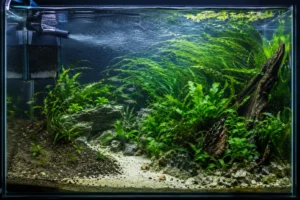
Hardscape shape, tall stems, floating plants, and surface agitation all influence how much light different parts of the aquarium really receive. This is why aquascaping design and lighting cannot be treated as separate subjects. A beautiful composition can create beautiful plant challenges too.
Frequently Asked Questions
How much light do aquarium plants need per day?
Most planted aquariums do well with 6 to 8 hours of light per day. New tanks usually benefit from starting closer to 6 hours.
How many lumens per liter do aquarium plants need?
A practical starting point is around 10–20 lm/L for low light, 20–40 lm/L for medium light, and 40+ lm/L for high light. These are rough planning ranges, not exact rules.
What PAR do aquarium plants need?
Low-demand plants often do well around 10–30 µmol at plant level, many mixed planted tanks perform well around 30–50 µmol, and demanding carpets or high-energy layouts often need 50+ µmol at the substrate.
Can aquarium plants grow in low light?
Yes. Many species grow well in low light, especially epiphytes, mosses, and several slow growers. The key is choosing plants that match the energy level of the tank.
Do aquarium plants need CO₂ with strong light?
They do not always require injected CO₂ to survive, but stronger lighting increases carbon demand quickly. High light without stable carbon usually reduces your margin for error and often encourages algae.
What happens if aquarium plants get too much light?
Common results include algae pressure, stalled growth, and plants that cannot keep up with the energy in the system. The issue is often imbalance rather than brightness alone.
Is PAR better than lumens for planted tanks?
Yes, PAR is more useful because it relates more directly to plant-usable light at plant level. Lumens are still helpful for rough comparisons, especially when planning fixtures.
Conclusion
So, how much light do aquarium plants need? Enough to match their species, placement, and growth goal — but not so much that the system becomes unstable. That is the real answer. Most planted tanks succeed not because they run the strongest possible light, but because they run the right light level consistently.
If you keep this lesson focused on one principle, let it be this: light should be matched to the plant mass and the system behind it. Low-light epiphytes do not need brute force. Carpet plants do not care how bright the fixture looks at the surface if the substrate remains weak. And high-output lights only become an advantage when CO₂, nutrients, circulation, and maintenance are ready to support them.
For broader fixture selection and lighting fundamentals, continue with the Aquarium Lighting Guide. If you want a faster estimate for your own setup, use the Aquarium Lighting Calculator to plan a more realistic target before you buy or upgrade.
Next step:
Check your tank depth, plant types, and current photoperiod — then compare them against your actual growth results. In planted aquariums, the right light is not the brightest light. It is the one your system can truly use.
New to AquariumLesson? Start with our complete Aquarium Lessons Hub or return to the homepage at AquariumLesson.com.