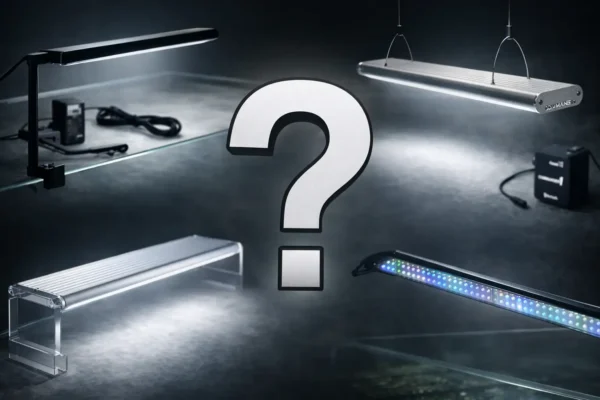
Best LED Light for Planted Aquarium
The best LED light for planted aquarium setups depends on more than just brightness. Tank depth, plant species, aquascape layout and lighting control all influence which fixture actually performs best in a planted tank.
That is why generic “top 10” lists often leave aquarists disappointed. A light can be excellent in one setup and completely wrong in another. What really matters is whether the fixture delivers suitable intensity to the substrate, spreads light evenly across the layout, and can be tuned to match plant growth without driving algae. In practice, the best planted tank light is the one that fits your tank’s energy level with the least compromise.
This lesson focuses specifically on how to choose the best LED light for a planted aquarium based on real-world use cases. Instead of turning this into a broad lighting guide, we will stay tightly focused on buying decisions, tank matching, plant compatibility, and setup strategy. If you want the broader fundamentals behind PAR, spectrum, and lighting theory, see our Aquarium Lighting Guide.
What you’ll learn in this lesson
- How to identify the best LED light for your exact planted tank
- Which lights make sense for low-light, medium-light, and high-light layouts
- How tank depth changes the type of fixture you should buy
- When budget lighting is enough and when premium lighting is worth it
- How to avoid common mistakes that lead to weak growth, shadowing, or algae
What makes an LED light “best” for a planted aquarium?
For planted tanks, “best” does not mean maximum output alone. A useful planted aquarium LED must combine four things well: usable intensity, good spread, controllability, and fit for the tank. Strong output without proper coverage creates hotspots and shaded corners. A beautiful RGB unit with weak penetration may look impressive above the tank but still fail to support demanding carpet plants at the substrate in a deeper layout.
In practical terms, the best LED light is the one that gives your plants the right amount of energy where they actually grow. For most aquascapes, that means stable light across the whole footprint rather than a dramatic beam in the center. It also means dimming matters. A powerful light that can be reduced is usually more flexible than an underpowered one that must run at full output all the time.
Three buying questions usually matter most:
- Can it reach the substrate? Especially important in tanks over 45–50 cm tall.
- Can it cover the full layout? Important in wide aquascapes with wood, rock, or dense planting.
- Can it be tuned? Dimming, scheduling, and app control help match the light to plant demand and algae risk.
If you are also comparing broader lighting concepts such as PAR targets or light categories, continue with our Aquarium Lighting Guide and How Much Light Do Aquarium Plants Need lesson.
If you are unsure whether a light is too weak or too strong for your layout, use the calculator before buying. It helps bridge the gap between product marketing and real planted tank planning.
How much power does your planted tank actually need?
The fastest way to choose the best LED light is to first identify your tank’s energy demand. Most planted aquariums fall into three practical groups: low-light, medium-light, and high-light. You do not need a full technical lighting lecture to make a smart buying decision. You mainly need to understand how demanding your plants are and how deep your aquarium is.
Low-light planted tanks
Low-light tanks usually contain slower-growing species such as Anubias, Java Fern, Bucephalandra, many Cryptocoryne species, and some mosses. These layouts often work without injected CO₂ and benefit from moderate, controlled lighting rather than brute force. In these systems, the best LED light is usually a reliable fixture with decent coverage and dimming, not an ultra-powerful RGB flagship.
Many shrimp tanks, epiphyte-focused aquascapes, and calm nature-style layouts fall into this category. If this sounds like your setup, you may also want to explore our Epiphyte Aquarium Plants and Low-Tech Aquarium Lighting content.
Medium-light planted tanks
Medium-light tanks are where many aquascapers land. They include a mix of stem plants, rosettes, compact midground species, and some easier carpets. These aquariums often look best under stronger full-spectrum lighting with adjustable output. You want a light that can grow plants cleanly without forcing the entire tank into a high-maintenance routine.
This is also the range where a high-quality mid-tier LED often gives the best value. You gain stronger output, better color rendering, and more control than entry-level lights, but without jumping into the cost of premium showcase fixtures unless the layout really needs it.
High-light planted tanks
High-light tanks are typically built for carpeting plants, red stems, dense Dutch layouts, or dramatic contest-style aquascapes. These systems demand more than just a strong light. They require consistency across CO₂, nutrients, circulation, and water changes. In this category, the best LED light is usually a powerful, well-built unit with excellent spread and refined control options.
If you want intense carpeting species or demanding red plants, remember that stronger lighting increases biological demand. Pairing a powerful light with unstable CO₂ is one of the fastest ways to create algae problems. For that reason, this decision should always be viewed together with your CO₂ System Guide and plant selection strategy in the Aquarium Plants Guide.
Ready to set up your own aquarium?
Create a free account to save lessons, plan your setup, and use the Aquarium Hub to turn ideas into a real aquarium.
Tank depth is one of the most ignored buying factors
Many aquarists choose lights based on tank length alone. That is a mistake. A 60 cm long aquarium that is only 30 cm tall needs a very different lighting strategy from a 60 cm long aquarium that is 50 or 60 cm deep. The deeper the tank, the more important intensity and penetration become. Hardscape can make this even worse by creating shadows over foreground plants or behind rock structures.
This is why deep tanks often need either a stronger fixture, a better reflector design, or multiple lights for even coverage. If you are building a layout around heavy stone composition, dense driftwood, or layered planting, think in terms of coverage pattern, not just wattage. Our Aquarium Hardscape Guide is useful here because the shape of the scape directly influences how light reaches your plants.
| Tank depth | Typical lighting need | Buying guidance |
|---|---|---|
| Up to 35 cm | Low to moderate penetration required | Many quality budget and mid-range LEDs work well |
| 35–45 cm | Balanced output and spread | Mid-range planted lights often offer the best value |
| 45–60 cm | Higher intensity needed at substrate | Choose stronger fixtures, careful mounting, or multiple lights |
| 60 cm and deeper | Demanding penetration and uniform coverage | Premium lights or multi-light setups are often the safest choice |
If your main concern is light loss in taller aquariums, that deserves its own deep-dive topic. Keep this lesson focused on the buying decision: as depth rises, bargain lights become less convincing and premium fixtures start making more sense.
Best LED lights for planted aquariums by budget level
There is no single best light for every planted tank, but there are clear buying tiers. A smart recommendation depends on your goal. Some aquariums need affordability and flexibility. Others need serious output and excellent color rendering. Below is the most practical way to think about the market.
Best budget LED lights
Budget lights are best for beginner planted tanks, low-tech systems, nano aquariums, or mixed community tanks with undemanding plants. The key strength of this category is accessibility. You can build a healthy planted aquarium without overspending, as long as your expectations stay realistic. Do not expect a cheap light to behave like a premium RGB fixture over a deep tank with a demanding carpet.
Budget lights make the most sense when:
- You keep low-light species
- Your tank is relatively shallow
- You are not chasing intense reds or aggressive carpeting growth
- You prefer a forgiving low-tech setup
Best mid-range LED lights
Mid-range lights are often the sweet spot for serious hobbyists. This tier usually gives you better plant growth, better spread, stronger construction, and useful control features without entering luxury pricing. For many aquascapes, this category offers the best combination of performance and value.
A fixture like the Fluval Plant series is especially relevant here because it works across a wide range of planted aquariums and gives enough control to adapt as the tank matures.
If your aquarium is larger, the longer variant can be the more natural fit for medium to longer tanks.
Best high-end LED lights
Premium planted tank LEDs are designed for aquascapers who want high output, refined spectrum, excellent color rendition, and stronger performance in more demanding layouts. This is the range for deeper tanks, advanced aquascapes, high-light carpets, red stem plants, and display-focused systems where both growth and visual presentation matter.
In this category, powerful fixtures such as Chihiros WRGB models or stronger Fluval Plant Pro units become much more relevant.
Premium lighting is worth it when your layout actually uses that performance. If you mainly grow epiphytes in a shallow tank, the extra spend often brings more prestige than practical benefit. But in deeper or more demanding planted systems, premium lights can reduce compromise and make the whole layout easier to tune.
How to choose the right light for your tank type
The most practical buying method is to match the fixture to the style of aquarium you are actually building. This avoids wasting money on features you do not need or buying too little light for a high-demand layout.
| Tank type | Best lighting approach | What to prioritize |
|---|---|---|
| Nano planted tank | Compact controllable LED | Spread, dimming, clean design |
| Low-tech planted tank | Moderate full-spectrum light | Stability, not maximum output |
| Nature-style aquascape | Balanced mid-range to premium LED | Even coverage and natural color |
| Dutch-style aquarium | Stronger controllable light | Intensity, spread, red plant support |
| Iwagumi with carpet | Higher-energy light with CO₂ support | Substrate intensity and uniform foreground coverage |
| Deep planted tank | Powerful fixture or multi-light setup | Penetration and shadow control |
If you are building a specific aquascape style, continue with our related guides on Iwagumi Aquascape, Dutch Style Aquarium, and Nature Style Aquascaping. The best LED light for a planted aquarium always changes slightly depending on the composition you are trying to achieve.
RGB vs white LED: which is better for planted tanks?
This question comes up constantly, but in buying terms the answer is simple: both can grow plants well when the fixture is properly designed. The real difference is usually not “can it grow plants?” but rather how the light looks, how it renders fish and plant colors, and how the manufacturer balances intensity, spread, and control.
White LEDs are often practical, efficient, and more than sufficient for many planted aquariums. RGB units tend to produce stronger color pop, especially with red plants and vivid fish, which is why they are popular in premium aquascaping. But RGB alone does not automatically make a light better. A well-built white fixture can outperform a weak RGB unit if the latter lacks proper output or coverage.
If you want the deeper comparison, see our dedicated White vs RGB Aquarium Light lesson. For this buying guide, the important point is that spectrum style should come after the bigger decisions: tank depth, plant demand, and coverage.
Mounting height, spread, and shadowing matter more than many reviews admit
Two planted tanks can use the exact same light and get very different results depending on how the fixture is mounted. Raising a light can improve front-to-back spread and soften harsh hotspots, but it also lowers intensity at the substrate. Lowering it increases punch, but can create stronger contrast, darker edges, and more shadowing behind hardscape.
This matters especially in aquascapes with branchy driftwood, tall stones, or heavy planting groups. A single light can look fine on paper but still leave key areas underlit. That is why some larger layouts perform better with two medium-powered lights than one extremely strong fixture in the center.
- Lower mount → stronger intensity, tighter spread, more hotspot risk
- Higher mount → wider spread, softer shadows, lower substrate intensity
- Multiple fixtures → better coverage in wide or demanding layouts
When choosing the best LED light for a planted aquarium, always imagine the real layout under it, not just the empty tank size on the box.
How to avoid algae when upgrading to a stronger planted tank light
Many aquarists blame the new light when algae appears, but the light is usually only exposing imbalance elsewhere. A better fixture increases energy in the system. If CO₂ delivery is inconsistent, plant mass is too low, nutrients are erratic, or water changes are neglected, algae quickly takes advantage.
The safest way to upgrade is to start lower than you think you need, then scale upward gradually. Run a shorter photoperiod during the early phase, maintain strong plant mass, and stay disciplined with maintenance. If you also want to reduce system stress, our Aquarium Water Change Guide is highly relevant because fresh water helps stabilize high-energy planted setups.
- Start with reduced output rather than full power
- Keep the photoperiod conservative at first
- Match stronger light with stable CO₂ and nutrients
- Trim heavily shaded areas and remove struggling leaves early
- Increase intensity only after the tank responds well
Common mistakes when choosing the best LED light for a planted aquarium
- Buying by brand reputation alone → even great brands have models that fit some tanks better than others.
- Ignoring tank depth → one of the biggest reasons lights underperform at the substrate.
- Prioritizing appearance over coverage → sleek design is useless if the layout has dark zones.
- Choosing too much light for a low-tech tank → this often increases algae pressure without improving stability.
- Assuming one fixture is always enough → wide or hardscape-heavy aquascapes may need two lights.
- Expecting the light to solve all plant problems → plant health still depends on carbon, nutrients, circulation, and maintenance.
Frequently asked questions
What is the best LED light for a planted aquarium overall?
There is no universal winner for every setup. The best overall choice is the light that matches your tank depth, plant demand, and aquascape style while offering enough control to avoid overlighting the system.
Are expensive planted tank lights worth it?
Yes, but mainly in demanding setups. Premium lights are most worthwhile in deeper tanks, high-light aquascapes, display-focused layouts, and systems that need strong output with refined control and color rendition.
Can a budget LED grow aquarium plants successfully?
Absolutely. Many low-light and moderate planted tanks grow very well under budget LEDs, especially when the aquarium is shallow and stocked with forgiving plant species.
Is RGB better than white LED for planted aquariums?
Not automatically. RGB often improves visual color pop, but both RGB and white LEDs can grow plants effectively when the fixture is well designed and appropriately matched to the tank.
How do I choose a light for a deep planted tank?
Focus on intensity at depth, front-to-back spread, and shadow control. Stronger fixtures or multi-light setups are often better choices for deeper aquariums than entry-level budget lights.
Do planted tank lights need dimming?
Dimming is highly valuable. It allows you to adapt the light to plant response, reduce algae risk during setup, and use one fixture across different phases of tank maturity.
Can one light fixture cover the entire aquarium evenly?
Sometimes, but not always. Wider aquariums, deep tanks, and complex hardscape layouts often benefit from two fixtures or a more carefully mounted premium unit.
Conclusion
The best LED light for a planted aquarium is the one that fits your aquascape rather than the one with the loudest marketing. For shallow low-tech tanks, a moderate controllable light is often the smartest choice. For balanced mixed planted tanks, a strong mid-range fixture usually offers the best value. For deeper, more demanding, or showcase aquascapes, premium LEDs begin to justify their price through better spread, stronger output, and improved control.
If you make your decision based on plant demand, tank depth, layout shape, and overall system stability, you are far more likely to choose a light that actually performs well long term. Use the Aquarium Lighting Calculator before buying, and keep this lesson connected to the wider support articles in your lighting, CO₂, plant, and hardscape ecosystem.
Next step:
Compare your tank depth, plant demand, and target intensity in the Aquarium Lighting Calculator before choosing your final fixture.
Start building your aquarium with the Aquarium Hub
Save your favorite lessons, organize your setup, and track your aquarium step by step in your personal Aquarium Hub.
New to AquariumLesson? Start with our complete Aquarium Lessons Hub or return to the homepage at AquariumLesson.com.