Aquarium Filter Media Guide: Biological, Mechanical & Chemical Filtration
Introduction
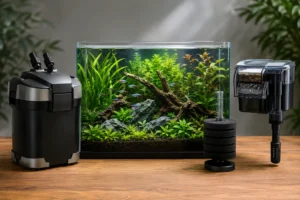
Aquarium filter media is the real engine inside your filtration system. While aquarists often focus on the filter itself — canister, sponge, HOB, or sump — the media inside the filter determines how efficiently waste is removed, ammonia is processed, and water stays stable long-term.
Many aquarium problems are not caused by “bad filters,” but by incorrect filter media setup, poor maintenance, restricted flow, over-cleaning, or misunderstanding the difference between biological, mechanical, and chemical filtration.
This guide explains how aquarium filter media actually works, how different media types support water quality, and how to build an efficient filter setup for freshwater aquariums, planted tanks, shrimp systems, and high-bioload aquariums.
For the full filtration foundation, start with the Aquarium Filter Guide. To compare filter types themselves, read Canister vs Sponge Filter.
Quick Answer
- Biological media supports beneficial bacteria that process ammonia and nitrite.
- Mechanical media traps physical waste particles.
- Chemical media removes dissolved substances like medication, tannins, or toxins.
- Biological filtration is the most important long-term filtration type.
- Over-cleaning filter media can destabilize the nitrogen cycle.
- High surface area improves bacterial colonization.
- Different aquariums require different media strategies.
- Flow direction inside the filter matters.
- Dirty mechanical media can reduce oxygen and flow.
- Most aquariums benefit from layered filtration.
What you’ll learn in this lesson
- How aquarium filter media works
- The difference between biological, mechanical, and chemical filtration
- How beneficial bacteria colonize filter media
- Which media types are best for different aquarium styles
- How to arrange filter media correctly
- How to clean filter media safely
- Which mistakes can destabilize filtration
- How filter media affects ammonia, nitrite, oxygen, and water clarity
- How planted tanks and shrimp tanks differ in media setup
What Is Aquarium Filter Media?
Aquarium filter media is the material placed inside a filter to support filtration processes. Depending on the media type, it may trap debris, host beneficial bacteria, or remove dissolved compounds from the water column.
The filter itself mainly moves water. The media inside the filter performs the actual filtration work. This is why two aquariums using the same filter body can perform very differently depending on the media arrangement and maintenance strategy.
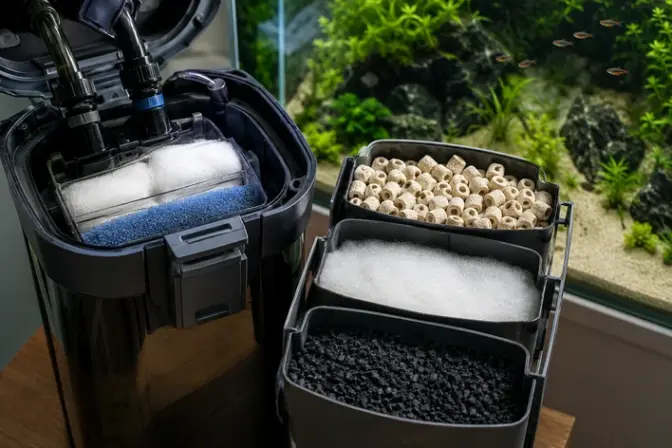
Most modern aquarium filtration systems combine multiple media types together in layers. This creates mechanical filtration, biological filtration, and sometimes chemical filtration simultaneously.
The Three Main Types of Aquarium Filter Media
| Media Type | Main Function | Examples | Most Important For |
|---|---|---|---|
| Mechanical | Traps physical debris | Filter floss, sponge, pads | Water clarity and waste removal |
| Biological | Hosts beneficial bacteria | Ceramic rings, bio balls, sponge | Ammonia and nitrite control |
| Chemical | Removes dissolved substances | Activated carbon, resins | Specific water polishing or toxin removal |
Most freshwater aquariums rely primarily on biological filtration supported by mechanical filtration. Chemical media is usually optional and used for specific situations.
Biological Filtration Explained
Biological filtration is the most important long-term filtration process in freshwater aquariums. Beneficial bacteria colonize oxygen-rich surfaces and convert toxic ammonia into nitrite, then nitrite into nitrate through the nitrogen cycle.
Without stable biological filtration, ammonia and nitrite can rapidly become dangerous to fish, shrimp, and other livestock.
Biological media works by maximizing surface area. More protected surface area allows more bacteria to colonize the filter safely.
Popular biological media includes:
- Ceramic rings
- Sintered glass media
- Bio balls
- Porous sponge
- Lava rock
- Moving bed media
For deeper nitrogen-cycle understanding, read the Aquarium Cycling Guide.
Mechanical Filtration Explained
Mechanical filtration physically traps particles before they decompose. This improves water clarity and reduces the load on biological filtration.
Mechanical media typically includes:
- Filter floss
- Foam sponges
- Fine polishing pads
- Coarse pre-filter foam
- Filter wool
Mechanical media should usually be positioned early in the filter flow path so debris is removed before reaching biological media.
If mechanical media becomes clogged, flow rate and oxygen delivery may drop significantly. This can reduce filtration efficiency and create unstable conditions.
Chemical Filtration Explained
Chemical filtration removes dissolved substances from aquarium water using adsorption or ion exchange. Unlike biological filtration, chemical media is usually temporary or situation-specific.
Common chemical media includes:
- Activated carbon
- Purigen
- Phosphate-removal resins
- Ammonia-removal resins
- Tannin-removal media
Activated carbon is commonly used after medication treatment or to remove discoloration and odors. However, many stable freshwater aquariums run successfully without permanent chemical filtration.
Best Biological Filter Media
The best biological media maximizes stable oxygen-rich surface area while resisting clogging.
| Media | Strength | Weakness | Best For |
|---|---|---|---|
| Ceramic rings | Reliable and affordable | Moderate surface area | General freshwater tanks |
| Sintered glass | Very high surface area | More expensive | High-performance systems |
| Sponge | Excellent oxygen exposure | Can clog over time | Shrimp and sponge filters |
| Bio balls | Strong wet/dry oxygenation | Lower density | Sumps and wet/dry systems |
| Lava rock | Natural porous structure | Irregular consistency | Budget biological filtration |
How to Arrange Filter Media Correctly
Media order matters because water should move from coarse debris removal toward stable biological processing.
A common filtration sequence is:
- Coarse mechanical filtration
- Fine mechanical filtration
- Biological media
- Optional chemical media
This layout prevents biological media from becoming clogged with debris while maintaining strong oxygen-rich flow.
Aquarium Filter Media for Different Tank Types
Planted Aquariums
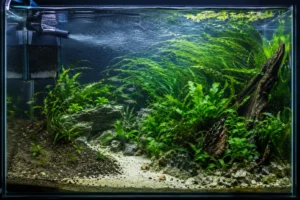
Planted aquariums usually prioritize stable biological filtration with moderate flow and clean mechanical filtration. Extremely aggressive mechanical polishing is often unnecessary.
High-tech planted tanks benefit from stable oxygenation and consistent flow distribution.
Shrimp Tanks
Sponge-based biological filtration is extremely popular in shrimp tanks because it provides gentle flow, biofilm growth, oxygenation, and baby-shrimp safety.
Sudden filter cleaning or aggressive media replacement can destabilize shrimp systems quickly.
High-Bioload Fish Tanks
Messy fish systems often require stronger mechanical filtration and larger biological capacity due to increased waste production.
These aquariums usually benefit from:
- larger pre-filter stages
- high-flow filtration
- frequent mechanical cleaning
- oversized biological media volume
How to Clean Aquarium Filter Media Safely
One of the biggest filtration mistakes is over-cleaning media.
Beneficial bacteria live directly on filter surfaces. Washing media aggressively under untreated tap water or replacing everything at once can destabilize the nitrogen cycle.
Safe cleaning guidelines:
- Rinse media gently in removed aquarium water
- Never replace all biological media simultaneously
- Clean only when flow noticeably decreases
- Preserve bacterial colonies whenever possible
- Replace mechanical floss more often than biological media
For troubleshooting, read Ammonia Spike in Aquarium and Nitrite Spike in Aquarium.
Common Aquarium Filter Media Mistakes
- Replacing all media at once: may destabilize biological filtration.
- Using only chemical media: does not replace biological filtration.
- Ignoring clogged mechanical media: reduces flow and oxygen.
- Overpacking the filter: may restrict water movement.
- Using undersized filtration: lowers stability margin.
- Cleaning media too aggressively: damages bacterial colonies.
- Incorrect media order: clogs biological filtration early.
- Using disposable cartridge systems incorrectly: can remove too much bacteria.
Filter Media vs Filter Type
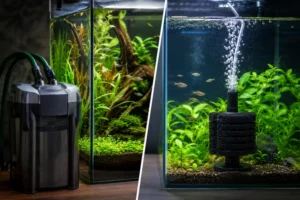
Many aquarists focus too heavily on filter type while underestimating media quality and arrangement. In reality, media setup often matters more than the filter body itself.
A properly configured sponge filter can outperform a poorly maintained canister filter. Likewise, a large canister filter with optimized media can support extremely stable high-bioload systems.
For direct comparison, continue with Canister vs Sponge Filter.
Quick Takeaways
- Biological filtration is the foundation of aquarium stability.
- Mechanical media removes physical debris and protects biological media.
- Chemical filtration is usually optional and situation-specific.
- High surface area improves bacterial colonization.
- Flow direction inside the filter matters.
- Do not replace all biological media at once.
- Clogged mechanical media reduces oxygen and filtration efficiency.
- Different aquariums require different media strategies.
- Most aquariums benefit from layered filtration.
- Filter media often matters more than the filter body itself.
Conclusion
Aquarium filter media is the biological core of your filtration system. Understanding how different media types work allows you to build more stable aquariums, reduce ammonia risk, improve water clarity, and support healthier fish, shrimp, and plants long-term.
The best setup is not necessarily the most expensive. A properly arranged combination of mechanical and biological media, maintained carefully and consistently, will outperform many overly complicated systems.
From here, continue with the Aquarium Filter Guide, Canister vs Sponge Filter, or Aquarium Filter Flow Guide.
💬 Join the Conversation
What filter media setup are you currently using in your aquarium? Tag us on Instagram @AquariumLesson and show us your canister filters, sponge setups, shrimp filtration systems, and biological media layouts.
FAQ
What is the best aquarium filter media?
The best filter media depends on the aquarium type. Most freshwater tanks benefit from strong biological media combined with mechanical filtration.
Do I need chemical filtration?
Not always. Many stable freshwater aquariums run successfully without permanent chemical filtration.
Can I rinse filter media under tap water?
Untreated tap water may harm beneficial bacteria. It is safer to rinse media gently in removed aquarium water.
How often should aquarium filter media be cleaned?
Only clean media when flow decreases noticeably or debris accumulation becomes excessive.
Should I replace filter media regularly?
Mechanical floss may require replacement more often, but biological media should usually be preserved long-term.
Lesson completed!
You've finished this lesson. Keep building your aquarium knowledge, one lesson at a time.
Continue learning →New to AquariumLesson? Start with our complete Aquarium Lessons Hub or return to the homepage at AquariumLesson.com.
References
- FAO. Water Quality and Biological Filtration Principles.
- North Central Regional Aquaculture Center. Biological Filtration in Recirculating Systems.
- University of Florida IFAS. Nitrogen Cycle and Biofiltration Basics.
- AquariumLesson. Aquarium Cycling Guide.
- AquariumLesson. Aquarium Filter Guide.