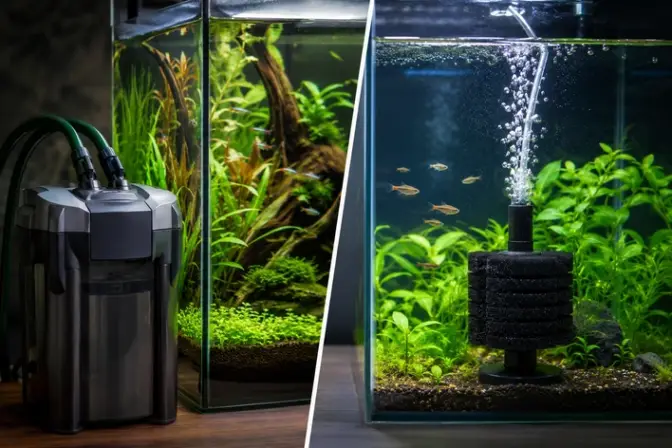
Canister vs Sponge Filter
Introduction
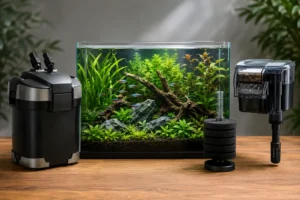
Canister filters and sponge filters solve aquarium filtration in completely different ways. One prioritizes high flow, large media capacity, and hidden equipment integration. The other focuses on simplicity, biological stability, shrimp safety, and gentle circulation.
Neither filter is universally “better.” The right choice depends on your aquarium goals, livestock, maintenance style, tank size, and whether you prioritize planted aquascaping, breeding stability, low maintenance, or maximum water clarity.
This guide compares canister filters and sponge filters in real-world aquarium use cases, including planted tanks, shrimp aquariums, nano systems, beginner setups, and high-tech aquascapes.
If you want a broader overview of filtration systems first, start with our Aquarium Filter Guide. To understand how circulation itself affects tank stability, also continue with Aquarium Filter Flow Guide.
What you’ll learn in this lesson
- The core differences between canister and sponge filters
- Which filter type is better for planted tanks
- Which filter is safest for shrimp and fry
- How flow and oxygenation differ
- How maintenance compares long-term
- How biological filtration capacity changes
- Which systems are best for beginners
- How noise, aesthetics, and cost compare
- Which filter fits your aquarium goals best
What Is a Canister Filter?
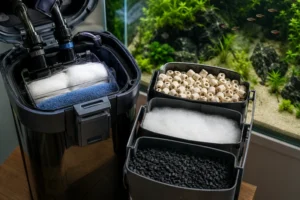
A canister filter is an external filtration system that pulls water from the aquarium through tubing into a sealed container filled with filtration media before returning the cleaned water back into the tank.
Canister filters are popular in planted aquariums and larger display tanks because they offer:
- Large media capacity
- Strong circulation
- Hidden equipment
- Flexible outflow systems
- High water clarity potential
- Better integration for aquascapes
Most serious planted aquariums and aquascapes rely on canister filtration because strong circulation and clean aesthetics become increasingly important as system complexity increases.
For deeper circulation optimization, see Filter Flow Guide.
What Is a Sponge Filter?
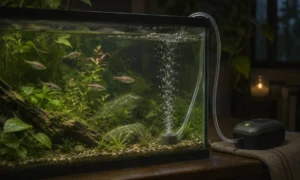
A sponge filter uses air-driven uplift to pull water gently through porous sponge material where biological filtration occurs.
Sponge filters are extremely popular in:
- Shrimp tanks
- Breeding aquariums
- Nano tanks
- Hospital tanks
- Beginner aquariums
- Low-flow setups
Because sponge filters create gentle circulation and extremely safe intake conditions, they are widely considered one of the safest filtration options for delicate livestock.
Unlike canister filters, sponge filters prioritize biological stability and simplicity over high mechanical polishing performance.
Canister Filter vs Sponge Filter: Quick Comparison
| Feature | Canister Filter | Sponge Filter |
|---|---|---|
| Flow strength | Medium to high | Gentle |
| Biological filtration | Excellent | Excellent |
| Mechanical filtration | Excellent | Moderate |
| Water polishing | Strong | Limited |
| Shrimp safety | Requires intake protection | Excellent |
| Noise level | Usually quiet | Air pump dependent |
| Maintenance complexity | Moderate | Very simple |
| Equipment visibility | Minimal | Visible inside tank |
| Best for | Planted & display tanks | Shrimp & breeding tanks |
Which Filter Is Better for Planted Tanks?
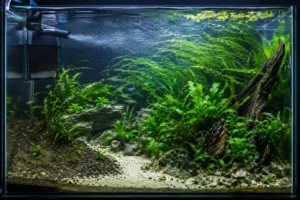
In most planted aquariums, canister filters are the preferred choice.
Planted tanks benefit heavily from:
- Stable circulation
- Better CO₂ distribution
- Cleaner visual presentation
- Higher turnover rates
- Flexible outflow positioning
- Stronger debris transport
This becomes especially important in high-tech aquascapes with carpeting plants and dense hardscape layouts.
Use what you learn in My Aquariums
Follow a new aquarium through cycling or see how water readings and care change over time in an established setup.
Strong circulation helps distribute dissolved nutrients and CO₂ more evenly throughout the aquarium.
Sponge filters can still work in low-tech planted tanks, but they usually lack the circulation strength needed for demanding aquascapes.
For lighting and plant growth balance, also see:
Which Filter Is Better for Shrimp Tanks?
Sponge filters are usually the safest and simplest option for shrimp tanks.
The gentle intake prevents baby shrimp from being sucked into the filtration system, while the sponge surface itself becomes an excellent grazing area for biofilm and microorganisms.
This is one reason sponge filters remain extremely popular in dedicated breeding setups.
Why shrimp keepers love sponge filters
- Safe for shrimplets
- Gentle water movement
- Simple maintenance
- Excellent oxygenation
- Strong biological stability
- Very low operating cost
Canister filters can still work in shrimp tanks if the intake is protected with a prefilter sponge.
For shrimp-focused systems, also continue with Aquarium Shrimp
Flow and Circulation Differences
Flow behavior is one of the biggest differences between these systems.
Canister filter flow
- Stronger circulation
- Better debris transport
- Improved CO₂ distribution
- Higher turnover potential
- Customizable outflow direction
Sponge filter flow
- Very gentle current
- Soft oxygenation
- Minimal turbulence
- Ideal for delicate livestock
- Less efficient debris movement
Neither approach is universally superior. The ideal flow depends on the ecosystem you are building.
River-style fish may prefer stronger current, while shrimp and long-finned fish often prefer calmer water movement.
Biological Filtration Capacity
Both filter types can provide excellent biological filtration.
The main difference is how the bacteria colony is housed and supported.
Canister filters
- Large media volume
- Multi-stage filtration
- Custom biological media
- High oxygen supply inside media chamber
Sponge filters
- Huge sponge surface area
- Stable bacteria growth
- Low disturbance during cleaning
- Simple biological efficiency
This is why sponge filters are often surprisingly effective despite their simplicity.
For cycling and bacterial stability, also see Fishless Cycle Guide.
When a sponge filter leaves particles in the water
First look at what is moving. Specks that settle and lift again when fish forage need a path to the intake. An even, milky haze may be a bloom, which calls for a different investigation. Check air delivery, sponge blockage and where the current carries debris before replacing a working filter.
A tank-size rating does not tell you how well a coarse sponge captures fine particles. If you need clearer water, gently siphon loose debris and consider a second filter that can hold fine mechanical media. Check it often for clogging. Leave the mature sponge running during the change and keep testing ammonia and nitrite. If a sponge is choking the flow during cycling, gently squeeze it in discarded tank water and put it straight back.
Maintenance Differences
Sponge filters are usually easier to maintain.
Most maintenance simply involves squeezing the sponge gently in removed aquarium water.
Canister filters require more involved cleaning because tubing, impellers, and media chambers all need periodic servicing.
| Maintenance Task | Canister Filter | Sponge Filter |
|---|---|---|
| Cleaning complexity | Moderate | Very easy |
| Media customization | High | Limited |
| Tubing cleaning | Required | None |
| Mechanical polishing | Excellent | Moderate |
| Maintenance frequency | Lower | Often more frequent |
However, canister filters often compensate for this extra complexity with better overall polishing and cleaner visual presentation.
Before switching on a canister filter
Use the manual for your model to check the permitted height difference and how its hose fittings are secured. Clean the gasket groove, inspect the seal for damage and seat it flat. Use lubricant only if the manufacturer specifies it. Seat the head evenly, secure the latches, and route the hoses without kinks, tension or sideways pull on the fittings.
With power off, assemble and prime the filter as directed. Dry the outside so a fresh drip is easy to spot. Arrange a drip loop in the cord. When you start the filter, stay nearby and check the head seam, valves and hose joints. Recheck after servicing or moving it. A shallow tray and leak alarm can help you notice the first drips.
If water reaches a plug, outlet or power strip, keep clear. Shut off the circuit at a dry, safely accessible breaker or get qualified help. Once the equipment is safely de-energized, close the valves as the manual directs. Find and repair the leak before restarting. Keep gas exchange going with separate equipment only if it can be used safely.
The Fluval 07 installation and gasket guidance illustrates model-specific checks. Use the instructions for the filter you actually own.
Noise, Aesthetics, and Equipment Visibility
Canister filters usually create cleaner-looking aquariums because most equipment remains hidden outside the tank.
This is one reason they dominate high-end aquascaping.
Sponge filters are visually more noticeable because the sponge body remains inside the aquarium.
Noise also differs:
- Canister filters are usually very quiet
- Sponge filters depend heavily on air pump quality
- Cheap air pumps can become noisy
- Surface bubbling may increase sound
For display-focused aquascapes, aesthetics often favor canister systems strongly.
Best Filter Choice by Aquarium Type
| Aquarium Type | Recommended Filter |
|---|---|
| High-tech planted tank | Canister filter |
| Shrimp breeding tank | Sponge filter |
| Nano aquarium | Sponge or small canister |
| Large aquascape | Canister filter |
| Hospital tank | Sponge filter |
| Betta aquarium | Gentle sponge filter |
| River-style setup | Canister filter |
Quick Takeaways
- Canister filters prioritize flow, hidden equipment, and strong polishing
- Sponge filters prioritize simplicity and livestock safety
- Planted aquascapes usually benefit more from canister systems
- Shrimp and fry setups often perform best with sponge filtration
- Both systems can provide excellent biological filtration
- The ideal filter depends on the ecosystem goals — not only tank size
FAQ
Are sponge filters enough for planted tanks?
Yes for low-tech planted tanks, especially smaller aquariums. High-tech aquascapes usually benefit more from stronger canister circulation and better CO₂ distribution.
Are canister filters safe for shrimp?
Yes, but intake protection is strongly recommended to prevent shrimplets from being sucked into the filter system.
Which filter is easier to maintain?
Sponge filters are usually simpler and faster to clean, while canister filters require more complete servicing.
Which filter creates better water clarity?
Canister filters generally provide stronger mechanical polishing and clearer water appearance.
Do sponge filters oxygenate the water better?
They often create strong surface aeration through air-driven uplift, which improves oxygen exchange effectively.
Conclusion
Canister filters and sponge filters are both highly effective — but they are optimized for different aquarium priorities.
Canister systems dominate modern planted aquascaping because they provide stronger circulation, hidden equipment, and cleaner aesthetics. Sponge filters remain unmatched for simplicity, shrimp safety, breeding systems, and low-stress biological stability.
The best filter is not the most powerful one. It is the system that supports your aquarium’s long-term biological balance most effectively.
Building a planted aquarium?
Choose filtration based on flow behavior, livestock sensitivity, maintenance style, and long-term ecosystem stability — not just marketing claims.
Lesson marked as read
Your reading progress is saved.
Continue learning →