
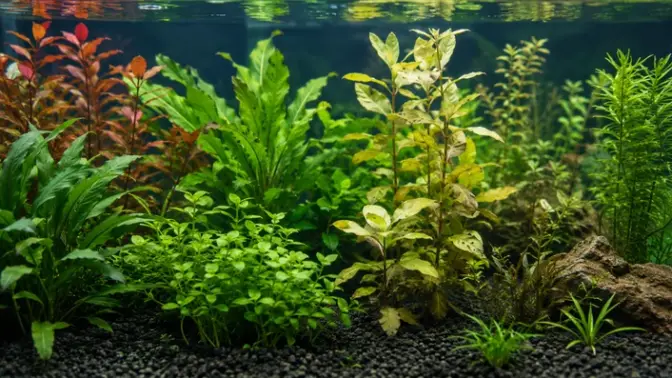
Aquarium Plant Deficiency Guide: Symptoms, Causes & Fixes
Introduction
An aquarium plant deficiency happens when aquatic plants cannot access enough of a nutrient they need for healthy growth. The result may be yellow leaves, pale new growth, pinholes, transparent tissue, stunted stems, melting, poor roots, weak colors or algae appearing while plants look stalled.
Plant deficiencies are frustrating because the symptoms often overlap. A yellow leaf does not automatically mean iron deficiency. Pinholes do not always mean potassium deficiency. Melting does not always mean a nutrient problem. CO₂ instability, excessive light, weak flow, old substrate, transition stress, livestock damage and poor maintenance can all look like nutrient issues.
The key is diagnosis, not guessing. You need to look at where symptoms appear, whether old or new leaves are affected, which plant types are struggling, how fast symptoms spread, and whether the tank recently changed. A deficiency pattern across several plants is much more useful than one damaged leaf.
This guide gives you a practical framework for reading aquarium plant deficiency symptoms without overreacting. It connects visual signs to likely nutrient problems, explains common false diagnoses, and shows when fertilizer, root tabs, CO₂, light or water changes are the real fix. For the broader nutrient foundation, start with the Aquarium Fertilizer Guide, Macronutrients for Aquarium Plants and Micronutrients for Aquarium Plants.
Quick answer: Diagnose aquarium plant deficiencies by checking whether old or new leaves are affected. Older leaf problems often point to mobile nutrients such as nitrogen, potassium or magnesium. New growth problems often point to less mobile nutrients such as iron, calcium or trace elements. Always check CO₂, light, flow and fertilizer routine before blaming one nutrient.
What You’ll Learn in This Lesson
- How to read aquarium plant deficiency symptoms correctly
- Why old leaves and new leaves tell different stories
- How nitrogen, phosphate, potassium, iron and magnesium deficiencies look
- Which symptoms are often confused with nutrient problems
- How CO₂, light and flow create false deficiency patterns
- When to use liquid fertilizer, root tabs or substrate support
- How to fix deficiencies without causing algae or livestock stress
- How to build a practical planted tank troubleshooting routine
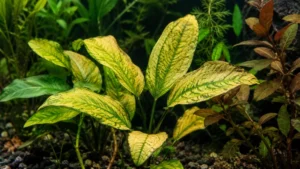
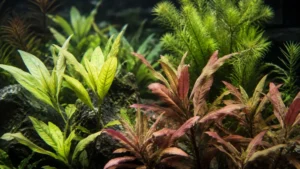
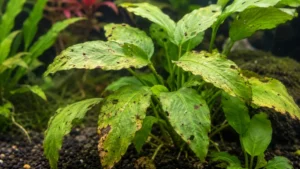
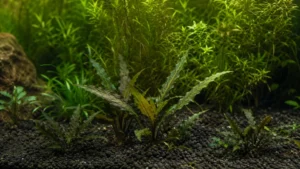
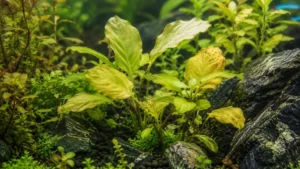
What Is an Aquarium Plant Deficiency?
An aquarium plant deficiency means a plant is missing enough of a nutrient required for normal growth. Aquatic plants need macronutrients, micronutrients, trace elements, minerals, light, carbon and stable water conditions. If one important factor becomes limiting, growth quality declines.
The word “deficiency” is often used too quickly. Not every damaged leaf is a nutrient deficiency. Aquarium plants can lose leaves after transport, emersed-to-submersed transition, trimming, replanting, unstable CO₂, poor flow, algae shading, fish grazing or old age.
A true deficiency usually shows a repeated pattern:
- The same symptom appears on multiple leaves or plants
- New growth or old growth is affected in a consistent way
- Growth quality declines over time
- The symptom matches a missing nutrient pathway
- The fertilizer routine or substrate support has a clear gap
- The issue improves after the missing factor is corrected
Good diagnosis starts by asking what changed. Did you increase light? Add CO₂? Stop dosing fertilizer? Switch water source? Add floating plants? Replace substrate? Increase water changes? Trim heavily? These changes often explain plant symptoms better than a single leaf chart.
Old Leaves vs New Leaves: The Most Important Clue
The most useful deficiency clue is whether symptoms appear mainly on old leaves or new leaves. Some nutrients are mobile inside the plant. When those nutrients run short, the plant can move them from older leaves to new growth. That means old leaves show symptoms first.
Other nutrients are less mobile. The plant cannot easily move them from old leaves into new tissues. When those nutrients are missing, new growth suffers first.
| Symptom Location | Often Points Toward | Common Examples |
|---|---|---|
| Older leaves yellow first | Mobile nutrient issue | Nitrogen or magnesium |
| Older leaves develop holes or necrosis | Mobile nutrient issue or damage | Potassium or livestock damage |
| New leaves are pale | Less mobile nutrient issue | Iron or trace elements |
| New growth is twisted or deformed | Less mobile nutrients or CO₂ instability | Calcium, boron, trace elements or CO₂ |
| All growth is slow | System-wide limitation | CO₂, light, nitrogen, phosphate or general nutrition |
This old-vs-new distinction prevents one of the most common mistakes: dosing iron for every yellow leaf. Iron problems usually affect new growth more than old growth. Older yellow leaves often point somewhere else.

Quick Aquarium Plant Deficiency Symptom Chart
Use this chart as a starting point, not as a final diagnosis. Several problems can look similar, and symptoms depend on plant species, growth speed, lighting, CO₂ and existing leaf damage.
| Visible Symptom | Likely Cause | What to Check First |
|---|---|---|
| Older leaves turn yellow or translucent | Nitrogen deficiency | Nitrate level, fish load, macro fertilizer |
| Slow growth with small shoots | Phosphate limitation, CO₂ issue or low energy | Phosphate, CO₂ timing, light balance |
| Pinholes and brown spots on older leaves | Potassium deficiency or grazing damage | Potassium dosing, snails, fish damage |
| Pale or yellow new leaves | Iron or trace element issue | Micro fertilizer, pH, dosing consistency |
| Older leaves yellow between green veins | Magnesium deficiency or soft water issue | GH, magnesium, remineralizer |
| Twisted or deformed new growth | Calcium, boron, trace issue or CO₂ instability | GH, CO₂ stability, trace dosing |
| Plant growth stops after light increase | CO₂ or nutrient demand increased | CO₂, macros, micros, PAR |
| Algae appears while plants stall | Imbalance, not always excess nutrients | Light, CO₂, flow, fertilizer and organics |
Use the detailed nutrient guides when symptoms point strongly in one direction: Nitrogen Deficiency in Aquarium Plants, Phosphate Deficiency in Aquarium Plants, Potassium Deficiency in Aquarium Plants, Iron Deficiency in Aquarium Plants and Magnesium Deficiency in Aquarium Plants.
Nitrogen Deficiency in Aquarium Plants
Nitrogen is one of the main macronutrients plants need for leaf growth, chlorophyll and plant mass. In aquariums, nitrogen is often discussed as nitrate, although plants can use nitrogen in different forms depending on the system.
Nitrogen deficiency often appears on older leaves first. The plant moves nitrogen from old leaves into new growth, so older leaves may become yellow, pale, translucent or weak. Fast-growing stem plants and floating plants often show nitrogen problems quickly.
Common signs include:
- Older leaves turn yellow
- Older leaves become translucent
- Growth slows across fast-growing plants
- Floating plants become small or pale
- Stem plants produce smaller tops
- Some plants become redder because green growth is limited
- Algae may appear while plants become less competitive
Nitrogen deficiency is common in heavily planted tanks with low fish load, strong lighting, CO₂ injection or fast floating plant growth. Fish food and fish waste may provide some nitrogen, but they do not always keep up with plant demand.
For a focused diagnosis and correction plan, use the Nitrogen Deficiency in Aquarium Plants guide.
Phosphate Deficiency in Aquarium Plants
Phosphate supports energy transfer, root development, shoot growth and recovery after trimming. It is needed in smaller quantities than nitrogen and potassium, but it is still a macronutrient and should not be treated only as a waste product.
Phosphate deficiency can be difficult to diagnose because symptoms are often general. Plants may grow slowly, produce smaller shoots, recover poorly after trimming or stall without a dramatic color change. Green spot algae is often associated with low phosphate in planted tanks, although light and CO₂ also matter.
Possible signs include:
- Very slow plant growth
- Small or weak new shoots
- Poor recovery after trimming
- Root development feels weak
- Green spot algae on glass or slow leaves
- Plants seem stalled despite nitrogen availability
- Fast stems lose momentum in high-tech tanks
Do not fear phosphate automatically. In planted aquariums, bottoming out phosphate can limit plants and make algae harder to control. For a deeper correction strategy, read Phosphate Deficiency in Aquarium Plants.
Potassium Deficiency in Aquarium Plants
Potassium supports plant transport systems, tissue strength and overall leaf health. It is one of the most common nutrient gaps because fish waste does not reliably supply enough potassium for planted tanks.
Potassium deficiency often appears on older leaves. Many aquarists associate it with pinholes, dark spots, brown edges or necrotic patches. However, similar damage can also come from snails, fish, old leaves, melting or mechanical damage, so diagnosis should be careful.
Possible signs include:
- Small pinholes in older leaves
- Dark dots that expand into damaged patches
- Brown or necrotic leaf edges
- Older leaves deteriorate faster than expected
- Epiphytes such as Anubias or Java Fern show damaged older leaves
- Stem plant lower leaves decline while tops continue growing
Potassium is often corrected through complete liquid fertilizer or a potassium supplement. But before dosing heavily, check whether the damage could come from grazing, old leaves or repeated CO₂ instability. For detailed help, read Potassium Deficiency in Aquarium Plants.
Iron Deficiency in Aquarium Plants
Iron is a micronutrient that supports chlorophyll, pigmentation and new growth quality. Iron deficiency is one of the most commonly suspected problems, but it is also one of the most overdiagnosed.
Iron deficiency usually affects new growth more than old growth. New leaves may appear pale, yellowish, washed out or weak while older leaves remain greener. In red plants, poor coloration may be blamed on iron, but light, CO₂, nitrate strategy and plant genetics also matter.
Possible signs include:
- Pale new leaves
- Yellow new shoot tips
- Weak new growth despite older leaves looking normal
- Reduced color intensity in some red plants
- Fast stems showing pale tops after trimming
- General micro deficiency symptoms in high-demand tanks
Iron should usually be supplied as part of a complete micronutrient fertilizer, not as a random overdose. If new growth is pale but CO₂ is unstable, light is excessive or macros are missing, extra iron alone may not fix the issue. Use the Iron Deficiency in Aquarium Plants guide for a focused diagnosis.
Magnesium Deficiency in Aquarium Plants
Magnesium is important for chlorophyll and photosynthesis. It is also part of general hardness, or GH. Magnesium deficiency is more likely in very soft water, RO water setups, unbalanced remineralization or tanks where calcium is present but magnesium is too low.
Magnesium deficiency often affects older leaves first. A classic pattern is interveinal chlorosis: the leaf tissue becomes pale while the veins stay greener. This can look similar to iron deficiency, but magnesium usually appears on older leaves while iron appears more on new leaves.
Possible signs include:
- Older leaves turn pale between green veins
- General yellowing in older foliage
- Weak photosynthesis and dull growth
- Soft-water tanks show repeated unexplained chlorosis
- RO water setups struggle without balanced remineralization
- Plants improve after GH and magnesium correction
Magnesium problems are often connected to water source and remineralization, not only fertilizer. If you use RO water or very soft tap water, check GH strategy. For deeper troubleshooting, read Magnesium Deficiency in Aquarium Plants.
Trace Element Deficiencies
Trace elements include nutrients such as manganese, zinc, boron, copper, molybdenum and others needed in tiny amounts. They are essential, but most aquarists should not dose them individually unless they understand the chemistry clearly.
Trace element deficiencies often show up as poor new growth, weak shoot tips, pale or distorted leaves, reduced vigor and general failure to thrive. These symptoms overlap heavily with iron deficiency, calcium issues and CO₂ instability.
Possible signs include:
- Weak or distorted new growth
- Pale new shoot tips
- Small new leaves
- Reduced plant vigor after trimming
- Growth looks incomplete despite macros being available
- Symptoms improve after consistent complete micro dosing
The practical fix is usually a complete micronutrient fertilizer used consistently. Do not stack multiple trace products blindly, especially in shrimp tanks. For the full concept, read Trace Elements for Aquarium Plants.
Calcium, GH and Deformed New Growth
Calcium is important for cell structure and new tissue development. In aquariums, calcium is often managed through GH rather than a separate calcium fertilizer. Deficiency is more likely in very soft water, poorly remineralized RO water or unusual source water situations.
Calcium-related problems may appear as twisted, deformed or weak new growth. However, similar symptoms can also come from CO₂ instability, trace element problems, severe nutrient imbalance or plant transition stress.
Possible signs include:
- Twisted new leaves
- Deformed shoot tips
- Weak or brittle new growth
- Severe stunting in fast-growing stems
- Problems appearing after switching to RO water
- Very low GH readings
Before adding random calcium, check GH, magnesium balance and CO₂ stability. Calcium and magnesium should be managed together in a stable mineral strategy.
Root Feeder Deficiencies
Some plants depend strongly on root-zone nutrition. Cryptocoryne, Amazon swords, lotus plants, Vallisneria and many rosette plants may struggle in plain sand or gravel if the substrate has no nutrients.
Root feeder deficiencies often look different from water-column problems. Rooted plants may stay small, produce pale leaves, lose old leaves, stop spreading or fail to recover after replanting while epiphytes and floating plants look fine.
Root-zone problems are likely when:
- Only heavy root feeders struggle
- The aquarium uses inert sand or gravel
- Old aquasoil has lost nutrient strength
- Crypts and swords grow well at first, then stall
- Liquid fertilizer helps stems but not root feeders enough
- Plants improve after root tabs are added near roots
For root-zone support, use the Aquarium Root Tabs Guide and Aquarium Soil Guide. Liquid fertilizer is still useful, but it may not fully support heavy root feeders in inert substrate.
Water-Column Feeder Deficiencies
Epiphytes, mosses, floating plants and many stem plants depend heavily on water-column nutrients. Root tabs buried in the substrate will not directly feed plants attached to hardscape or floating at the surface.
Water-column nutrient gaps are likely when Anubias, Java Fern, Bucephalandra, mosses, floating plants or fast stems show symptoms while rooted rosette plants remain stable.
Water-column deficiencies may appear as:
- Pale floating plants
- Pinholes on epiphyte leaves
- Slow moss growth
- Weak stem plant tops
- Anubias leaves aging poorly
- Java Fern producing damaged new growth
- Plants attached to wood or rocks failing despite root tabs
The usual fix is consistent complete liquid fertilizer, not more substrate tablets. Use the Aquarium Liquid Fertilizer Guide to build the routine.
CO₂ Problems That Look Like Nutrient Deficiency
CO₂ instability is one of the most common false deficiency causes in high-tech planted tanks. If CO₂ is low, late, fluctuating or poorly distributed, plants may show weak growth even when nutrients are available.
CO₂-related symptoms can include small stem tips, algae after trimming, poor carpet growth, distorted new growth, melting, weak recovery and plants looking generally “hungry” despite fertilizer. Adding more nutrients may not help if carbon is the real limiting factor.
Suspect CO₂ when:
- Symptoms appear after increasing light
- Algae appears in high-flow or high-light areas
- Plants pearl only near the diffuser
- Carpets grow upward or stall
- Drop checker stays blue during the photoperiod
- Fish or shrimp limit how much CO₂ you can add
- Plant growth differs across tank zones
Before increasing fertilizer heavily, check the Aquarium CO₂ System Guide, CO₂ Troubleshooting Guide and Aquarium Filter Flow Guide.
Lighting Problems That Look Like Deficiencies
Lighting can also create false deficiency patterns. Too little light causes slow, weak or leggy growth. Too much light increases demand for CO₂ and nutrients faster than the aquarium can provide them.
In many planted tanks, algae after a lighting change is not caused by nutrients alone. It is caused by increased plant demand that CO₂ and fertilizer do not match.
Lighting-related symptoms include:
- Carpets growing upward instead of spreading
- Lower leaves dying because upper plants shade them
- Algae appearing after increasing intensity or photoperiod
- Plants near the surface doing well while substrate plants struggle
- Stem plants becoming leggy in low-light zones
- Slow epiphytes getting algae under excessive light
Use Aquarium PAR Explained and Aquarium Lighting and Algae to decide whether light intensity is pushing the system beyond what CO₂ and nutrients can support.
Algae as a Deficiency Clue
Algae can provide clues, but it should not be treated as a perfect diagnosis. Algae often appears when plants are stressed or limited. That limitation may be nutrients, CO₂, light imbalance, poor flow or organic waste.
Some algae patterns are commonly associated with nutrient or system gaps:
| Algae Pattern | Possible Link | What to Check |
|---|---|---|
| Green spot algae | Low phosphate, strong light or slow plant growth | Phosphate, light intensity, CO₂ stability |
| Hair algae | Plant weakness under excess light or imbalance | CO₂, light, nutrients, plant mass |
| Black beard algae | CO₂ instability, organics or weak flow | CO₂ timing, flow, maintenance |
| Staghorn algae | Instability, organics or CO₂ issues | Flow, cleaning, CO₂ consistency |
| Algae on slow leaves | Too much light for slow plant turnover | Shade, flow and nutrient consistency |
Do not starve plants to fight algae. Nutrient starvation often makes plants weaker and algae harder to control. Balance the system instead.
Plant Melting vs Nutrient Deficiency
Plant melting is not always a deficiency. Many aquarium plants are grown emersed above water before sale. When moved into an aquarium, old emersed leaves may melt while new submersed leaves form. Cryptocoryne can also melt after sudden changes even when nutrients are not the main problem.
Melting may come from:
- Emersed-to-submersed transition
- Sudden parameter changes
- Unstable CO₂
- Poor planting or root damage
- Major trimming stress
- Transport damage
- Old leaves adapting to new light
- Ammonia or water-quality stress
- Severe nutrient imbalance
If new growth is healthy, melting old leaves may simply be transition. If new growth also fails, diagnose light, CO₂, roots, substrate and fertilizer together.
How to Fix Aquarium Plant Deficiencies Safely
Fix deficiencies slowly and logically. Do not add every fertilizer at once. If you change macros, micros, root tabs, CO₂ and light all in the same week, you will not know what helped or what caused new problems.
A safe correction process looks like this:
- Identify whether old leaves or new leaves are affected
- Check whether the issue affects root feeders, water-column feeders or all plants
- Review the current fertilizer label and what nutrients it actually contains
- Check CO₂ stability before increasing light or nutrients aggressively
- Use root tabs only where root feeders need substrate support
- Use complete liquid fertilizer for water-column feeders
- Make one main adjustment at a time
- Observe new growth over the next weeks
- Remove old decaying leaves so they do not confuse diagnosis
- Keep water changes stable and predictable
Old damaged leaves often do not heal. Judge success by new leaves, new roots, stronger shoot tips and better regrowth after trimming.
Liquid Fertilizer, Root Tabs or Both?
The right fix depends on how your plants feed. Liquid fertilizer supports the water column. Root tabs support the substrate. Many planted aquariums need both because they contain mixed plant types.
| Problem Pattern | Likely Best Fix | Reason |
|---|---|---|
| Floating plants are pale | Liquid fertilizer | They feed from the water column |
| Anubias and Java Fern show nutrient symptoms | Liquid fertilizer | Epiphytes are not fed directly by root tabs |
| Crypts and swords struggle in sand | Root tabs plus liquid fertilizer | Heavy root feeders need substrate support |
| Stem plants have weak tops | Liquid macros, micros and CO₂ review | Fast stems rely heavily on water-column balance |
| Old aquasoil no longer supports roots | Root tabs or substrate refresh | Root-zone nutrients decline over time |
| Whole tank looks nutrient-starved | Complete fertilizer routine | General nutrient availability may be too low |
If you are unsure, start with the Aquarium Fertilizer Guide and Aquarium Root Tabs Guide.
Common Mistakes When Diagnosing Deficiencies
Most deficiency mistakes come from reacting to one symptom too quickly. Aquarium plants need time, and diagnosis works best through patterns.
| Mistake | Why It Causes Problems | Better Approach |
|---|---|---|
| Dosing iron for every yellow leaf | Old yellow leaves often point to nitrogen or magnesium | Check old vs new leaves first |
| Ignoring CO₂ instability | CO₂ problems mimic nutrient issues | Stabilize CO₂ before heavy dosing |
| Using root tabs for epiphytes | Hardscape plants need water-column nutrients | Use liquid fertilizer |
| Using only liquid fertilizer for heavy root feeders | Sand or gravel may lack root-zone nutrition | Add root tabs where needed |
| Changing everything at once | You cannot identify the real fix | Adjust one main variable at a time |
| Judging old damaged leaves | Old leaves may never recover | Judge new growth |
| Starving plants to fight algae | Weak plants compete poorly | Balance nutrients, CO₂ and light |
A calm diagnosis beats aggressive correction. Plants respond over days and weeks, not minutes.
Aquarium Plant Deficiency Troubleshooting Checklist
Use this checklist before adding more fertilizer:
- Are old leaves or new leaves affected first?
- Does the problem affect one plant type or the whole tank?
- Are root feeders planted in sand, gravel or old soil?
- Are epiphytes and floaters receiving liquid fertilizer?
- Does your fertilizer contain macros, micros or both?
- Are nitrate, phosphate and potassium available?
- Are iron and trace elements dosed consistently?
- Is the tank very soft or using RO water?
- Is CO₂ stable and well distributed?
- Did light intensity or photoperiod recently increase?
- Is flow reaching dense plant groups?
- Are fish, shrimp or snails damaging leaves?
- Are old leaves simply transitioning or aging?
- Are water changes removing nutrients without replacement?
- Are you judging recovery by new growth?
If several answers are uncertain, fix the system basics before chasing one nutrient.
When to Use the Fertilizer Dosing Calculator
A dosing calculator is useful when you want to understand what your fertilizer actually adds. This matters because two products may both be called “complete fertilizer” while supplying very different amounts of nitrate, phosphate, potassium, iron or magnesium.
Use the Fertilizer Dosing Calculator when:
- You are comparing fertilizers
- You suspect one nutrient is missing
- You dose several products and want to avoid overlap
- You changed tank volume or dosing frequency
- You want to estimate macros after water changes
- You are moving from beginner dosing to structured dosing
- You want to avoid random overdosing
The calculator helps quantify dosing, but it does not replace plant observation. Use numbers to support diagnosis, then confirm with new growth.
Final Recommendation
Diagnose aquarium plant deficiencies by patterns, not panic. Start with old leaves versus new leaves. Then check whether the affected plants are root feeders or water-column feeders. After that, review fertilizer, substrate, CO₂, light, flow and water-change routine.
Use liquid fertilizer for water-column feeders, root tabs for heavy root feeders, complete macros and micros for demanding planted tanks, and stable CO₂ when light intensity is high. Do not dose random single nutrients unless the symptom pattern and setup clearly support it.
The best deficiency fix is not always “more fertilizer.” Sometimes it is better CO₂, lower light, cleaner flow, stronger substrate support, more stable water changes or simply time for new submersed growth to replace old leaves.
Conclusion
Aquarium plant deficiency symptoms can tell you a lot, but only when you read them carefully. Yellow leaves, pinholes, pale growth, melting, slow stems and algae are clues — not final answers.
Older leaf symptoms often point toward mobile nutrients such as nitrogen, potassium or magnesium. New growth symptoms often point toward iron, calcium or trace elements. But every symptom must be checked against CO₂, light, flow, substrate and plant type.
Healthy planted aquariums are built on balance. Fertilizer supplies nutrients, CO₂ supplies carbon, light drives demand, flow distributes resources and water changes reset the system. When those pieces work together, deficiency diagnosis becomes easier, plant recovery becomes more predictable and algae becomes much less confusing.
💬 Join the Conversation
Which aquarium plant deficiency symptom are you trying to diagnose — yellow leaves, pale new growth, pinholes, melting, weak roots or algae appearing while plants stop growing?
Tag us on Instagram @AquariumLesson — we’d love to see your planted tank recovery, fertilizer routine and plant growth progress.
FAQ
How do I know if aquarium plants have a deficiency?
Look for repeated patterns such as yellow old leaves, pale new growth, pinholes, weak shoots, stalled growth or poor recovery after trimming. Then check whether symptoms appear on old leaves, new leaves, root feeders or water-column feeders.
Why are my aquarium plant leaves turning yellow?
Yellow leaves can come from nitrogen deficiency, magnesium deficiency, iron deficiency, old leaf aging, transition stress or weak light. Older yellow leaves often point to nitrogen or magnesium, while pale new leaves often point to iron or trace elements.
What causes pinholes in aquarium plant leaves?
Pinholes are often associated with potassium deficiency, especially on older leaves. However, snails, fish, old leaves, melting or mechanical damage can look similar, so check for repeated patterns before dosing heavily.
Why is new aquarium plant growth pale?
Pale new growth often points toward iron, trace element or micro nutrient issues. It can also appear when CO₂ is unstable, macros are missing or fast plants are growing faster than the fertilizer routine supports.
Can CO₂ problems look like nutrient deficiencies?
Yes. Unstable or poorly distributed CO₂ can cause weak growth, algae, poor carpets, small stem tips and distorted new growth. Always check CO₂ stability before assuming fertilizer is the only issue.
Should I use root tabs or liquid fertilizer for deficiencies?
Use root tabs for heavy root feeders such as Cryptocoryne, swords, Vallisneria and lotus plants in sand, gravel or old soil. Use liquid fertilizer for stem plants, floating plants, mosses and epiphytes such as Anubias and Java Fern.
How long does it take aquarium plants to recover from deficiency?
Recovery usually appears in new growth over the next few weeks. Old damaged leaves often do not heal fully, so judge progress by new leaves, stronger shoot tips, better color and improved regrowth after trimming.
Can too much fertilizer cause plant problems?
Yes, especially if several products overlap or the tank has low plant demand. However, many planted tank problems come from imbalance rather than fertilizer alone. Match nutrients to light, CO₂, plant mass and water changes.
New to AquariumLesson? Start with our complete Aquarium Lessons Hub or return to the homepage at AquariumLesson.com.
References
- Aquasabi — Deficiency Symptoms in Aquatic Plants
- Green Aqua — The Most Common Plant Deficiency Symptoms in the Aquarium
- Aquarium Co-Op — Nutrient Deficiencies: Why Your Aquarium Plants Are Dying
- Aqua Rebell — Deficiency Symptoms
- Aquarium Gardens — Nutrients Guide for Planted Tanks
- Tropica — Plant Care
- Tropica — Premium Nutrition
- Tropica — Specialised Nutrition