
Calcium Deficiency in Aquarium Plants: Symptoms & Fixes
Introduction
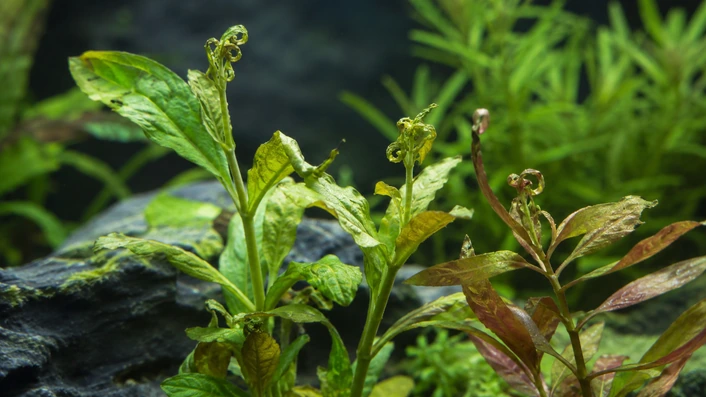
Calcium deficiency aquarium plants problems usually appear in the newest growth first. Leaves may emerge twisted, curled, crinkled, stunted, unusually small or deformed. Growing tips may look weak, pale or damaged, and in severe cases the plant may stop producing healthy new tissue altogether.
Calcium is not usually the first deficiency beginners should suspect. In many freshwater aquariums, tap water already contains enough calcium. But calcium deficiency can become relevant in very soft water, RO or RODI water, poorly remineralized tanks, shrimp aquariums, high-tech planted tanks, or systems where GH is too low or mineral balance is incomplete.
The difficult part is that calcium deficiency can look similar to other problems. Twisted new growth may also come from unstable CO₂, trace element issues, boron limitation, severe iron or micro imbalance, physical damage, emersed-to-submersed transition, or poor growing conditions. That means the fix is not always “add calcium immediately.” The better approach is to check GH, water source, remineralizer, new growth pattern, CO₂ stability and overall nutrient routine.
This guide explains how calcium deficiency appears in aquarium plants, why it affects new leaves first, how it relates to GH, magnesium and RO water, how to fix it safely, and how to avoid confusing it with other planted tank problems. For the full symptom framework, start with the Aquarium Plant Deficiency Guide. If symptoms point more toward magnesium, compare this with Magnesium Deficiency in Aquarium Plants.
Quick answer: Calcium deficiency in aquarium plants usually affects new growth. Look for twisted, curled, stunted or deformed young leaves, especially in very soft or RO water. Check GH and remineralization before dosing random calcium, because CO₂ instability and trace element problems can look similar.
What You’ll Learn in This Lesson
- What calcium does for aquarium plants
- How calcium deficiency symptoms look in aquatic plants
- Why new leaves are affected before old leaves
- How calcium relates to GH, magnesium and RO water
- How to separate calcium deficiency from CO₂ or trace problems
- Which aquarium setups are most at risk
- How to correct calcium deficiency safely
- Common calcium dosing mistakes to avoid
What Does Calcium Do for Aquarium Plants?
Calcium supports plant structure, cell wall development, new tissue formation and growing tips. In simple terms, plants need calcium to build strong, organized new growth. Without enough available calcium, the newest leaves and shoot tips may form poorly.
Calcium is different from nutrients such as nitrogen or potassium because it does not move freely inside the plant once deposited in older tissue. This matters for diagnosis. When calcium becomes limited, the plant cannot easily pull it out of older leaves and move it into new growth. Instead, the newest tissue suffers first.
In aquariums, calcium is usually discussed as part of general hardness, or GH. GH mostly reflects calcium and magnesium ions in the water. A tank with extremely low GH may not provide enough calcium and magnesium for healthy plant growth, even if nitrate, phosphate, potassium and iron are available.
| Calcium Role | Why It Matters | Where Problems Usually Appear |
|---|---|---|
| Cell wall support | Helps build strong new tissue | New leaves and growing tips |
| Growth point development | Supports healthy shoot and root tips | Stem tops, rosettes and young leaves |
| Structural stability | Helps leaves form normally | Twisting, curling or crinkling when limited |
| Mineral balance | Works alongside magnesium and other ions | Very soft or poorly remineralized water |
Calcium is not a flashy nutrient, but when it is missing, new growth quality can collapse quickly.
Ready to set up your own tank?
Create a free account to save lessons, plan your setup, and use the Tank Hub to turn ideas into a real aquarium.
Calcium Deficiency Symptoms in Aquarium Plants
Calcium deficiency usually shows in the youngest growth first. The plant may keep older leaves relatively normal while new leaves emerge distorted, curled, twisted, crinkled or stunted.
Symptoms can vary by species. Fast-growing stem plants often show problems at the shoot tips. Rosette plants may show deformed center growth. Some plants may produce tiny, pale or brittle new leaves. Roots may also look weak or poorly developed in severe mineral deficiency situations.
Common calcium deficiency signs include:
- Twisted new leaves
- Curled or crinkled young growth
- Small or stunted new leaves
- Deformed shoot tips
- New leaves that look pale or weak
- Growing tips that appear damaged or aborted
- Rosette plants producing distorted center leaves
- Fast stem plants showing curled top growth
- Root tips that appear short, weak or poorly developed
The key clue is location. Calcium deficiency is mainly a new-growth issue. If only old leaves are yellowing, melting or developing holes, calcium is usually not the first suspect.
Why Calcium Deficiency Affects New Growth First
Calcium is considered relatively immobile inside plants. Once calcium is built into older tissue, the plant cannot easily move it to new leaves. This is why calcium deficiency symptoms usually appear in growing tips rather than older leaves.
This makes calcium different from nitrogen, magnesium or potassium. Those nutrients are more mobile, so plants can move them from older leaves into new tissue when supply is low. As a result, nitrogen, magnesium and potassium issues often show on older leaves first.
| Symptom Location | More Likely Nutrients | Example Symptoms |
|---|---|---|
| Newest leaves | Calcium, iron, boron, trace elements, CO₂ instability | Twisted, pale, stunted or deformed new growth |
| Older leaves | Nitrogen, potassium, magnesium | Yellowing, pinholes, chlorosis or old leaf decline |
| Whole plant | CO₂, light, general nutrition, severe root issues | Slow growth, melting, algae or weak recovery |
This old-versus-new distinction is the most important diagnostic step. Calcium should be considered when new growth is distorted, especially if the aquarium has very soft or poorly remineralized water.
Calcium Deficiency vs Magnesium Deficiency
Calcium and magnesium are both part of GH, but their deficiency symptoms are different. Calcium problems usually affect new growth. Magnesium problems more often affect older leaves, especially as pale tissue between greener veins.
This matters because many aquarists respond to any GH-related issue by adding a random mineral product. But the problem may be calcium, magnesium, both, or the balance between them.
| Feature | Calcium Deficiency | Magnesium Deficiency |
|---|---|---|
| Main symptom location | New growth | Older leaves |
| Typical visual sign | Twisted, curled or stunted new leaves | Yellowing between veins on older leaves |
| Common water context | Very soft or poorly remineralized water | Very soft water, RO water or low magnesium GH |
| Plant mobility | Less mobile | More mobile |
| Best first check | GH, calcium source, new growth pattern | GH, magnesium source, older leaf pattern |
If symptoms appear on older leaves, read Magnesium Deficiency in Aquarium Plants before assuming calcium. If symptoms appear on young leaves and growing tips, calcium becomes more plausible.
Calcium Deficiency vs Iron Deficiency
Calcium and iron problems can both affect new growth, but the visual pattern is different. Iron deficiency usually causes pale, yellowish or washed-out new leaves. Calcium deficiency is more associated with twisted, curled, crinkled or malformed new leaves.
A plant can also have multiple issues at once. For example, a high-tech tank with strong light, unstable CO₂ and incomplete fertilization may show pale and distorted new growth. In that case, adding only iron or only calcium may not solve the underlying system problem.
| Feature | Calcium Issue | Iron Issue |
|---|---|---|
| New leaf shape | Often twisted, curled or stunted | Usually normal shape at first |
| New leaf color | May be pale, but distortion is the stronger clue | Pale or yellow new leaves are the main clue |
| Water context | Very soft water, low GH or RO water | Micro dosing gaps, high pH issues or fast growth demand |
| Correction path | Check GH and remineralization | Check complete micronutrient dosing |
If your main symptom is pale new growth without much deformation, compare with Iron Deficiency in Aquarium Plants. If shape is clearly distorted, calcium, boron, trace elements or CO₂ instability should be considered.
Calcium Deficiency vs CO₂ Instability
CO₂ instability is one of the most common false calcium diagnoses in high-tech aquariums. Unstable carbon can cause small, twisted, weak or stunted new growth, especially in fast-growing stems. It can also cause algae, poor carpets and weak recovery after trimming.
Before adding calcium, check whether the aquarium’s CO₂ system is stable. If the bubble rate changes daily, the drop checker stays blue, flow is weak, the diffuser is dirty or plants only grow well near the CO₂ source, carbon distribution may be the real issue.
Suspect CO₂ instability when:
- Symptoms appear after increasing light
- Fast stems twist or stunt mostly near the top
- Plants pearl only near the diffuser
- Algae appears at the same time as growth distortion
- Drop checker response is inconsistent
- Fish or shrimp limit how much CO₂ you can add
- Growth differs strongly between tank zones
If CO₂ is uncertain, review the Aquarium CO₂ System Guide and CO₂ Troubleshooting Guide before making calcium the main correction.
Calcium, GH and Water Hardness
General hardness, or GH, measures dissolved calcium and magnesium ions in the water. It is one of the most important values for understanding calcium availability in freshwater planted aquariums.
A very low GH tank may not supply enough calcium or magnesium. This is common when aquarists use pure RO or RODI water without proper remineralization. It can also happen in naturally very soft tap water areas.
GH is important because:
- It reflects calcium and magnesium availability
- It affects plant mineral nutrition
- It supports shrimp and snail shell health when balanced correctly
- It helps stabilize soft-water planted systems
- It provides context for deformed new growth
- It helps separate mineral deficiency from fertilizer deficiency
A low GH reading does not automatically prove calcium deficiency, but it gives you a strong reason to investigate mineral balance. A normal GH does not completely rule out calcium problems either, because the calcium-to-magnesium balance and actual source of GH also matter.
Why RO Water Can Cause Calcium Problems
RO and RODI water are nearly stripped of minerals. This makes them useful for controlling water chemistry, but they must be remineralized before use in most freshwater aquariums. Pure RO water is not a complete environment for plants, fish or shrimp.
If RO water is used without enough GH minerals, plants may lack calcium and magnesium. Shrimp and snails may also struggle if mineral balance is inappropriate for the species.
RO-related calcium deficiency risk increases when:
- RO water is used without GH remineralizer
- Only KH is raised but GH remains low
- Remineralizer is designed for a different tank type
- The calcium-to-magnesium ratio is poorly balanced
- Large water changes create mineral swings
- High-tech growth increases mineral demand
- Shrimp-specific parameters are targeted without plant needs considered
If you use RO water, remineralization is not optional. It is part of the aquarium’s nutrition and livestock safety system.
Calcium Deficiency in Soft Water Tanks
Soft water tanks can be beautiful and stable, but they need careful mineral planning. Many soft-water fish prefer lower mineral content, yet plants still need enough calcium and magnesium to grow correctly.
The goal is not to make every planted aquarium hard-water. The goal is to avoid mineral starvation while respecting livestock needs. A blackwater-style aquarium with easy plants is different from a high-tech aquascape with fast stems and carpets.
In soft water tanks, calcium deficiency is more likely when:
- GH is extremely low
- Fast-growing plants show distorted new growth
- RO or rainwater is used without enough remineralization
- Tap water contains little calcium and magnesium
- Only macro and micro fertilizers are dosed, but minerals are ignored
- High light and CO₂ increase growth demand
Soft water is not the problem by itself. Incomplete mineral strategy is the problem.
Which Plants Show Calcium Deficiency Most Clearly?
Fast-growing stem plants often reveal calcium or mineral problems quickly because they produce new tissue rapidly. If new shoot tips twist, curl or deform across multiple stems, calcium, trace elements, CO₂ and GH should be checked.
Rosette plants may show problems in the newest center leaves. Rooted plants may also react to poor substrate or root-zone conditions, so do not diagnose only from one plant.
Useful indicator plant groups include:
- Fast stem plants with visible shoot tips
- Hygrophila species
- Ludwigia species
- Rotala species
- Limnophila and similar fast growers
- Rosette plants producing new center leaves
- Demanding carpets in high-energy tanks
Do not diagnose calcium deficiency from one damaged leaf. Look for repeated new-growth deformation across several plants.
How to Test for Calcium Deficiency
There is no perfect visual test for calcium deficiency. The best method is to combine plant symptoms with water testing and setup context.
Start with GH. If GH is very low and new growth is distorted, calcium and magnesium availability become strong suspects. If GH is normal, look harder at CO₂, trace elements, plant transition stress and overall nutrition before adding calcium.
Use this diagnostic process:
- Check whether symptoms are on new leaves, not old leaves.
- Test GH with a reliable kit.
- Review your water source: tap, RO, RODI or mixed water.
- Check whether you use a GH remineralizer.
- Review the calcium and magnesium source in your routine.
- Check CO₂ stability and flow before dosing minerals aggressively.
- Check whether symptoms affect multiple plant species.
- Observe new growth after correction rather than old leaves.
If you use RO water and GH is close to zero, the mineral strategy needs correction even if calcium is not the only issue.
How to Fix Calcium Deficiency Safely
The safest fix depends on the cause. If the aquarium uses very soft or RO water, the best correction is usually proper remineralization, not random calcium dosing. A balanced GH remineralizer can restore calcium and magnesium in a controlled way.
If tap water already has enough GH, calcium deficiency is less likely. In that case, check CO₂, trace elements, light intensity and general fertilizer routine first.
Safe correction options include:
- Use a suitable GH remineralizer for RO or very soft water.
- Target stable GH rather than sudden mineral swings.
- Choose a remineralizer appropriate for your livestock.
- Maintain a reasonable calcium and magnesium balance.
- Make changes gradually during water changes.
- Keep CO₂ and light stable while correcting minerals.
- Observe new growth over several weeks.
Do not dump calcium products into the aquarium without understanding GH, livestock needs and water-change routine. Sudden mineral changes can stress fish, shrimp and plants.
Calcium Supplements vs GH Remineralizers
Calcium supplements add calcium. GH remineralizers usually add a more balanced mineral mix, often including calcium and magnesium. For most aquarium situations, especially RO water, a proper GH remineralizer is safer and more complete than adding calcium alone.
Adding only calcium can create imbalance if magnesium remains too low. Plants need both. Shrimp and snails also depend on appropriate mineral balance, not just one number.
| Option | Best Use | Main Caution |
|---|---|---|
| GH remineralizer | RO water, very soft water and complete mineral rebuilding | Choose one that fits plants and livestock |
| Calcium-only supplement | Specific calcium correction when magnesium is already adequate | Can unbalance Ca:Mg if used blindly |
| Crushed coral or limestone | Slow mineral and KH/GH increase in some tanks | Less precise and may raise KH/pH too |
| Tap water blending | Mixing RO with mineral-rich tap water | Requires stable tap water chemistry |
| Complete liquid fertilizer | Macro and micro nutrient routine | Often does not supply enough calcium to rebuild GH |
If the problem is low GH, fix GH. If the problem is incomplete fertilizer, fix fertilizer. If the problem is unstable CO₂, fix CO₂. Do not use calcium as a universal cure.
Can Liquid Fertilizer Fix Calcium Deficiency?
Most aquarium liquid fertilizers are designed to supply macros, micros or both. They may not supply enough calcium to correct low-GH water. This is especially true if the tank uses RO water or very soft tap water.
A complete liquid fertilizer can be excellent for nitrogen, phosphate, potassium, iron and trace elements, but mineral hardness often needs a separate GH strategy.
Use liquid fertilizer when:
- Water-column nutrients are missing
- Stem plants, floating plants or epiphytes show nutrient symptoms
- Iron or trace elements are inconsistent
- Macros are being consumed quickly
- The fertilizer routine is incomplete
Use GH remineralization when:
- GH is too low
- RO or RODI water is used
- Calcium and magnesium are both missing
- Shrimp, snails or plants need stable mineral hardness
- New growth deformation appears with soft water context
For water-column dosing, use the Aquarium Liquid Fertilizer Guide. For broader nutrient context, use the Aquarium Fertilizer Guide.
Calcium Deficiency and Shrimp Tanks
Shrimp tanks need careful mineral management. Calcium and magnesium are important not only for plants but also for shrimp molting and shell development. However, shrimp species have different preferences, so mineral correction must match the livestock.
Neocaridina shrimp usually tolerate and often prefer moderately mineralized water. Caridina shrimp are often kept in softer, more controlled water, frequently using RO water and shrimp-specific remineralizers. In both cases, stability matters.
In shrimp tanks:
- Do not raise GH suddenly.
- Use remineralizers designed for the shrimp type if needed.
- Match water-change water before adding it to the tank.
- Monitor TDS, GH and KH according to livestock needs.
- Avoid random calcium-only dosing.
- Watch shrimp behavior and molting after mineral changes.
- Correct plant problems without destabilizing the animals.
In shrimp aquariums, the best plant solution is the one that keeps livestock stable too.
Calcium Deficiency and Snails
Snails also depend on mineral availability for shell health. Very soft, acidic or poorly mineralized water can contribute to shell erosion or weak shell development, depending on species and conditions.
If plants show possible calcium deficiency and snails also show shell problems, water hardness deserves serious attention. However, snail shell damage can also involve pH, KH, diet, age and species-specific needs.
Check mineral balance if you see:
- Very low GH
- Very low KH in species that need harder water
- Snail shells eroding or becoming thin
- RO water used without complete remineralization
- Plants showing twisted new growth at the same time
- Water changes causing mineral swings
Do not correct snail and plant mineral problems by guessing. Test the water and choose a mineral strategy that fits the tank’s livestock.
Calcium Deficiency and Aquarium Soil
Aquarium soil can influence water chemistry, especially in the early months. Active soils often reduce KH and pH, and many aquascapers use them with soft water or RO water. This can be excellent for some plants and shrimp, but mineral planning still matters.
Aquasoil itself does not eliminate the need for calcium and magnesium in the water column. If RO water is used with soil and remineralization is incomplete, mineral deficiency can still appear.
In aquasoil tanks, check:
- GH after water changes
- Whether remineralizer adds both calcium and magnesium
- Whether active soil is changing KH and pH expectations
- Whether high-tech growth has increased mineral demand
- Whether symptoms appear in new growth across multiple plants
For substrate context, read the Aquarium Soil Guide. Soil supports roots, but water minerals still matter.
Common Calcium Deficiency Mistakes
Calcium deficiency is easy to overdiagnose. Many aquarists see twisted growth and immediately add calcium, even when CO₂ instability, trace elements or transition stress are more likely.
| Mistake | Why It Causes Problems | Better Approach |
|---|---|---|
| Dosing calcium without testing GH | You may not have a calcium problem | Test GH and review water source first |
| Ignoring magnesium | Calcium alone may not fix mineral imbalance | Use balanced remineralization where needed |
| Blaming calcium for old yellow leaves | Old leaf symptoms usually point elsewhere | Check nitrogen, magnesium or old leaf aging |
| Ignoring CO₂ instability | CO₂ can mimic deformed growth | Stabilize CO₂ before mineral chasing |
| Changing GH suddenly | Livestock and plants dislike mineral swings | Adjust gradually through water changes |
| Using crushed coral for precision | It can raise KH and pH unpredictably | Use measured remineralizer for controlled tanks |
| Expecting old leaves to heal | Damaged tissue often stays damaged | Judge new growth after correction |
The safest correction is controlled, measured and based on the whole aquarium context.
Calcium Deficiency Troubleshooting Checklist
Use this checklist before adding calcium:
- Are symptoms mainly on new leaves and growing tips?
- Are leaves twisted, curled, crinkled or stunted?
- Is GH very low?
- Are you using RO, RODI, rainwater or very soft tap water?
- Do you use a GH remineralizer?
- Does the remineralizer provide both calcium and magnesium?
- Are shrimp or snails showing mineral-related issues?
- Is CO₂ stable and well distributed?
- Did symptoms appear after increasing light?
- Are trace elements dosed consistently?
- Are old leaves fine while new growth is deformed?
- Do multiple plant species show the same new-growth pattern?
- Have you changed only one major variable at a time?
- Are you judging recovery by new growth?
If the answer to several mineral questions is yes, calcium and GH correction may be appropriate. If CO₂, light or trace dosing is uncertain, fix those basics too.
How Long Does Recovery Take?
Calcium deficiency recovery appears in new growth. Old twisted leaves usually do not straighten out. Damaged tips may stay damaged. The goal is to see healthier new leaves after the mineral balance improves.
Fast-growing stem plants may show improvement within one to three weeks if the diagnosis and correction are right. Slower plants may take longer. Rooted rosette plants may need several new leaves before the improvement becomes obvious.
Look for:
- New leaves forming with better shape
- Less curling or crinkling at shoot tips
- More normal stem growth after trimming
- Stronger center growth in rosette plants
- Fewer aborted growing tips
- Stable plant growth without new livestock stress
If new growth remains distorted after GH correction, revisit CO₂, trace elements, boron, light intensity and overall fertilizer balance.
Final Recommendation
Suspect calcium deficiency when aquarium plants show twisted, curled, crinkled or stunted new growth, especially in very soft water or RO water setups. The strongest clue is distorted new tissue combined with low GH or incomplete remineralization.
Do not diagnose calcium from old yellow leaves, pinholes or general melting alone. Those symptoms often point to nitrogen, potassium, magnesium, transition stress, CO₂ instability or other system issues.
The safest fix is stable mineral management. Use a suitable GH remineralizer when water is too soft, keep calcium and magnesium balanced, adjust gradually through water changes and confirm success by healthier new growth. If the tank is high-tech, make sure CO₂, light and fertilizer are stable too.
Conclusion
Calcium deficiency in aquarium plants is a real issue, but it is not the most common cause of every distorted leaf. It mainly affects new growth because calcium is not easily moved from old leaves to young tissue. Twisted, curled, crinkled or stunted new leaves are the main signs to watch for.
The most common risk setups are very soft water tanks, RO or RODI water systems, poorly remineralized aquariums and high-growth planted tanks where mineral demand is higher. GH testing and water-source review are essential before dosing calcium.
Correct calcium problems with balance, not panic. Stable GH, proper remineralization, good calcium-magnesium balance, consistent CO₂, suitable lighting and complete fertilization create healthier new growth than random single-nutrient dosing. When the system is corrected, the proof will appear in the next leaves your plants produce.
💬 Join the Conversation
Are your aquarium plants showing twisted new growth, curled leaves, stunted shoot tips or mineral problems in soft or RO water?
Tag us on Instagram @AquariumLesson — we’d love to see your planted tank recovery, water parameters and new growth progress.
FAQ
What does calcium deficiency look like in aquarium plants?
Calcium deficiency usually appears as twisted, curled, crinkled, stunted or deformed new growth. It affects young leaves and growing tips more than old leaves.
Can low GH cause calcium deficiency in aquarium plants?
Yes. Very low GH can indicate low calcium and magnesium availability, especially in RO water or very soft tap water. Plants may develop distorted new growth if mineral supply is incomplete.
Does calcium deficiency affect old or new leaves first?
Calcium deficiency affects new leaves first because calcium is not easily moved from old tissue to new growth. Old leaf yellowing usually points to other issues such as nitrogen or magnesium deficiency.
Can RO water cause calcium deficiency?
Yes. RO water contains very little mineral content and must usually be remineralized. Without a suitable GH remineralizer, plants may lack calcium and magnesium.
How do I fix calcium deficiency in aquarium plants?
Check GH and water source first. If GH is too low, use a suitable GH remineralizer to add calcium and magnesium gradually through water changes. Avoid sudden mineral changes or random calcium-only dosing.
Can liquid fertilizer fix calcium deficiency?
Usually not if the real problem is low GH. Many liquid fertilizers supply macros and micros but do not rebuild calcium and magnesium hardness. RO or very soft water often needs GH remineralization.
Can CO₂ problems look like calcium deficiency?
Yes. Unstable CO₂ can cause weak, twisted or stunted new growth, especially in high-light planted tanks. Check CO₂ stability, flow and drop checker behavior before blaming calcium alone.
Will damaged leaves recover after fixing calcium deficiency?
Usually no. Damaged or twisted leaves often stay damaged. Recovery should be judged by healthier new growth after calcium, GH or mineral balance has been corrected.
Start building your aquarium with the Tank Hub
Save your favorite lessons, organize your setup, and track your aquarium step by step in your personal Tank Hub.
New to AquariumLesson? Start with our complete Aquarium Lessons Hub or return to the homepage at AquariumLesson.com.
Continue learning
References
- Aqua Rebell — Deficiency Symptoms
- Aqua Rebell — Calcium in Planted Aquariums
- Aquasabi — Deficiency Symptoms in Aquatic Plants
- Green Aqua — Common Plant Deficiency Symptoms in the Aquarium
- Aquarium Co-Op — Nutrient Deficiencies in Aquarium Plants
- Buce Plant — Nutrient Deficiencies in Aquatic Plants
- Aquarium Gardens — Nutrients Guide for Planted Tanks
- Bulk Reef Supply — Why Aquarium Plants Keep Dying