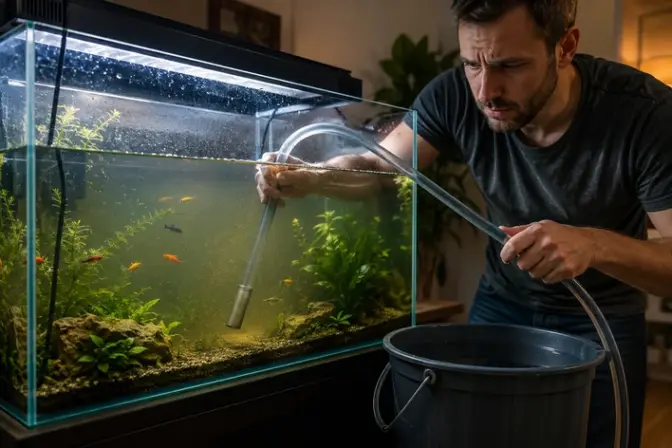
Emergency Aquarium Water Change: When, How Much & Safe Steps
Emergency aquarium water changes are one of the fastest ways to protect fish, shrimp, snails, and beneficial bacteria when water quality becomes unsafe. In a normal aquarium, water changes are part of routine maintenance. In an emergency, they become a rescue tool: they dilute toxins, reduce waste concentration, improve stability, and buy time while the root cause is fixed.
An emergency water change may be needed when ammonia or nitrite is measurable in a stocked aquarium, fish are gasping, food was massively overfed, dead livestock has decomposed, a chemical or medication mistake happened, nitrate is extremely high, or contaminated water entered the tank. The goal is not to “reset” the aquarium. The goal is to make the water safer quickly without causing additional shock.
This guide explains when emergency water changes are necessary, how much water to change, how to prepare replacement water safely, what to do before and after the change, and which mistakes can make emergencies worse. For normal maintenance routines, read Aquarium Water Changes: Schedule, Amounts & Water Stability. For common errors, continue with Aquarium Water Change Mistakes.
Quick Answer
- Do an emergency water change if ammonia or nitrite is measurable in a stocked tank.
- Act fast if fish are gasping, but increase aeration immediately before long diagnosis.
- Use dechlorinated, temperature-matched water to avoid adding a second stressor.
- Do not replace all filter media during the emergency.
- Remove the cause: uneaten food, dead livestock, rotting plants, chemical source, or contamination.
- Change enough water to reduce danger, but avoid sudden parameter shock in sensitive tanks.
- Test ammonia, nitrite, nitrate, pH, KH, GH, and temperature when possible.
- Increase surface movement during and after the emergency.
- Repeat controlled water changes if toxins remain high.
The safest emergency routine is: increase aeration, test water, remove the source, prepare safe replacement water, perform a controlled water change, restart equipment, and retest.
What you’ll learn in this lesson
- When an emergency aquarium water change is necessary
- How much water to change during different emergencies
- How to prepare replacement water quickly but safely
- What to do if ammonia or nitrite is present
- What to do when fish are gasping at the surface
- How to handle overfeeding, dead fish, contamination, and medication mistakes
- Why aeration and filter protection matter during emergencies
- How to avoid shocking fish, shrimp, snails, and plants
- How to retest and stabilize the aquarium afterward
What Is an Emergency Aquarium Water Change?
An emergency aquarium water change is a partial water change performed because the current water may be unsafe for livestock. Unlike routine maintenance, which is planned around weekly or biweekly stability, an emergency water change responds to a sudden or serious water-quality problem.
The main purpose is dilution. If ammonia, nitrite, contaminants, excess food, medication overdose, or extreme nitrate are present, removing part of the water lowers the concentration. This does not always solve the root cause, but it reduces immediate exposure.
An emergency water change should still be controlled. Panic can make the situation worse. Untreated tap water, temperature shock, pH swings, filter-media replacement, or aggressive deep cleaning can add new stress while you are trying to fix the first problem.
In simple terms: an emergency water change is a fast safety action, not a full aquarium reset.
When Should You Do an Emergency Water Change?
You should consider an emergency water change when water quality creates immediate risk. The strongest triggers are measurable ammonia, measurable nitrite, severe overfeeding, dead livestock decomposing in the tank, fish gasping, chemical contamination, medication mistakes, or extreme nitrate with stressed livestock.
Not every unusual test result requires panic. But some values are urgent. In a stocked aquarium, ammonia and nitrite should normally be 0 ppm. If either appears, especially with fish or shrimp showing stress, a controlled emergency water change is often appropriate.
| Situation | Emergency Level | First Action |
|---|---|---|
| Ammonia present in stocked tank | High | Water change, reduce feeding, oxygenate, protect filter |
| Nitrite present in stocked tank | High | Water change, increase aeration, keep testing |
| Fish gasping at surface | High | Increase aeration immediately, then test water |
| Massive overfeeding | Moderate to high | Remove food, water change, aerate |
| Dead fish or shrimp found late | Moderate to high | Remove body, water change, test ammonia/nitrite |
| Medication overdose | High | Follow medication guidance, water change if appropriate |
| Contaminant entered tank | High | Remove source, water change, use carbon if suitable |
| Very high nitrate with stress | Moderate | Controlled water changes and cause review |
How Much Water Should You Change in an Emergency?
The amount depends on the emergency and the difference between tank water and replacement water. A larger water change dilutes toxins more strongly, but it can also cause more parameter shift if the new water is different in temperature, pH, KH, GH, or mineral content.
In many emergencies, a 30–50% water change can be reasonable if replacement water is safe and well matched. In sensitive shrimp tanks, very soft-water setups, or aquariums with large chemistry differences, repeated smaller controlled changes may be safer than one extreme change.
If ammonia or nitrite remains high after the first change, repeat testing and continue controlled water changes as needed. The goal is to reduce exposure while keeping the aquarium stable enough for livestock to recover.
| Emergency | Possible Water Change Amount | Main Caution |
|---|---|---|
| Low ammonia reading with mild stress | 25–40% | Retest and repeat if needed |
| High ammonia or severe stress | 40–50% or repeated controlled changes | Match temperature and protect filter |
| Nitrite present | 30–50% | Increase aeration and monitor closely |
| Massive overfeeding | 30–50% | Siphon food first |
| Shrimp tank emergency | 10–30%, repeated if needed | Avoid mineral and temperature shock |
| Extreme nitrate | 30–50%, possibly repeated | Check tap nitrate and livestock sensitivity |
| Contamination | Large controlled change may be needed | Remove source and consider carbon if suitable |
There is no universal emergency percentage. The correct amount is the largest safe change you can do with properly prepared replacement water.
Emergency Step-by-Step Routine
When an aquarium emergency happens, the order of actions matters. A structured routine prevents panic and reduces the risk of making the situation worse.
Step 1: Increase aeration immediately
If fish are gasping, breathing rapidly, or gathering near the surface, increase surface movement immediately. Adjust the filter outlet, add an air stone, or use stronger circulation. Do this before spending too much time diagnosing.
Oxygen support is useful in many emergencies because ammonia, nitrite, warm water, bacterial blooms, decomposing waste, and CO₂ problems can all create respiratory stress.
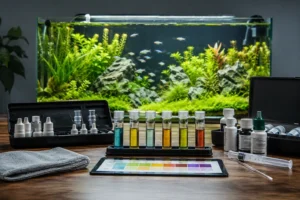
Step 2: Test the most urgent parameters
Test ammonia and nitrite first. Then check temperature, nitrate, pH, KH, and GH if relevant. In CO₂ planted tanks, also consider CO₂ timing and fish behavior during injection.
If you cannot test immediately but fish are clearly distressed, still increase aeration and prepare a safe water change. Testing helps confirm the cause, but visible severe respiratory stress should not be ignored.
Step 3: Remove the source
Remove uneaten food, dead livestock, rotting plants, contaminated materials, spilled chemicals, or anything visibly decomposing. If the source remains, the problem can continue even after the water change.
Step 4: Prepare safe replacement water
Use dechlorinated, temperature-matched water. If you use RO water, remineralize it correctly. In shrimp tanks and soft-water setups, avoid sudden KH, GH, pH, and temperature swings.
Do not add untreated tap water during an emergency. That can turn one problem into two.
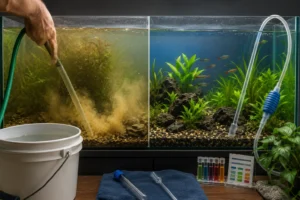
Step 5: Remove water carefully
Siphon out the planned amount. If overfeeding or dead matter is involved, target the affected area. Avoid ripping up the entire substrate unless the emergency source is trapped there and must be removed.
Step 6: Refill slowly
Refill gently to avoid temperature shock, substrate disturbance, plant uprooting, or shrimp stress. Use a plate, cup, hose clip, diffuser, or slow pump flow if needed.
Step 7: Restart equipment and retest
Restart filter, heater, air stone, circulation, and CO₂ equipment as appropriate. Check that the filter is flowing properly. Retest ammonia and nitrite after the water change and continue monitoring over the next days.
Emergency Water Change for Ammonia
Ammonia is one of the most urgent reasons for an emergency water change. It can appear in new tanks, after filter disruption, after overfeeding, after livestock death, or when the biological filter is not able to process waste quickly enough.
In a stocked aquarium, ammonia should normally be 0 ppm. If ammonia is measurable, reduce exposure quickly. A controlled water change dilutes ammonia, but you also need to protect and support the biological filter.
Do not replace all filter media. Do not overfeed. Do not add more fish. Increase aeration, remove waste sources, and keep testing. High pH and warm temperatures make ammonia risk more serious, so alkaline warm tanks need special urgency.
- Perform a controlled water change.
- Remove uneaten food and dead matter.
- Reduce or pause feeding temporarily.
- Increase surface movement and oxygenation.
- Keep the filter running.
- Do not replace all biological media.
- Retest ammonia and nitrite.
For the full emergency process, read Ammonia Spike in Aquarium.
Emergency Water Change for Nitrite
Nitrite is another urgent water-quality problem. It often appears during cycling after ammonia begins converting, but before the second stage of biological filtration is mature enough. It can also appear after filter disruption or sudden waste overload.
In a stocked aquarium, nitrite should normally be 0 ppm. If nitrite is present, perform a controlled water change and increase oxygenation. Fish may show rapid breathing, gasping, lethargy, clamped fins, or surface gathering.
Nitrite problems are not solved by cleaning the tank aggressively. The biological filter must continue developing or recovering. Protect the filter, reduce feeding, and keep testing until nitrite remains at 0 ppm.
- Perform a controlled water change.
- Increase aeration and surface movement.
- Reduce feeding temporarily.
- Do not add more livestock.
- Protect filter media.
- Retest daily until stable.
For details, read Nitrite Spike in Aquarium.
Emergency Water Change for Fish Gasping
Fish gasping at the surface is an urgent warning sign. It can be caused by low oxygen, ammonia, nitrite, chlorine exposure, high temperature, excess CO₂, disease, or gill irritation. Because several causes overlap, the first action should be oxygen support.
Increase surface movement immediately. Add an air stone if available. If CO₂ is running, reduce or pause CO₂ temporarily. Then test ammonia, nitrite, temperature, and pH. If ammonia or nitrite is present, perform a controlled emergency water change.
If gasping began right after a water change, consider chlorine/chloramine exposure, temperature mismatch, parameter swing, or CO₂ imbalance. If gasping began during a heat wave, temperature and oxygen availability may be central.
For oxygen-specific troubleshooting, read Aquarium Oxygen Levels.
Emergency Water Change After Overfeeding
Overfeeding can quickly turn into a water-quality emergency. Uneaten food decomposes, increases ammonia risk, fuels bacterial growth, reduces oxygen stability, and can cloud the water. The more food was added, the faster you should act.
First, remove as much uneaten food as possible with a siphon, net, or turkey baster. Then perform a partial water change. Increase aeration because bacterial activity and decomposition can consume oxygen. Test ammonia and nitrite afterward.
- Remove visible food immediately.
- Siphon waste from the affected area.
- Perform a controlled water change.
- Increase surface movement.
- Skip or reduce feeding for a short period.
- Test ammonia and nitrite over the next days.
Emergency Water Change After Dead Livestock
A dead fish, shrimp, or snail can quickly affect water quality, especially in small tanks or warm water. If livestock dies and remains hidden, decomposition can increase ammonia, bacterial activity, and oxygen demand.
Remove dead livestock immediately. Then test ammonia and nitrite. If the animal was decomposing for some time, perform a controlled water change and increase aeration. Check hidden areas behind hardscape, plants, filter intakes, and dense vegetation.
If multiple animals die, do not assume the dead animals are the original cause. They may be the result of a water-quality problem. Test the full system and look for ammonia, nitrite, oxygen stress, temperature problems, contamination, or recent changes.
Emergency Water Change for Contamination
Contamination can come from sprays, soap, cleaning products, hand creams, paint fumes, pesticides, metals, accidental chemical dosing, or objects placed in the tank. In these cases, an emergency water change may be necessary even if standard test kits do not show the contaminant.
Remove the source immediately. Perform a large controlled water change if livestock are at risk and replacement water is safe. Activated carbon or chemical filtration media may help in some contamination cases, but it depends on the substance. Always increase aeration and monitor livestock closely.
Never use household cleaning products inside or near aquarium equipment. Buckets, hoses, sponges, and tools used for aquariums should be aquarium-only.
Emergency Water Change for Medication Mistakes
Medication mistakes can happen when a product is overdosed, mixed incorrectly, used with sensitive species, or combined with another treatment. Some medications can reduce oxygen availability, affect biological filtration, or stress shrimp, snails, plants, or scaleless fish.
Read the product instructions immediately. If overdose or livestock distress occurs, a partial water change may be recommended, but the correct response depends on the medication. Activated carbon is sometimes used to remove medication after treatment or overdose, but not all cases are identical.
During any medication-related emergency, increase aeration and observe livestock closely. Do not mix additional treatments unless you know they are compatible.
Emergency Water Change for High Nitrate
High nitrate is usually less immediately urgent than ammonia or nitrite, but very high nitrate can still indicate a serious accumulation problem, especially if fish or shrimp show stress. Water changes are the fastest practical way to lower nitrate.
If nitrate is extremely high, a large water change may help, but check tap water nitrate first. If tap water already contains nitrate, the water change may not lower nitrate as much as expected. In neglected tanks, avoid sudden extreme chemistry shifts. Repeated controlled water changes may be safer.
After reducing nitrate, fix the cause: overfeeding, overstocking, dirty substrate, low plant uptake, poor maintenance, clogged filter debris, or nitrate in source water.
For a full guide, read High Nitrate in Aquarium.
Emergency Water Changes in Shrimp Tanks
Shrimp tanks need special care during emergencies because shrimp are sensitive to sudden changes in temperature, pH, KH, GH, and dissolved minerals. A water change may be necessary, but replacement water must be matched carefully.
If ammonia or nitrite is present, the danger of leaving toxins in the water may be greater than the risk of a controlled water change. Still, refill slowly and use properly prepared water. If you use RO water, remineralize it consistently.
- Match temperature carefully.
- Match GH and KH as closely as practical.
- Use remineralized RO water if that is your normal system.
- Refill slowly with airline tubing, drip method, or low-flow pump.
- Avoid sudden pH or TDS swings.
- Increase aeration if shrimp climb upward or act weak.
What Not to Do During an Emergency Water Change
Emergency water changes can save livestock, but the wrong actions can make the situation worse. Avoid these mistakes during urgent maintenance.
- Do not add untreated tap water. Chlorine or chloramine can harm livestock and bacteria.
- Do not use cold or hot water suddenly. Temperature shock can worsen stress.
- Do not replace all filter media. This can trigger ammonia or nitrite spikes.
- Do not turn off the filter for long periods. Flow and oxygen-rich filtration matter.
- Do not deep-clean the whole aquarium. Target the source and preserve stability.
- Do not add more livestock. The system is already under stress.
- Do not overfeed afterward. Extra food becomes more waste.
- Do not add random chemicals. Identify the cause before stacking treatments.
- Do not ignore gasping. Increase aeration immediately.
- Do not walk away from hoses or siphons. Floods and overdraining happen fast.
Emergency Water Change Troubleshooting Table
Use this table to connect emergency symptoms with likely causes and first actions.
| Emergency Sign | Likely Cause | First Action |
|---|---|---|
| Fish gasping | Low oxygen, ammonia, nitrite, chlorine, CO₂ excess | Aerate immediately and test water |
| Ammonia present | Cycle issue, waste overload, filter disruption | Water change, reduce feeding, protect filter |
| Nitrite present | Incomplete or disrupted cycle | Water change, oxygenation, keep testing |
| Cloudy water after overfeeding | Bacterial bloom and organic waste | Remove food, aerate, water change |
| Shrimp climbing upward | Oxygen stress, ammonia, nitrite, parameter swing | Aerate and compare water parameters |
| Sudden deaths | Toxin, oxygen crash, ammonia/nitrite, contamination | Remove dead livestock, test, water change |
| Nitrate extremely high | Long-term accumulation | Controlled water changes and cause review |
| Fish stressed after refill | Temperature, chlorine, pH/KH/GH swing | Aerate, test, compare source water |
After the Emergency: Stabilizing the Aquarium
The first emergency water change reduces immediate risk, but the aquarium still needs follow-up. Retest ammonia and nitrite. Watch livestock behavior. Confirm filter flow. Check temperature. Continue aeration if fish were gasping.
If ammonia or nitrite remains measurable, repeat controlled water changes as needed and continue protecting the biological filter. If nitrate remains high, review feeding, stocking, water change schedule, plants, and tap water nitrate. If shrimp reacted badly, compare old tank water and replacement water for pH, KH, GH, temperature, and TDS if you use it.
After the crisis, the goal is to return to a stable routine. Do not keep making random changes every few hours unless water tests show a reason. Stability matters during recovery.
Post-emergency checklist
- Retest ammonia and nitrite.
- Check nitrate trend.
- Confirm filter flow and surface movement.
- Observe fish and shrimp behavior.
- Remove remaining waste sources.
- Feed lightly until water stabilizes.
- Do not add new livestock.
- Record what happened and what fixed it.
- Adjust routine to prevent recurrence.
Emergency Prevention Checklist
The best emergency is the one you prevent. Most emergency water changes come from predictable causes: overfeeding, immature filters, overstocking, untreated tap water, hidden dead livestock, poor maintenance, clogged filters, or sudden chemical changes.
- Cycle the aquarium before full stocking.
- Feed only what livestock actually eat.
- Remove dead leaves and uneaten food.
- Check livestock daily.
- Keep filter media stable and oxygen-rich.
- Do not replace all filter media at once.
- Use dechlorinator for tap water.
- Test ammonia and nitrite in new or unstable tanks.
- Test nitrate before routine water changes.
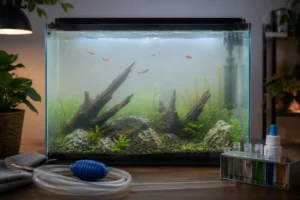
- Prepare emergency supplies: conditioner, bucket, siphon, air pump, and test kit.
- Do not use household cleaning products near aquarium tools.
Quick Takeaways
- Emergency water changes dilute dangerous substances and reduce immediate livestock exposure.
- Ammonia and nitrite in stocked tanks are major emergency triggers.
- Fish gasping requires immediate aeration and water testing.
- Use dechlorinated, temperature-matched replacement water.
- Do not replace all filter media during an emergency.
- Remove the source of the problem before or during the water change.
- Large water changes can be safe if replacement water matches the aquarium.
- Shrimp tanks need slower, more carefully matched emergency changes.
- Retesting after the water change is essential.
- Prevention depends on cycling, feeding control, filter stability, and regular testing.
Conclusion
An emergency aquarium water change can save livestock when water quality becomes unsafe. It is one of the fastest practical tools for diluting ammonia, nitrite, contaminants, excess food, medication mistakes, and extreme waste buildup.
The key is control. Increase aeration, test water, remove the source, prepare safe replacement water, protect the filter, change enough water to reduce danger, and retest afterward. Do not panic-clean the entire aquarium or replace all filter media. The goal is safer water and system stability.
From here, continue with Aquarium Water Changes, Aquarium Water Change Mistakes, Ammonia Spike in Aquarium, Nitrite Spike in Aquarium, and Aquarium Oxygen Levels.
Next step:
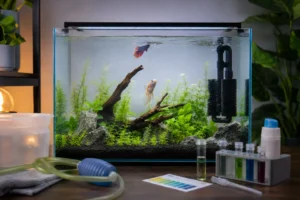
Build an emergency kit before you need it: water conditioner, siphon, bucket, thermometer, ammonia test, nitrite test, nitrate test, and an air pump or air stone. In an emergency, preparation saves time.
💬 Join the Conversation
Tag us on Instagram @AquariumLesson — we’d love to hear how you solved your aquarium emergency and what you learned from it.
👉 Have you ever had to do an emergency water change? Was it caused by ammonia, nitrite, overfeeding, oxygen stress, or something else?
FAQ
When should I do an emergency water change?
Do an emergency water change when ammonia or nitrite is measurable in a stocked aquarium, fish are gasping, major overfeeding happened, dead livestock decomposed, contamination occurred, or water quality is clearly unsafe.
How much water should I change in an emergency?
Many emergencies can require 30–50% or repeated controlled changes, but the safest amount depends on replacement water quality and livestock sensitivity. Shrimp tanks and soft-water systems may need slower, better-matched changes.
Can a large water change hurt fish?
A large water change can hurt fish if replacement water is untreated, the wrong temperature, or very different in pH, KH, GH, or minerals. Properly prepared water makes large changes much safer.
Should I change water if ammonia is present?
Yes, in a stocked aquarium, a controlled water change is often needed when ammonia is present. Also reduce feeding, remove waste, increase aeration, and protect filter media while the biological filter recovers.
Should I change water if nitrite is present?
Yes, measurable nitrite in a stocked aquarium is an urgent warning. Perform a controlled water change, increase aeration, reduce feeding, and continue testing until nitrite remains at 0 ppm.
What should I do if fish are gasping?
Increase aeration and surface movement immediately. Then test ammonia, nitrite, temperature, and check for CO₂ excess or chlorine exposure. If toxins are present, perform a controlled water change.
Can I use tap water in an emergency?
You can use tap water only if it is made aquarium-safe first. Treat it with a suitable conditioner for chlorine or chloramine and match temperature before adding it to the aquarium.
Should I clean the filter during an emergency water change?
Only clean clogged mechanical media gently if flow is reduced. Do not replace or sterilize all filter media during an emergency because that can weaken biological filtration and worsen ammonia or nitrite problems.
Why are shrimp sensitive to emergency water changes?
Shrimp are sensitive to sudden changes in temperature, pH, KH, GH, and dissolved minerals. In emergencies, use well-matched water, refill slowly, and avoid sudden mineral swings.
Do water changes remove beneficial bacteria?
Partial water changes remove very little beneficial bacteria because most of it lives on surfaces, filter media, substrate, plants, and hardscape. Replacing or sterilizing filter media is much more disruptive than changing water.
Lesson completed!
You've finished this lesson. Keep building your aquarium knowledge, one lesson at a time.
Continue learning →New to AquariumLesson? Start with our complete Aquarium Lessons Hub or return to the homepage at AquariumLesson.com.
References
- U.S. Environmental Protection Agency. Aquatic Life Criteria – Ammonia.
- North Central Regional Aquaculture Center. An Introduction to Water Chemistry in Freshwater Aquaculture.
- New Mexico State University. Important Water Quality Parameters in Aquaponics Systems.
- FAO. Environment and Fish Health: Water Quality for Aquaculture.
- AquariumLesson. Aquarium Water Changes.