
Magnesium Deficiency in Aquarium Plants: Symptoms & Fixes
Introduction
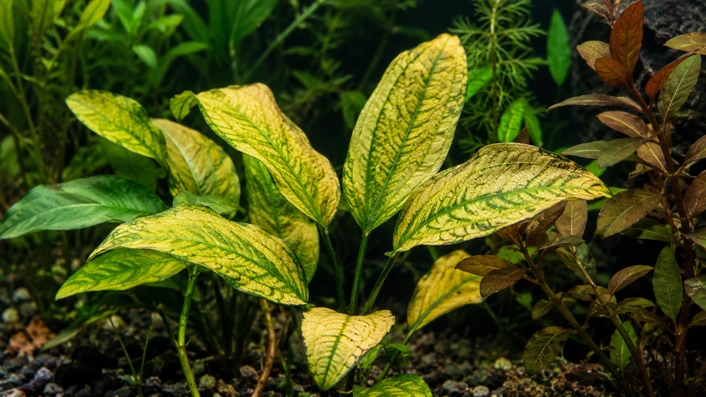
Magnesium deficiency in aquarium plants often appears as pale, yellow, or light green discoloration on older leaves while the leaf veins remain darker. This pattern is called interveinal chlorosis, and it can look very similar to iron deficiency at first glance.
The key difference is leaf age. Iron deficiency usually affects new growth first. Magnesium deficiency usually shows more clearly on older or mature leaves because magnesium is relatively mobile inside the plant. When the plant cannot access enough magnesium, it can move magnesium away from older leaves to support newer growth. The old leaves then become pale between the veins.
Magnesium is often underestimated in planted aquariums because it is part of general hardness, often hidden inside tap water chemistry, and not always discussed as much as nitrate, phosphate, potassium, or iron. But plants need magnesium for chlorophyll, photosynthesis, enzyme function, and stable growth. In very soft water, RO water setups, shrimp tanks, high-light aquascapes, or tanks with strong plant mass, magnesium can become limiting.
This guide explains how to recognize aquarium plant magnesium deficiency, how it differs from iron and nitrogen deficiency, why GH and calcium-magnesium balance matter, how to fix the problem safely, and how to avoid recurring pale older leaves. For the broader trace-nutrient system, start with Micronutrients for Aquarium Plants. If your newest leaves are pale instead, compare this article with Iron Deficiency in Aquarium Plants.
Quick answer: Magnesium deficiency usually causes older leaves to become pale or yellow between the veins while the veins stay greener. It is common in very soft water, RO water setups, low-GH tanks, or aquariums where calcium and magnesium are out of balance. The fix is stable magnesium availability through complete fertilization, remineralization, or controlled magnesium supplementation.
What You’ll Learn in This Lesson
- What magnesium does for aquarium plants
- How magnesium deficiency looks in planted tanks
- Why older leaves often show symptoms first
- How magnesium deficiency differs from iron, nitrogen and potassium problems
- Why very soft water and RO water can create magnesium issues
- How GH and calcium-magnesium balance affect plant growth
- How to fix magnesium deficiency safely
- How to prevent recurring pale leaves, dark veins and weak growth
What Magnesium Does for Aquarium Plants
Magnesium is an essential plant nutrient and one of the minerals that contributes to general hardness in freshwater aquariums. It is needed in smaller amounts than nitrogen or potassium, but it is still critical for healthy plant growth.
The most important role of magnesium is its connection to chlorophyll. Chlorophyll is the green pigment plants use for photosynthesis. Without enough available magnesium, plants struggle to maintain healthy green leaf tissue, especially in older leaves.
Magnesium also supports enzyme activity, energy transfer, nutrient transport and overall plant metabolism. In planted aquarium terms, magnesium helps plants stay green, photosynthesize efficiently and use the rest of the nutrient system properly.
Magnesium supports:
- Chlorophyll production
- Healthy green leaf color
- Photosynthesis
- Enzyme activity
- Plant metabolism
- Nutrient transport inside the plant
- Stable growth in soft-water aquariums
- Balanced calcium and magnesium uptake
Magnesium is not only a “hardness mineral.” For planted aquariums, it is part of the nutrient foundation that allows plants to use light, CO₂ and fertilizers effectively.
Ready to set up your own tank?
Create a free account to save lessons, plan your setup, and use the Tank Hub to turn ideas into a real aquarium.
Magnesium Deficiency Symptoms in Aquarium Plants
The classic magnesium deficiency symptom is interveinal chlorosis on older leaves. That means the tissue between leaf veins becomes pale, yellow or light green while the veins stay darker green. This creates a striped, mottled or net-like pattern.
In stronger cases, the pale tissue can become weak, brown, transparent or necrotic. Leaf edges may droop, curl or deteriorate. Growth may slow because the plant is no longer photosynthesizing efficiently.
| Symptom | What It May Look Like | Why It Matters |
|---|---|---|
| Pale older leaves | Older leaves lose green color | Classic magnesium deficiency pattern |
| Green veins | Veins stay darker while tissue between them turns yellow | Interveinal chlorosis is a key clue |
| Mottled leaves | Leaf color looks patchy, striped or uneven | Magnesium shortage affects chlorophyll distribution |
| Brown or weak patches | Pale tissue begins to break down | More advanced deficiency or mixed nutrient issue |
| Drooping leaf edges | Older leaves look tired or weakened | Often seen when the deficiency becomes visible |
| Slower growth | Plants continue growing, but less strongly | Photosynthesis and metabolism are affected |
| Poor response to iron dosing | New fertilizer does not fix pale leaves | The issue may be magnesium, not iron alone |
One pale leaf does not automatically prove magnesium deficiency. Look for a repeated pattern on older or mature leaves, especially in soft-water tanks, RO water setups or aquariums where GH is very low.
Which Leaves Show Magnesium Deficiency First?
Magnesium deficiency usually appears on older leaves first because magnesium is relatively mobile inside the plant. When supply is limited, the plant can move magnesium from older leaves into newer growth. The older leaves then lose color between the veins.
This is the opposite of classic iron deficiency, where new leaves are usually most affected. That distinction is extremely important because both deficiencies can cause pale leaves with darker veins.
| Leaf Pattern | More Likely Problem | Reason |
|---|---|---|
| Older leaves pale between green veins | Magnesium deficiency | Magnesium is mobile and old leaves often show symptoms first |
| New leaves pale with darker veins | Iron deficiency | Iron is not very mobile, so new growth suffers first |
| Older leaves turn generally yellow | Nitrogen deficiency | Nitrogen is mobile and old leaves are sacrificed |
| Older leaves develop holes or necrosis | Potassium deficiency | Physical tissue damage is more typical |
| Growth stalls without clear yellowing | Phosphate, CO₂ or light issue | The main symptom may be weak growth rather than leaf position |
Before adding iron, ask one question: are the newest leaves affected first, or are the older leaves showing the strongest chlorosis? That answer changes the likely diagnosis.
Magnesium Deficiency vs Iron Deficiency
Magnesium deficiency and iron deficiency are easy to confuse because both can create pale leaves with green veins. The difference is usually where the symptom appears first.
Iron deficiency usually affects young leaves, shoot tips and new growth. Magnesium deficiency usually affects older leaves first. If you keep dosing iron but the pale older leaves continue, magnesium or general hardness may be the missing piece.
| Feature | Magnesium Deficiency | Iron Deficiency |
|---|---|---|
| Most affected leaves | Older or mature leaves | New leaves and shoot tips |
| Typical color pattern | Pale tissue between green veins | Pale new growth with darker veins |
| Mobility in plant | Relatively mobile | Low mobility |
| Common tank context | Very soft water, RO water, low GH, poor Ca:Mg balance | Weak micro dosing, high pH, iron availability issue |
| Best first check | GH, remineralization, magnesium source | Micro fertilizer, iron dosing, pH and chelation |
If the problem is clearly on new growth, read Iron Deficiency in Aquarium Plants. If the problem is mostly older leaves, magnesium becomes more likely.
Magnesium Deficiency vs Nitrogen, Potassium and Phosphate Deficiency
Magnesium deficiency can overlap with other macronutrient and micronutrient problems. The best diagnosis comes from leaf position, damage type, water chemistry and fertilizer routine.
Nitrogen deficiency usually causes older leaves to yellow more generally. Potassium deficiency often creates pinholes, dark spots and necrotic damage. Phosphate deficiency often appears as slow growth, small shoot tips, poor recovery and sometimes green spot algae. Magnesium deficiency is most associated with interveinal chlorosis on older leaves.
| Problem | Typical Pattern | How It Differs From Magnesium Deficiency |
|---|---|---|
| Magnesium deficiency | Older leaves pale between green veins | Interveinal chlorosis on older growth is the key clue |
| Nitrogen deficiency | Older leaves turn generally yellow, pale or translucent | Less vein-based pattern, more whole-leaf yellowing |
| Potassium deficiency | Pinholes, dark spots, yellow-edged holes, necrosis | Physical holes and damage are more typical |
| Phosphate deficiency | Slow growth, smaller shoots, poor trimming recovery | Often less visible as a clear leaf-color pattern |
| Iron deficiency | Pale new leaves and shoot tips | Newest growth is usually most affected |
| Low light | Weak, leggy or shaded growth | Symptoms follow light zones rather than leaf age |
| CO₂ instability | Melting, algae, weak high-light growth | Often appears as broad system imbalance |
If your older leaves are mostly yellow without green veins, compare Nitrogen Deficiency in Aquarium Plants. If the leaves have holes, compare Potassium Deficiency in Aquarium Plants.
Why Magnesium Deficiency Happens in Aquariums
Magnesium deficiency happens when plant demand is higher than available magnesium supply. This can happen because the water is naturally very soft, the aquarium uses RO water without enough remineralization, the fertilizer routine lacks magnesium, or the calcium-magnesium balance is poor.
Many aquarists assume GH automatically means plants have enough magnesium. But GH measures calcium and magnesium together. A tank can have measurable GH while still having a poor balance between calcium and magnesium. If calcium is high and magnesium is low, plants may still show magnesium-related problems.
Common causes include:
- Very soft tap water
- RO or distilled water without complete remineralization
- Low GH in planted aquariums
- High calcium but low magnesium balance
- Using fertilizers that do not provide enough magnesium
- Heavy plant mass and strong growth
- High light and CO₂ increasing nutrient demand
- Large water changes with low-mineral water
- Shrimp tanks with very specific remineralization routines
- Assuming fish food alone provides enough minerals for plants
Magnesium deficiency is often a water-mineral issue as much as a fertilizer issue. This is why GH, source water and remineralization matter.
Magnesium, GH and the Calcium-Magnesium Balance
General hardness, or GH, mainly represents calcium and magnesium in freshwater aquariums. Both minerals are important. Calcium supports cell structure and new growth. Magnesium supports chlorophyll and photosynthesis. Plants need both in a usable balance.
A GH test tells you the overall hardness level, but it does not always tell you the exact calcium-to-magnesium ratio. Two aquariums can have the same GH but different calcium and magnesium proportions.
This matters because some aquariums have enough calcium but not enough magnesium. Very soft water can lack both. RO water has almost none unless remineralized. Hard tap water may contain plenty of calcium but not necessarily enough magnesium for demanding planted tanks.
| Water Situation | Magnesium Risk | What to Check |
|---|---|---|
| Very soft tap water | Higher risk | GH, plant symptoms and fertilizer routine |
| RO water without remineralizer | Very high risk | Use complete remineralization before planting heavily |
| RO water with GH booster | Depends on product | Check whether it adds magnesium, not only calcium |
| Hard tap water | Lower but still possible | Check calcium-magnesium balance if symptoms persist |
| Shrimp remineralized water | Variable | Balance shrimp needs with plant mineral needs |
| High-tech aquascape | Demand can be high | Match minerals to light, CO₂ and plant mass |
Do not treat GH as a number that only matters for fish and shrimp. In planted aquariums, GH also affects plant nutrition and mineral availability.
Magnesium Deficiency in RO Water Setups
RO water is useful because it gives aquarists control over water chemistry. But pure RO water is stripped of minerals. If it is used without proper remineralization, aquarium plants can quickly run into calcium, magnesium and general mineral problems.
This is especially important in aquascapes, shrimp tanks and soft-water planted tanks. RO water should usually be remineralized before use so it contains appropriate GH for livestock and plants. The remineralizer should provide magnesium as part of the mineral profile.
- Do not use pure RO water as a complete planted tank solution.
- Use a suitable remineralizer for your livestock and plants.
- Check whether the product adds magnesium.
- Measure GH after remineralization.
- Keep the routine consistent during water changes.
- Watch older leaves for interveinal chlorosis.
- Avoid large swings in mineral content.
RO water gives control, but control only helps if minerals are rebuilt intentionally.
Magnesium Deficiency in Low-Tech Aquariums
Low-tech aquariums can develop magnesium deficiency, especially when they use soft water, RO water, sand-based layouts, low fertilization, or many slow-growing plants that rely on stable water-column minerals.
Because low-tech plants grow more slowly, symptoms may appear gradually. Older leaves may become pale between the veins over several weeks. The tank may not look like it is “crashing,” but growth becomes less reliable and plants stop looking deep green.
- Check GH if plants show older-leaf chlorosis.
- Use complete fertilizer if no micros or minerals are dosed.
- Use remineralized water if tap water is very soft.
- Do not increase light while mineral nutrition is weak.
- Watch slow plants over several weeks.
- Judge recovery by new healthy leaves and fewer new symptoms.
For low-tech planning, read No CO₂ Planted Tank. Low-tech aquariums still need mineral stability, even when they do not use CO₂ injection.
Magnesium Deficiency in High-Tech Aquascapes
High-tech aquascapes have stronger magnesium demand because light and CO₂ push plants to grow faster. Faster growth means faster nutrient and mineral use. If magnesium is low, plants may show chlorosis even when nitrate, phosphate, potassium and iron appear to be available.
High-tech aquascapes also often use RO water for control. This makes remineralization essential. A high-light CO₂ tank with incomplete mineral rebuilding can develop confusing deficiency symptoms because the system is pushing plant growth hard while the mineral foundation is weak.
- Use consistent GH remineralization if using RO water.
- Do not rely only on nitrogen, phosphate and potassium dosing.
- Watch fast stems for older-leaf chlorosis.
- Check whether iron dosing fails to correct pale leaves.
- Keep CO₂ stable before increasing light further.
- Review calcium and magnesium together, not separately from GH.
- Use complete nutrient routines rather than isolated corrections.
For high-light systems, compare your mineral routine with Aquarium PAR Explained and Aquarium Lighting and Algae. Strong light exposes nutrient gaps quickly.
Magnesium Deficiency in Stem Plants, Epiphytes and Carpets
Different plant groups show magnesium deficiency differently. Fast stem plants often reveal it quickly because they grow actively and show leaf patterns clearly. Epiphytes show it slowly, and carpets can be harder to diagnose because light and CO₂ issues often look similar.
| Plant Group | Possible Magnesium Deficiency Pattern | Diagnostic Note |
|---|---|---|
| Stem plants | Older lower leaves become pale between green veins | Often easiest group for spotting trends |
| Rosette plants | Outer older leaves show chlorosis or weak patches | Check root nutrition and GH |
| Anubias and Java Fern | Older leaves fade slowly between veins | Can be confused with old age or algae |
| Bucephalandra | Slow pale older leaves, weak color or poor new growth | Symptoms appear slowly |
| Carpeting plants | Patchy growth, pale older tissue, weak spread | Check substrate light and CO₂ first |
| Floating plants | Pale older leaves and weaker multiplication | Can reveal water-column mineral problems quickly |
Fast plants are usually the best diagnostic plants. Slow plants can confirm a trend, but they may take much longer to respond after correction.
How to Test for Magnesium Deficiency
Magnesium is not always tested directly in beginner aquariums. Many aquarists start with GH testing because GH reflects total calcium and magnesium hardness. However, a GH test alone does not show the exact magnesium concentration or calcium-magnesium balance.
Direct magnesium testing can be useful in advanced planted aquariums, RO water systems or high-tech aquascapes. But for many hobbyists, the practical diagnosis comes from combining symptoms, source water, GH, fertilizer routine and response to correction.
Testing and Review Checklist
- Check whether symptoms appear mostly on older leaves.
- Look for pale tissue between darker veins.
- Test GH and compare it with your livestock and plant needs.
- Check whether you use RO, distilled or very soft tap water.
- Review whether your fertilizer or remineralizer adds magnesium.
- Consider calcium-magnesium balance if GH is present but symptoms continue.
- Compare symptoms with iron deficiency before dosing iron again.
- Watch whether new symptoms stop after stable magnesium correction.
Testing helps, but plant response matters. If the newest mature leaves stop developing chlorosis after a stable correction, the diagnosis becomes more likely.
How to Fix Magnesium Deficiency in Aquarium Plants
The safest way to fix magnesium deficiency is to restore stable magnesium availability without shocking the aquarium. The best method depends on the cause. Very soft water may need remineralization. A planted tank with otherwise good GH may need a better calcium-magnesium balance. A lightly fertilized tank may need a complete fertilizer routine.
Do not correct magnesium deficiency by randomly adding large amounts of mineral salts. Sudden GH changes can stress fish, shrimp and plants. Gradual, consistent correction is safer.
Step-by-Step Fix
- Confirm the pattern: older leaves pale between green veins.
- Check whether symptoms could be iron, nitrogen or potassium instead.
- Test GH and review your source water.
- Check whether you use RO water or very soft tap water.
- Review whether your fertilizer or remineralizer includes magnesium.
- Use complete remineralization for RO water setups.
- Use a complete fertilizer if the full nutrient routine is weak.
- Use magnesium supplementation only when the cause is clear.
- Adjust gradually and avoid sudden GH swings.
- Judge recovery by new healthy growth and fewer new symptoms.
If you are calculating fertilizer additions, use the Fertilizer Dosing Calculator instead of guessing. Magnesium correction should be controlled, especially in shrimp or soft-water tanks.
Complete Fertilizer, Remineralizer or Magnesium Supplement?
The best solution depends on what is actually missing. If your aquarium uses RO water, a remineralizer is usually more important than a simple liquid fertilizer because the water lacks the mineral foundation plants and livestock need. If your tap water has reasonable GH but the fertilizer routine is incomplete, a complete fertilizer may solve the problem. If magnesium is specifically low compared with calcium, a magnesium supplement may be useful.
| Correction Method | Best For | Main Caution |
|---|---|---|
| Complete liquid fertilizer | General planted tanks with weak nutrition | Check whether it includes magnesium or only trace micros |
| GH remineralizer | RO, distilled or very soft water setups | Choose one suitable for both livestock and plants |
| Magnesium supplement | Clear magnesium shortage with otherwise stable chemistry | Avoid sudden GH or mineral swings |
| Epsom salt / magnesium sulfate | Targeted advanced correction | Dose carefully and understand the impact on water chemistry |
| Root tabs only | Root feeders in inert substrate | May not solve water-column mineral imbalance |
| Fish food and waste | Low-demand tanks only | Not reliable for magnesium management |
If you are not sure, solve the water foundation first. A planted tank using RO water should be remineralized consistently before chasing individual deficiency corrections.
Can Too Much Magnesium Cause Problems?
More magnesium is not automatically better. Magnesium should be balanced with calcium, GH, livestock needs and the rest of the fertilizer routine. Excessive magnesium dosing can disrupt mineral balance and may create unnecessary stress in sensitive setups.
The goal is not to push magnesium as high as possible. The goal is enough magnesium for plants to maintain chlorophyll and growth while keeping water chemistry stable.
| Situation | Likely Meaning | Better Response |
|---|---|---|
| Low GH with deficiency symptoms | Mineral foundation may be weak | Use suitable remineralization |
| Normal GH but symptoms continue | Calcium-magnesium balance or another deficiency may be involved | Check source water and compare symptoms |
| Iron dosing does not help | Magnesium may be confused with iron deficiency | Check leaf age and GH |
| Large magnesium correction causes stress | Water chemistry changed too quickly | Adjust gradually through water changes |
| New growth improves after stable minerals | Correction may be working | Maintain the routine |
Magnesium works best as part of a stable mineral profile, not as an isolated emergency fix.
What to Watch After Fixing Magnesium Deficiency
After correcting magnesium deficiency, old damaged leaves may not fully recover. Pale tissue may stay pale, and necrotic areas will not become healthy again. The real sign of success is that newer mature leaves stop developing interveinal chlorosis.
Fast-growing plants may show improvement sooner than slow plants. Anubias, Java Fern, Bucephalandra and Cryptocoryne may take longer because their leaf turnover is slower.
- New mature leaves should stay greener between the veins.
- Older leaves should stop developing fresh chlorosis as quickly.
- Stem plants should produce stronger lower growth.
- Slow plants should produce healthier new leaves over time.
- Plant color should look more stable after water changes.
- Iron dosing may become more effective if magnesium was limiting overall nutrient use.
- Algae pressure may improve if plant growth becomes stronger.
If symptoms continue after several weeks of stable mineral correction, reassess the diagnosis. Iron, nitrogen, potassium, CO₂, light or general plant transition stress may be involved.
Common Mistakes When Fixing Magnesium Deficiency
Magnesium deficiency is fixable, but it is easy to misdiagnose because it resembles iron deficiency. The biggest mistake is adding more and more iron when the actual issue is older-leaf chlorosis caused by low magnesium or poor mineral balance.
| Mistake | Why It Causes Problems | Better Approach |
|---|---|---|
| Confusing magnesium deficiency with iron deficiency | Both can show pale leaves with green veins | Check whether old or new leaves are affected first |
| Using RO water without remineralization | Plants and livestock lack essential minerals | Rebuild GH consistently before use |
| Assuming GH always means enough magnesium | GH combines calcium and magnesium | Consider calcium-magnesium balance |
| Adding large magnesium doses suddenly | Can stress fish, shrimp and plants | Correct gradually and consistently |
| Ignoring macronutrients | Plants may still stall despite magnesium | Balance magnesium with NPK and micros |
| Increasing light during deficiency | Raises demand and algae risk | Fix nutrition before increasing light |
| Expecting old leaves to recover fully | Damaged tissue often stays damaged | Judge new growth instead |
The safest correction is stable water chemistry, complete nutrition and patient observation.
Final Magnesium Deficiency Checklist
Use this checklist before changing your routine:
- Are older leaves turning pale or yellow between green veins?
- Are new leaves healthier than old leaves?
- Have you ruled out iron deficiency by checking leaf age?
- Is your aquarium using RO, distilled or very soft water?
- Is GH low or unstable after water changes?
- Does your remineralizer include magnesium?
- Could calcium be high while magnesium is low?
- Does your fertilizer provide magnesium or only trace elements?
- Are you changing minerals gradually rather than suddenly?
- Are you judging recovery by new growth, not old leaves?
If several answers point toward magnesium limitation, improve mineral stability and magnesium availability gradually.
Conclusion
Magnesium deficiency in aquarium plants usually appears as pale or yellow older leaves with darker green veins. This interveinal chlorosis can look very similar to iron deficiency, but the affected leaf age is different. Iron deficiency usually appears on new growth first. Magnesium deficiency usually appears on older growth first.
The most common causes are very soft water, RO water without proper remineralization, low GH, poor calcium-magnesium balance, incomplete fertilization or high plant demand. Magnesium matters because it supports chlorophyll, photosynthesis and plant metabolism. Without it, plants cannot maintain strong green tissue and stable growth.
The best fix is not random mineral dosing. Check symptoms, GH, source water and fertilizer routine. Use complete remineralization for RO water, complete fertilizer when the general nutrient routine is weak, and targeted magnesium correction only when the cause is clear. When magnesium is stable, plants grow greener, recover better and use light and nutrients more effectively.
💬 Join the Conversation
Are your aquarium plants showing pale older leaves, green veins, weak color, low-GH problems or possible magnesium deficiency?
Tag us on Instagram @AquariumLesson — we’d love to see your planted tank recovery, remineralization routine and new growth updates.
FAQ
What does magnesium deficiency look like in aquarium plants?
Magnesium deficiency usually appears as pale, yellow or light green older leaves while the leaf veins stay darker green. This pattern is called interveinal chlorosis and often appears first on older leaves.
Does magnesium deficiency affect old or new leaves first?
Magnesium deficiency usually affects older leaves first because magnesium is relatively mobile inside plants. The plant can move magnesium from older leaves to support newer growth when supply is limited.
How is magnesium deficiency different from iron deficiency?
Magnesium deficiency usually affects older leaves, while iron deficiency usually affects new leaves. Both can show pale tissue with green veins, so leaf age is the most important diagnostic clue.
Can low GH cause magnesium deficiency?
Yes. Very low GH can indicate low calcium and magnesium availability. Plants need magnesium for chlorophyll and photosynthesis, so very soft or poorly remineralized water can contribute to deficiency symptoms.
Can RO water cause magnesium deficiency in aquarium plants?
Yes. Pure RO water contains almost no minerals. If RO water is not properly remineralized, plants may lack magnesium, calcium and other essential minerals. Always rebuild GH according to the needs of plants and livestock.
How do I fix magnesium deficiency in aquarium plants?
Check symptoms, GH and source water first. Then use a complete fertilizer, a suitable GH remineralizer or a controlled magnesium supplement depending on the cause. Correct gradually and judge improvement by new healthy growth.
Can I use Epsom salt for aquarium plant magnesium deficiency?
Epsom salt is magnesium sulfate and can add magnesium, but it should be used carefully because it changes water chemistry. In most aquariums, a complete remineralizer or planted tank fertilizer is safer and easier to manage.
Will pale leaves turn green again after magnesium correction?
Some mild chlorosis may improve, but damaged older leaves often do not fully recover. The best sign that magnesium deficiency is fixed is that new mature leaves stay greener and fresh chlorosis stops appearing.
Start building your aquarium with the Tank Hub
Save your favorite lessons, organize your setup, and track your aquarium step by step in your personal Tank Hub.
New to AquariumLesson? Start with our complete Aquarium Lessons Hub or return to the homepage at AquariumLesson.com.
Continue learning
References
- Aquasabi — Deficiency Symptoms in Aquatic Plants
- Aqua Rebell — Magnesium Mg Nutrient Information
- Aqua Rebell — Deficiency Symptoms
- Buce Plant — Nutrient Deficiencies in Aquatic Plants
- Aquarium Co-Op — Nutrient Deficiencies: Why Your Aquarium Plants Are Dying
- Aquarium Co-Op — How to Choose Aquarium Plants
- Green Aqua — Common Plant Deficiency Symptoms in the Aquarium