Monte Carlo Aquarium Plant Guide: Carpet Care & Planting
Introduction
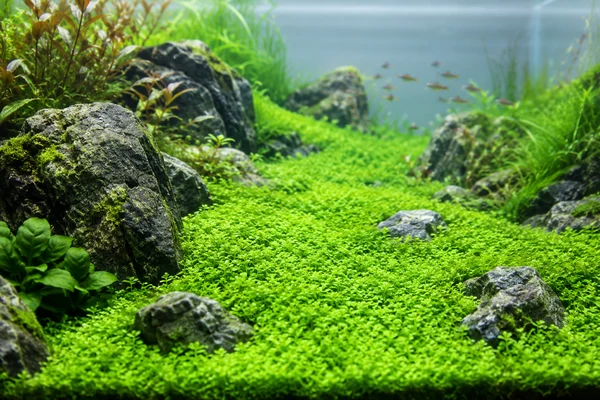
The Monte Carlo aquarium plant is one of the most popular carpeting plants in modern aquascaping. It forms a fresh green foreground carpet with small round leaves, creeping stems, and a softer, slightly larger texture than HC Cuba. For many aquarists, Monte Carlo is the best balance between a beautiful aquascape carpet and realistic care difficulty.
Monte Carlo is often recommended because it is more forgiving than some demanding foreground plants. But that does not mean it is effortless. A dense, compact Monte Carlo carpet still depends on good substrate-level light, stable nutrients, proper planting, regular trimming, and ideally CO₂ injection if you want fast and reliable results.
Without CO₂, Monte Carlo can still grow, but expectations matter. It usually spreads slower, may grow looser, and can become patchy if light or nutrients are not strong enough. With CO₂, good light, and aquarium soil, it can form the classic bright green carpet seen in many high-quality aquascapes.
This guide explains Monte Carlo care in detail: lighting, CO₂, substrate, planting technique, dry start method, trimming, propagation, melting, algae, upward growth, and how to decide whether Monte Carlo is right for your tank. For broader plant choices, read the Aquarium Carpeting Plants Guide. If you are specifically planning a low-tech setup, compare this article with Carpet Plants Without CO₂.
Quick answer: Monte Carlo is a medium-difficulty carpeting plant that grows best with moderate to strong substrate-level light, nutrient-rich substrate, stable fertilization, and CO₂ injection. It can grow without CO₂, but the carpet usually develops slower and less compact.
What You’ll Learn in This Lesson
- What Monte Carlo is and why aquascapers use it
- Whether Monte Carlo can grow without CO₂
- How much light Monte Carlo needs to carpet
- Which substrate works best for strong root growth
- How to plant Monte Carlo without it floating away
- How to trim Monte Carlo into a dense carpet
- How the dry start method works for Monte Carlo
- How to troubleshoot melting, algae, upward growth and patchy carpets
What Is Monte Carlo?
Monte Carlo is the common aquarium name for Micranthemum tweediei “Monte Carlo,” a low-growing foreground plant from South America. In aquariums, it is used mainly as a carpeting plant because it creeps across the substrate and forms a dense green mat when conditions are strong enough.
Its leaves are small, round, and bright green. Compared with HC Cuba, Monte Carlo has slightly larger leaves and is usually more forgiving. Compared with dwarf hairgrass, it creates a leafy carpet rather than a grassy one. Compared with Marsilea, it usually creates a brighter and more classic aquascape foreground, but it also demands more light and maintenance.
Monte Carlo is commonly used in:
- Nature style aquascapes
- Iwagumi-inspired layouts
- Foreground carpets
- Nano aquascapes
- High-tech planted tanks
- Dry start aquascapes
- Rock island layouts
- Open foreground transitions
Monte Carlo is not a beginner-proof plant, but it is one of the more realistic carpeting plants for aquarists who want a lush foreground without choosing the most difficult species.
Ready to set up your own tank?
Create a free account to save lessons, plan your setup, and use the Tank Hub to turn ideas into a real aquarium.
Monte Carlo Care Overview
Monte Carlo is best described as a medium-difficulty plant. It is easier than HC Cuba, but more demanding than Anubias, Java Fern, Cryptocoryne, Marsilea, or many low-tech foreground alternatives.
| Care Factor | Monte Carlo Preference | Practical Meaning |
|---|---|---|
| Difficulty | Medium | Forgiving for a carpet plant, but not effortless |
| Placement | Foreground carpet | Best at the front and open substrate zones |
| Light | Moderate to strong at substrate level | Weak light causes upward or patchy growth |
| CO₂ | Strongly recommended for best results | Possible without CO₂, but slower and less compact |
| Substrate | Nutrient-rich fine substrate | Aquarium soil makes establishment easier |
| Growth rate | Moderate to fast in good conditions | Needs trimming once established |
| Maintenance | Regular trimming and debris removal | Thick mats can brown underneath |
| Best tank type | Planted and aquascaped tanks | Works best in balanced medium- to high-energy systems |
The main care principle is simple: Monte Carlo should be encouraged to creep sideways. If it grows upward, floats loose, melts, or becomes algae-covered, something in the system is preventing compact horizontal growth.
Can Monte Carlo Grow Without CO₂?
Monte Carlo can grow without CO₂, but it performs much better with CO₂. This is the most important expectation to set before using it.
In a no-CO₂ aquarium, Monte Carlo may survive, root, and spread if light is good and nutrients are stable. But the carpet usually develops slowly. It may stay thinner, grow upward, or remain patchy for a long time. In a CO₂-injected aquarium, Monte Carlo usually roots faster, spreads more confidently, and becomes denser after trimming.
| Setup Type | Monte Carlo Result | Expectation |
|---|---|---|
| Low-tech without CO₂ | Possible but slow | Needs patience and good substrate-level light |
| Low-tech with weak light | Often patchy or upward growth | Not ideal for a dense carpet |
| Medium light without CO₂ | Can work in stable tanks | Usually slower and looser than high-tech carpets |
| CO₂ with moderate light | Reliable carpet growth | Strong general approach |
| CO₂ with strong balanced light | Fast, dense, compact carpet | Best aquascape result |
If your goal is a relaxed low-tech tank, Monte Carlo may still be worth trying. If your goal is a fast, dense, competition-style foreground, CO₂ is strongly recommended. For a full comparison of low-tech alternatives, read Carpet Plants Without CO₂.
Lighting Requirements for Monte Carlo
Monte Carlo needs enough usable light at the substrate. This is different from the tank looking bright from above. A light can appear strong to your eyes but still deliver weak light at the foreground, especially in deep tanks, shaded layouts, or aquariums with floating plants.
When substrate-level light is too weak, Monte Carlo often grows upward instead of creeping across the substrate. It may also stay thin, melt after planting, or become covered with algae because growth is too slow.
| Lighting Situation | Monte Carlo Response | What to Do |
|---|---|---|
| Low substrate light | Upward growth, weak spreading, patchy carpet | Improve light spread or choose easier plants |
| Moderate substrate light | Good growth if nutrients and CO₂ are stable | Best starting range |
| Strong substrate light | Compact growth and faster spread | Use CO₂ and balanced fertilization |
| Strong light without CO₂ | Higher algae risk | Reduce intensity or add CO₂ |
| Shaded by floaters or hardscape | Uneven carpet and weak patches | Keep foreground light windows open |
For better lighting decisions, use the Aquarium Plant Light Requirements, Aquarium PAR Explained, and Aquarium Lighting Calculator.
Best Substrate for Monte Carlo
Monte Carlo grows best in a fine, nutrient-rich substrate where small portions can anchor securely. Aquarium soil is usually the easiest option because it supports root growth and helps new plugs establish.
Monte Carlo can grow in sand or inert substrate, but it becomes harder. Fine sand may hold plants in place, but it does not provide nutrients by itself. Coarse gravel can be frustrating because tiny portions may float up before they root.
| Substrate Type | Monte Carlo Result | Recommendation |
|---|---|---|
| Aquarium soil | Best root support and nutrient availability | Best choice for most carpets |
| Fine sand over nutrient layer | Can work if roots reach nutrients | Plant carefully and avoid a thick cap |
| Inert fine gravel | Possible with liquid fertilizer and root support | More difficult than soil |
| Coarse gravel | Small plugs often float or root poorly | Not ideal for Monte Carlo carpets |
| Bare decorative sand foreground | Not suitable for a rooted carpet | Use sand as open space beside the carpet |
If you are building a new aquascape, substrate planning matters before planting. Compare the Aquarium Soil Guide and the Aquarium Sand Guide before deciding where the carpet will grow.
How to Plant Monte Carlo
Planting technique is one of the biggest reasons Monte Carlo succeeds or fails. Large clumps often melt in the center. Tiny loose pieces may float away. The goal is to divide the plant into small portions and anchor them deeply enough to stay in place while still leaving leaves exposed to light.
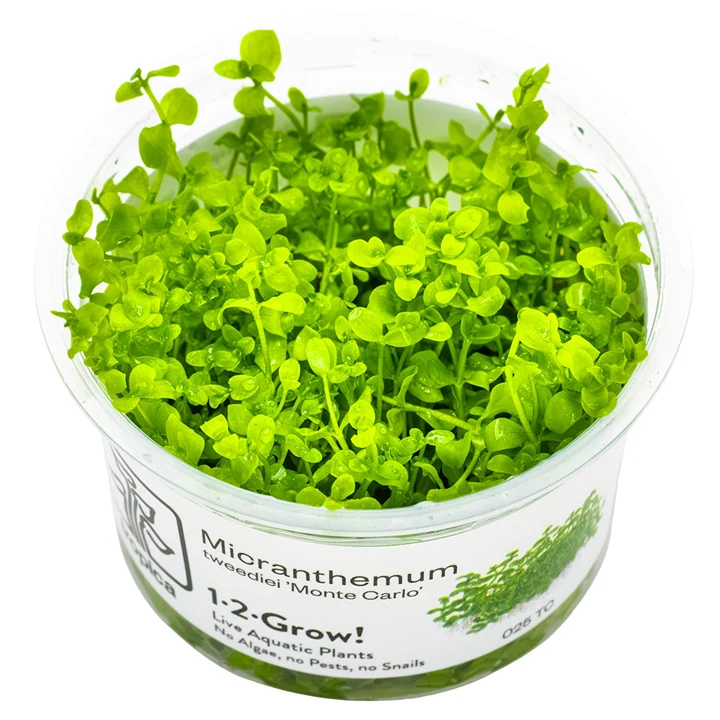
Tissue culture Monte Carlo is especially common. It usually arrives as a clean cup of dense plant mass. Rinse off gel carefully, divide it into small portions, and spread those portions across the foreground.
Planting Method
- Prepare the substrate before planting.
- Divide Monte Carlo into small plugs.
- Use long aquascaping tweezers for precise placement.
- Plant each portion deep enough that it does not float up.
- Leave small gaps between portions so they can spread.
- Keep leaves above the substrate and roots/stems anchored below.
- Fill the aquarium slowly to avoid lifting the plugs.
- Remove floating pieces and replant them immediately.
Do not try to plant one large mat as a single piece. Smaller separated plugs usually root better and create a more even carpet over time.
How Much Monte Carlo Should You Plant?
The more healthy plant mass you start with, the faster the carpet can fill in. Starting with too little Monte Carlo is possible, but it increases the time the substrate remains exposed. Exposed foreground areas can collect debris and algae before the carpet closes.
For a high-tech aquascape, using more tissue culture cups or portions from the start can shorten the transition period. For a low-tech tank, more initial plant mass also helps, but growth will still be slower without CO₂.
| Planting Density | Result | Best For |
|---|---|---|
| Very sparse plugs | Slow fill-in and higher algae risk between patches | Budget setups with patience |
| Moderate spacing | Balanced cost and carpet speed | Most planted tanks |
| Dense planting | Faster visual coverage | High-tech aquascapes and show layouts |
| Large clumps | Risk of melting and uneven rooting | Not recommended |
| Dry start mat | Strong early anchoring before flooding | Planned aquascapes with patience |
A carpet does not need to cover every part of the foreground. Monte Carlo often looks better when combined with sand paths, stones, or open negative space.
Dry Start Method for Monte Carlo
The dry start method is popular for Monte Carlo because it helps the plant root and spread before the aquarium is filled. The plant grows emersed in moist substrate under high humidity. Once the carpet has anchored, the tank is flooded and the plant transitions to submerged growth.
A dry start can reduce floating problems and create early coverage. However, it does not guarantee success after flooding. Monte Carlo still needs good light, CO₂ or enough carbon availability, nutrients, and algae control once submerged.
Dry Start Basics
- Use moist aquarium soil, not fully flooded substrate.
- Plant small Monte Carlo portions across the foreground.
- Cover the tank to keep humidity high.
- Open the cover briefly for air exchange.
- Keep the substrate moist but not waterlogged.
- Provide enough light for emersed growth.
- Wait for visible rooting and spreading before flooding.
- Flood slowly and adjust lighting if algae appears.
The dry start method is helpful when anchoring is the main challenge. It is not a substitute for a balanced submerged aquarium.
CO₂ for Monte Carlo
CO₂ is not absolutely required for Monte Carlo, but it is the difference between “possible” and “reliable” in many aquariums. With CO₂, Monte Carlo can use stronger light more safely, grow more compact, recover faster after trimming, and spread into a denser carpet.
Without CO₂, strong light can become risky because plant demand rises while available carbon remains limited. This is a common reason Monte Carlo carpets become algae-covered in low-tech tanks with powerful lights.
- Use CO₂ if you want a dense carpet quickly.
- Use CO₂ if your light is strong at substrate level.
- Use CO₂ if Monte Carlo grows upward despite enough light.
- Use CO₂ if algae appears after increasing light.
- Keep CO₂ stable instead of chasing extreme bubble rates.
- Watch livestock carefully when adjusting CO₂.
If you plan to add CO₂, read the Aquarium CO₂ System Guide before increasing light or fertilizer. Monte Carlo responds best when the entire system is balanced.
Fertilizer and Nutrients for Monte Carlo
Monte Carlo needs nutrients from both the substrate and the water column. Aquarium soil supports root growth, but water-column nutrients still matter, especially in high-light or CO₂-injected tanks.
A common mistake is starving the tank to prevent algae. This often weakens Monte Carlo and makes algae worse because plant growth stalls. The goal is not zero nutrients. The goal is stable nutrients that match light and CO₂.
| Nutrient Factor | Why It Matters | Practical Tip |
|---|---|---|
| Nitrogen | Supports leaf and stem growth | Deficiency can cause pale or stalled growth |
| Phosphorus | Supports energy transfer and growth | Too little can limit spreading |
| Potassium | Supports leaf health and overall function | Holes or weak growth may suggest imbalance |
| Micronutrients | Support healthy new growth | Use complete fertilizer if needed |
| Root nutrition | Supports anchoring and foreground spread | Aquarium soil is the easiest path |
For nutrition basics, read Macronutrients for Aquarium Plants and Micronutrients for Aquarium Plants. For dosing calculations, use the Fertilizer Dosing Calculator.
How to Trim Monte Carlo
Trimming is essential once Monte Carlo starts forming a carpet. If the mat becomes too thick, the lower layer can lose light, turn brown, detach, or decay. A carpet that looks lush from above can be unhealthy underneath if it is never trimmed.
Trim Monte Carlo with curved aquascaping scissors or sharp trimming scissors. Cut lightly and remove floating fragments immediately. Loose cuttings can spread around the tank, clog filters, or decay in hidden areas.
- Trim before the carpet becomes too thick.
- Use sharp scissors for clean cuts.
- Remove cuttings with a net or siphon.
- Do not let old lower layers brown and detach.
- Trim more lightly in no-CO₂ tanks because recovery is slower.
- Trim more often in high-tech tanks because growth is faster.
- Watch for debris trapped inside the carpet after trimming.
Regular light trimming is usually safer than rare heavy trimming, especially in low-tech aquariums.
How to Propagate Monte Carlo
Monte Carlo propagates by creeping stems that root as they spread. Once the plant is established, it naturally expands across the substrate. You can also use healthy trimmings or separated portions to start new patches.
The best propagation pieces are healthy, green, algae-free stems. Avoid replanting decaying or algae-covered fragments because they may create problems in the new area.
- Use healthy green portions only.
- Separate small rooted sections from established patches.
- Replant them into open substrate gaps.
- Anchor each portion securely with tweezers.
- Keep light and nutrients stable after replanting.
- Remove floating pieces before they decay.
- Trim mature areas to encourage sideways density.
Propagation is easiest after the plant has already rooted strongly. During the early phase, focus on establishment rather than harvesting cuttings.
Monte Carlo vs HC Cuba vs Dwarf Hairgrass
Monte Carlo is often compared with HC Cuba and dwarf hairgrass because all three are common foreground carpet plants. They create very different effects and have different difficulty levels.
| Plant | Carpet Style | Difficulty | Best Use |
|---|---|---|---|
| Monte Carlo | Bright green round-leaf carpet | Medium | Best balance of beauty and realistic care |
| HC Cuba | Very fine tiny-leaf carpet | Difficult | High-tech aquascapes with strong light and CO₂ |
| Dwarf Hairgrass | Grass-like meadow carpet | Medium | Natural grassy layouts and Iwagumi-style tanks |
| Marsilea | Clover-like slow carpet | Easy to medium | Low-tech carpets with patience |
| Cryptocoryne parva | Slow compact foreground patches | Easy but very slow | Low-maintenance foregrounds |
Choose Monte Carlo if you want a classic green carpet that is easier than HC Cuba but more compact and aquascape-like than many low-tech foreground alternatives.
Monte Carlo in Nano Aquariums
Monte Carlo can work beautifully in nano aquariums because its leaves are small enough to keep the layout in scale. It can make a small tank look larger by creating a clean foreground carpet around rocks, wood, or sand paths.
However, nano tanks are less forgiving. Light can be intense because the tank is shallow, but CO₂ and nutrients can fluctuate quickly. Small tanks also collect debris in the carpet faster if flow and maintenance are weak.
- Use small portions and plant densely enough to prevent long bare periods.
- Keep hardscape shadows away from key carpet zones.
- Use moderate lighting unless CO₂ is stable.
- Trim lightly and remove fragments quickly.
- Leave some open sand or foreground space for scale.
- Watch algae closely during the first weeks after planting.
In nano tanks, Monte Carlo looks best when it supports the hardscape rather than covering every visible surface.
Monte Carlo on Rocks and Driftwood
Monte Carlo is usually planted in substrate, but it can also be grown attached to hardscape in certain aquascapes. When attached to rocks or wood, it can create a hanging or creeping green effect, especially in high-humidity or well-fertilized systems.
This is more advanced than normal substrate planting. Monte Carlo attached to hardscape needs strong water-column nutrients and suitable light because it cannot rely on substrate nutrition in the same way.
- Use small portions, not thick clumps.
- Attach lightly with thread or small glue points.
- Keep the plant moist during setup.
- Provide stable water-column nutrients.
- Avoid placing it in deep shade.
- Trim hanging growth if it becomes messy.
For most aquarists, substrate planting is the better starting point. Hardscape growth is a design option once you understand the plant’s needs.
Why Monte Carlo Grows Upward
Monte Carlo usually grows upward when it is trying to reach more light. This often happens in tanks with weak substrate-level light, heavy shade, deep water, floating plant cover, or crowded foregrounds.
Upward growth can also happen if the plant is not trimmed. Once stems stack on top of each other, the lower layer receives less light and the carpet becomes taller instead of denser.
| Cause | What It Looks Like | Fix |
|---|---|---|
| Weak substrate light | Long stems rising upward | Improve light spread or reduce shading |
| No trimming | Thick stacked mat | Trim the top layer and remove fragments |
| Too much shade | Patchy growth under rocks or floaters | Open light windows over the carpet |
| Poor CO₂ under strong light | Weak, algae-prone growth | Improve CO₂ stability or reduce light |
| Planting too deep | Buried leaves melt or rot | Replant with leaves exposed |
If Monte Carlo grows upward, do not automatically cut it down and hope for the best. Identify why it is reaching upward first.
Why Monte Carlo Melts
Monte Carlo can melt after planting, especially when transitioning from tissue culture, emersed growth, shipping, dry start, or different water conditions. Some initial adjustment is normal. The important question is whether healthy new growth appears after the transition.
Severe melting often points to poor planting, unstable CO₂, weak light, nutrient imbalance, poor water circulation, or the plant being buried too deeply.
| Melting Situation | Likely Cause | What to Do |
|---|---|---|
| Melt after planting | Transition stress | Remove decay and watch for new growth |
| Melt after flooding dry start | Emersed-to-submerged transition | Stabilize CO₂, light and nutrients |
| Lower layer turns brown | Carpet too thick or shaded | Trim and remove dead material |
| Plugs melt and float | Poor anchoring or coarse substrate | Replant smaller portions deeper |
| Melt with algae | System imbalance | Reduce light pressure and improve plant growth conditions |
Remove melting plant material quickly. Decaying carpet leaves can trap debris and fuel algae in the foreground.
Algae on Monte Carlo Carpets
Algae on Monte Carlo usually appears when light demand is higher than the plant’s ability to grow. This can happen when light is too strong, CO₂ is unstable, nutrients are inconsistent, the carpet is newly planted, or debris collects between the leaves.
Because Monte Carlo grows low to the substrate, debris can settle into the carpet. Poor flow across the foreground makes this worse. A dirty carpet is more likely to develop algae and brown lower growth.
- Keep light strong enough but not excessive.
- Use stable CO₂ if running high light.
- Do not starve the tank of nutrients.
- Trim before the carpet becomes too thick.
- Remove loose trimmings after every cut.
- Use gentle foreground flow to prevent debris buildup.
- Siphon lightly above the carpet during water changes.
If algae appears after increasing light, read Aquarium Lighting and Algae. The solution is usually balance, not simply more light, more fertilizer, or more cleaning animals.
Common Monte Carlo Problems
Monte Carlo problems are usually caused by a mismatch between light, CO₂, nutrients, planting method, and maintenance. Use the symptom to identify the most likely issue.
| Problem | Likely Cause | Best Response |
|---|---|---|
| Monte Carlo floats up | Planted too shallow, coarse substrate, livestock disturbance | Replant smaller portions with tweezers |
| Carpet grows upward | Weak substrate light or no trimming | Improve light spread and trim regularly |
| Leaves turn yellow | Nutrient limitation or transition stress | Check new growth and fertilization |
| Carpet melts | Transition, poor CO₂, unstable tank or buried leaves | Remove decay and stabilize conditions |
| Algae covers the carpet | Too much light for system balance | Balance CO₂, nutrients and maintenance |
| Carpet stays patchy | Low planting density, slow growth, weak light | Add more plugs or improve conditions |
| Lower carpet browns | Mat too thick, poor flow, old shaded growth | Trim and remove dead material |
Do not change everything at once. Adjust the most likely cause, then observe new growth.
Common Mistakes With Monte Carlo
Monte Carlo is forgiving for a carpet plant, but it still fails when treated like a no-maintenance beginner plant. Most mistakes happen during setup and early growth.
| Mistake | Why It Causes Problems | Better Approach |
|---|---|---|
| Using weak foreground light | Plant grows upward or stays patchy | Check substrate-level light |
| Skipping CO₂ in a high-light setup | Algae appears before carpet improves | Add stable CO₂ or reduce light |
| Planting large clumps | Centers melt and root unevenly | Divide into small plugs |
| Using coarse gravel | Small portions float up easily | Use fine aquarium soil or finer substrate |
| Never trimming | Lower layers brown and detach | Trim lightly and regularly |
| Starving nutrients | Growth stalls and algae can take over | Use balanced fertilization |
| Expecting instant carpet without CO₂ | Low-tech growth is slower | Plan for months, not days |
The most reliable Monte Carlo carpet comes from planning the system before planting, not trying to rescue it afterward.
Best Setup for a Monte Carlo Carpet
A strong Monte Carlo setup does not need to be extreme, but it should be balanced. Light, CO₂, substrate, nutrients and trimming all need to support the same goal: compact horizontal growth.
| Setup Element | Recommended Choice | Why It Helps |
|---|---|---|
| Substrate | Fine aquarium soil | Supports rooting and nutrient availability |
| Light | Moderate to strong substrate-level PAR | Encourages creeping growth |
| CO₂ | Stable pressurized CO₂ if possible | Improves density and recovery |
| Fertilizer | Balanced water-column dosing | Prevents stalled growth |
| Planting | Small separated plugs | Creates even spread |
| Flow | Gentle circulation across the foreground | Prevents debris buildup |
| Maintenance | Light regular trimming | Keeps the carpet healthy and compact |
This setup gives Monte Carlo the best chance to form a bright, dense, long-term carpet without becoming a trapped debris layer.
Final Recommendation
Choose Monte Carlo if you want a classic green aquascape carpet and are willing to provide good light, proper planting, and regular trimming. It is one of the best carpet plants for aquarists who want something more refined than Marsilea but easier than HC Cuba.
If you run CO₂, Monte Carlo is an excellent foreground choice. If you do not run CO₂, it can still work, but you should expect slower growth and a less compact carpet. In low-tech tanks, consider whether Marsilea, Cryptocoryne parva, or Staurogyne repens might match your system better.
The best Monte Carlo carpet is not created by the plant alone. It is created by a balanced system where light, carbon, nutrients, substrate and trimming all support compact creeping growth.
Conclusion
Monte Carlo is one of the most useful carpeting plants in modern aquascaping. It offers a bright green, small-leaf foreground that is easier than HC Cuba but more classic and carpet-like than many low-tech alternatives.
For the best results, use nutrient-rich substrate, plant small portions with tweezers, provide moderate to strong substrate-level light, maintain stable nutrients, and add CO₂ if you want a dense compact carpet. Trim regularly before the mat becomes too thick, and remove fragments before they decay.
Monte Carlo can grow without CO₂, but it becomes far more reliable with it. If you match the plant to the right system, Monte Carlo can become one of the most beautiful and rewarding foreground plants in your aquarium.
💬 Join the Conversation
Are you growing Monte Carlo with CO₂, without CO₂, through a dry start, or as a foreground carpet in a new aquascape?
Tag us on Instagram @AquariumLesson — we’d love to see your Monte Carlo carpet progress, planting method and aquascape layout.
FAQ
Is Monte Carlo a good aquarium carpet plant?
Yes. Monte Carlo is one of the best aquarium carpet plants because it forms a bright green foreground and is usually easier than HC Cuba. It still needs good substrate-level light, nutrients, planting technique and trimming.
Can Monte Carlo grow without CO₂?
Monte Carlo can grow without CO₂, but it usually grows slower and less compact. CO₂ injection makes the carpet denser, faster and more reliable, especially under stronger lighting.
How much light does Monte Carlo need?
Monte Carlo needs moderate to strong light at substrate level. Weak light often causes upward growth, patchy coverage or slow spreading. Strong light works best when CO₂ and nutrients are stable.
Why is my Monte Carlo growing upward?
Monte Carlo usually grows upward when substrate-level light is too weak, the plant is shaded, or the carpet has become too thick. Improve light distribution, reduce shading and trim the carpet regularly.
Why is my Monte Carlo melting?
Monte Carlo can melt because of transition stress, poor planting, unstable CO₂, weak light, nutrient imbalance, buried leaves or algae pressure. Remove decaying material and focus on stable new growth.
What substrate is best for Monte Carlo?
Fine aquarium soil is usually the best substrate for Monte Carlo because it supports root growth, nutrient access and easy planting. Fine sand or inert substrate can work, but it is usually harder.
Can Monte Carlo grow on rocks or wood?
Monte Carlo can grow attached to rocks or wood in some aquascapes, but it is usually easier as a rooted substrate carpet. Hardscape-grown Monte Carlo needs good light and water-column nutrients.
How often should Monte Carlo be trimmed?
Trim Monte Carlo whenever the carpet becomes thick enough that the lower layer is shaded. High-tech tanks may need frequent trimming, while low-tech tanks usually recover more slowly and should be trimmed more gently.
Start building your aquarium with the Tank Hub
Save your favorite lessons, organize your setup, and track your aquarium step by step in your personal Tank Hub.
New to AquariumLesson? Start with our complete Aquarium Lessons Hub or return to the homepage at AquariumLesson.com.