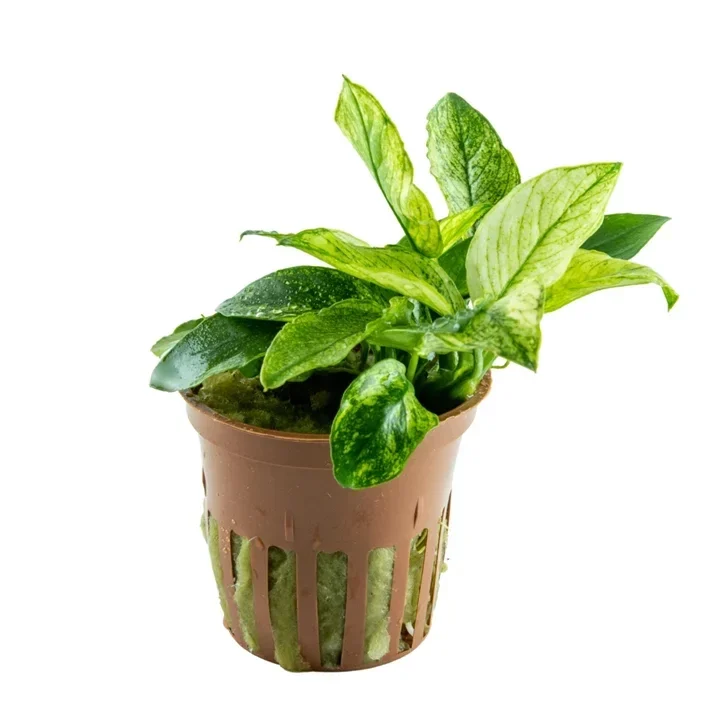
Microsorum pteropus 'Prothallium'
Microsorum pteropus (Blume) Copel. — gametophyte
Save this plant or add it directly to one of your aquariums.
Need help with Microsorum pteropus 'Prothallium'?
Ask what this plant needs or what might explain a change in its leaves or growth.
Planting & care
This plant suits beginners. It grows in low light. It grows better with added CO₂.
Suitable for long-term aquarium use.
About this plant
Persistent gametophyte (prothallium) of the Java fern Microsorum pteropus rather than a conventional fern cultivar. It was formerly circulated as Loxogramme sp. Wave Moss and looks superficially like a liverwort. The soft dark-green thallus lobes are smaller than those of the Lomariopsis gametophyte and form compact cushions with dark brown hair-like rhizoids on their undersides and margins. Growth is very slow, but the plant is undemanding and tolerates low light. CO2 and water-column fertilisation strongly improve growth. Tie or glue small portions to stone, wood or moss pads; the thalli will attach to varying degrees. Its miniature scale makes it particularly useful in nano aquariums.
Water conditions
Plant reference ranges, not dosing instructions or measurements from your aquarium. Consider livestock needs and measured conditions.
- Temperature
- 68–82°F (20–28°C)
- pH
- 5–8
- Carbonate hardness
- 0–14 °dKH
- Recorded CO₂ (mg/L)
- 5–30 mg/L
Growth & placement
- Growth rate
- Very slow
- Width
- 1.2–3.9" (3–10 cm)
- How to propagate
- division and fragmentation
- Ways to use it
- Small aquariums, Wood and rock layouts
Grow it successfully
What you’ll need to grow Microsorum pteropus 'Prothallium'
Start with this plant’s documented care needs, then use an AquariumLesson calculator to size the setup for your aquarium.
Taxonomy
- Major group
- Ferns
- Family
- Polypodiaceae
- Genus
- Microsorum
- Botanical name
- Microsorum pteropus (Blume) Copel. — gametophyte
- Also known as
- Wave Moss, Loxogramme sp. Wave moss, Java fern prothallium
- Origin
- Cultivated, Asia
- Order
- Polypodiales