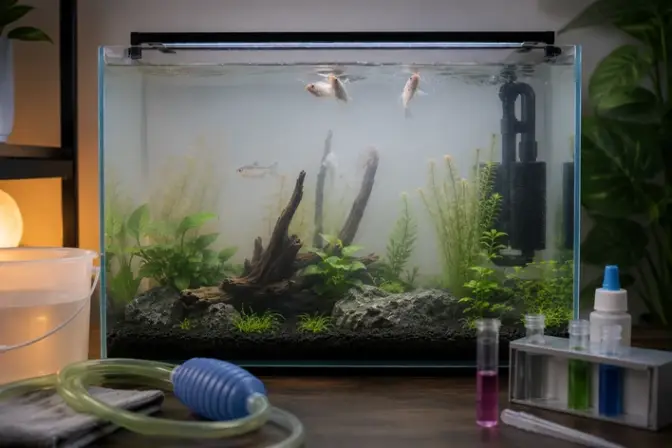
High Nitrate in Aquarium: Causes, Risks & Safe Ways to Lower Nitrate
High nitrate in an aquarium usually means waste is being processed, but not exported fast enough. Nitrate is the later-stage product of the nitrogen cycle: ammonia becomes nitrite, and nitrite becomes nitrate. That makes nitrate less urgent than ammonia or nitrite, but it still matters for long-term fish, shrimp, snail, plant, and algae control.
In a freshwater aquarium, nitrate commonly rises from fish waste, uneaten food, decaying plant material, overstocking, dirty substrate, clogged filter debris, and inconsistent water changes. Unlike ammonia and nitrite, nitrate usually builds gradually. This makes it easy to ignore until the tank starts showing signs of stress, algae, poor plant response, or declining livestock condition.
The most important principle is simple: high nitrate is usually not a sudden mystery — it is a long-term accumulation problem. If nitrate keeps rising, the aquarium is producing more nitrogen waste than your water changes, plants, filtration, and maintenance routine are removing.
This guide explains what nitrate is, what causes high nitrate, how to lower nitrate safely, how planted tanks change the picture, and how to prevent nitrate from coming back. For the bigger water-quality system, start with the Aquarium Water Guide. If your tank is still new, first read the Aquarium Cycling Guide, because ammonia and nitrite are more urgent during cycling.
Quick Answer
- High nitrate usually comes from waste accumulation.
- Common causes include overfeeding, overstocking, dirty substrate, weak maintenance, and low plant uptake.
- Water changes are the fastest practical way to lower nitrate.
- Fast-growing plants can help reduce nitrate over time.
- Always test tap water too, because nitrate may already be present in your source water.
- Do not confuse nitrate with nitrite: nitrite is much more urgent.
- Stable, moderate nitrate is different from a sudden or extreme nitrate problem.
If fish are gasping, dying, or acting severely stressed, test ammonia and nitrite immediately too. Nitrate alone is usually a slower long-term issue, while ammonia and nitrite are emergency parameters.
What you’ll learn in this lesson
- What nitrate means in the aquarium nitrogen cycle
- How nitrate differs from ammonia and nitrite
- What causes high nitrate in freshwater aquariums
- How to lower nitrate safely with water changes
- Why plants can help but do not replace maintenance
- How source water can contribute to nitrate
- Why nitrate is different in planted tanks
- How to prevent nitrate from returning
- Which mistakes make nitrate problems worse
What Is Nitrate in an Aquarium?
Nitrate is the later-stage nitrogen compound produced by the aquarium nitrogen cycle. In a cycled tank, beneficial microorganisms convert ammonia into nitrite, then nitrite into nitrate. This process is part of biological filtration and is a sign that the aquarium is processing waste.
That does not mean nitrate should be ignored. Nitrate can accumulate over time, especially in closed aquarium systems where waste has nowhere to go unless the aquarist removes it through water changes, plant growth, substrate cleaning, pruning, or other export methods.
In nature, nitrogen compounds are diluted, absorbed, transformed, and moved through large ecosystems. In a glass aquarium, the system is much smaller and more concentrated. That is why nitrate control becomes part of routine aquarium maintenance.
In simple terms, nitrate tells you: your aquarium is processing waste, but you still need to export the end product.
Nitrate vs Ammonia vs Nitrite
Nitrate is often confused with nitrite, but they are very different in aquarium care. Ammonia and nitrite are the urgent danger compounds during cycling problems. Nitrate is usually the later accumulation compound that must be controlled over time.
This distinction matters. If ammonia or nitrite is present in a stocked aquarium, treat it as an emergency. If nitrate is high, treat it as a maintenance and system-balance problem unless fish are showing severe stress or other parameters are also wrong.
| Compound | Cycle Stage | Typical Meaning | Urgency |
|---|---|---|---|
| Ammonia | First waste stage | Waste is not being processed safely | High emergency risk |
| Nitrite | Middle cycle stage | Cycle is incomplete or disrupted | High emergency risk |
| Nitrate | Later cycle stage | Waste is processed but accumulating | Long-term management issue |
If your aquarium has high nitrate but ammonia and nitrite are both zero, the biological filter is probably processing waste. The next question is why nitrate export is not keeping up.
Is High Nitrate Dangerous?
High nitrate can become harmful, especially with long exposure, sensitive species, young fish, shrimp, poor oxygenation, or additional stress factors. Nitrate is usually less immediately toxic than ammonia or nitrite, but that does not make it harmless. Scientific reviews describe nitrate toxicity as increasing with concentration and exposure time.
In practical freshwater aquarium keeping, nitrate tolerance varies widely by species, age, health, adaptation, water chemistry, and exposure duration. Some hardy fish tolerate moderate nitrate better than sensitive shrimp, fry, wild-caught soft-water fish, or already stressed animals.
That is why nitrate should not be managed with one universal panic number. Instead, think in terms of trend, livestock sensitivity, plant strategy, and maintenance consistency. A stable planted aquarium with moderate nitrate is different from a neglected tank where nitrate keeps climbing every week.
What Nitrate Level Is Too High?
There is no single nitrate number that fits every freshwater aquarium. Species sensitivity, tank age, plants, feeding, stocking, oxygen, and maintenance all matter. However, nitrate should not be allowed to climb indefinitely.
For many community freshwater aquariums, keeping nitrate controlled and predictable is more important than chasing absolute zero. In planted tanks, nitrate may intentionally be present as a plant nutrient. In shrimp tanks, breeding tanks, fry tanks, and sensitive livestock systems, lower and more stable nitrate is usually preferred.
Use the table below as a practical orientation, not as a rigid law.
| Nitrate Range | Practical Meaning | Suggested Response |
|---|---|---|
| 0–10 ppm | Low nitrate; common in light stocking or planted tanks | Watch plant nutrition if plants show deficiency |
| 10–30 ppm | Moderate, often manageable in many freshwater tanks | Maintain routine and watch trends |
| 30–50 ppm | Elevated for many setups, especially sensitive livestock | Review feeding, stocking, water changes, plants |
| 50+ ppm | High accumulation signal | Increase export and identify the cause |
| Very high / rapidly rising | System imbalance or neglected maintenance | Controlled water changes and full maintenance review |
The trend matters. If nitrate rises from 10 ppm to 40 ppm every week, your system is producing more waste than it exports. If nitrate remains stable in a planted aquarium, the system may be balanced for that specific setup.
Common Causes of High Nitrate
High nitrate is usually caused by excess nitrogen entering the system or not enough nitrogen leaving it. In most aquariums, nitrate rises because of feeding, stocking, waste buildup, and insufficient water changes.
Before trying advanced solutions, start with the basics. Most nitrate problems improve when feeding becomes more controlled, water changes become consistent, dead organic matter is removed, and stocking is matched to filtration and tank volume.
| Cause | Why It Raises Nitrate | First Fix |
|---|---|---|
| Overfeeding | More food becomes more waste | Feed less and remove uneaten food |
| Overstocking | More livestock creates more waste | Reduce load or improve system capacity |
| Infrequent water changes | Nitrate accumulates over time | Improve water-change routine |
| Dirty substrate | Trapped debris decomposes | Vacuum appropriate areas carefully |
| Clogged filter debris | Organic waste breaks down inside filter | Clean mechanical media without destroying biofilter |
| Low plant mass | Less nitrogen uptake | Add fast-growing plants if suitable |
| Dead plant matter | Decay adds nitrogen waste | Prune and remove melting leaves |
| Nitrate in tap water | Source water already contains nitrate | Test tap water and consider alternatives |
High Nitrate in a New Aquarium
High nitrate in a new aquarium can mean the cycle is progressing, especially if ammonia and nitrite have already dropped to zero. In this case, nitrate is not the first emergency parameter. It is the waste product that remains after the cycle has converted ammonia and nitrite.
However, nitrate in a new tank can also come from source water, decaying plant matter, heavy fish food used during cycling, active substrate, or early stocking mistakes. Always interpret nitrate together with ammonia and nitrite.
High Nitrate in a Mature Aquarium
High nitrate in a mature aquarium usually means long-term waste export is not matching waste production. The tank may be cycled, but nitrate is accumulating faster than water changes, plants, and maintenance remove it.
This is common in heavily stocked tanks, tanks with messy fish, tanks that are fed generously, aquariums with little plant mass, and systems where water changes are too small or too infrequent.
A mature aquarium with high nitrate is not necessarily crashing. But it is sending a maintenance signal. The tank is telling you that the current routine does not export enough nitrogen waste.
Questions to ask in a mature tank
- Has feeding increased recently?
- Are fish eating all food within a short time?
- Is the tank overstocked for its volume?
- Are water changes large and frequent enough?
- Is debris trapped in the substrate or behind hardscape?
- Is mechanical filter media full of decomposing waste?
- Are plants growing strongly or stalling?
- Does tap water already contain nitrate?
High Nitrate in Planted Aquariums
Planted aquariums change the nitrate discussion because nitrate is also a plant nutrient. In a planted tank, nitrate is not automatically bad. Many aquascapers intentionally maintain measurable nitrate so plants do not run into nitrogen deficiency.
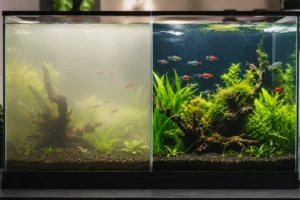
The key is context. A planted tank with healthy growth, stable nitrate, no livestock stress, and consistent maintenance is different from a neglected tank with rising nitrate, algae, dirty substrate, and stressed fish.
In high-tech planted aquariums, nitrate interacts with light, CO₂, phosphate, potassium, micronutrients, plant mass, and water changes. Too little nitrate can limit plant growth. Too much nitrate may indicate overfeeding, excess organic waste, or an imbalanced routine.
For plant nutrition, continue with Macronutrients for Aquarium Plants, Micronutrients for Aquarium Plants, and the Aquarium Fertilizer Dosing Calculator.
High Nitrate in Shrimp Tanks
Shrimp tanks usually benefit from lower and more stable nitrate than many hardy community fish tanks. Shrimp are often more sensitive to instability, pollutants, and poor long-term water quality. A nitrate problem in a shrimp tank should be handled carefully because sudden changes can also stress shrimp.
If nitrate is high in a shrimp tank, avoid extreme corrections. Use controlled water changes with matched temperature and suitable mineral parameters. Check GH, KH, pH, and TDS if you use them for your shrimp system. Make sure the replacement water is appropriate for the shrimp species.
Also check feeding. Shrimp foods, powders, leaves, and supplements can add organic load if overused. Biofilm is good; rotting excess food is not.
High Nitrate From Tap Water
Sometimes nitrate is high before the water even enters the aquarium. Tap water can contain nitrate depending on local water sources, agriculture, treatment, and regional conditions. If you only test the aquarium, you may miss this source.
Always test your source water when nitrate remains high despite regular water changes. If tap water already contains nitrate, water changes may not lower the aquarium as much as expected.
What to do if tap water has nitrate
- Test tap water directly.
- Let a sample sit and test again if results are unclear.
- Compare tap water nitrate to aquarium nitrate.
- Use fast-growing plants to improve long-term uptake.
- Consider purified or reverse osmosis water if appropriate.
- Remineralize RO water correctly before using it with livestock.
- Avoid sudden changes in GH, KH, pH, or temperature.
RO water can help in some nitrate-source situations, but it must be used carefully. Pure water without remineralization is not automatically safe for fish, shrimp, snails, or plants.
How to Test Nitrate Correctly
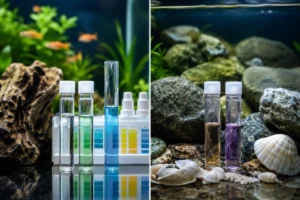
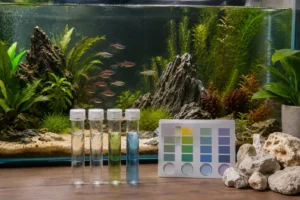
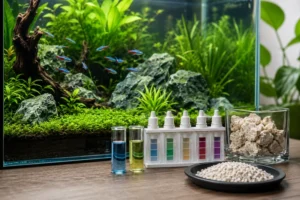
Nitrate testing can be more error-prone than many beginners expect. Some liquid nitrate tests require strong shaking and exact timing. Test strips can be convenient but may be less precise. Always follow the test instructions carefully.
If the result seems surprising, retest. Also test your tap water. A single nitrate reading tells you less than a trend. What matters is whether nitrate is stable, rising slowly, rising rapidly, or staying high despite maintenance.
Useful nitrate testing routine
- Test nitrate after the aquarium is cycled.
- Test before and after water changes to understand reduction.
- Test tap water if nitrate remains high.
- Test weekly while fixing a nitrate problem.
- Record results so you can see trends.
- In planted tanks, compare nitrate with plant growth and algae response.
- Always test ammonia and nitrite if fish are severely stressed.
How to Lower Nitrate Safely
Lowering nitrate safely means exporting accumulated nitrogen without shocking livestock. The most direct method is a water change. But if nitrate has been very high for a long time, sudden massive changes in water chemistry can also stress fish or shrimp, especially if pH, KH, GH, temperature, or TDS shift sharply.
The safest approach is controlled correction: water changes, better feeding, debris removal, plant growth, and source-water testing.
Step 1: Perform controlled water changes
Water changes are the fastest practical way to lower nitrate. Use dechlorinated, temperature-matched water. If nitrate is extremely high or livestock are sensitive, use repeated controlled water changes rather than one careless massive correction.
For a detailed routine, read the Aquarium Water Change Guide.
Step 2: Reduce feeding
Food becomes waste, and waste eventually becomes nitrate in a cycled aquarium. Overfeeding is one of the most common nitrate causes. Feed only what your fish actually eat, remove leftovers, and avoid constant “just in case” feeding.
Step 3: Remove trapped organic waste
Debris trapped in substrate, behind rocks, inside filter sponges, or under driftwood can continue breaking down and producing nitrate. Clean carefully without destroying beneficial bacteria. In planted tanks, avoid tearing up the entire substrate at once.
Step 4: Add or improve plant growth
Fast-growing plants can help reduce nitrate over time. Floating plants, stem plants, and healthy background plants are especially useful because they grow quickly and use nitrogen. However, plants only help if they are actually growing. Stalled or melting plants can add waste instead.
Step 5: Reassess stocking and filtration
If nitrate keeps rising quickly, the aquarium may be overstocked or under-maintained for its biological load. Filtration converts waste; it does not make nitrate disappear in most freshwater systems. A bigger filter can help process ammonia and nitrite, but nitrate still needs export.
Emergency Action Plan for High Nitrate
Use this plan if nitrate is very high or fish are showing possible stress. If fish are gasping, dying, or acting severely abnormal, test ammonia and nitrite immediately too.
| Action | Why It Helps | Important Warning |
|---|---|---|
| Test ammonia and nitrite | Rules out urgent toxic compounds | Do this before assuming nitrate is the only issue |
| Water change | Directly lowers nitrate | Match temperature and dechlorinate |
| Test tap water | Finds nitrate source | Water changes may not help if tap nitrate is high |
| Reduce feeding | Reduces future nitrate production | Do not leave uneaten food |
| Remove debris | Stops ongoing waste breakdown | Clean carefully, not destructively |
| Add fast-growing plants | Improves long-term uptake | Plants must be healthy and growing |
| Review stocking | Reduces waste load | Large messy fish may need larger systems |
What Not to Do With High Nitrate
High nitrate usually develops gradually, so the solution should be systematic. Avoid reactions that shock livestock, damage the biological filter, or hide the real cause.
- Do not ignore ammonia and nitrite if fish are severely stressed.
- Do not perform extreme careless water changes with mismatched temperature or chemistry.
- Do not replace all filter media; this can cause ammonia or nitrite problems.
- Do not assume a bigger filter removes nitrate; filtration usually converts waste into nitrate.
- Do not overfeed while trying to lower nitrate.
- Do not rely only on nitrate-removing products without fixing waste input.
- Do not add more fish to a tank that already has nitrate accumulation problems.
- Do not let dead plant matter decay in the tank.
Do Aquarium Plants Remove Nitrate?
Yes, aquarium plants can use nitrate as a nitrogen source. Fast-growing plants can help reduce nitrate over time, especially when they are healthy, well-lit, and supported by balanced nutrients and CO₂ availability.
However, plants are not a substitute for maintenance. A lightly planted tank with slow-growing Anubias and Java Fern will not remove nitrate as quickly as a dense tank full of fast-growing stems and floating plants. Plant uptake depends on growth speed.
Also remember that plant biomass must eventually be exported. When you prune and remove plant mass, you remove nutrients from the system. If plants grow and then decay inside the tank, nutrients return to the water.
For nitrate uptake, useful plant groups include floating plants, fast stem plants, and vigorous background plants. Continue with Floating Aquarium Plants, Aquarium Background Plants, and Easy Aquarium Plants.
Do Filters Remove Nitrate?
Most standard aquarium filters do not remove nitrate in the same way they process ammonia and nitrite. They mainly provide mechanical filtration and biological filtration. Biological filtration converts ammonia into nitrite and nitrite into nitrate. This is essential, but it can leave nitrate as the final accumulation product.
Some specialized media and low-oxygen denitrification approaches can reduce nitrate under certain conditions, but most freshwater hobbyists should first solve nitrate with water changes, feeding control, plants, and stocking balance.
A bigger filter may improve ammonia and nitrite stability, but it does not automatically make nitrate disappear. If the tank produces a lot of waste, nitrate still needs export.
For filtration fundamentals, read the Aquarium Filter Guide.
High Nitrate After Water Change
If nitrate remains high after a water change, there are several possible explanations. The water change may have been too small, the tap water may already contain nitrate, debris may still be decomposing in the tank, or the nitrate test may not have been performed correctly.
Start by testing tap water. Then test the aquarium before and after a water change. This helps you understand how much nitrate is being removed and how quickly it returns.
Check these causes
- The water change volume was too small.
- Tap water already contains nitrate.
- Nitrate test was performed incorrectly.
- Food or waste remains trapped in the tank.
- Filter media contains decomposing debris.
- Stocking level is too high for the routine.
- Plants are not growing strongly enough to help.
High Nitrate and Algae
High nitrate is often blamed for algae, but algae is rarely caused by nitrate alone. Algae usually appears when light, CO₂, nutrients, plant mass, maintenance, and organic waste are out of balance. Nitrate can be part of the picture, but it is not the only variable.
In planted tanks, nitrate may be intentionally present while algae remains controlled. In neglected tanks, high nitrate often appears alongside excess organics, poor maintenance, overfeeding, weak plant growth, and long photoperiods. Those combined conditions create opportunity for algae.
How Long Does It Take to Lower Nitrate?
Nitrate can be lowered immediately through water changes, but keeping it low depends on the system. If the cause is overfeeding or poor maintenance, nitrate will rise again unless the routine changes. If the cause is tap water, nitrate may remain high even after water changes unless source water is addressed.
Think of nitrate reduction in two phases:
- Immediate reduction: water changes dilute existing nitrate.
- Long-term control: feeding, stocking, plants, maintenance, and source water determine whether nitrate stays controlled.
If nitrate has been very high for a long time, lower it with controlled consistency. Sensitive livestock may react poorly to sudden large changes in overall water chemistry, especially if temperature, pH, KH, GH, or TDS shift at the same time.
How to Prevent High Nitrate
Preventing high nitrate is easier than correcting it after weeks of accumulation. The main strategy is to reduce waste input and increase waste export. In a cycled aquarium, nitrate is expected. The goal is to keep it from accumulating beyond your tank’s comfort zone.
Prevention checklist
- Feed only what livestock actually eat.
- Remove uneaten food.
- Stock appropriately for tank volume and filtration.
- Perform consistent water changes.
- Test nitrate trends, not just single results.
- Clean mechanical filter media before it becomes a waste trap.
- Vacuum debris carefully where appropriate.
- Remove dead leaves and plant melt.
- Add fast-growing plants if they fit the setup.
- Test tap water if nitrate remains high.
- Do not add more fish to an already overloaded system.
High Nitrate Troubleshooting Table
Use this table to connect nitrate patterns with likely causes and first actions.
| Situation | Likely Cause | First Action |
|---|---|---|
| Nitrate rises every week | Waste production exceeds export | Increase water changes and reduce feeding |
| Nitrate high after water change | Tap water nitrate or small water change | Test source water and adjust routine |
| Nitrate high in planted tank | Fertilizer, stocking, weak uptake, excess waste | Review dosing, plants, feeding, maintenance |
| Nitrate high with algae | Organic waste, light imbalance, poor maintenance | Reduce organics and review light/CO₂ balance |
| Nitrate high in shrimp tank | Overfeeding, immature system, low export | Controlled water changes and feeding review |
| Nitrate high but ammonia/nitrite zero | Cycle works, export is insufficient | Improve long-term nitrate removal |
| Nitrate suddenly very high | Testing error, dead matter, source water, buildup | Retest and inspect tank carefully |
Quick Takeaways
- Nitrate is the later-stage product of the aquarium nitrogen cycle.
- High nitrate usually means waste is processed but not exported fast enough.
- Nitrate is less urgent than ammonia or nitrite, but high long-term exposure can still matter.
- Water changes are the fastest practical way to lower nitrate.
- Overfeeding, overstocking, dirty substrate, and weak maintenance are common causes.
- Fast-growing plants can help reduce nitrate over time.
- Tap water can contain nitrate, so source water should be tested.
- Filters usually convert ammonia and nitrite into nitrate; they do not automatically remove nitrate.
- In planted tanks, nitrate can be a nutrient, but rising nitrate still signals imbalance.
- Long-term nitrate control depends on feeding, stocking, water changes, plants, and maintenance.
Conclusion
High nitrate in an aquarium is usually a sign of accumulation. The biological filter is doing part of its job by converting ammonia and nitrite into nitrate, but the final waste product is not being exported quickly enough.
The solution is not panic. Start with testing, water changes, feeding control, debris removal, healthy plant growth, and source-water checks. If ammonia or nitrite is also present, treat those as the more urgent emergency parameters first.
For the full water-quality framework, return to the Aquarium Water Guide. If your aquarium is still new, read the Aquarium Cycling Guide. For routine nitrate export, continue with the Aquarium Water Change Guide.
Next step:
If nitrate is high, test ammonia and nitrite first to rule out an emergency. Then test your tap water, perform a controlled water change, reduce feeding, remove debris, and improve long-term export with plants and better maintenance.
💬 Join the Conversation
Tag us on Instagram @AquariumLesson — we’d love to see your water test results, planted tank progress, and nitrate-control routines.
👉 What is your current nitrate level, and does it rise quickly between water changes?
FAQ
What causes high nitrate in an aquarium?
High nitrate is usually caused by overfeeding, overstocking, infrequent water changes, dirty substrate, clogged filter debris, decaying plants, low plant uptake, or nitrate already present in tap water.
Is high nitrate dangerous to fish?
High nitrate can become harmful, especially with long exposure, sensitive species, young fish, shrimp, or additional stress factors. It is usually less immediately dangerous than ammonia or nitrite, but it should still be controlled.
How do I lower nitrate quickly?
The fastest practical way to lower nitrate is a controlled water change with dechlorinated, temperature-matched water. Also reduce feeding, remove debris, test tap water, and improve long-term export with healthy plant growth and maintenance.
Can I remove nitrate without water changes?
Fast-growing plants, specialized media, and some advanced filtration approaches may help reduce nitrate, but water changes remain the simplest and most reliable method for most freshwater aquariums.
Do plants use nitrate?
Yes. Aquarium plants can use nitrate as a nitrogen source. Fast-growing plants and floating plants can help reduce nitrate over time, but they must be healthy and actively growing.
Why is nitrate high after a water change?
Nitrate may remain high after a water change if the change was too small, tap water already contains nitrate, debris is still decomposing in the tank, the test was performed incorrectly, or nitrate is returning quickly from overfeeding or overstocking.
Does a filter remove nitrate?
Most standard aquarium filters convert ammonia into nitrite and nitrite into nitrate. They do not automatically remove nitrate. Nitrate is usually controlled through water changes, plant growth, feeding control, and waste export.
Is nitrate bad in planted aquariums?
Nitrate is not automatically bad in planted aquariums because plants use it as a nutrient. The issue is context: stable nitrate that supports plant growth is different from nitrate that keeps rising because of excess waste or poor maintenance.
Should nitrate be zero?
Not always. In planted aquariums, zero nitrate can indicate nitrogen limitation for plants. In sensitive livestock systems, lower nitrate may be preferred. The goal is stable, appropriate nitrate for your specific tank, not blindly chasing zero.
Should I test ammonia and nitrite if nitrate is high?
Yes, especially if fish are stressed, gasping, dying, or the tank is new. Ammonia and nitrite are more urgent than nitrate and should be ruled out during any serious water-quality problem.
Lesson completed!
You've finished this lesson. Keep building your aquarium knowledge, one lesson at a time.
Continue learning →New to AquariumLesson? Start with our complete Aquarium Lessons Hub or return to the homepage at AquariumLesson.com.
References
- Camargo, J. A., Alonso, Á., & Salamanca, A. Nitrate Toxicity to Aquatic Animals: A Review With New Data for Freshwater Invertebrates.
- Camargo et al. Nitrate Toxicity to Aquatic Animals: A Review With New Data for Freshwater Invertebrates.
- FAO. Water Quality Criteria for European Freshwater Fish.
- FAO. Nitrogen in Aquaculture Systems.
- AquariumLesson. Aquarium Water Guide.