Aquarium pH Too High: Causes, Risks & Safe Ways to Lower pH
Aquarium pH too high means the water is more alkaline than expected or higher than your livestock can comfortably tolerate. High pH is not automatically bad. Many freshwater aquariums run naturally above neutral, and some fish, snails, and hard-water species actually prefer alkaline water. The real question is whether the pH is stable, suitable, and safe in context.
Many aquarists panic when they see a pH above 7.5 or 8.0. But a stable pH of 7.8 can be safer than a tank that repeatedly drops from 8.0 to 6.8 after chemical pH reducers. In freshwater aquariums, stability is usually more important than forcing pH to a perfect number.
High aquarium pH usually comes from hard alkaline tap water, high KH, carbonate-rich rocks, limestone, coral, shells, aragonite, crushed coral, certain substrates, or mineral additives. It can also appear when CO₂ is very low in planted tanks or when water changes repeatedly add high-pH source water.
This guide explains why aquarium pH becomes too high, when high pH is actually dangerous, how KH and GH affect alkaline water, how to lower pH safely if needed, and why sudden pH-lowering chemicals often create more problems than they solve. For the complete pH framework, start with the Aquarium pH Guide. For the full water-quality system, read the Aquarium Water Guide.
Quick Answer
- High pH is not automatically dangerous if it is stable and suitable for your livestock.
- KH is the first value to test because high KH makes pH harder to lower.
- Hard tap water is a common cause of high aquarium pH.
- Limestone, coral, shells, aragonite and some rocks can raise pH, KH or GH.
- High pH makes ammonia more dangerous if ammonia is present.
- Do not use pH-down products repeatedly without addressing KH and source water.
- Lower pH slowly if your livestock truly need softer or more acidic water.
- Choosing livestock that match your tap water is often safer than constantly changing pH.
If fish are stressed and pH is high, do not look at pH alone. Test ammonia, nitrite, temperature, KH, GH, oxygen, and recent changes. High pH can increase ammonia risk, but ammonia itself must be reduced directly.
What you’ll learn in this lesson
- What high aquarium pH actually means
- When high pH is normal and when it becomes risky
- Why KH makes pH difficult to lower
- How tap water, rocks, substrate and minerals raise pH
- How high pH affects ammonia toxicity
- How to lower pH safely without shocking fish or shrimp
- Why pH-down chemicals often fail in hard water
- How to prevent pH from rising again
- How to choose fish, shrimp, snails and plants for alkaline water
What Does High pH Mean in an Aquarium?
High pH means aquarium water is alkaline. On the pH scale, 7.0 is neutral, values below 7.0 are acidic, and values above 7.0 are alkaline. In freshwater aquariums, high pH usually means the water is above neutral and often connected to higher buffering, hardness, or carbonate content.
High pH can be completely normal in the right setup. Many livebearers, snails, some rainbowfish, some cichlids, and hard-water community fish can do well in alkaline water. The problem begins when soft-water fish or shrimp are kept in water that does not match their needs, or when pH changes quickly.
High pH is also important during ammonia problems. Ammonia becomes more dangerous as pH and temperature rise. This is why a high-pH tank with measurable ammonia should be treated urgently, especially in new aquariums or after a cycle disruption.
The better question is not simply “Is my pH above 7?” The better question is: Is my aquarium pH stable, suitable for my livestock, and safe considering ammonia, KH, GH and temperature?
Is High pH Bad for Fish?
High pH is not automatically bad for fish. Some species prefer alkaline water and may do poorly in acidic, low-mineral conditions. Other fish come from softer or more acidic habitats and may not thrive long-term in hard alkaline water.
The biggest danger is not always the pH number itself. It is the mismatch between pH, hardness, species needs, ammonia risk and stability. A fish adapted slowly to stable pH 7.8 may be healthier than a fish exposed to repeated chemical swings between 8.0 and 6.8.
High pH becomes more concerning when livestock are not suited to alkaline water, ammonia is present, pH rises suddenly, KH/GH are far outside the species’ needs, or the aquarist keeps trying to force pH down with unstable corrections.
| Situation | Meaning | Action |
|---|---|---|
| High pH, stable, hard-water fish | May be normal | Monitor KH, GH and livestock behavior |
| High pH, soft-water fish | May be unsuitable long-term | Review livestock choice or source water |
| High pH with ammonia | Higher ammonia toxicity risk | Reduce ammonia immediately |
| pH rises after adding rocks | Hardscape may be carbonate-rich | Test KH/GH and inspect rock type |
| pH-down product does not hold | KH buffering pushes pH back up | Address KH/source water instead |
High pH vs Stable Alkaline Water
High pH and unstable pH are not the same thing. A stable alkaline aquarium can be healthy when designed for the right livestock. An unstable tank that is repeatedly chemically lowered and then rebounds upward is more stressful.
Many aquarists with hard tap water naturally have higher pH. Instead of fighting that water constantly, it may be smarter to build the aquarium around it. Livebearers, some snails, and many hardy community fish can be easier choices than forcing soft-water species into hard alkaline water.
The goal is not to make every aquarium acidic or neutral. The goal is to create stable water that fits the animals and plants you keep.
KH: Why High pH Is Hard to Lower
KH is one of the most important values to test when aquarium pH is too high. KH, often called carbonate hardness or alkalinity in aquarium discussions, helps buffer pH. High KH makes pH more resistant to change.
This is why pH-down products often fail in hard alkaline water. The product may lower pH temporarily, but the buffering system pushes it back up. This creates a cycle of correction and rebound. The fish experience repeated swings, and the aquarist never solves the cause.
If KH is high, lowering pH safely usually requires source-water management rather than quick chemical correction. This often means mixing with reverse osmosis water, removing carbonate sources, or choosing livestock that fit the water.
High KH signs in aquariums
- pH stays high despite pH-down products.
- pH rebounds after temporary lowering.
- Tap water is hard and alkaline.
- Crushed coral, shells, limestone, aragonite or carbonate media are used.
- KH test results are high.
- Soft-water fish or shrimp seem difficult to keep stable.
- Water changes push pH back upward.
High KH is not automatically wrong. It can be useful for hard-water livestock. But it makes low-pH goals difficult unless source water is adjusted.
Common Causes of Aquarium pH Too High
High pH usually comes from the water source or materials inside the aquarium. Before trying to lower pH, identify what is raising it or holding it high.
| Cause | Why It Raises pH | First Check |
|---|---|---|
| Hard alkaline tap water | Source water already has high KH/pH | Test tap pH, KH and GH |
| High KH | Strong buffering resists pH reduction | Test KH and source water |
| Limestone or calcareous rock | Can release carbonates/minerals | Check rock type and hardness trend |
| Crushed coral or shells | Raise buffering and alkalinity | Remove if not needed |
| Aragonite or coral sand | Carbonate-rich substrate | Review substrate choice |
| Mineral additives | May raise KH, GH or pH | Review dosing and product purpose |
| Low dissolved CO₂ | Can contribute to higher pH in planted tanks | Check CO₂, aeration and plant needs |
| Water changes | High-pH source water resets tank upward | Compare tap and tank parameters |
High pH From Tap Water
Tap water is one of the most common reasons aquarium pH is high. Many regions naturally have hard alkaline water because of dissolved minerals and carbonate buffering. If your tap water has high KH and high pH, every water change adds that chemistry back into the aquarium.
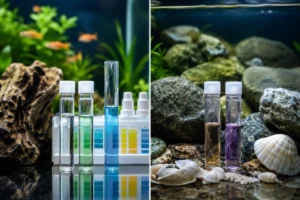
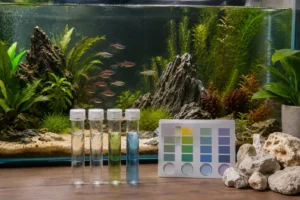
Before lowering aquarium pH, test your source water. Test tap water immediately and again after it has rested. Also test KH and GH. These values tell you whether your water is naturally buffered and alkaline.
If tap water is stable and your livestock match it, there may be no problem. If you want to keep soft-water species, you may need to manage source water more deliberately instead of fighting every water change.
What to test in tap water
- pH immediately after drawing water
- pH after resting
- KH
- GH
- Nitrate
- Temperature before water changes
Knowing your tap water baseline helps you decide whether pH correction is realistic, necessary, or even worth attempting.
High pH From Rocks and Substrate
Hardscape and substrate can influence pH, KH and GH. Limestone, coral rock, shells, aragonite, crushed coral, coral sand and some carbonate-rich stones can raise alkalinity and hardness over time.
This is not always bad. In tanks designed for alkaline water, these materials can help maintain stability. In soft-water aquascapes, shrimp tanks or blackwater setups, they can work against your goals.
If pH keeps rising after adding rock or substrate, test KH and GH over time. A rising KH or GH trend often tells you that something in the aquarium is dissolving minerals into the water.
- Limestone: commonly raises alkalinity and hardness.
- Crushed coral: used intentionally to raise KH and pH.
- Aragonite: carbonate-rich and often alkaline.
- Shells and coral pieces: can dissolve and raise buffering.
- Seiryu-style stones: may raise hardness depending on composition.
- Inert sand: should not significantly change pH if truly inert.
- Active soil: usually lowers pH/KH rather than raising it.
For more hardscape planning, read the Aquarium Rock Guide, Aquarium Sand Guide and Aquarium Soil Guide.
High pH and Ammonia Toxicity
High pH becomes especially important when ammonia is present. Aquarium test kits often measure total ammonia, which includes ammonia and ammonium forms. The more toxic unionized ammonia fraction becomes more significant at higher pH and higher temperature.
This means a high-pH aquarium with measurable ammonia deserves fast attention. The solution is not to crash pH quickly. The solution is to reduce ammonia directly with controlled water changes, waste removal, reduced feeding, oxygenation and biological filtration support.
If ammonia is measurable, read Ammonia Spike in Aquarium and test nitrite as well. High pH should make you take ammonia more seriously, but pH-lowering panic can create additional stress.
High pH in Planted Aquariums
Planted aquariums can run at different pH values depending on KH, CO₂, substrate and plant choice. Many common aquarium plants can adapt to moderately alkaline water, but very high KH or very hard water can make certain soft-water aquascaping goals harder.
In CO₂-injected tanks, pH often drops during the CO₂ period and rises again later. This daily movement can be normal if controlled. If your pH remains high and plants struggle, the issue may be low CO₂ availability, high KH, nutrient imbalance, poor lighting, or plant species selection.
Do not use CO₂ only as a random pH-lowering tool. CO₂ is primarily used as a carbon source for plants. Fish safety, oxygenation, KH and circulation still matter.
For complete CO₂ setup planning, read the Aquarium CO₂ System Guide.
High pH and Shrimp
Shrimp sensitivity depends strongly on species and overall mineral stability. Neocaridina shrimp often tolerate moderately alkaline and mineral-rich water better than many Caridina shrimp. Caridina setups are often built around softer, more acidic water with active soil and carefully remineralized RO water.
If you keep shrimp, do not judge pH alone. Test KH, GH, temperature and overall stability. Sudden changes can be more dangerous than a stable value. A shrimp tank with high pH, high KH and high GH may work for some species but be unsuitable for others.
Do not lower pH quickly in a shrimp tank. Shrimp are sensitive to parameter swings. If the water chemistry is wrong for the species, rebuild the setup gradually or choose livestock that matches the water.
High pH and Snails
Many aquarium snails benefit from mineral-rich water because calcium and carbonate availability support shell health. Very acidic, low-mineral water can contribute to shell erosion in some snail setups. This means a moderately high pH is not necessarily bad for snails.
However, high pH still matters if ammonia is present. Snails can be affected by poor water quality too. If you see snail stress, test ammonia, nitrite, nitrate, pH, KH and GH rather than assuming pH alone is the cause.
How to Test High pH Correctly
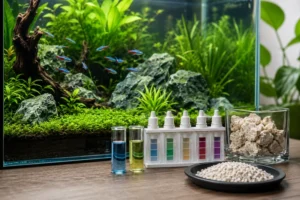
Testing pH correctly matters before trying to lower it. Many aquarists test only pH and ignore KH. That gives an incomplete picture. If pH is high, KH and GH are the next values to test.
Also test tap water. If tap water is naturally alkaline and strongly buffered, your aquarium will likely return toward that chemistry after every water change. If pH is high only inside the aquarium, something in the tank may be raising it.
High pH testing checklist
- Test aquarium pH.
- Test KH.
- Test GH.
- Test tap water pH immediately.
- Test rested tap water pH.
- Test ammonia if livestock are stressed.
- Test nitrite in new or unstable tanks.
- Compare pH before and after water changes.
- Track KH and GH over time if rocks or substrate may be raising hardness.
- Record trends instead of reacting to one isolated result.
One pH reading tells you where the tank is at that moment. A trend tells you whether the system is stable, rising, rebounding or being affected by a source inside the aquarium.
How to Lower Aquarium pH Safely
You should lower aquarium pH only when there is a real reason. If your pH is high but stable and livestock are suited to alkaline water, changing it may be unnecessary. If you are keeping soft-water species or your pH is rising because of unwanted carbonate sources, then correction may make sense.
The safest way to lower pH is to address the reason it is high. In most cases, that means managing KH, source water and carbonate materials. It does not mean repeatedly adding pH-down products.
Safer ways to lower high pH
- Use reverse osmosis water mixed with tap water when appropriate.
- Remineralize RO water correctly to stable KH and GH.
- Remove limestone, shells, coral or carbonate-rich materials if they are unwanted.
- Use active aquarium soil for soft-water aquascapes or shrimp systems when suitable.
- Avoid aragonite or coral sand if you want soft acidic water.
- Use driftwood or botanicals for gentle blackwater-style influence in low-KH systems.
- Make changes gradually and test between adjustments.
Do not lower pH suddenly in a stocked aquarium. A rapid pH drop can shock fish and shrimp, especially if KH, GH, temperature or TDS also change.
Why pH-Down Products Often Fail
pH-down products often fail because they fight KH instead of solving it. If water has strong carbonate buffering, acid-based pH reducers may temporarily lower the pH, but the buffer system can push the pH back upward.
This creates unstable water. The aquarist adds product, pH drops, pH rebounds, and the process repeats. Fish and shrimp experience the swings, while the root cause remains.
If pH-down products do not hold, stop chasing the number. Test KH, test source water, check rocks and substrate, and decide whether you need source-water management or different livestock.
Should You Use RO Water to Lower pH?
Reverse osmosis water can help lower pH indirectly by reducing KH and hardness when mixed correctly. However, RO water should not be used carelessly. Pure RO water lacks the minerals and buffering that fish, shrimp, snails, plants and bacteria need.
The safe method is controlled mixing and remineralization. You can mix RO water with tap water or remineralize RO water to a target KH and GH that matches your livestock. This gives you more control than repeatedly adding pH reducers.
If you switch to RO water, change gradually. Sudden drops in KH, GH and pH can shock livestock. For shrimp tanks and soft-water aquascapes, consistent water preparation is essential.
Emergency: High pH With Ammonia
The most urgent high-pH situation is high pH combined with measurable ammonia. In this case, do not focus on lowering pH first. Focus on reducing ammonia exposure safely.
High pH makes ammonia more dangerous, but sudden pH reduction can also stress livestock. The safer response is controlled water changes, waste removal, reduced feeding, oxygenation, filter protection and continued testing.
| Action | Why It Helps | Important Warning |
|---|---|---|
| Test ammonia and nitrite | Confirms urgent toxic compounds | Do not rely on pH alone |
| Controlled water change | Dilutes ammonia | Use dechlorinated, temperature-matched water |
| Reduce feeding | Creates less new ammonia | Remove uneaten food |
| Remove decaying matter | Stops ammonia sources | Check behind hardscape and plants |
| Increase oxygenation | Supports fish and beneficial bacteria | Especially important in warm water |
| Protect filter media | Preserves biological filtration | Do not replace all media |
For the full emergency guide, read Ammonia Spike in Aquarium.
What Not to Do When pH Is Too High
High pH problems often become worse when aquarists react quickly without understanding KH and source water. Avoid sudden corrections that create unstable chemistry.
- Do not chase pH with repeated pH-down products. Solve KH and source-water issues instead.
- Do not lower pH suddenly. Fast changes can shock fish and shrimp.
- Do not ignore KH. KH explains why pH may rebound.
- Do not keep soft-water livestock in hard alkaline water without a plan.
- Do not use pure RO water without remineralization.
- Do not leave carbonate rocks or coral in a soft-water setup.
- Do not ignore ammonia in high-pH tanks. Ammonia is more dangerous at higher pH.
- Do not change several parameters at once. Adjust gradually and test.
Aquarium pH Too High Troubleshooting Table
Use this table to connect high-pH patterns with likely causes and first actions.
| Situation | Likely Cause | First Action |
|---|---|---|
| pH high but stable | Hard alkaline source water | Check livestock suitability before changing |
| pH keeps rising | Carbonate rocks, shells, coral, substrate | Test KH/GH and inspect materials |
| pH-down does not work | High KH buffering | Address KH/source water |
| High pH with ammonia | Ammonia more dangerous in alkaline water | Reduce ammonia immediately |
| pH rises after water changes | Tap water is alkaline | Test tap pH, rested pH, KH and GH |
| Soft-water fish stressed | Water chemistry mismatch | Adjust source water gradually or choose different livestock |
| Shrimp struggle in high pH | Species mismatch, KH/GH instability | Check shrimp species needs and minerals |
| Plants struggle in high pH | Hard water, CO₂ limitation, nutrient balance | Review CO₂, light, KH and plant selection |
How to Prevent Aquarium pH From Rising Again
Preventing high-pH problems means controlling the sources that raise or maintain alkalinity. If your tap water is naturally alkaline, you may either build the aquarium around it or use controlled source-water management. If hardscape or substrate is raising pH, remove or replace the source if it conflicts with your goals.
Prevention checklist
- Test tap water pH, KH and GH before designing the aquarium.
- Choose livestock that match your stable water whenever possible.
- Avoid limestone, coral, shells and aragonite in soft-water tanks.
- Use inert substrate if you do not want hardness changes.
- Use RO water only with proper remineralization.
- Make water chemistry changes gradually.
- Monitor ammonia carefully in high-pH tanks.
- Do not rely on repeated pH-down products.
- Track KH and GH trends when using decorative rocks.
- Keep maintenance consistent so other water-quality issues do not compound stress.
If your water is naturally hard and alkaline, the easiest long-term strategy may be to keep species that enjoy that water. Stability is often more sustainable than constant correction.
Quick Takeaways
- High aquarium pH is not automatically bad.
- Stable alkaline water can be suitable for many hard-water fish, snails and some community setups.
- KH is the key value behind high pH stability and pH rebound.
- Hard alkaline tap water is one of the most common causes of high pH.
- Limestone, shells, coral, aragonite and crushed coral can raise pH and buffering.
- High pH makes ammonia more dangerous if ammonia is present.
- pH-down products often fail when KH is high.
- RO water can help only when mixed or remineralized correctly.
- Lower pH slowly if your livestock truly need softer water.
- Choosing livestock that match your water is often safer than chasing pH.
Conclusion
If your aquarium pH is too high, do not panic. First decide whether the pH is actually unsafe or simply alkaline. A stable high-pH aquarium can be healthy when the livestock, plants, substrate and hardscape match that water.
The most important test is KH. If KH is high, quick pH reducers usually do not solve the problem. If rocks, shells or substrate are raising pH, remove the source if it conflicts with your goal. If tap water is naturally alkaline, choose suitable livestock or manage source water carefully with RO mixing and remineralization.
From here, continue with the Aquarium pH Guide for the full pH framework, read Aquarium pH Too Low for the opposite problem, or return to the Aquarium Water Guide to understand the complete water-quality system.
Next step:
If your aquarium pH is too high, test KH, GH, tap water and ammonia before adjusting anything. If pH is high but stable and livestock are suitable, avoid unnecessary correction. If ammonia is present, reduce ammonia immediately.
💬 Join the Conversation
Tag us on Instagram @AquariumLesson — we’d love to see your planted tanks, water test results and pH-stability routines.
👉 Is your aquarium pH naturally high from tap water, or did it rise after adding rocks, substrate or minerals?
FAQ
Is high pH bad in an aquarium?
High pH is not automatically bad. It can be normal for hard-water fish, livebearers, snails and some community aquariums. It becomes a problem when it is unstable, unsuitable for livestock, or combined with measurable ammonia.
What causes aquarium pH to be too high?
Common causes include hard alkaline tap water, high KH, limestone, shells, coral, aragonite, crushed coral, carbonate-rich substrate, mineral additives and water changes with high-pH source water.
How do I lower high aquarium pH safely?
Lower pH safely by addressing KH and source water. Use RO water mixing or proper remineralization when appropriate, remove carbonate sources if needed, and make changes gradually. Avoid sudden pH drops in stocked aquariums.
Why does my pH go back up after using pH-down?
Your KH is probably buffering the water and pushing pH back upward. pH-down products often fail in hard alkaline water because they do not remove the underlying buffering source.
Can rocks raise aquarium pH?
Yes. Limestone, coral rock, shells, aragonite, crushed coral and some carbonate-rich stones can raise pH, KH or GH over time. Test KH and GH if pH rises after adding hardscape.
Can high pH make ammonia worse?
Yes. Ammonia becomes more dangerous as pH and temperature increase. If ammonia is measurable in a high-pH aquarium, reduce ammonia directly with controlled water changes, waste removal, reduced feeding and biological filtration support.
Should I use RO water to lower pH?
RO water can help lower KH and make lower pH easier to maintain, but it must be mixed or remineralized correctly. Pure RO water without minerals and buffering is not automatically safe for aquarium use.
Is pH 8.0 too high for fish?
pH 8.0 is not automatically too high. It can be suitable for hard-water fish and some community setups. It may be unsuitable for soft-water species or sensitive shrimp. Always consider KH, GH, species needs and stability.
Can driftwood lower high pH?
Driftwood may gently acidify soft, low-KH water, but it usually has limited effect in hard, well-buffered water. If KH is high, driftwood alone will not reliably lower pH.
Should I change fish if my tap water has high pH?
Sometimes choosing fish that match your stable tap water is the safest long-term solution. Constantly forcing hard alkaline water into soft acidic conditions can create instability unless you manage source water carefully.
Lesson completed!
You've finished this lesson. Keep building your aquarium knowledge, one lesson at a time.
Continue learning →New to AquariumLesson? Start with our complete Aquarium Lessons Hub or return to the homepage at AquariumLesson.com.
References
- U.S. Environmental Protection Agency. Aquatic Life Criteria – Ammonia.
- University of Florida IFAS. Basic Water Quality Parameters for Aquaculture.
- AgMRC. Water Quality Management for Recirculating Aquaculture.
- New Mexico State University. Important Water Quality Parameters in Aquaponics Systems.
- AquariumLesson. Aquarium pH Guide.