
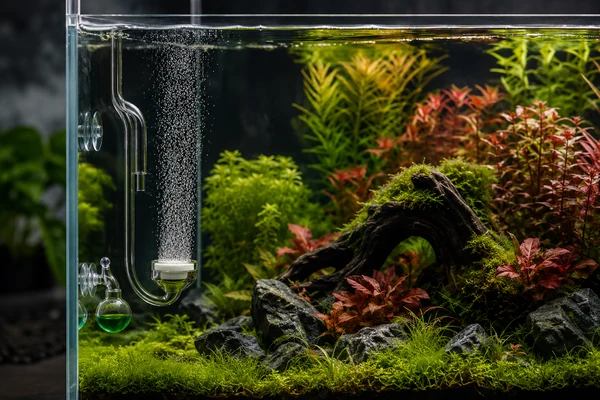
CO₂ Troubleshooting Guide: Fix Planted Tank CO₂ Problems
Introduction
This CO2 troubleshooting guide helps you diagnose the most common planted aquarium CO₂ problems: blue drop checkers, yellow drop checkers, fish gasping, algae after increasing CO₂, poor carpet growth, unstable pH, large diffuser bubbles, weak flow, and plants that still struggle even when the bubble counter is running.
CO₂ is one of the strongest growth tools in a planted aquarium, but it is also one of the easiest systems to misread. A bubble counter can look active while very little CO₂ reaches the plants. A drop checker can look green while one part of the tank still has a carbon dead zone. A pH drop can look impressive while fish are already stressed. And algae can appear not because CO₂ is absent, but because it is unstable, late, poorly distributed, or mismatched with light and nutrients.
The most important rule is simple: never troubleshoot CO₂ by increasing gas blindly. CO₂ affects both plants and livestock. More CO₂ can help plants only if it is delivered evenly, supported by flow, matched to lighting, balanced with fertilizer, and kept safe for fish and shrimp.
This guide gives you a structured way to diagnose CO₂ issues without guessing. For the complete equipment foundation, read the Aquarium CO2 System Guide. For specific tools, use the CO₂ Drop Checker Guide, CO₂ Bubble Rate Guide, CO₂ Diffuser Guide, and CO₂ Reactor Guide.
Quick answer: Most aquarium CO₂ problems come from unstable timing, poor diffusion, weak flow, excessive light, dirty equipment, or unsafe over-adjustment. Fix CO₂ by checking livestock first, then bubble rate, drop checker, pH trend, diffuser or reactor performance, surface agitation, flow, light intensity and fertilizer balance.
What You’ll Learn in This Lesson
- How to diagnose aquarium CO₂ problems safely
- Why a running bubble counter does not guarantee enough CO₂
- What blue, green and yellow drop checker readings usually mean
- Why fish gasping is an emergency warning sign
- How CO₂ instability triggers algae in high-light tanks
- How diffuser, reactor, flow and surface agitation change CO₂ delivery
- How to fix poor plant growth without overdosing CO₂
- How to build a safer CO₂ troubleshooting checklist
Start With Safety: Are Fish or Shrimp Stressed?
Before diagnosing plant growth, check livestock safety. CO₂ troubleshooting always starts with animals, not plants. A planted tank can recover from weak growth or algae. Fish and shrimp may not recover from severe CO₂ overdose.
If livestock show stress after CO₂ starts, treat it as urgent. Do not wait for a drop checker to change color. Drop checkers react slowly, and animals can show distress before the indicator fully catches up.
Warning signs of too much CO₂ or poor gas balance include:
- Fish gasping at the surface
- Rapid gill movement
- Fish gathering near the filter outflow
- Fish becoming lethargic or hiding unusually
- Erratic swimming or loss of balance
- Shrimp climbing upward or becoming inactive
- Snails moving toward the surface
- Sudden stress after increasing bubble rate
- Yellow or lime-yellow drop checker combined with abnormal behavior
If these signs appear, reduce or stop CO₂ immediately, increase surface movement, and observe livestock closely. A water change can help if the situation is severe. Only after livestock are stable should you continue troubleshooting plant performance.
Ready to set up your own tank?
Create a free account to save lessons, plan your setup, and use the Tank Hub to turn ideas into a real aquarium.
The CO₂ Troubleshooting Order
CO₂ problems are easiest to solve when you follow a fixed order. Randomly increasing bubble rate, moving the diffuser, changing the light and adding fertilizer at the same time makes diagnosis impossible.
Use this order when something looks wrong:
| Step | What to Check | Why It Matters |
|---|---|---|
| Safety | Fish, shrimp and snails | Livestock stress overrides plant goals |
| Timing | When CO₂ starts and stops | Plants need CO₂ available when lights begin |
| Injection | Bubble rate and regulator stability | Gas must flow consistently |
| Diffusion | Diffuser, atomizer or reactor performance | Gas must dissolve efficiently |
| Distribution | Flow, dead zones and outlet direction | CO₂ must reach all plant zones |
| Monitoring | Drop checker and pH trend | Tools help confirm patterns, not instant truth |
| Balance | Light, fertilizer and water changes | CO₂ only works when the full system matches |
This order prevents the most dangerous mistake: adding more CO₂ when the real problem is poor distribution, too much light, a clogged diffuser, or weak plant nutrition.
Problem: The Drop Checker Stays Blue
A blue drop checker usually means CO₂ is low, but it does not automatically mean you should increase the bubble rate. The reading may also be caused by poor placement, old solution, weak flow, a clogged diffuser, late CO₂ timing or excessive surface agitation.
Start by checking whether the drop checker is set up correctly. It should use proper 4 dKH indicator solution or trusted premixed solution, not random aquarium water. It should be placed away from direct bubbles but in normal circulation. It also needs enough time to react.
| Possible Cause | What It Looks Like | Fix |
|---|---|---|
| Bubble rate too low | Checker stays blue through the photoperiod | Increase CO₂ slowly and monitor livestock |
| CO₂ starts too late | Checker turns green only late in the day | Start CO₂ earlier before lights on |
| Dirty diffuser | Large bubbles, weak mist or uneven output | Clean or replace diffuser |
| Poor flow | Checker blue while bubbles stay in one area | Improve circulation and diffuser placement |
| Excessive surface agitation | CO₂ never builds despite high gas use | Reduce splashing, keep a gentle ripple |
| Old indicator solution | Color looks weak, odd or unchanged | Replace solution |
| Checker in dead zone | Reading stays blue but nearby plants look fine | Move checker to a representative flow zone |
If the drop checker stays blue and plants show CO₂-limited growth, increase CO₂ only in small steps. Watch livestock after every adjustment. For detailed color interpretation, use the CO₂ Drop Checker Guide.
Problem: The Drop Checker Turns Yellow
A yellow drop checker usually means CO₂ is high. This is not automatically an emergency if livestock are completely normal, but it should be treated with caution. If fish or shrimp show stress, act immediately.
A yellow reading can be caused by excessive injection, poor drop checker placement, low oxygen exchange, too much CO₂ starting too early, or a sudden regulator change. Because drop checkers are delayed, the tank may already have been high in CO₂ for some time before the color turns yellow.
| Possible Cause | Warning Sign | Fix |
|---|---|---|
| Bubble rate too high | Yellow checker and fish breathing faster | Reduce CO₂ immediately |
| Checker near diffuser | Yellow locally, but tank may not be evenly high | Move checker away from direct bubbles |
| CO₂ starts too early | Livestock stressed before lights are fully active | Shorten pre-light CO₂ period |
| Surface movement too low | Fish gasp despite plant growth | Increase gentle surface ripple |
| Regulator drift | Bubble rate changes unexpectedly | Check regulator, needle valve and cylinder pressure |
| Reactor very efficient after upgrade | Same bubble rate now produces much more dissolved CO₂ | Reduce bubble rate and retune from scratch |
If you recently switched from a diffuser to a reactor, do not keep the old bubble rate automatically. Reactors can dissolve CO₂ much more efficiently, so the same bubble rate may create a stronger dissolved CO₂ level.
Problem: Fish Are Gasping After CO₂ Starts
Fish gasping after CO₂ starts is one of the clearest danger signs. It may mean CO₂ is too high, oxygen exchange is too low, water movement is poor, temperature is high, or another water-quality problem is present. But if the timing follows a CO₂ adjustment, treat CO₂ as the first suspect.
Immediate response:
- Turn down or stop CO₂.
- Increase surface agitation.
- Point the filter outlet slightly upward if needed.
- Add temporary aeration if livestock remain stressed.
- Check temperature, ammonia, nitrite and general water quality.
- Do a water change if the situation is severe.
- Do not restart CO₂ at the same rate.
After the emergency is over, review the cause. Did the bubble rate drift? Did the diffuser clog and then suddenly clear? Did a filter intake get blocked by plant debris? Did surface movement drop? Did CO₂ run at night by mistake? Did the solenoid fail open?
CO₂ safety depends on both carbon and oxygen. A tank can have high dissolved oxygen and still stress fish with excessive CO₂. Keep the system stable, and never use livestock stress as a normal part of CO₂ tuning.
Problem: Plants Still Grow Poorly With CO₂ Running
If CO₂ is running but plants still grow poorly, do not assume the answer is always more gas. Poor growth can come from low CO₂, unstable CO₂, weak distribution, too much light, missing nutrients, poor substrate support, transition stress or plant choice.
First ask where the problem appears. If only plants far from the diffuser struggle, distribution is likely. If all new growth is pale, micronutrients or iron may be involved. If older leaves yellow, nitrogen or magnesium may be involved. If carpets grow upward, substrate PAR or CO₂ at the carpet level may be weak.
| Plant Symptom | Possible Cause | What to Check |
|---|---|---|
| Carpet grows upward | Low substrate PAR or weak CO₂ near substrate | Light spread, flow and diffuser placement |
| Stem tops are small or twisted | CO₂ instability, micros or nitrate/phosphate issue | CO₂ timing and fertilizer balance |
| Plants pearl only near diffuser | Uneven CO₂ distribution | Flow path and dead zones |
| Older leaves yellow | Nitrogen or magnesium issue | Macro dosing and GH/mineral balance |
| Pinholes on older leaves | Potassium shortage or damage | Fertilizer routine and livestock grazing |
| Pale new growth | Iron, trace elements or CO₂ issue | Micro fertilizer and pH/CO₂ stability |
| Plants melt after changes | Transition stress, CO₂ swing or parameter shift | Recent changes and stability |
Use the Aquarium Fertilizer Guide if symptoms point toward nutrients. Use Aquarium PAR Explained if the problem appears related to lighting zones or carpet growth.
Problem: Algae Appears After Increasing CO₂
Algae after increasing CO₂ does not always mean CO₂ caused algae directly. It often means the system became unstable during adjustment. Large daily CO₂ changes, inconsistent bubble rate, excessive light, dirty equipment, poor flow or missing nutrients can all trigger algae while CO₂ is being tuned.
High-light tanks are especially sensitive. If light is strong and CO₂ is late, fluctuating or uneven, plants cannot use the available energy consistently. Algae then takes advantage of the imbalance.
Common CO₂-related algae patterns:
- Black beard algae: often linked with unstable CO₂, poor flow, organics or stressed slow leaves.
- Staghorn algae: often appears in unstable high-energy tanks with CO₂ or organic issues.
- Hair algae: can appear when light is strong and plants are not growing competitively.
- Green spot algae: often points more toward phosphate/light balance than CO₂ alone.
- Algae on slow plants: often means too much light for slow leaf turnover or poor flow around leaves.
Do not respond by changing everything at once. First stabilize CO₂ timing and flow. Then reduce excessive light if needed. Then review nutrients and maintenance. For the broader algae framework, read Aquarium Lighting and Algae.
Problem: CO₂ Is Unstable From Day to Day
Plants respond badly to unstable CO₂. A tank can have enough CO₂ on one day and too little or too much the next. This inconsistency is often worse than a slightly conservative but stable CO₂ level.
Day-to-day instability can come from manual operation, regulator drift, inconsistent needle valve settings, changing surface agitation, clogged diffusers, variable filter flow, or plant mass changes.
Common instability causes:
- CO₂ turned on manually at different times
- No solenoid timer
- Needle valve too sensitive or unstable
- Working pressure changes
- Regulator drift as cylinder pressure changes
- Diffuser slowly clogging
- Filter flow weakening as media becomes dirty
- Surface skimmer or lily pipe position changing
- Dense plants blocking circulation after growth
- Air trapped in a reactor or filter line
The fix is routine. Use a timer and solenoid. Clean equipment regularly. Keep surface movement consistent. Trim plants before they create dead zones. Recheck bubble rate and pH trend after major maintenance.
Problem: Bubble Rate Looks Correct but CO₂ Is Still Low
A bubble counter only shows gas passing through the counter. It does not show dissolved CO₂ in the aquarium. A “correct” bubble rate can still fail if the diffuser is dirty, the reactor is trapping gas, bubbles escape at the surface, or flow does not carry CO₂ to plants.
If the bubble rate looks normal but plants and monitoring suggest low CO₂, check the delivery chain from cylinder to plant zone.
| System Part | Possible Failure | Fix |
|---|---|---|
| Regulator | Pressure drift or unstable output | Check working pressure and equipment quality |
| Needle valve | Hard to fine-tune | Make tiny adjustments and allow stabilization |
| Bubble counter | Misleading due to bubble size differences | Use only as a repeatability reference |
| Diffuser | Dirty ceramic or large bubbles | Clean or replace diffuser |
| Reactor | Gas buildup or low flow | Check flow, purge gas, reduce CO₂ if needed |
| Filter flow | CO₂ not distributed | Clean filter and adjust outflow |
| Surface agitation | CO₂ off-gassing too fast | Reduce splashing, keep gentle ripple |
For bubble-rate tuning, use the CO₂ Bubble Rate Guide. Do not compare your bubbles per second directly with another aquarist’s tank.
Problem: Diffuser Produces Large Bubbles
Large bubbles usually reduce CO₂ efficiency. They rise quickly, dissolve poorly and may escape at the surface before plants can use the carbon. Fine mist is generally more efficient than large bubbles in diffuser-based setups.
Large bubbles often mean the diffuser is clogged, dirty, damaged, too low quality, or not receiving the right pressure. Ceramic pores can become blocked by algae, biofilm and mineral deposits. When fewer pores remain open, gas escapes through larger openings.
Fix large bubbles by:
- Removing and cleaning the diffuser outside the aquarium
- Checking for cracks or damaged seals
- Confirming the working pressure is suitable for the diffuser
- Replacing cheap or worn ceramic discs if needed
- Checking tubing and check valve restrictions
- Placing the diffuser lower in the flow path after cleaning
If the diffuser repeatedly clogs, build cleaning into the routine. A clean diffuser is often safer than increasing CO₂ to compensate for poor mist quality.
Problem: CO₂ Does Not Reach the Whole Tank
Uneven CO₂ distribution is one of the most common planted tank problems. The drop checker may be green in one area while plants in another area are carbon-limited. Dense plants, hardscape, weak filter flow and poor outlet direction can all create CO₂ dead zones.
Signs of uneven distribution include:
- Plants near the diffuser grow better than plants elsewhere
- Algae appears repeatedly in one corner
- Carpet struggles in one zone but not another
- Fine bubbles stay local and do not travel across the tank
- Drop checker readings differ when moved to another location
- Debris collects in the same planted areas
- Stem bases decay in dense low-flow groups
Improve distribution before adding more gas. Move the diffuser lower into the main flow path. Adjust lily pipe or spray bar direction. Clean filter media if flow has declined. Trim dense stems that block circulation. Use the Aquarium Filter Flow Guide if dead zones are part of the issue.
Problem: CO₂ Builds Too Slowly Before Lights On
Plants need CO₂ available when the light period begins. If CO₂ starts at the same time as the lights, the tank may spend the first part of the photoperiod carbon-limited. This is especially important in high-light tanks because plant demand rises quickly when lights turn on.
Many aquarists start CO₂ about one to two hours before lights on. The exact timing depends on tank size, flow, diffusion, surface agitation and safety. The goal is to reach a useful CO₂ level by the time plants are actively photosynthesizing.
If CO₂ builds too slowly:
- Start CO₂ earlier before lights on.
- Improve diffuser or reactor efficiency.
- Check whether surface agitation is too strong.
- Improve flow through the tank.
- Watch livestock carefully during the earlier start.
- Track pH trend if you use pH monitoring.
- Do not simply increase bubble rate without checking safety.
If livestock show stress before lights begin, your pre-light CO₂ period may be too long, too strong or poorly oxygenated.
Problem: CO₂ Runs Too Long or Overnight
In most planted aquariums, CO₂ should not run all night. Plants mainly use CO₂ during the light period. At night, plants and animals both respire, and oxygen balance becomes more important. Running CO₂ overnight usually wastes gas and can increase livestock risk.
A solenoid and timer are the safest normal approach. CO₂ turns on before lights and turns off before or around lights out. Manual operation is less reliable because forgetting one evening can create a dangerous situation.
Check your system if:
- CO₂ continues bubbling after the timer should stop
- The solenoid feels stuck or fails open
- Fish look stressed early in the morning
- The drop checker remains very yellow overnight
- There is no separate CO₂ timer
- CO₂ is controlled only by manual valve operation
If CO₂ is running overnight accidentally, correct the timer, solenoid or valve before further plant tuning.
Problem: pH Drop Looks Wrong
CO₂ lowers pH, so pH trend can help you understand how strongly CO₂ is affecting the aquarium. But pH is not a perfect CO₂ measurement in every tank. Active aquasoil, tannins, acids, buffers and non-carbonate chemistry can affect the interpretation.
Use pH trend as a pattern, not as a single absolute truth. Compare degassed or pre-CO₂ pH with pH during the photoperiod. If the pH barely changes, CO₂ may be low or off-gassing quickly. If pH drops sharply and fish react badly, CO₂ may be too high or gas balance may be unsafe.
| pH Pattern | Possible Meaning | Next Step |
|---|---|---|
| No clear pH drop | Low CO₂, strong off-gassing or measurement issue | Check diffusion, flow and surface agitation |
| Very slow pH drop | CO₂ starts too late or dissolves poorly | Start earlier or improve delivery |
| Sharp pH drop with stressed fish | CO₂ may be too high | Reduce CO₂ and increase gas exchange |
| pH varies daily | Inconsistent CO₂, KH, flow or measurement | Stabilize routine and test method |
| pH chart does not match drop checker | Water chemistry or checker setup may distort interpretation | Check 4 dKH solution and KH assumptions |
If you use pH and KH estimates, compare values with the Aquarium pH CO₂ Calculator, but always treat livestock behavior as the final safety signal.
Problem: CO₂ Improved but Nutrient Deficiencies Appeared
When CO₂ improves, plants may grow faster. Faster growth increases nutrient demand. This can reveal fertilizer gaps that were hidden when carbon was the main limitation.
After improving CO₂, you may suddenly see nitrogen, phosphate, potassium, magnesium, iron or trace element symptoms. This does not mean CO₂ caused the deficiency. It means plants are now capable of stronger growth and need matching nutrition.
Review fertilizer if you notice:
- Older leaves yellowing after faster growth
- Green spot algae and stalled shoot tips
- Pinholes or dark spots on older leaves
- Pale new growth after trimming
- Red plants growing faster but losing quality
- Floating plants turning pale or shrinking
- Carpets spreading but becoming weak or yellow
Use the Aquarium Liquid Fertilizer Guide to review water-column nutrients. CO₂, light and fertilizer must rise together in high-energy aquariums.
Problem: Liquid Carbon Did Not Fix the CO₂ Issue
Liquid carbon is not the same as pressurized CO₂. It may help some low-tech tanks and certain algae situations, but it does not replace stable injected CO₂ in high-light aquascapes, carpet tanks or dense stem layouts.
If you use liquid carbon and still see CO₂-limited growth, the tank may simply need real CO₂ injection or lower light. Liquid carbon cannot solve a system designed around high carbon demand.
Liquid carbon is unlikely to solve:
- High-light carpets failing from carbon limitation
- Dense red stem tanks needing stable CO₂
- Unstable pressurized CO₂ timing
- Poor diffuser or reactor performance
- CO₂ dead zones caused by weak flow
- Algae caused by excessive light and inconsistent carbon
For a realistic comparison, read the Liquid Carbon Aquarium Guide. If you want a no-injection setup, choose plants and lighting around that limitation rather than forcing high-tech goals.
Common CO₂ Mistakes to Avoid
CO₂ problems often come from a few repeated mistakes. Avoiding these mistakes makes planted tanks safer and easier to tune.
| Mistake | Why It Causes Problems | Better Approach |
|---|---|---|
| Increasing bubble rate too quickly | Can stress or kill livestock | Adjust in small steps and wait |
| Trusting bubble rate alone | Bubbles do not equal dissolved CO₂ | Use drop checker, pH trend, plants and livestock |
| Ignoring flow | CO₂ may not reach plant zones | Improve distribution before adding gas |
| Running high light before CO₂ is stable | Algae and plant stress increase | Lower light until CO₂ is reliable |
| Using old drop checker solution | Readings become unreliable | Replace solution regularly |
| Letting diffusers clog | Large bubbles waste CO₂ | Clean diffuser on schedule |
| Forgetting fertilizer after improving CO₂ | Faster growth exposes nutrient gaps | Match nutrients to higher plant demand |
| Running CO₂ overnight | Raises livestock risk and wastes gas | Use solenoid and timer |
The best CO₂ system is not the strongest one. It is the most stable one that produces healthy plants without animal stress.
Emergency CO₂ Checklist
Use this checklist if fish or shrimp look stressed while CO₂ is running:
- Turn off or reduce CO₂ immediately.
- Increase surface agitation.
- Add temporary aeration if needed.
- Check whether CO₂ is still bubbling after the solenoid should close.
- Check the bubble counter for unexpected increase.
- Check diffuser or reactor for trapped gas release or sudden change.
- Check temperature, ammonia and nitrite.
- Perform a water change if stress is severe.
- Do not restart at the same rate.
- Retune CO₂ from a lower starting point.
After the emergency, identify the failure. CO₂ incidents often come from equipment drift, blocked flow, timer mistakes, excessive bubble rate or reduced oxygen exchange.
Full CO₂ Troubleshooting Checklist
Use this checklist when plant growth, algae or CO₂ readings do not make sense:
- Are fish, shrimp and snails behaving normally?
- Does CO₂ turn on before the lights?
- Does CO₂ turn off before or around lights out?
- Is the bubble rate stable from day to day?
- Is the diffuser clean and producing fine bubbles?
- Is the reactor collecting trapped gas?
- Is the drop checker using proper 4 dKH solution?
- Is the drop checker away from direct bubbles?
- Has the drop checker had enough time to react?
- Is filter flow still strong?
- Are bubbles or CO₂-rich water reaching the whole tank?
- Is surface movement a gentle ripple rather than heavy splashing?
- Is light intensity too high for the current CO₂ stability?
- Are macros and micros available for faster plant growth?
- Have you trimmed dense plants that block circulation?
- Did algae appear after a specific CO₂, light or maintenance change?
If several answers are uncertain, do not increase CO₂ yet. Stabilize the system first.
Final Recommendation
Troubleshoot aquarium CO₂ slowly and systematically. Start with livestock safety, then check timing, injection, diffusion, flow, monitoring, light and fertilizer. Do not jump directly to a higher bubble rate unless you know the tank can handle it safely.
If the drop checker is blue, confirm solution, placement, timing, diffusion and flow before adding more gas. If the drop checker is yellow or fish gasp, reduce CO₂ and improve oxygen exchange. If algae appears, look for instability, not just “too much” or “too little” CO₂.
The goal is not maximum CO₂. The goal is stable, well-distributed, plant-usable CO₂ that fits the light level, fertilizer routine and livestock in your aquarium.
Conclusion
CO₂ troubleshooting is one of the most important skills in planted aquarium keeping. A pressurized CO₂ system can transform plant growth, but only when it is stable, safe and balanced with the rest of the tank.
Most CO₂ problems are not solved by simply adding more gas. Blue drop checkers, algae, poor carpets, weak stems and pale plants can all come from timing, diffusion, flow, light, nutrients or monitoring errors. Yellow drop checkers and gasping fish show that the system may already be unsafe.
Use CO₂ as a precision tool. Tune gradually, observe carefully, clean equipment regularly, keep flow strong, match lighting to carbon availability and never ignore livestock behavior. When CO₂ becomes stable, planted tanks become easier to grow, easier to balance and far more predictable long term.
💬 Join the Conversation
What CO₂ issue are you trying to solve in your planted aquarium: blue drop checker, algae, fish gasping, poor carpet growth, weak flow or unstable bubble rate?
Tag us on Instagram @AquariumLesson — we’d love to see your CO₂ setup, plant growth and troubleshooting progress.
FAQ
Why is my CO₂ drop checker still blue?
A blue drop checker usually means low CO₂, but it can also be caused by old solution, poor placement, weak flow, a dirty diffuser, late CO₂ timing or excessive surface agitation. Check those issues before increasing gas.
Why are my fish gasping after CO₂ starts?
Fish gasping after CO₂ starts often means CO₂ is too high or gas exchange is poor. Turn down or stop CO₂, increase surface agitation and check water quality immediately.
Can too much CO₂ cause algae?
Too much CO₂ is mainly a livestock safety risk. Algae is more often linked to unstable CO₂, poor distribution, excessive light, weak plant growth or organic waste. CO₂ imbalance can contribute to algae even when nutrients are available.
Why do plants struggle even though my bubble counter is running?
A bubble counter only shows gas flow through the equipment. It does not prove that CO₂ is dissolved or distributed well. Check diffuser cleanliness, reactor performance, flow, drop checker reading, pH trend and plant zones.
Should I increase CO₂ if plants are not growing?
Not automatically. Poor plant growth can also come from low light, too much light, nutrient deficiency, poor substrate support, transition stress or weak flow. Increase CO₂ only after checking safety and delivery.
Why did algae appear after I adjusted CO₂?
Algae can appear after CO₂ changes because the system became unstable. Large adjustments, inconsistent timing, poor flow, excessive light or missing nutrients can all create imbalance while CO₂ is being tuned.
Is a green drop checker always safe?
No. A green drop checker is useful, but it is delayed and approximate. If fish or shrimp show stress, reduce CO₂ even if the checker does not look yellow yet.
Can liquid carbon fix CO₂ problems?
Liquid carbon can support some low-tech tanks and algae control, but it does not replace stable pressurized CO₂ in high-light aquascapes, demanding carpet layouts or dense stem plant tanks.
Start building your aquarium with the Tank Hub
Save your favorite lessons, organize your setup, and track your aquarium step by step in your personal Tank Hub.
New to AquariumLesson? Start with our complete Aquarium Lessons Hub or return to the homepage at AquariumLesson.com.
Continue learning
References
- Bulk Reef Supply — Reasons Why Your Aquarium CO₂ Is Failing
- Practical Fishkeeping — CO₂: Striking the Balance
- Green Leaf Aquariums — Aquarium CO₂ Installation & Monitoring Guide
- Aquarium Gardens — CO₂ Set Up Guide
- Aquarium Gardens — The CO₂ Drop Checker Help Guide
- UKAPS — CO₂ Measurement Using a Drop Checker
- Aquarium Science — Measuring CO₂
- The Spruce Pets — Fish Gasping for Air