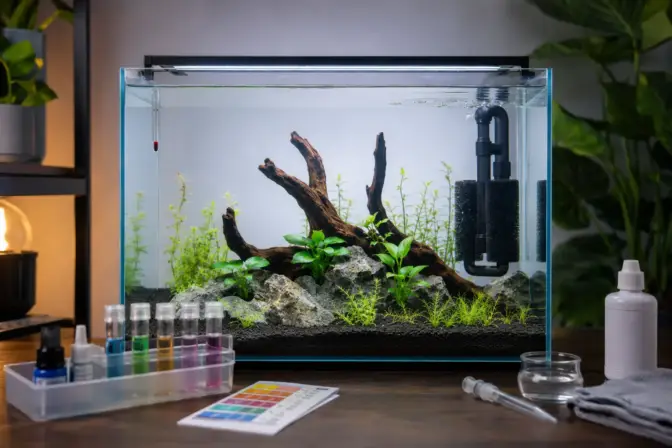
Aquarium Cycling Guide: How to Cycle a New Aquarium Safely
Introduction
Aquarium cycling is the process that makes a new aquarium biologically safe before it carries a full fish, shrimp, or snail population. It is one of the most important steps in freshwater aquarium keeping, because an uncycled tank can look clear while dangerous ammonia and nitrite are building up invisibly.
When people say a tank needs to “cycle,” they are talking about the development of beneficial microorganisms that process waste. Fish waste, uneaten food, dying plant matter, and organic debris create ammonia. In a mature aquarium, the biological filter converts ammonia into nitrite, then nitrite into nitrate. This process is called the nitrogen cycle, and it is the foundation of long-term aquarium water stability.
This guide explains how aquarium cycling works, how long it usually takes, how to cycle a tank safely, which test results matter, and when your aquarium is ready for livestock. If you are still learning the bigger water-quality system, start with the Aquarium Water Guide. This article focuses specifically on cycling as the first biological foundation of a stable aquarium.
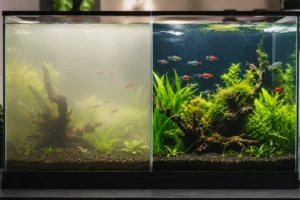
The most important principle is simple: do not judge a new aquarium by how clear the water looks. Judge it by ammonia, nitrite, nitrate, filter maturity, and livestock behavior. Clear water can still be unsafe. A cycled aquarium is not just clean-looking — it is biologically prepared.
Quick Cycling Check
- Ammonia: should be 0 ppm before adding sensitive livestock.
- Nitrite: should be 0 ppm before the tank is considered cycled.
- Nitrate: usually appears once nitrification is working.
- Filter: must run continuously during the cycle.
- Livestock: should be added slowly after cycling, not all at once.
What you’ll learn in this lesson
- What aquarium cycling means in practical terms
- How the nitrogen cycle converts ammonia into nitrite and nitrate
- Why new tanks are risky even when the water looks clean
- How to cycle an aquarium with or without fish
- How to read ammonia, nitrite, and nitrate test results
- How long aquarium cycling usually takes
- How plants, filters, substrate, and bottled bacteria influence cycling
- When your aquarium is safe for fish, shrimp, and snails
- Which mistakes delay or crash the cycle
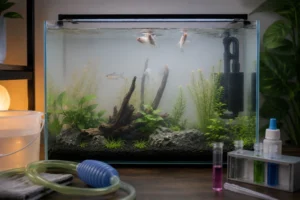
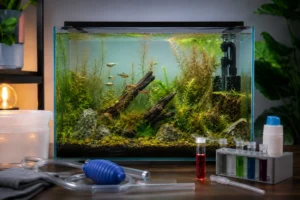
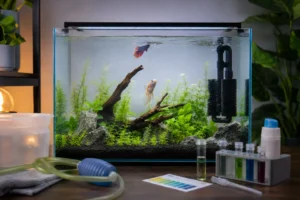
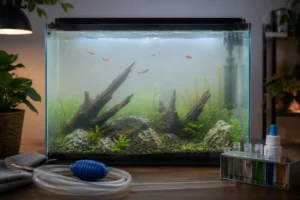
What Is Aquarium Cycling?
Aquarium cycling is the process of establishing a stable biological filter. This biological filter is made of beneficial microorganisms living mainly in the filter media, but also on substrate, hardscape, glass, plants, and other surfaces inside the tank.
These microorganisms process nitrogen waste. Without them, ammonia from fish waste, uneaten food, and decaying organic material can accumulate. Ammonia is dangerous to aquatic life, especially when pH and temperature make more of it available in its toxic unionized form. Once the aquarium has enough beneficial bacteria and other nitrifying organisms, ammonia is converted into nitrite and then into nitrate.
This is why cycling is not the same as simply letting water sit in a tank. Water does not become safe because it has been standing for a few days. The aquarium becomes safer when the biological surfaces inside the system can process waste consistently.
In simple terms, aquarium cycling answers one question: Can this tank process waste before it harms livestock?
The Aquarium Nitrogen Cycle Explained
The nitrogen cycle is the core process behind aquarium cycling. It describes how nitrogen waste changes form inside the aquarium. In freshwater tanks, the main compounds aquarists test are ammonia, nitrite, and nitrate.
Each stage means something different. Ammonia usually means the tank cannot yet process waste safely. Nitrite means the first stage of the cycle is working, but the second stage is not mature enough. Nitrate usually means nitrification is progressing and waste is reaching the less immediately dangerous end product.
Stage 1: Waste creates ammonia
Ammonia enters the aquarium from several sources. Fish release waste through respiration and excretion. Uneaten food breaks down. Dead plant leaves decay. Dead livestock, hidden debris, and dirty filter material can also add ammonia pressure.
In a mature aquarium, this waste is processed quickly. In a new aquarium, the biological filter is not yet strong enough. That is why ammonia often rises in the early cycling phase.
- Fish waste can create ammonia.
- Uneaten food can create ammonia.
- Decaying plants can create ammonia.
- Dead livestock can create ammonia quickly.
- Overcleaning the filter can make ammonia reappear.
Stage 2: Ammonia becomes nitrite
As the first group of nitrifying organisms becomes established, ammonia begins to drop and nitrite begins to rise. This is a sign that the cycle is moving forward, but it does not mean the aquarium is already safe.
Nitrite is also dangerous to fish. A tank can pass the ammonia stage and still be unsafe because nitrite has not yet been converted efficiently into nitrate. This is one of the most common points where beginners add fish too early.
Stage 3: Nitrite becomes nitrate
As the second stage of nitrification develops, nitrite begins to fall and nitrate appears. This usually means the biological filter is becoming more complete. Nitrate is less immediately dangerous than ammonia or nitrite, but it still needs long-term management through water changes, plant uptake, feeding control, and stocking balance.
In planted tanks, nitrate can also be a plant nutrient. This is why nitrate should be interpreted in context. A lightly stocked, heavily planted aquarium may behave differently from a heavily stocked tank with few plants.
| Cycle Stage | Main Compound | What It Means | Tank Status |
|---|---|---|---|
| Early cycle | Ammonia | Waste is present but not processed safely yet | Unsafe for most livestock |
| Middle cycle | Nitrite | Ammonia conversion has started, but cycle is incomplete | Still unsafe |
| Late cycle | Nitrate | Nitrite conversion is developing | Nearly stable if ammonia and nitrite are zero |
| Mature cycle | Low ammonia, low nitrite, controlled nitrate | Biological filtration can process normal waste | Ready for gradual stocking |
Why Aquarium Cycling Matters
Cycling matters because fish, shrimp, and snails live directly in their waste environment. In terrestrial animal care, waste can be removed from the enclosure more easily. In an aquarium, waste dissolves into the water and affects every organism inside the system.
An uncycled aquarium may look perfect on day one. The water is clear. The plants look fresh. The filter is running. The light is bright. But biologically, the system may still be empty. There may not be enough beneficial microorganisms to handle the waste produced once animals are added.
This is why many new-tank problems happen after the first fish are introduced. The livestock create waste, ammonia rises, nitrite follows, and the tank enters a stressful phase while animals are already inside.
Cycling protects fish
Fish exposed to ammonia or nitrite may gasp, hide, clamp fins, become inactive, lose appetite, or show general stress. Some fish survive poor cycling conditions, but survival is not the same as good welfare. A properly cycled tank prevents unnecessary stress from the beginning.
Cycling protects shrimp
Shrimp are often more sensitive to new-tank instability than many beginner fish. Even when ammonia and nitrite are low, immature tanks may still fluctuate. Biofilm, stable minerals, and mature surfaces matter. For shrimp tanks, cycling should be treated with extra patience.
Cycling supports plants and algae control
Cycling is not only about animals. New aquariums often experience cloudy water, algae blooms, diatoms, melting plants, and unstable nutrients. A mature biological system helps the tank settle into a more predictable rhythm.
For planted aquariums, cycling connects directly to lighting, CO₂, fertilization, and water changes. A high-energy aquascape with strong lighting but immature biology can become unstable quickly. For broader plant balance, read the Aquarium Plants Guide and the Aquarium Lighting Guide.
How Long Does Aquarium Cycling Take?
Aquarium cycling commonly takes several weeks, but there is no universal number that applies to every tank. Some aquariums cycle faster because they use mature filter media, established substrate, bottled bacteria, live plants, or a stable ammonia source. Others take longer because temperature, pH, oxygen, filter media, or ammonia availability are not ideal.
The safest answer is this: your aquarium is cycled when test results prove it, not when a calendar says it should be ready.
Do not assume a tank is cycled after one week simply because the water looks clear. Also do not assume that every tank must follow the same day-by-day pattern. Cycling is biological, so speed depends on conditions.
Typical cycling timeline
| Timeframe | What Often Happens | What To Watch |
|---|---|---|
| Week 1 | Ammonia may begin to appear | Do not add full livestock load |
| Weeks 2–3 | Nitrite may rise as ammonia starts converting | Nitrite can still make the tank unsafe |
| Weeks 3–6 | Nitrite may fall and nitrate may rise | Confirm ammonia and nitrite reach zero |
| After cycling | Nitrate becomes the main routine waste marker | Add livestock gradually and monitor results |
This timeline is only a practical orientation. A seeded aquarium with mature media may cycle faster. A new sterile setup with little biological surface may take longer. Testing is always more reliable than guessing.
Fishless Cycling vs Fish-In Cycling
There are two main ways people cycle aquariums: fishless cycling and fish-in cycling. Fishless cycling is usually the safer and more controlled method because it establishes the biological filter before animals are exposed to ammonia or nitrite.
Fish-in cycling can happen intentionally or accidentally. Many beginners buy fish before realizing the tank is not cycled. In that case, the goal changes: you are no longer just building bacteria — you are protecting living animals while the biological filter develops.
Fishless cycling
Fishless cycling uses an ammonia source without exposing fish to toxic waste. The ammonia source feeds the beneficial microorganisms while the tank matures. Once the system can process ammonia and nitrite reliably, livestock can be added gradually.
- Best for: new aquariums before livestock are purchased.
- Main advantage: safer and more controlled.
- Main requirement: ammonia source, patience, and testing.
- Risk: overdosing ammonia or stopping the process too early.
Fish-in cycling
Fish-in cycling means livestock are already present while the biological filter is still immature. This method requires careful feeding, frequent testing, water changes when ammonia or nitrite appear, and strong oxygenation.
- Best for: emergency situations where fish are already in the tank.
- Main advantage: sometimes unavoidable if the mistake has already happened.
- Main requirement: daily awareness and protective water changes.
- Risk: exposing fish to ammonia and nitrite stress.
If you already have fish in an uncycled aquarium, do not panic and do not replace everything. Test ammonia and nitrite, reduce feeding, keep the filter running, improve surface movement, and use controlled water changes to keep waste compounds as low as possible.
How to Cycle an Aquarium Step by Step
The exact cycling method can vary, but the basic logic is always the same. You need water movement, oxygen, biological surface area, an ammonia source, and time for nitrifying organisms to establish.
Step 1: Set up the aquarium completely
Install the tank, filter, heater, substrate, hardscape, and plants before cycling. The filter should run continuously from the beginning. If you are still planning dimensions or total volume, use the Aquarium Volume Calculator first.
Do not cycle a tank with the filter switched off. The filter is where much of the biological activity will develop, especially inside porous media with oxygen-rich water flow.
Step 2: Add dechlorinated water
If your tap water contains chlorine or chloramine, use a suitable water conditioner. Chlorine is added to drinking water to control microbes, but in an aquarium it can harm the biological filter you are trying to establish.
It is also smart to test your tap water baseline. Knowing your source pH, KH, GH, and nitrate level helps you understand what is coming from the tap and what is developing inside the aquarium.
Step 3: Provide an ammonia source
The biological filter needs a waste source to develop. In fishless cycling, this is usually controlled ammonia or a small, deliberate amount of fish food that decomposes. In fish-in cycling, the fish themselves produce waste, which is why careful feeding is critical.
Do not add random large amounts of food. Rotting food can create cloudy water, low oxygen, fungal growth, and unstable waste spikes. A controlled cycling process is better than simply polluting the tank and hoping the filter catches up.
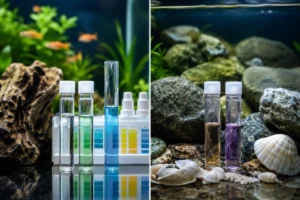
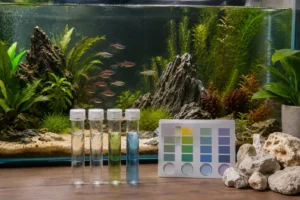
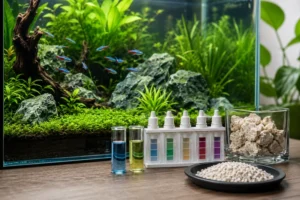
Step 4: Test ammonia, nitrite, and nitrate
Testing is what turns cycling from guessing into aquarium management. During cycling, ammonia and nitrite are the most important values. Nitrate helps show whether the process is moving toward completion.
- Ammonia rising usually means the cycle has started.
- Nitrite rising usually means ammonia conversion has begun.
- Nitrate appearing usually means nitrite conversion is developing.
- Ammonia and nitrite reaching zero means the tank is approaching safe conditions.
Step 5: Wait for ammonia and nitrite to reach zero
A tank is not ready just because ammonia dropped once. Nitrite must also reach zero. The biological filter needs to process both stages reliably. If ammonia is zero but nitrite is high, the aquarium is still not fully cycled.
Once ammonia and nitrite repeatedly test at zero and nitrate is present or controlled through plants and water changes, the aquarium is much closer to being ready.
Step 6: Add livestock gradually
Even after cycling, do not add all fish at once. The biological filter grows according to the waste load it receives. A sudden stocking jump can overwhelm a newly cycled tank and create a mini-cycle.
Add livestock slowly, feed lightly at first, and test water after new additions. This is especially important for shrimp, sensitive fish, and nano aquariums where small changes have larger effects.
How Do You Know When an Aquarium Is Cycled?
An aquarium is cycled when it can process normal waste without measurable ammonia or nitrite. In practical hobby testing, this usually means ammonia reads 0 ppm, nitrite reads 0 ppm, and nitrate is present or otherwise controlled by plants and water changes.
The exact interpretation depends on the tank. A heavily planted aquarium may show lower nitrate because plants are using nitrogen. A tank with nitrate in the tap water may show nitrate before the aquarium has completed cycling. This is why ammonia and nitrite are the key safety markers.
Signs your tank is likely cycled
- Ammonia repeatedly tests at 0 ppm.
- Nitrite repeatedly tests at 0 ppm.
- Nitrate is present or controlled by plants and water changes.
- The filter has been running continuously.
- The tank has had a stable ammonia source during cycling.
- Water is not showing repeated cloudy bacterial blooms.
- Livestock, if present, behave normally and are not gasping or hiding unusually.
If you are unsure, wait longer and keep testing. Patience is safer than rushing. The cost of waiting a few extra days is small compared with the stress of dealing with an ammonia or nitrite emergency after adding fish.
Cycling With Live Plants
Live plants can help a cycling aquarium, but they do not make cycling irrelevant. Fast-growing plants can absorb nitrogen compounds and compete with algae. Established plants can also bring helpful microorganisms on their surfaces. However, a planted tank still needs stable filtration and careful livestock introduction.
Plants change how test results behave. In some planted aquariums, nitrate may not rise dramatically because plants are using nitrogen. This can confuse beginners who expect a textbook nitrate spike. In planted tanks, it is still important to watch ammonia and nitrite closely.
Best plants for new tanks
Fast-growing, hardy plants are useful during the early aquarium phase because they help absorb nutrients and stabilize the system visually and biologically.
- Hygrophila species
- Limnophila species
- Hornwort
- Floating plants
- Java fern
- Anubias
- Cryptocoryne species
- Easy stem plants
For plant planning, continue with the Easy Aquarium Plants Guide, Aquarium Background Plants Guide, and Floating Aquarium Plants Guide.
Does Bottled Bacteria Speed Up Cycling?
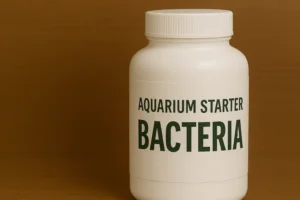
Bottled bacteria products may help speed up cycling, especially when combined with a suitable ammonia source, oxygen-rich flow, and proper filter media. However, they should not replace testing. A tank is not cycled just because a product was added.
The quality, storage, species composition, and freshness of bacterial products can vary. Some aquarists see fast results. Others see little difference. The safest approach is to treat bottled bacteria as a possible accelerator, not as proof that the aquarium is ready.
Mature filter media from a healthy established aquarium is often one of the strongest ways to seed a new tank. However, it should only come from a disease-free, stable system. Never transfer media from a tank with unexplained deaths, parasites, or serious algae and disease issues.
Can You Cycle an Aquarium Without a Filter?
Technically, beneficial microorganisms can live on many aquarium surfaces, not only inside a filter. Substrate, rocks, wood, plants, and glass all provide surface area. However, cycling without a filter is usually less forgiving, especially for beginners.
A filter provides three important advantages: water movement, oxygen delivery, and concentrated biological surface area. These make the cycling process more stable and predictable. For most freshwater tanks, a properly sized filter is strongly recommended.
If you want a low-tech or filterless-style aquarium, it should still be planned carefully with low stocking, heavy planting, stable substrate, and very slow livestock introduction. For most beginners, a filter-based cycle is safer.
For filter selection, read the Aquarium Filter Guide.
What Can Crash an Aquarium Cycle?
A cycled aquarium can lose stability if the biological filter is damaged or suddenly overwhelmed. This is often called a cycle crash or mini-cycle. It can happen in mature tanks too, especially after aggressive cleaning, medication, power outages, overstocking, or heavy overfeeding.
Common causes of cycle crashes
- Replacing all filter media at once
- Rinsing biological media under untreated chlorinated tap water
- Leaving the filter switched off too long
- Adding too many fish at once
- Heavy overfeeding
- Dead livestock hidden in the tank
- Medication that affects the biological filter
- Deep substrate disturbance in dirty tanks
- Major oxygen depletion
If ammonia or nitrite appears in a previously stable tank, treat it as a warning sign. Reduce feeding, check the filter, remove decaying material, improve oxygenation, and perform controlled water changes to protect livestock while the biological filter recovers.
New Tank Syndrome
New tank syndrome describes the problems that happen when fish are added before the aquarium has developed enough biological filtration. The tank is new, the filter is immature, waste begins to build, and fish are exposed to ammonia or nitrite.
The symptoms can look like many other fish problems: gasping, lethargy, hiding, clamped fins, poor appetite, or sudden deaths. But the root cause is often water chemistry, not a mysterious disease.
This is why every new-tank problem should begin with testing ammonia and nitrite. Treating fish without checking water can miss the actual cause.
How to prevent new tank syndrome
- Cycle the aquarium before adding fish.
- Add livestock gradually.
- Feed lightly in the first weeks.
- Do not replace all filter media.
- Test ammonia and nitrite after stocking.
- Keep water changes consistent.
- Use live plants to support stability, but do not rely on plants alone.
Cycling Different Aquarium Types
Not every aquarium cycles the same way. Tank size, plant mass, substrate type, filter size, stocking plan, and livestock sensitivity all influence how careful you need to be.
Nano aquariums
Nano tanks can be beautiful, but they are less forgiving because small water volume changes quickly. A small amount of waste can create a bigger concentration shift than it would in a larger aquarium. Cycle nano tanks carefully and stock them lightly.
Shrimp tanks
Shrimp tanks benefit from extra maturity. Even after ammonia and nitrite reach zero, many shrimp keepers wait longer so biofilm, microbial surfaces, and mineral stability can develop. This is especially important for sensitive Caridina setups.
Planted aquascapes
Planted aquascapes may cycle differently because plants absorb nitrogen and active soil can release ammonia early on. Strong light, CO₂, and fertilizers also influence early stability. During the first weeks, keep lighting moderate and focus on plant establishment, water changes, and filtration.
High-bioload tanks
Tanks with messy fish, heavy feeding, or dense stocking need stronger biological filtration. Cycling should be completed carefully, and stocking should be gradual. A filter that works for a lightly stocked aquascape may not be enough for a high-bioload community tank.
Common Aquarium Cycling Mistakes
Most cycling problems are predictable. They happen because the tank is stocked too early, the filter is cleaned too aggressively, or the aquarist reacts to unclear water by changing too many things at once.
- Adding fish too soon: clear water does not mean the tank is cycled.
- Skipping test kits: cycling cannot be confirmed by appearance alone.
- Replacing filter media: this removes much of the biological colony.
- Overfeeding during cycling: excess food creates unstable waste spikes.
- Stopping the filter: nitrifying organisms need oxygen-rich water flow.
- Adding too many fish after cycling: this can overload a young filter.
- Chasing pH while cycling: sudden changes can slow stability and stress livestock.
- Assuming bottled bacteria means instant safety: always verify with tests.
Aquarium Cycling Troubleshooting
If cycling seems stuck, look at the conditions that nitrifying organisms need: ammonia source, oxygen, suitable surface area, stable temperature, and continuous water movement. A cycle usually stalls because one of these pieces is missing or unstable.
| Problem | Possible Cause | What To Do |
|---|---|---|
| No ammonia appears | No ammonia source, too many water changes, heavy plant uptake | Confirm source and test again |
| Ammonia stays high | Cycle not mature, too much waste, weak filtration | Wait, reduce waste input, improve filter oxygenation |
| Nitrite stays high | Second nitrification stage not mature yet | Continue cycling and avoid adding livestock |
| No nitrate appears | Cycle not advanced, plants using nitrate, nitrate-free source water confusion | Focus on ammonia and nitrite trends |
| Cloudy water | Bacterial bloom, overfeeding, new substrate dust | Do not overreact; test ammonia and nitrite |
| Fish stressed during fish-in cycle | Ammonia, nitrite, low oxygen, too much feeding | Water change, reduce feeding, improve surface movement |
Do not solve a stuck cycle by tearing down the tank. In most cases, the safer path is to keep the filter running, keep oxygen high, avoid overcleaning, test consistently, and let the biological system mature.
Aquarium Cycling Checklist
Use this checklist before adding fish, shrimp, or snails to a new aquarium.
- The filter has been running continuously.
- The tank has had an ammonia source.
- Ammonia has risen and returned to zero.
- Nitrite has risen and returned to zero.
- Nitrate is present or explained by plant uptake/source water.
- Water has been dechlorinated.
- Temperature is stable.
- pH, KH, and GH are suitable for planned livestock.
- No dead plant matter or decaying waste is hidden in the tank.
- Livestock will be added gradually, not all at once.
Quick Takeaways
- Aquarium cycling creates the biological filter that processes waste.
- Clear water does not prove a tank is safe.
- Ammonia and nitrite should be zero before adding most livestock.
- Nitrate usually appears when the cycle is progressing.
- Fishless cycling is safer than cycling with fish.
- Live plants can support cycling but do not replace testing.
- Bottled bacteria may help, but test results decide readiness.
- Never replace all filter media in a cycled tank.
- Add livestock gradually after cycling to avoid a mini-cycle.
- Patience during cycling prevents most beginner aquarium disasters.
Conclusion
Aquarium cycling is the first real stability test of a freshwater tank. It is not just a beginner step and it is not optional. It is the biological foundation that allows your aquarium to process waste before ammonia and nitrite harm fish, shrimp, snails, or plants.
The safest cycling strategy is simple: set up the aquarium fully, keep the filter running, provide a controlled ammonia source, test ammonia, nitrite, and nitrate, and wait until the system proves it can process waste. Once ammonia and nitrite repeatedly test at zero, livestock can be added slowly.
If you want to understand the wider system behind cycling, continue with the Aquarium Water Guide. If you need routine maintenance after cycling, read the Aquarium Water Change Guide. For biological filtration and filter media, continue with the Aquarium Filter Guide.
Next step:
Before adding livestock, test ammonia, nitrite, and nitrate. If ammonia and nitrite are not both zero, the aquarium is not ready yet. Wait, keep the filter running, and let the biological system mature.
💬 Join the Conversation
Tag us on Instagram @AquariumLesson — we’d love to see your new tank setups, planted aquariums, and cycling progress.
👉 What stage is your aquarium in right now: ammonia rising, nitrite rising, nitrate appearing, or fully cycled?
FAQ
What does cycling an aquarium mean?
Cycling an aquarium means establishing beneficial microorganisms that convert ammonia into nitrite and nitrite into nitrate. This biological filter helps keep the water safe for fish, shrimp, snails, and plants.
How long does aquarium cycling take?
Aquarium cycling often takes several weeks, but the exact time depends on filter media, ammonia source, temperature, oxygen, pH, plants, and whether mature media or bottled bacteria are used. Test results are more reliable than a fixed timeline.
How do I know my aquarium is cycled?
Your aquarium is likely cycled when ammonia and nitrite repeatedly test at 0 ppm and the tank can process normal waste without spikes. Nitrate may be present unless plants or water changes are keeping it low.
Can I cycle an aquarium with fish?
Yes, but fish-in cycling is riskier because fish may be exposed to ammonia and nitrite. If fish are already present, test frequently, feed lightly, keep oxygen high, and perform water changes when ammonia or nitrite appear.
Is fishless cycling better?
Fishless cycling is usually safer because it builds the biological filter before animals are added. It allows ammonia to feed the cycle without exposing fish to toxic waste compounds.
Do live plants cycle a tank instantly?
No. Live plants can help absorb nitrogen and support microbial stability, but they do not automatically make a tank cycled. You should still test ammonia and nitrite before adding livestock.
Can bottled bacteria instantly cycle an aquarium?
Bottled bacteria may speed up cycling, but it should not be treated as instant proof that the tank is safe. Always confirm with ammonia and nitrite test results before adding sensitive livestock.
Why is nitrite high after ammonia drops?
This often means the first stage of nitrification is working, but the second stage is not mature yet. The tank is still cycling and should not be considered safe until nitrite also reaches zero.
Can I add fish when nitrate appears?
Nitrate appearing is a good sign, but it is not enough by itself. Ammonia and nitrite should both be zero before adding most livestock. Add fish gradually after cycling.
Can a cycled aquarium become uncycled again?
Yes. A cycle can crash or weaken if filter media is replaced, the filter is off too long, oxygen drops, livestock are added too quickly, or the tank is heavily overfed. Test ammonia and nitrite if problems appear in a mature aquarium.
Lesson completed!
You've finished this lesson. Keep building your aquarium knowledge, one lesson at a time.
Continue learning →New to AquariumLesson? Start with our complete Aquarium Lessons Hub or return to the homepage at AquariumLesson.com.
References
- U.S. Environmental Protection Agency. Aquatic Life Criteria – Ammonia.
- FAO. The Water Requirements of Aquaculture Rearing Systems.
- McKnight et al. Microbial Community Succession of Home Aquarium Biofilters.
- Godzieba et al. Network of Nitrifying Bacteria in Aquarium Biofilters.
- AquariumLesson. Aquarium Water Guide.